
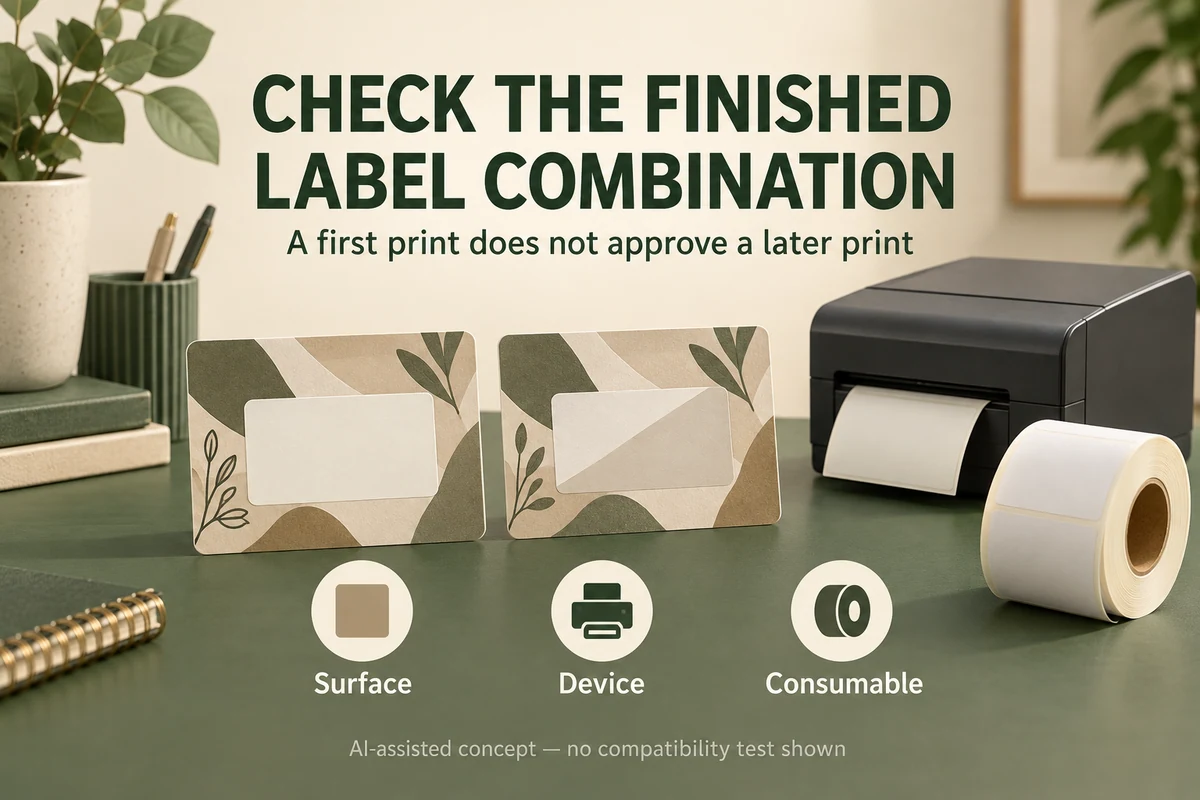
Before ordering preprinted labels that will receive a batch code or other variable text later, confirm the actual label surface, printing device and consumable as one combination. A clean first print does not establish that a later print will work over its ink or coating. Request evidence and an agreed trial for the finished labels you will receive.
Use Roll Labels vs Sheet Labels: Choose by Application to identify the actual supply and application route before planning a second printing pass. The receiving surface, backing, equipment and variable-print area still need their own compatibility review.
Here, second-pass printing means physically adding information to an already made label. It is a different operation from a PDF’s overprint setting, dispensing a label or bonding its adhesive to a container.
Identify the surface that receives the later print
Show the converter the variable-information area in the artwork. State whether that area remains unprinted, contains background ink or receives a finish. The proposed facestock name alone may not describe the surface that the second printer encounters.
Keep three layers distinct in the discussion: the face material and its topcoat, the first print, and any later protective finish. Ask which of those layers is present in the variable area. Do not identify the layer from a concept image or assume that a visually blank area is untreated.
The same finished design can therefore need different evidence depending on how that area is produced. Record the offered construction rather than applying a result for an unprinted stock to a finished preprinted roll.
Match evidence to the printing combination
An Avery Dennison TC7007 technical guide illustrates the level of detail a compatibility statement can contain. Its final page identifies specific thermal-transfer printer, head/resolution and ribbon combinations. It also lists named material constructions and says the purchaser must determine suitability.
The guide is copyright 2020 and concerns the manufacturer’s stated topcoat context. It is an educational example of scoped evidence, not confirmation of current stock, a particular supplier’s finished label or every overprinted/coated construction. Request current information for the actual proposal.
Give the converter and printing-equipment owner the exact device identity and the proposed consumable. Where thermal transfer is used, include the ribbon reference rather than the broad phrase thermal printer. Leave an unknown device or consumable open before treating a material recommendation as settled.
Use this request as a starting point, adding the actual references: "Please identify the finished label construction and the ink or finish in its variable-information area. Confirm which evidence covers our named printing device and consumable, then propose a representative finished-label trial, observations and acceptance owner. Identify anything that remains unconfirmed." Keep a variable-area drawing with the request so a bare-stock recommendation cannot be mistaken for the finished-label answer.
Compare the variable areas without mixing the results
The following comparison is an original planning aid, not a tested performance table.
| Finished-label proposal | Surface to identify | What a trial would need to represent |
|---|---|---|
| Preprinted label with a reserved variable area | The actual face/topcoat within that reserved area | The delivered label construction, including any finish that crosses into it |
| Variable text over first-pass background ink | The supplied ink surface | The identified first print and later device/consumable combination |
| Variable text over a coated first print | The outer coating in the variable area | The final coating and all relevant production layers, not a bare-stock sample |
Ask the relevant owners to define the method, observations and acceptance criteria for the actual application. Do not invent universal temperatures, speeds, durability periods or barcode-quality limits.
Run a hypothetical comparison for a gift label
Imagine a gift brand wants the same decorative label with a production code added at its packing bench. Proposal A reserves an unprinted area; Proposal B carries background artwork through that area. The converter supplies both proposals, while the brand identifies the printer and consumable it intends to use.
The comparison should keep the agreed device, information and evaluation method visible. If the converter also changes a coating or the equipment owner changes a ribbon, record that difference before interpreting the results. A successful print on A is not evidence for B.
Retain an actual observation as an observation. Clear text immediately after printing does not, by itself, establish resistance to every later handling condition. If machine-readable information is required, include the appropriate separate data and printed-quality reviews with qualified owners.
Connect printing approval to the delivered construction
Before order approval, ask the converter to identify the exact finished-label proposal covered by the evidence. Ask the equipment owner which device and consumable were used, and retain any open operating or evaluation requirements. A later ink, coating, stock or device change should be returned to those owners for review.
After printing questions are resolved, assess the label’s bond to the actual packaging surface through the separate label-adhesion planning method. Printing on a label face and attaching its adhesive to a jar or box concern different interfaces.
Packrivo can help organize the questions around the proposed packaging brief. This article does not establish a label-printing service, equipment compatibility or a released supplier construction. Ask for the combination-specific evidence before committing the variable-information area to production.
Source accessed 9 October 2026. The linked technical guide’s historical date and product-specific limits are retained; the comparison and gift-label example describe proposed review work, not measured Packrivo results.
Bind each variable area to its own finished-surface record
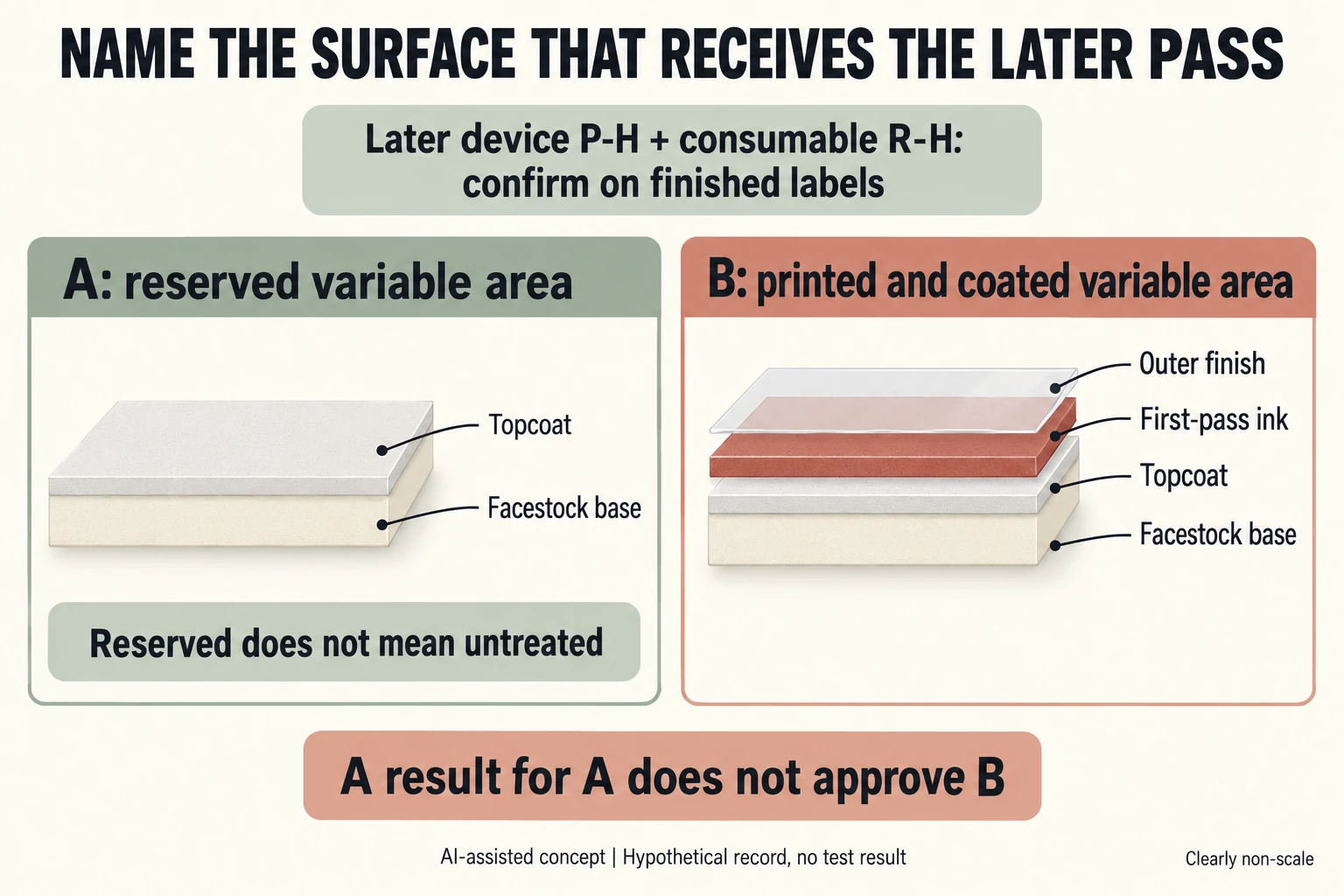
Use invented label proposals A and B with the same intended later device P-H and consumable R-H. A reserves an area without first-pass ink or added finish but still assumes a topcoat. B places first-pass ink and an outer finish in that area. These are planning descriptions, not delivered labels or successful printing results.
Scroll horizontally if columns extend beyond the view.
| Proposal | Planned receiving surface | Hold constant for a useful comparison | Still missing |
|---|---|---|---|
| A reserved | Topcoat above facestock | Named device, consumable and intended information | Actual finished construction |
| B printed/coated | Outer finish above first ink/topcoat | Same intended P-H/R-H if appropriate | Combination-specific evidence |
| Changed equipment | P2 or R2 instead | Record as additional changed input | No surface-only attribution |
Do not translate reserved into untreated. Obtain the converter's actual layer description for that precise area, including finishes that cross into it. The exploded blocks are layer categories rather than thicknesses or a production recipe.
Keep actual device/head/resolution, consumable and evaluation conditions with each candidate. A later result for A could not simply be copied into B's row. If equipment or ribbon also changes, preserve that additional difference before attributing any observation to the surface. All print observations, durability and acceptance fields are blank here. The worksheet does not approve second-pass printing, bonding to a jar or any machine-readable output.
Download the printing on preprinted labels record (.csv). HYPOTHETICAL rows are invented examples. Use ACTUAL_BLANK for permitted project inputs; replace that row label only when recording actual facts. Empty evidence, observation and date fields mean unknown or not performed, never acceptance. Keep checkpoints and revisions separate.
Send the exact variable-area layer description and actual later-device/consumable identities before requesting finished-label evidence. Packrivo coordinates independent suppliers. These records establish no supplier offer, service availability or MOQ exception; its published baseline is 500 pieces per product/design.