
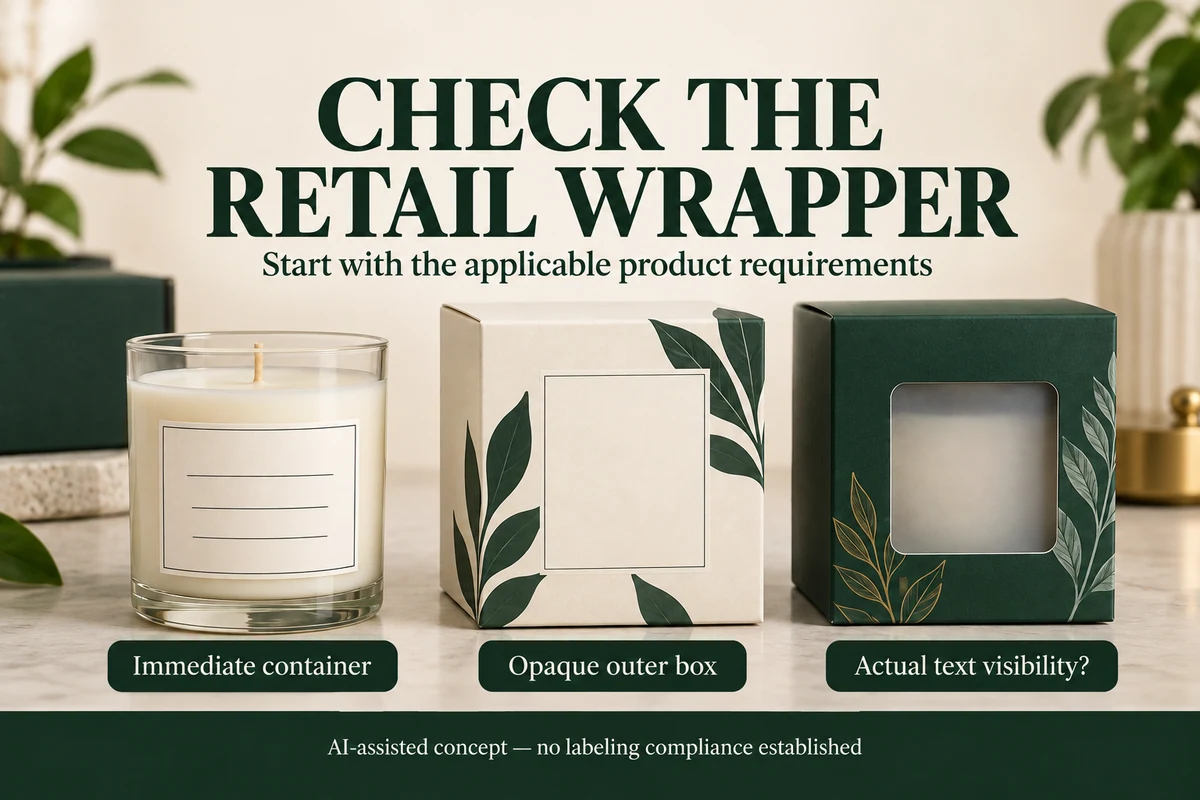
Before adding a gift box around a candle for US retail sale, ask the responsible market reviewer which labeling requirements apply to the actual product. If the candle is subject to FHSA cautionary labeling, review its immediate container and retail wrapper together. An existing jar label does not automatically settle what must appear on an opaque outer gift box.
This article addresses that packaging question. It does not classify a candle, supply approved warning text or establish that a product is safe.
Establish which rule the review concerns
The CPSC candle guidance says candles containing a hazardous substance as defined under the Federal Hazardous Substances Act must bear cautionary labeling. It separately lists voluntary industry standards, including ASTM F2058 for candle fire-safety labeling.
Keep those bases separate. Do not assume that every candle has the same FHSA status, or that a summary of a voluntary standard answers a statutory labeling question. Have the qualified product or market reviewer identify the applicable basis before the designer chooses where the text goes.
The complete ASTM F2058 text was not acquired for this article. No placement rule, symbol set or warning wording from that standard is prescribed here. Other applicable product and market requirements also remain part of the responsible review.
Review the outer wrapper under its actual scope
For a hazardous substance within its scope, 16 CFR 1500.121(b)(4) requires the immediate container’s cautionary labeling on an outer container or wrapper used in retail display. Statements clearly legible through that wrapper need not be repeated on it.
That exception concerns the actual statements, not merely a visible jar or a window in the box. Show the reviewer the complete retail configuration and the text it reveals. Do not use an illustration with the lid removed to demonstrate visibility through the closed retail wrapper.
The same section has other placement and legibility requirements. Its removable-lid provision concerns a principal display panel on the immediate container that can be discarded; it is not a blanket rule about every removable gift-box lid. A short packaging guide cannot replace review of the complete applicable requirements and final artwork.
Compare three physical states without inventing a result
Use the actual product and proposed wrapping in the review. The following states are an original planning comparison, not evidence that a particular configuration complies.
| State shown to the reviewer | Packaging question | What the image cannot establish alone |
|---|---|---|
| Closed opaque gift carton at retail | Does applicable cautionary text need an outer-wrapper position? | Correct wording, classification or full layout compliance |
| Closed wrapper with a viewing opening | Which statements are actually legible through it? | That every necessary statement is visible, or that all other requirements are met |
| Gift carton or detachable lid removed | What label remains on the relevant container? | That a loose card or discarded lid substitutes for required container labeling |
Record which configuration each view represents. A product can look unchanged while a new sleeve, finish or presentation position changes what a customer can read at retail.
Resolve a hypothetical opaque-carton proposal
Imagine a candle brand plans to put its already labeled jar into a new opaque gift carton. The brand’s qualified reviewer has determined that the product is subject to the FHSA cautionary-labeling requirements. No actual candle classification or approved text is assumed beyond that hypothetical condition.
The closed carton hides the jar’s cautionary statements. The design team therefore asks the reviewer to identify the applicable outer-wrapper text and its required presentation before approving artwork. Placing the same jar beside the open carton in a sales image would not close that retail-wrapper question.
If the brand proposes a window instead, return the actual closed configuration for a visibility review. Keep any unreadable or concealed statements identified rather than treating the presence of a window as blanket permission to remove outer text.
Send a packaging-specific question with the proof
Supply the product’s stated review basis, the current approved text reference and drawings or photographs of the closed and removed-wrapper states. Ask: "For this actual retail wrapper, please identify the cautionary statements and placement requirements that apply, including any claimed legibility exception, and the unresolved items before artwork approval."
Use the retail-copy responsibility method to keep that decision connected to the supplied wording. Translation, print reproduction and sample review remain separate tasks; an attractive box proof does not complete them.
Sources accessed 9 October 2026. The eCFR display reported Title 16 current through 7 October 2026. This US planning example is not a legal compliance or candle-safety determination, and it creates no Packrivo testing, certification or warning-approval service.
A window that reveals one statement may leave another concealed
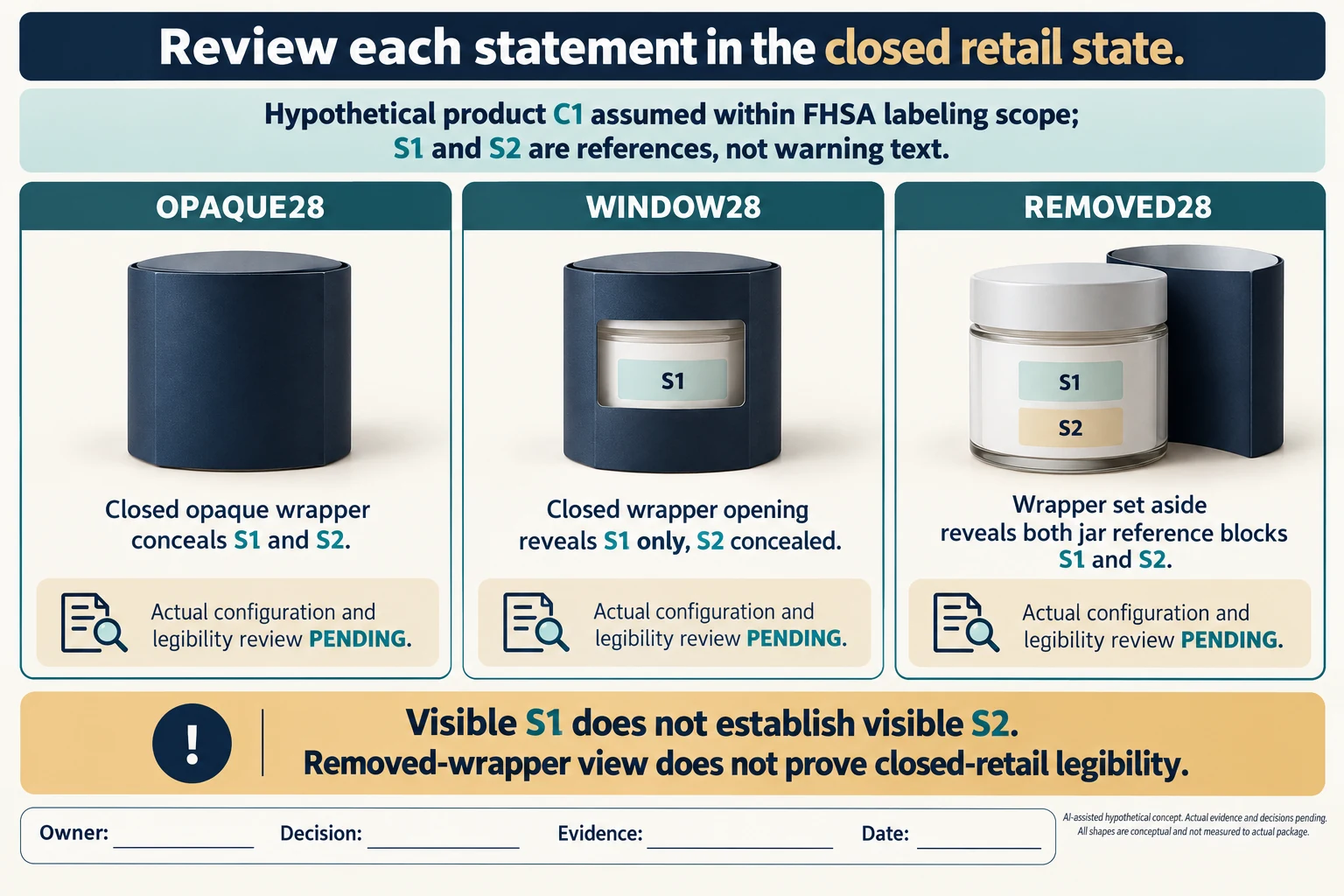
Assume only for an invented exercise that qualified review has placed product C1 within the FHSA cautionary-labeling scope. Name two required-statement references S1 and S2 without supplying their words. OPAQUE28 conceals both behind the closed retail carton. WINDOW28 is drawn to reveal S1 while concealing S2. REMOVED28 shows both only after the wrapper has been taken away. These are stated planning assumptions, not observed labels or legal findings.
Scroll horizontally if columns extend beyond the view.
| Hypothetical configuration | Named object | Relationship | Input or next scope |
|---|---|---|---|
| VISIBILITY28 | PRODUCT_C1 | assumed for exercise | FHSA_CAUTIONARY_LABELING_APPLIES |
| OPAQUE28 | STATEMENT_S1 | assumed visible state | CONCEALED |
| OPAQUE28 | STATEMENT_S2 | assumed visible state | CONCEALED |
| WINDOW28 | STATEMENT_S1 | assumed visible state | VISIBLE |
| WINDOW28 | STATEMENT_S2 | assumed visible state | CONCEALED |
| REMOVED28 | STATEMENT_S1 | assumed visible state | VISIBLE |
| REMOVED28 | STATEMENT_S2 | assumed visible state | VISIBLE |
| WINDOW28 | S1_VISIBLE | does not establish | S2_VISIBLE_OR_ALL_REQUIREMENTS |
| REMOVED28 | LABEL_WITH_WRAPPER_REMOVED | does not establish | CLOSED_RETAIL_WRAPPER_LEGIBILITY |
| VISIBILITY28 | S1_AND_S2 | are only | REFERENCE_TOKENS_NOT_APPROVED_WARNINGS |
Read the comparison statement by statement. Showing S1 in a window does not establish that S2 is legible through the actual wrapper. A photograph of both statements beside a removed carton does not demonstrate the closed retail condition. The useful output is the unresolved statement and exact state for the responsible reviewer, rather than a general claim that the jar label is visible.
For a product and wrapper actually within section 1500.121(b)(4), the legibility-through-wrapper exception concerns the corresponding statements that can truly be read. The relevant reviewer must also check all applicable placement, type and presentation requirements. A window’s existence supplies none of those results by itself. Keep product classification, approved content, placement and physical reproduction as distinct responsibilities.
The S1 and S2 tokens are not a warning template, prescribed symbol set or complete list of required text. ASTM F2058 remains a separately listed voluntary standard whose full text was not acquired. Supply the actual closed configuration, current text source and proposed viewing area to the qualified reviewer, then carry its scoped answer into the artwork and final print proof. If the sleeve, window or retail orientation changes, return the affected statement visibility to that review.
Download the candle gift box warning statement visibility states record (.csv). It includes the original table fields and scenarios alongside the added relationships. HYPOTHETICAL rows are editorial examples or required review scopes, not actual records. Actual quantity, configuration, component and file identities, materials, process, specification, copy, method, condition, observation, owner, decision, evidence and dates are blank. ACTUAL_BLANK is a separate empty starting row; enter permitted project evidence before using an actual record. A blank means unknown.
Use the Assign Product Copy Responsibility Before the Packaging Proof for its separate question.
Source scope checked 17 October 2026: CPSC guidance and 16 CFR 1500.121 retain FHSA applicability and corresponding-statement legibility conditions. The full voluntary ASTM F2058 standard was not acquired; no actual warning content or package compliance is approved. The added configurations and calculations are hypothetical, with actual evidence and decisions pending.
Discuss this packaging specification with Packrivo. We coordinate independent suppliers. MOQ: 500 pieces per product/design; illustrative quantities are not production offers. Confirm materials, samples, price and timing for your project.