
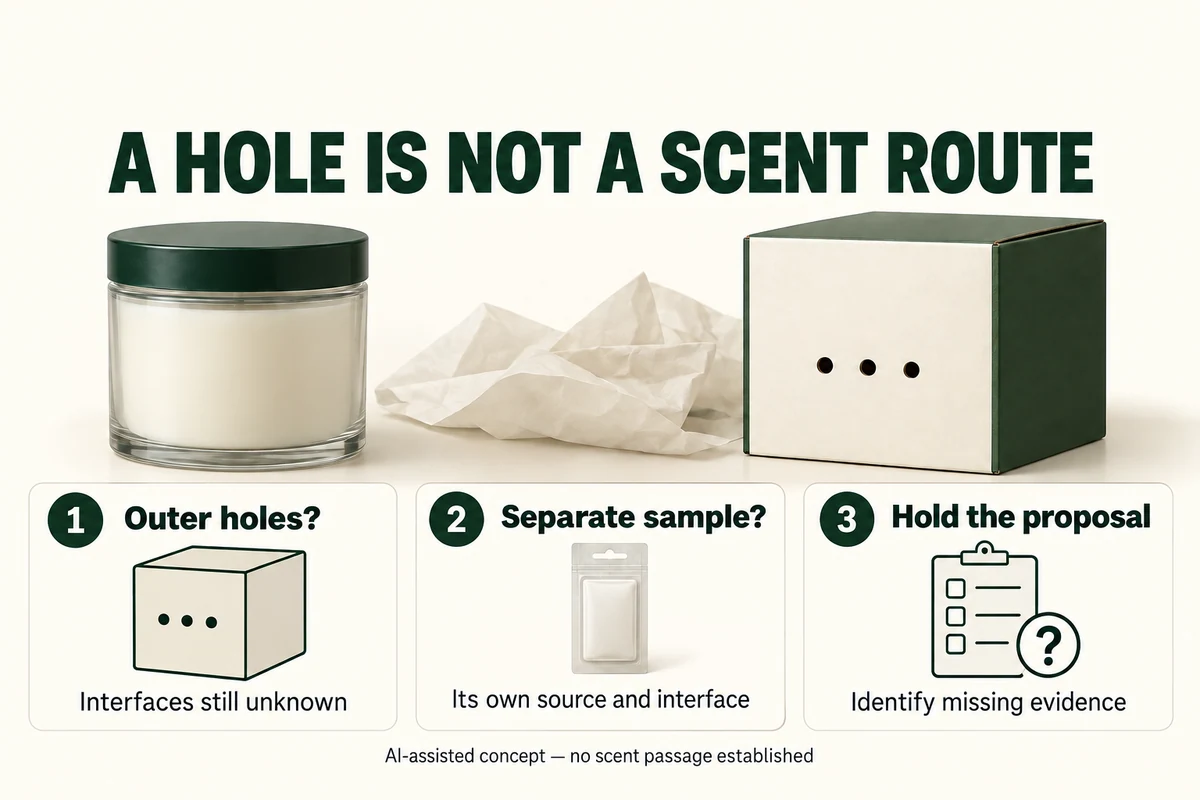
Compare three scent-sampling choices before adding holes to a candle gift box: investigate a route through the complete closed pack, provide a separately identified sampler, or hold sampling. The choice depends on the actual aroma source, every inner closure and wrap, and the shopper’s sampling position. An outer opening alone cannot establish the complete path.
Compare three commercial sampling choices
For the hypothetical lidded-jar, tissue-and-carton pack described below, the intact sales unit keeps its closed lid, tissue and ordinary carton. The hole proposal changes only that outer carton. A separate sampler has its own source and activation interface, independent of the saleable jar.
| Decision | Source-to-shopper path | Evidence to request next |
|---|---|---|
| Investigate outer holes | Candle wax → lid/rim → tissue → carton interior → holes → shopper; investigate the five interfaces mapped below | Actual closed pack, component cross-section, proposed hole position and a defined complete-pack observation |
| Keep saleable stock closed; identify a separate sample | Named sample source → sample’s own opening or activation → shopper, independent of the closed stock | Sample format and identity, relationship to the candle SKU, proposed display position and retailer acceptance |
| Hold the scent-sampling proposal | No scent route is represented as available | Confirm the buyer’s sampling objective, actual product version and missing interfaces before selecting a format |
Identify who can authorize the proposed sampling arrangement and who will maintain or replace the sampling object. Follow the actual sample’s instructions and intended service life; do not assume that a single-use sampler can be reset or reused. Keep its identity and relationship to the saleable candle visible when the retailer reviews the arrangement.
For comparison, Arcade Beauty’s ScentStrip® is a manufacturer example of a distinct fragrance sampler with its own activation interface. It does not show that such a sample matches a given candle, is appropriate for this retail setting or has retailer approval.
The outer hole cannot establish the inner route
Clearpak’s special-features page presents fragrance-release holes as an option for clear-plastic candle and beauty packaging. That establishes a manufacturer’s feature example, not an observed result for a lidded candle inside a paperboard gift box. It does not establish fragrance delivery, product safety, suitability or retail sales.
Start with the saleable unit as it would actually sit on a shelf. A closed fitted lid does not prove an airtight seal, zero fragrance transmission or a known barrier. Equally, holes in the outer carton do not prove that anything from the candle reaches them. Both conclusions require evidence about the intervening interfaces.
A hypothetical layered candle pack reveals the gaps
This hypothetical planning scenario represents no Packrivo offer, customer order, physical sample or test. The proposed retail configuration contains one unlit scented candle in a glass jar with its fitted lid closed, one folded tissue wrap around that jar, and one folding paperboard carton with proposed holes on its front panel. No liner, film, tray or second inner box is specified here; none belongs on this route map unless the real configuration includes it.
| Order | Named source or interface | Status of the proposed route | Next evidence requested |
|---|---|---|---|
| 1 | Fragranced wax surface → space below the closed jar lid | UNKNOWN: whether the named unlit SKU supplies a recognizable aroma at this point | Identify the actual candle/SKU and the intended closed condition |
| 2 | Fitted lid ↔ glass-jar rim | UNKNOWN: whether and where a connection continues past this closure | Lid/rim configuration and a section of the actual closed assembly |
| 3 | Jar exterior → folded tissue and overlap | UNKNOWN: where the wrap might interrupt the proposed continuation | As-wrapped views identifying the actual folds and overlap |
| 4 | Wrapped jar → carton interior → proposed front-panel holes | UNKNOWN: alignment or obstruction between the wrap and opening | Assembled cross-section marking jar position and exact proposed holes |
| 5 | Outer hole → shopper’s intended smelling position | UNKNOWN: whether the panel faces an unobstructed sampling position | Proposed shelf orientation and observation position |
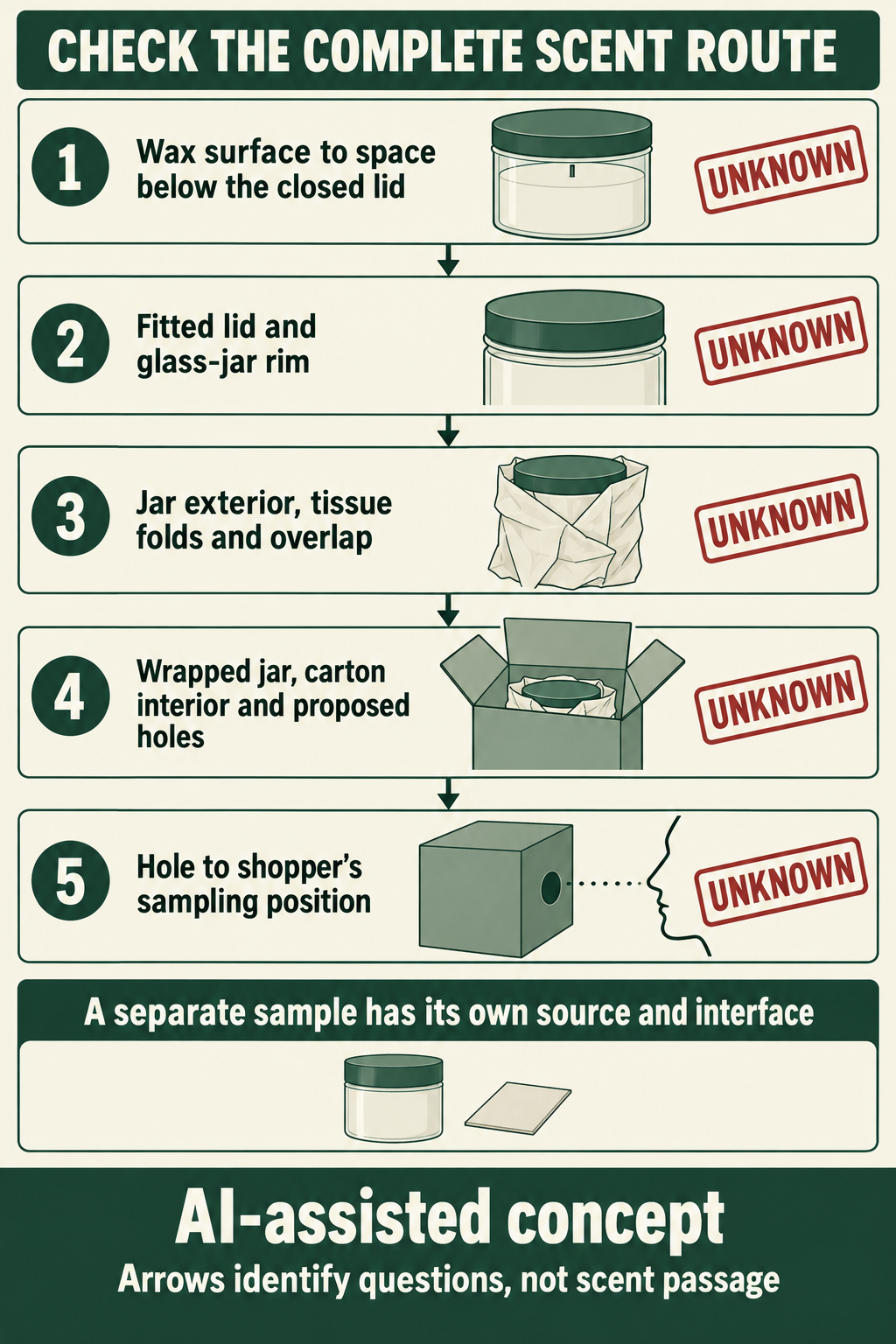
The arrows identify connections to investigate, without establishing fragrance passage. Add any seal, bag, sleeve or other layer present in the real pack and reassess the complete route.
Request interface evidence before specifying holes
Ask for a single annotated drawing showing the actual jar and lid, tissue-fold layout, carton panels, proposed openings and intended shelf-facing side. Review two clearly distinguished configurations: intact saleable stock and the otherwise identical closed pack with proposed outer holes. An empty perforated carton is insufficient evidence for the inner route. Any future observation should identify the complete product and pack condition, setting and what was actually observed, without being presented as a general result.
Keep visual opening alignment separate from observed scent recognition. Neither a rendering nor an unreviewed prototype establishes fragrance persistence, transfer behavior, safety, durability or sales impact. Fit, glass contact and transport are separate questions addressed by Packrivo’s candle packaging brief and glass-contact map.
Bring the route map and unresolved junctions to a Packrivo packaging inquiry. Packrivo supports sourcing and project coordination, not factory production. Its public starting MOQ is 500 pieces per product/design; samples, final construction, price, capacity and timing need project-specific confirmation.
Sources accessed 9 October 2026. The manufacturer pages do not display clear publication dates. They illustrate scent-hole and separate-sampler formats, not verified scent transmission, candle equivalence, retailer acceptance, product safety or Packrivo production capability.
Keep the saleable candle and the sampling object separately identified
For invented unlit candle C-H, choose among investigating the complete closed pack, reviewing separate sampler S-H, or holding sampling. The closed-pack option retains its fitted lid, tissue and carton. S-H is only a proposed identity; no matching fragrance, retailer acceptance or available sampling service is assumed.
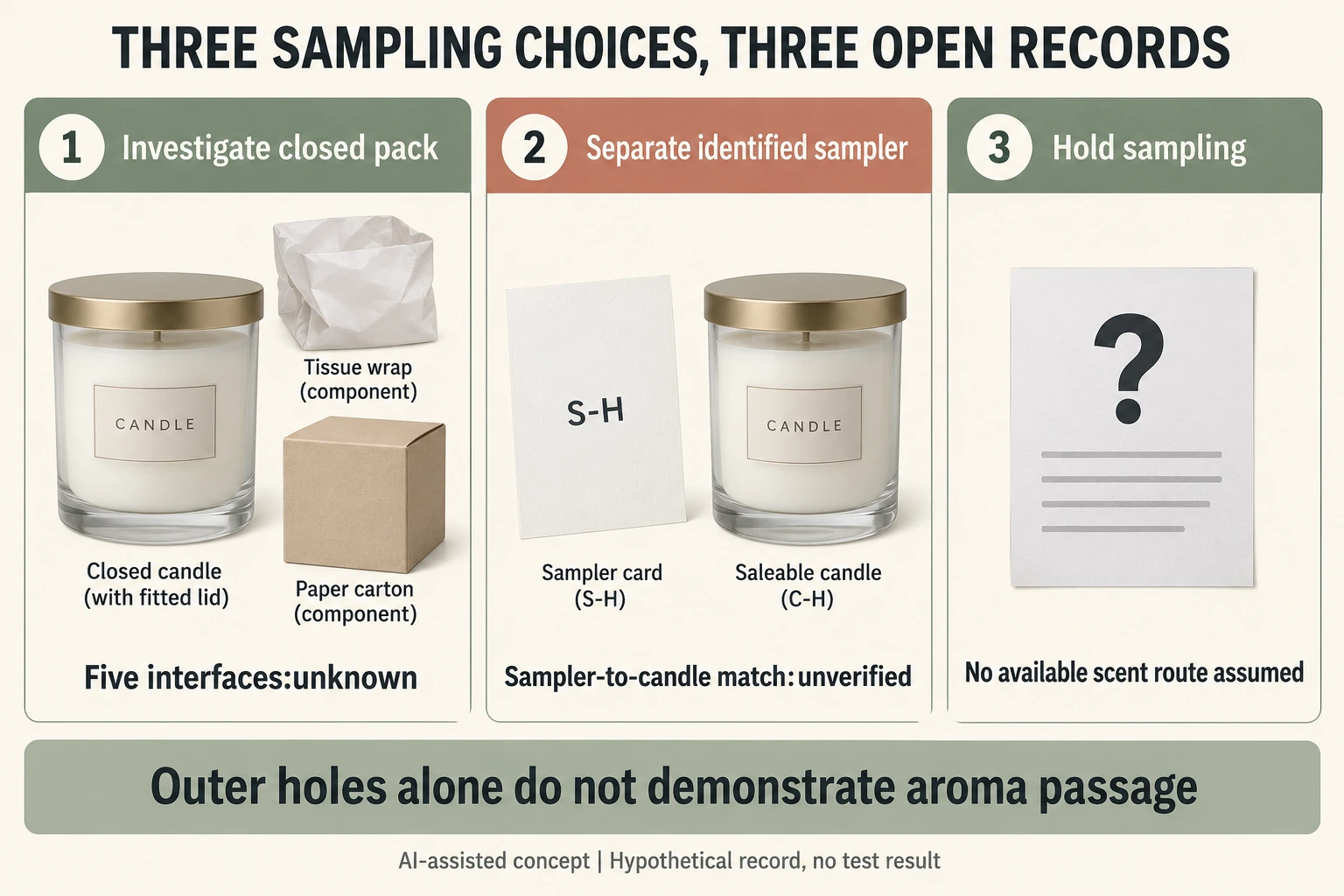
Scroll horizontally if columns extend beyond the view.
| Option | Identity to retain | Unanswered evidence |
|---|---|---|
| Closed-pack investigation | C-H plus lid/tissue/carton revisions | All five source-to-shopper interfaces |
| Separate sampler | S-H linked to C-H | Actual source, activation and representativeness |
| Hold sampling | No route represented as available | Objective and missing inputs before selection |
| Retail operation | Each chosen configuration | Permission, placement and maintenance owner |
Do not let a sample labelled for C-H silently stand in for proof that the actual lidded candle transmits aroma through outer holes. They are different source/interface records. Conversely, a blank sampler card icon does not establish that an appropriate candle-matching sample can be supplied.
The component pictures are not an assembled route or a scent test. Keep SKU/source identity, intended condition, sample instructions and any relevant use limit together. Dates, actual scent observations and matching evidence remain empty in the CSV. Selecting hold is a valid planning state when those inputs are absent; it is not a conclusion that a closed lid is airtight or that the outer-hole idea has failed.
Download the candle packaging scent holes record (.csv). HYPOTHETICAL rows are invented examples. Use ACTUAL_BLANK for permitted project inputs; replace that row label only when recording actual facts. Empty evidence, observation and date fields mean unknown or not performed, never acceptance. Keep checkpoints and revisions separate.
Send the actual candle and separate sampling identities with the missing closed-pack interfaces or sampler-to-SKU evidence. Packrivo coordinates independent suppliers. These records establish no supplier offer, service availability or MOQ exception; its published baseline is 500 pieces per product/design.