
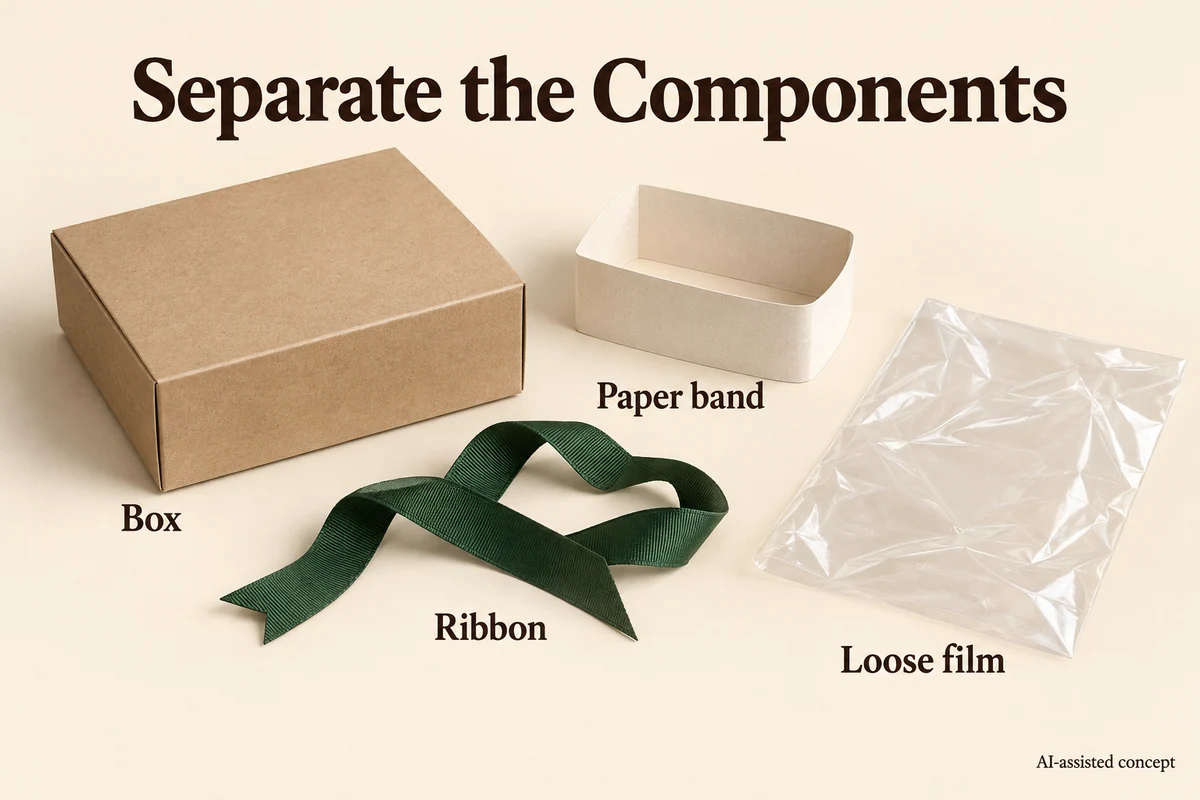
Write disposal instructions for the components a customer will have after opening the gift. Identify what separates by hand, what stays attached and which local household program accepts each final state. A paperboard box, loose film and ribbon can need different instructions even when they arrive as one package.
The example below uses San Francisco household guidance. It is a hypothetical planning tool, not an instruction approved for a real product or a rule for other destinations.
Define the package before writing the removal steps
Assume a gift arrives in an ordinary non-waxed cardboard box with a separate plain, non-metallic paper band, a hand-tied ribbon and a loose plastic film sheet. The band slides away, the ribbon unties and the film can be lifted out. These construction assumptions must be checked on any actual design.
Keep the loose film distinct from a film laminated to the cardboard. A bonded layer, glued decoration or unidentified coating changes the remaining component. Gloss, color or a supplier’s broad paper description cannot settle that construction.
For this example, the paper and cardboard must also be clean and dry when discarded. No insert, jar, product or other accessory is included in the map; each additional item would need its own applicable review.
Make the intended sequence produce identifiable components
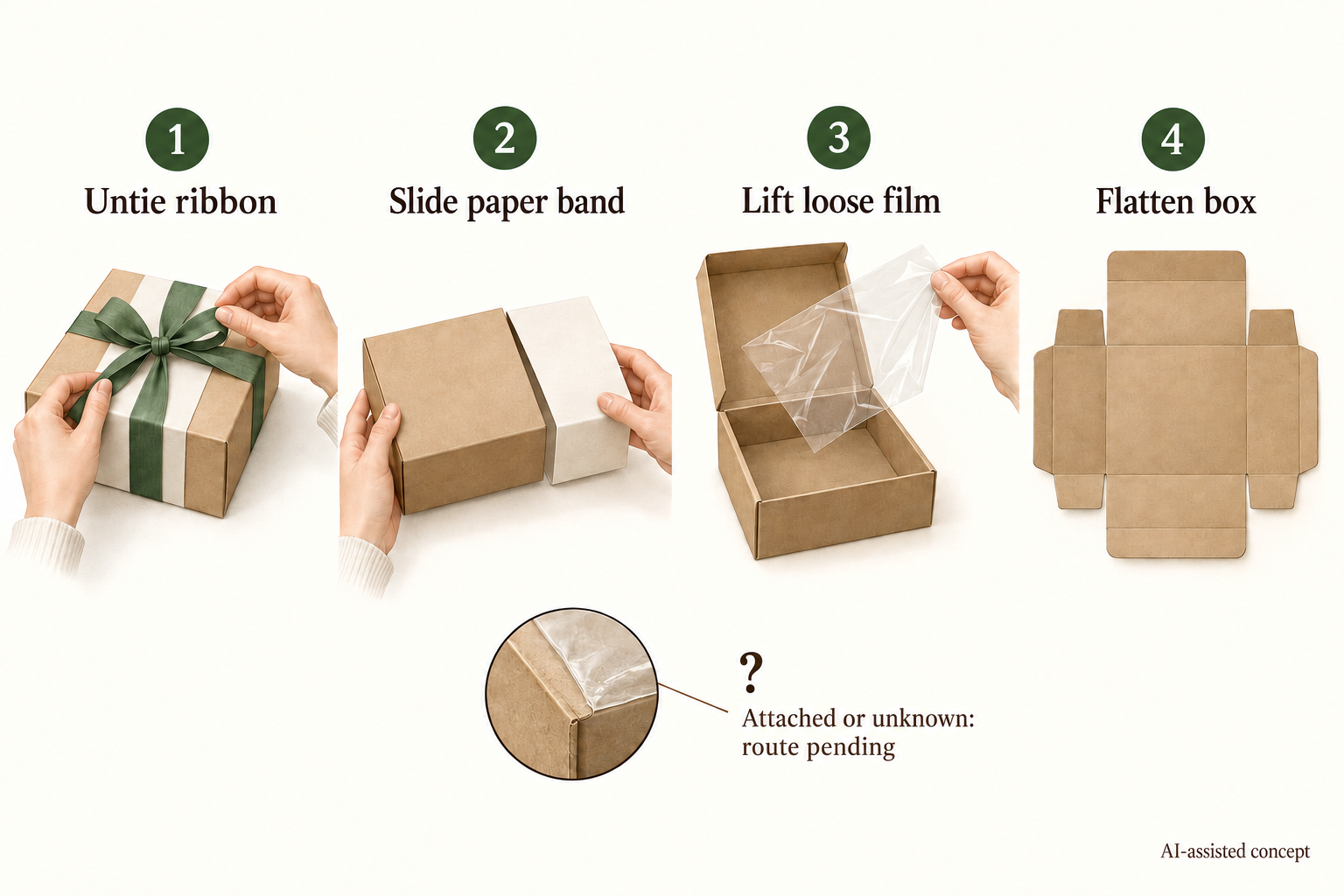
- Untie the ribbon and set it aside. It can be kept for another use; if discarded, it needs its own route.
- Slide the plain paper band off the box. Keep it separate from the ribbon.
- Remove the gift, then lift out the loose plastic film. This action describes a separate sheet, not peeling a laminate from board.
- Empty and flatten the cardboard box. Check the state of the cardboard before assigning its route.
These are proposed hand actions. Before adapting the sequence to customer-facing copy, try the actual construction and record any step that leaves an attachment behind or requires a different action. The concept illustration will not demonstrate that removal works.
Map each final state to San Francisco household guidance
Recology’s San Francisco three-cart guide describes its accepted paper/cardboard states and lists plastic bags and film under landfill items. SF Environment’s cardboard entry adds preparation and contamination conditions. Apply those conditions to the separated item rather than to the assembled gift box.
| Final state in this hypothetical package | Preparation or condition | Household route supported by the cited guidance |
|---|---|---|
| Untied ribbon | Kept for reuse or discarded separately | If discarded, landfill; the city’s 29 December 2025 notice names ribbon and twine |
| Separate plain, non-metallic paper band | Clean, dry and still the specified plain paper | Blue recycling cart under the paper guidance |
| Loose plastic film | Removed as a separate sheet | Landfill under the cited three-cart guide |
| Ordinary non-waxed cardboard box | Empty, clean, dry and flattened | Blue recycling cart; wet or food/grease-contaminated cardboard is excluded |
| Attached or unidentified layer | Construction or remaining state unresolved | No cart assigned by this example; identify the component and resolve its specific route |
The cardboard entry allows clean portions to be separated from soiled portions. That does not establish a method for stripping an unidentified coating or laminate.
Use the household guide specified here. A commercial-customer FAQ gives different plastic-bag preparation advice. It does not establish a household route for this loose-film example. Recheck the relevant service guidance before finalizing actual customer instructions; no collection-provider clarification has been obtained for this article.
The December 2025 city notice also described temporary tree and light collection windows. Those January 2026 arrangements have expired and are not disposal options recommended here.
Hold the unknown component without blocking the known ones
Suppose a glossy surface remains after the loose film is removed. Keep the connected component together while the brand resolves its construction. Do not instruct the customer to scrape, heat or peel an unknown layer. Already separated components can retain their independently supported routes.
The brand needs the substrate, finish, film or coating and attachment method for the affected face. The surface-layer BOM guide explains how to obtain those details. Then prepare an item-specific question containing the component, material, attached state and disposal location for Recology’s WhatBin resource.
If the exact state still has no confirmed route, keep its instruction pending. This example has not established acceptance for any glued or coated gift-box assembly, and an unknown component does not automatically receive a landfill assignment.
Turn the map into construction-specific copy
For the defined example, proposed wording could read:
For San Francisco households: untie the ribbon and place it in the landfill cart if discarded. Slide off the plain paper band and recycle it if clean and dry. Lift out the loose plastic film and place it in the landfill cart. Empty and flatten the clean, dry, non-waxed cardboard box for the blue recycling cart.
This is hypothetical planning copy. It depends on the four specified components, successful separation and the named household program. Keep the package revision, removal sequence, final states and source dates beside the proposed wording. Reopen the map if the material, attachment or destination changes.
Environmental wording for the complete package requires its own review. The material-claim evidence guide covers that broader question; this disposal map does not authorize a package-wide recyclable claim or recycling symbol.
Sources checked 9 October 2026. The cardboard and three-cart pages show no publication date; the ribbon notice is dated 29 December 2025. No real package, removal test, recycling outcome or collection agreement is established here. Any accompanying illustration is an AI-assisted concept.
A bonded-film revision changes the remaining component
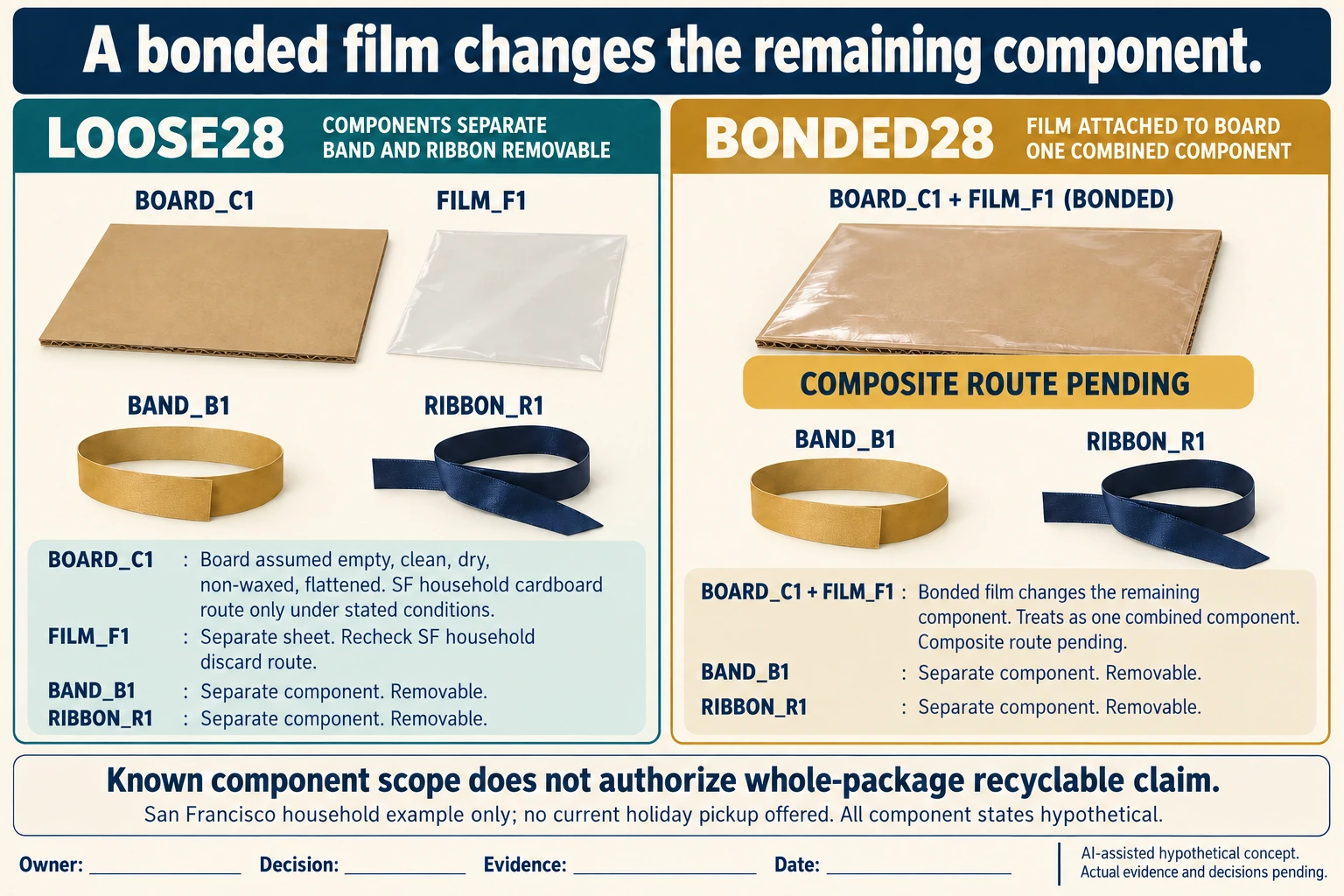
Compare two invented revisions before carrying disposal copy forward. LOOSE28 has the original separate film sheet, plain paper band and untied ribbon. Its ordinary non-waxed board is assumed empty, clean, dry and flattened at disposal. BONDED28 instead attaches film F1 to board C1. The band and ribbon remain separately removable in this example; the board-and-film remainder has changed.
Scroll horizontally if columns extend beyond the view.
| Hypothetical configuration | Named object | Relationship | Input or next scope |
|---|---|---|---|
| LOOSE28 | FILM_F1 | assumed attachment | SEPARATE_LOOSE_SHEET |
| BONDED28 | FILM_F1 | assumed attachment | BONDED_FILM_ON_BOARD |
| LOOSE28 | BOARD_C1 | assumed final state | EMPTY_CLEAN_DRY_NONWAXED_FLATTENED |
| LOOSE28 | BOARD_C1 | source limited household route | SF_BLUE_CART_IF_STATED_CONDITIONS_MET |
| LOOSE28 | FILM_F1 | source limited household route | SF_LANDFILL_IF_DISCARDED |
| BONDED28 | BOARD_C1_WITH_FILM_F1 | requires | COMPOSITE_CONSTRUCTION_AND_ACTUAL_ROUTE |
| BONDED28 | BONDED_LAYER | has no authorized method | HEAT_SCRAPE_OR_PEEL |
| BOTH28 | BAND_B1 | retains limited route scope | SF_PLAIN_PAPER_IF_CLEAN_DRY_AND_ACCEPTED |
| BOTH28 | RIBBON_R1 | retains limited route scope | KEEP_FOR_REUSE_OR_RECHECK_DISCARD_ROUTE |
| BOTH28 | SEPARATE_COMPONENT_ROUTES | do not authorize | WHOLE_PACKAGE_RECYCLABLE_CLAIM |
For the specified loose-sheet state, the cited San Francisco household guidance supplies a limited route for film discarded separately and for qualifying prepared cardboard. It does not answer the bonded composite. Keep BOARD_C1_WITH_FILM_F1 as one unresolved state until the real construction and service guidance are established. No scraping, heating or peeling method is proposed or shown as successful.
Avoid reopening unrelated components merely because one attachment changed. The plain band still needs its stated clean, dry material and household acceptance conditions; the ribbon can be retained for another use, with any discard instruction rechecked for the current local route. Neither component’s record makes the attached board recyclable. Conversely, an unresolved composite does not erase separately supported information about the unaffected items.
The household/commercial distinction remains important. A commercial bag preparation instruction cannot approve a household loose-film route. The city notice dated 29 December 2025 is a historical source for ribbon and twine; its January 2026 tree and light collection windows are not current service options. This revision map supports item-specific copy review for a named household location. It authorizes neither a whole-package recyclable claim nor a universal cart assignment.
Download the gift box disposal loose film bonded revision map record (.csv). It includes the original table fields and scenarios alongside the added relationships. HYPOTHETICAL rows are editorial examples or required review scopes, not actual records. Actual quantity, configuration, component and file identities, materials, process, specification, copy, method, condition, observation, owner, decision, evidence and dates are blank. ACTUAL_BLANK is a separate empty starting row; enter permitted project evidence before using an actual record. A blank means unknown.
Use the Lamination and Varnish Need Separate Layers in the Packaging BOM for its separate question. Use the Packaging Material Claims: Match the Evidence Scope for its separate question.
Source scope checked 17 October 2026: The cited Recology and SF Environment pages concern the stated San Francisco household example; commercial instructions cannot authorize household loose-film disposal. The 29 December 2025 holiday announcement is historical, and its January 2026 collection windows have passed. The added configurations and calculations are hypothetical, with actual evidence and decisions pending.
Discuss this packaging specification with Packrivo. We coordinate independent suppliers. MOQ: 500 pieces per product/design; illustrative quantities are not production offers. Confirm materials, samples, price and timing for your project.