
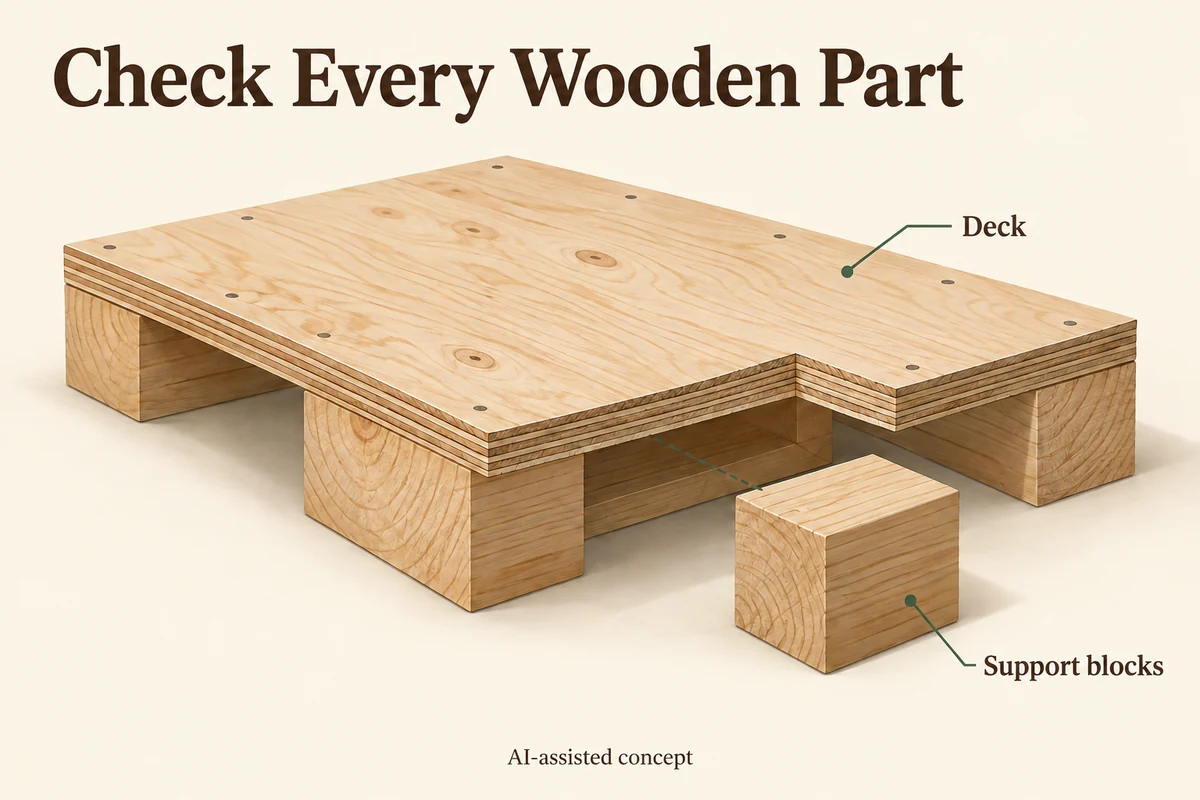
For packaging goods shipped from China to the continental United States, identify the material and role of every wooden part before selecting its import-review route. A plywood deck does not establish that the support blocks beneath it are processed wood. Wooden boxes imported as merchandise also need a separate review from the pallet carrying them.
This guide uses hypothetical constructions. It organizes material-scope questions for the packing party and importer; it does not establish treatment, mark authorization or compliance for an actual shipment.
Read the supporting assembly before accepting its name
The IPPC’s ISPM 15 publication concerns raw-wood packaging used to support, protect or carry goods in international trade, including dunnage. Its processed-wood exclusion is construction-specific.
List the deck, blocks, feet, runners, braces and loose supports separately. For each part, obtain the material and manufacturing description from the packing party. A photograph or sales term such as plywood pallet cannot identify concealed parts.
In section 2.1 of the official 2018 adopted, 2019 published text, the processed-wood exemption applies to packaging made wholly from qualifying processed material. A support with a plywood face and raw solid-wood blocks does not meet that whole-assembly condition.
The section also contains other conditional exceptions. Do not infer that an assembly qualifies because one part meets an exception, or because a decorative wooden box looks finished. The table below records investigation routes rather than import approvals.
Compare material, role and route together
Every row assumes the stated material has been confirmed. Unknown material belongs in the last row.
| Hypothetical construction | Function on the China-to-US route | Scope decision to carry forward |
|---|---|---|
| Raw solid-wood pallet or braces outside the relevant exceptions | Supports or protects cartons | Regulated WPM review under the applicable US requirements |
| Support made wholly from verified qualifying processed plywood, including its feet and runners | Carries cartons | Document the complete construction for the section 2.1 processed-wood exemption review |
| Plywood deck with raw solid-wood blocks outside the relevant exceptions | Carries cartons | Review the solid-wood parts and complete assembly as regulated WPM; do not claim the wholly processed-wood exemption |
| Empty wooden gift boxes imported for resale | Merchandise itself | Separate wood-product import review for the actual construction and classification |
| Wooden gift box holding another imported item | Packaging function | Review the specific gift-box exception and its processing condition; the category name is insufficient |
| Separate pallet carrying wooden gift-box merchandise | Transport support | Assess its own constituent materials independently of the boxes |
| Support sold as wooden or plywood, with unspecified feet or blocks | Proposed transport support | Hold the material classification until the full construction is identified |
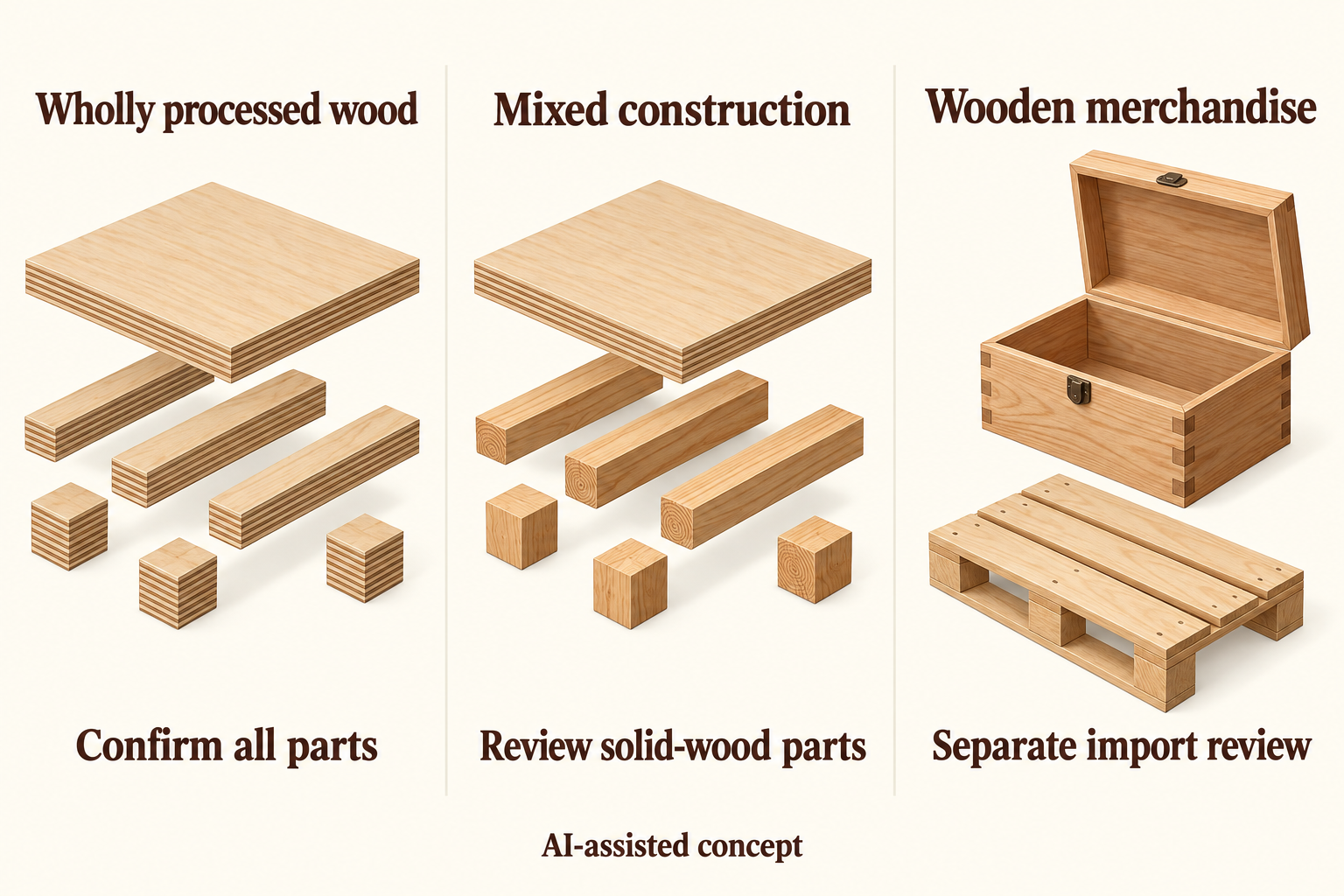
APHIS’s US wood-packaging importer guidance, modified 27 July 2026, is the destination-market starting point. It describes regulated WPM and lists processed-material alternatives. Those alternatives concern transport packaging; they do not clear the merchandise itself for import.
Resolve a mixed or unknown support before packing approval
Consider a hypothetical proposal for a plywood deck. The drawing identifies its surface but leaves the support blocks unnamed. Record the proposal as unresolved rather than treating the visible plywood as evidence for the complete assembly.
If the packing party identifies the blocks as raw solid wood outside the relevant exceptions, move the assembly into regulated-WPM review. If all supporting members are confirmed as qualifying processed material, retain that component evidence with the proposed exemption route. Neither outcome comes from an appearance comparison.
For the regulated route, the importer and exporter must establish who provides the applicable compliant WPM and how the actual support will be reviewed before dispatch. Treatment and official marking operate under the relevant national plant protection organization’s authority. A designer-generated mark or unverified supplier statement cannot establish that authority.
When the material remains unknown, request the missing construction, consider a fully specified alternative or ask the importer to obtain the appropriate official guidance. Do not convert missing information into a declaration that customs has rejected the support.
Keep merchandise requirements beside the support review
ISPM 15’s gift-box exception depends on processing or manufacture that renders the material free from pests. Its accompanying footnote warns that some gift boxes remain within scope. A smooth exterior or decorative finish alone cannot prove that condition.
When the boxes themselves are imported goods, the importer needs their origin, materials, construction, finish, use and commodity classification. APHIS’s plant-material requirements page identifies wood-containing handicrafts from China, including boxes, as a category requiring attention. Its generally authorized products page describes qualifying finished constructions. Read the applicable conditions together rather than treating either page as a universal answer.
The importer can use APHIS’s commodity requirements database for the actual goods. Lacey Act declaration requirements are another distinct check: the page separates packaging used to carry other goods from packaging imported as merchandise, and includes classification and entry conditions. This article does not assign a tariff code or filing result to a gift box.
Add a material-scope record to the freight description
For each support or wood commodity, retain its identity, role, component materials, evidence and open decision. Name the packing or importing party that will close the question. A practical hypothetical entry is:
P-03: plywood deck with raw solid-wood blocks outside the relevant exceptions. Transport support. The wholly processed-wood condition is not met. Importer and exporter to resolve the regulated-WPM arrangement before packing approval.
Keep that record with the carton configuration and revision. The carton freight-data worksheet supplies count, dimensions and weight; it does not replace this material-scope review. Reopen the scope record when a supplier changes a deck, foot, runner or brace.
Packrivo can help organize packaging specifications and coordinate the material questions. The relevant packing party, importer and authorities confirm the requirements for the actual shipment.
Sources checked 9 October 2026. The IPPC adopted-standards index was observed with its ISPM 15 entry pointing to publication 640. The readable text used here was adopted in 2018 and published in 2019; the adopted list updated 25 March 2026 records those annex revisions. The index’s English FAO download returned a reading restriction, so no byte-for-byte latest-edition guarantee is made. No actual support, treatment or shipment was inspected. Any accompanying illustration is an AI-assisted concept.
One unknown foot keeps the whole-material conclusion open
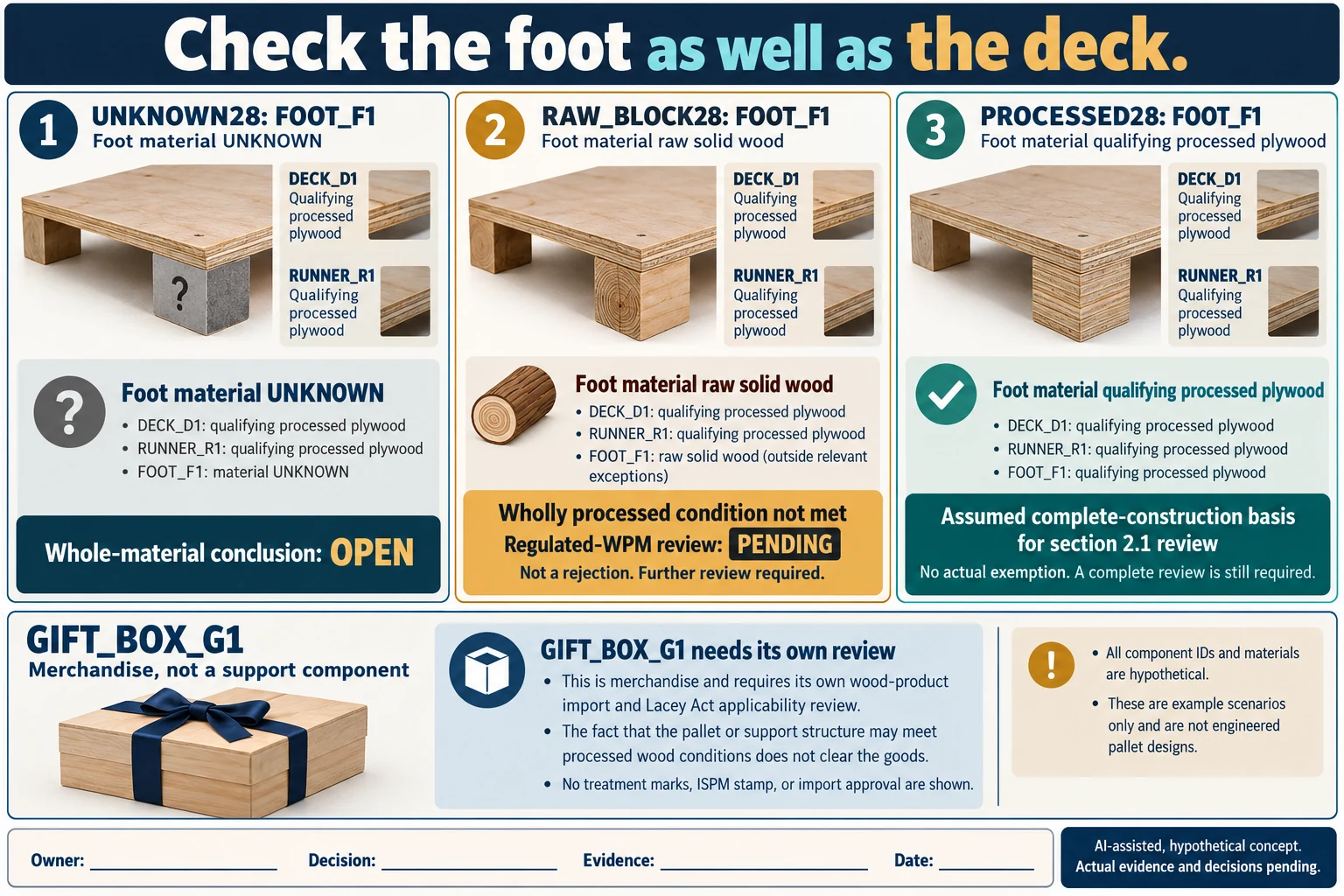
Name every supporting member in a separate invented assembly: deck D1, runner R1 and foot F1. Assume D1 and R1 are qualifying processed plywood. UNKNOWN28 leaves F1’s material unknown; RAW_BLOCK28 specifies raw solid wood outside the relevant exceptions; PROCESSED28 assumes F1 is qualifying processed plywood too. Each assembly is a transport support, not the wooden gift-box merchandise it may carry.
Scroll horizontally if columns extend beyond the view.
| Hypothetical configuration | Named object | Relationship | Input or next scope |
|---|---|---|---|
| UNKNOWN28 | DECK_D1 | assumed material | QUALIFYING_PROCESSED_PLYWOOD |
| UNKNOWN28 | RUNNER_R1 | assumed material | QUALIFYING_PROCESSED_PLYWOOD |
| UNKNOWN28 | FOOT_F1 | assumed material | UNKNOWN |
| UNKNOWN28 | FOOT_F1 | prevents conclusion | WHOLLY_PROCESSED_SCOPE |
| RAW_BLOCK28 | FOOT_F1 | assumed material | RAW_SOLID_WOOD_OUTSIDE_RELEVANT_EXCEPTIONS |
| RAW_BLOCK28 | ASSEMBLY_A1 | does not meet | WHOLLY_QUALIFYING_PROCESSED_CONDITION |
| PROCESSED28 | FOOT_F1 | assumed material | QUALIFYING_PROCESSED_PLYWOOD |
| PROCESSED28 | ASSEMBLY_A1 | supplies assumed basis for | SECTION_2_1_EXCLUSION_REVIEW |
| GOODS28 | GIFT_BOX_G1 | requires separate | WOOD_PRODUCT_IMPORT_AND_LACEY_APPLICABILITY |
| GOODS28 | SUPPORT_SCOPE | does not clear | GIFT_BOX_MERCHANDISE |
| GOODS28 | ACIR_REQUIREMENTS | status | NOT_QUERIED_TOOL_ACCESS_GAP_NOT_404 |
UNKNOWN28 has no basis for a wholly processed-material conclusion. RAW_BLOCK28 does not meet that condition and needs the applicable regulated-WPM review; that is not a finding that a shipment has been rejected. PROCESSED28 supplies an assumed complete-construction basis for the section 2.1 exclusion review. It is still no actual exemption or import clearance, because none of those component descriptions has been verified for a real support.
Apply the word wholly to the complete construction, including any additional feet, runners, braces or loose supports the actual arrangement uses. A plywood deck photograph cannot fill an unknown block field. The ISPM 15 text used for the source review was adopted in 2018 and published in 2019; an index-page date is not a new technical edition. Official marking and treatment authority remain distinct from a design description.
Keep wooden gift boxes imported as merchandise on their own record. The support’s material scope cannot settle the goods’ plant-material requirements, classification, origin or Lacey applicability. No actual ACIR commodity query was run; the reported internal access error is not a demonstrated 404 or a conclusion about the goods. Give the importer the actual full construction, role and entry facts instead of translating a transport-support exclusion into a general wood-product import permission.
Download the wood packaging support all component material scope record (.csv). It includes the original table fields and scenarios alongside the added relationships. HYPOTHETICAL rows are editorial examples or required review scopes, not actual records. Actual quantity, configuration, component and file identities, materials, process, specification, copy, method, condition, observation, owner, decision, evidence and dates are blank. ACTUAL_BLANK is a separate empty starting row; enter permitted project evidence before using an actual record. A blank means unknown.
Use the Packaging Freight Quotes: Carton Data to Prepare for its separate question.
Source scope checked 17 October 2026: The named ISPM 15 PDF was adopted in 2018 and published in 2019; processed-material scope concerns the whole construction. APHIS transport WPM, merchandise plant-material and Lacey requirements remain separate. ACIR had an internal retrieval error, not a verified 404; no actual commodity query or import decision occurred. The added configurations and calculations are hypothetical, with actual evidence and decisions pending.
Discuss this packaging specification with Packrivo. We coordinate independent suppliers. MOQ: 500 pieces per product/design; illustrative quantities are not production offers. Confirm materials, samples, price and timing for your project.