

A magnetic gift-box closure and the outer carton offered for air transport need different reviews. The closure’s opening feel does not establish the external magnetic field of a carton holding many boxes. Identify the complete shipping configuration, obtain appropriate technical evidence and check the intended air service before describing the shipment as ready to fly.
This article explains those decision boundaries. It does not classify or approve an actual gift-box shipment, prescribe a magnetic measurement method or supply a shipping label.
Define the shipping package rather than one closure
A magnet specification describes one component. The air-shipment review concerns the final packed package. Identify the closure construction, number and arrangement of boxes, their flat or assembled state, the outer carton and any other included components.
Keep that configuration tied to its version. Evidence from one retail box cannot simply be renamed as a result for a master carton. Nor should a buyer multiply a single-magnet figure by the box count and treat the result as a measured package field.
For a collapsible design, compare the specified delivery state with the state the shipping party will actually offer. The folding gift-box guide covers closure and assembly questions; it does not answer the magnetic air-transport question.
The US prohibition is a package-level condition
49 CFR 173.21(d) forbids carriage by aircraft of a package with a magnetic field greater than 0.00525 gauss measured at 4.5 m, or 15 feet, from any surface of the package. The stated relation is greater than; do not change it to a different cutoff or distance.
That provision concerns the package offered for transport. It is not a specification for choosing a retail-box magnet. A photograph, closure-force statement or successful opening trial cannot provide the field evidence it requires.
The FAA’s Advisory Circular 121-28, issued in 1987 and listed as active at review, explains the aircraft compass-interference concern. It uses an older paragraph reference; cite the current 173.21(d) for the US prohibition rather than carrying the advisory’s old numbering into a new brief.
A result that does not trigger this prohibition still leaves other applicable transport and acceptance questions open. Do not turn one numerical screen into an international shipping guarantee.
Check international rules and the actual cargo service separately
ICAO’s Technical Instructions page identifies the 2025–2026 edition for operations through 31 December 2026. IATA’s 2026 publication information identifies its 67th Dangerous Goods Regulations edition. These edition pages are not the complete technical requirements.
A historical PHMSA interpretation distinguishes US HMR treatment from international magnetized-material provisions. It is useful context, not a substitute for the applicable current text. The responsible shipping party needs the relevant international criteria, variations and operator instructions for the actual route.
Carrier acceptance is another decision. DHL Aviation Cargo’s commodity page lists magnetized material and states that special-cargo acceptance depends on the operator and destination, with prior approval required. That is a cargo-service example, not permission for any DHL courier product or a particular China-origin shipment.
Passenger guidance about carrying magnets in baggage also cannot settle acceptance of a commercial packaging order.
Give missing evidence and adverse findings different outcomes
The following are planning states, not results from a tested package.
| Situation for the defined shipping configuration | Appropriate decision |
|---|---|
| No suitable field evidence exists | Hold the air-eligibility statement and obtain an appropriate technical assessment |
| The evidence exceeds the applicable US prohibition | Stop the air-carriage proposal where this US prohibition applies and return it to qualified transport review; special-cargo acceptance does not override the prohibition |
| The prohibition does not stop it, but applicable rules require a magnetized-material route | Resolve the current classification, handling and operator arrangements with the responsible shipper |
| A qualified review supports a non-restricted proposal under the applicable rules | Present the correctly described package to the chosen service for route-specific acceptance |
| The intended operator declines or does not offer the required service | Resolve another appropriate service or transport proposal; a technical result does not compel acceptance |

The article has not acquired the complete current ICAO/IATA provisions. It therefore supplies no international numerical classification cutoff, procedure, marking instruction or automatic general-cargo decision.
Keep a hypothetical master carton on hold until it is assessed
Imagine a gift brand plans to ship empty magnetic-closure boxes together in master cartons. It has product images, proposed carton counts and a freight estimate, but no suitable magnetic-field evidence.
The immediate output is an identified packing configuration with air eligibility unresolved. Give the responsible shipping party the confirmed closure construction, delivered state, boxes per carton, arrangement and outer-pack specification. Ask what assessment and evidence the actual air route requires. Disclose the magnetic closures rather than assuming an ordinary freight quotation has already considered them.
The qualified evaluator determines the appropriate instrumentation, method and interpretation. This guide does not recommend improvised shielding or magnet repositioning as a proven solution. A visual arrangement can identify the proposal; it cannot establish the field.
If the closure, box count, delivery state or carton arrangement changes, ask whether the earlier evidence still covers that package. If the carrier or route changes while the physical package stays the same, reopen the acceptance question separately.
The carton freight-data worksheet helps identify the shipping units. A protection or distribution test answers another question and does not itself establish magnetic-field compliance. Packrivo can coordinate packaging specifications and supplier questions; the technical and shipping decisions remain with the appropriate responsible parties.
Sources reviewed 9 October 2026. The eCFR page displayed Title 49 current through 6 October 2026; the FAA advisory retains its 1987 issue date. ICAO/IATA edition information and DHL’s public cargo description do not provide full current technical provisions or shipment-specific acceptance. No package measurement, qualified laboratory result or carrier approval is claimed. Any accompanying illustration is an AI-assisted concept.
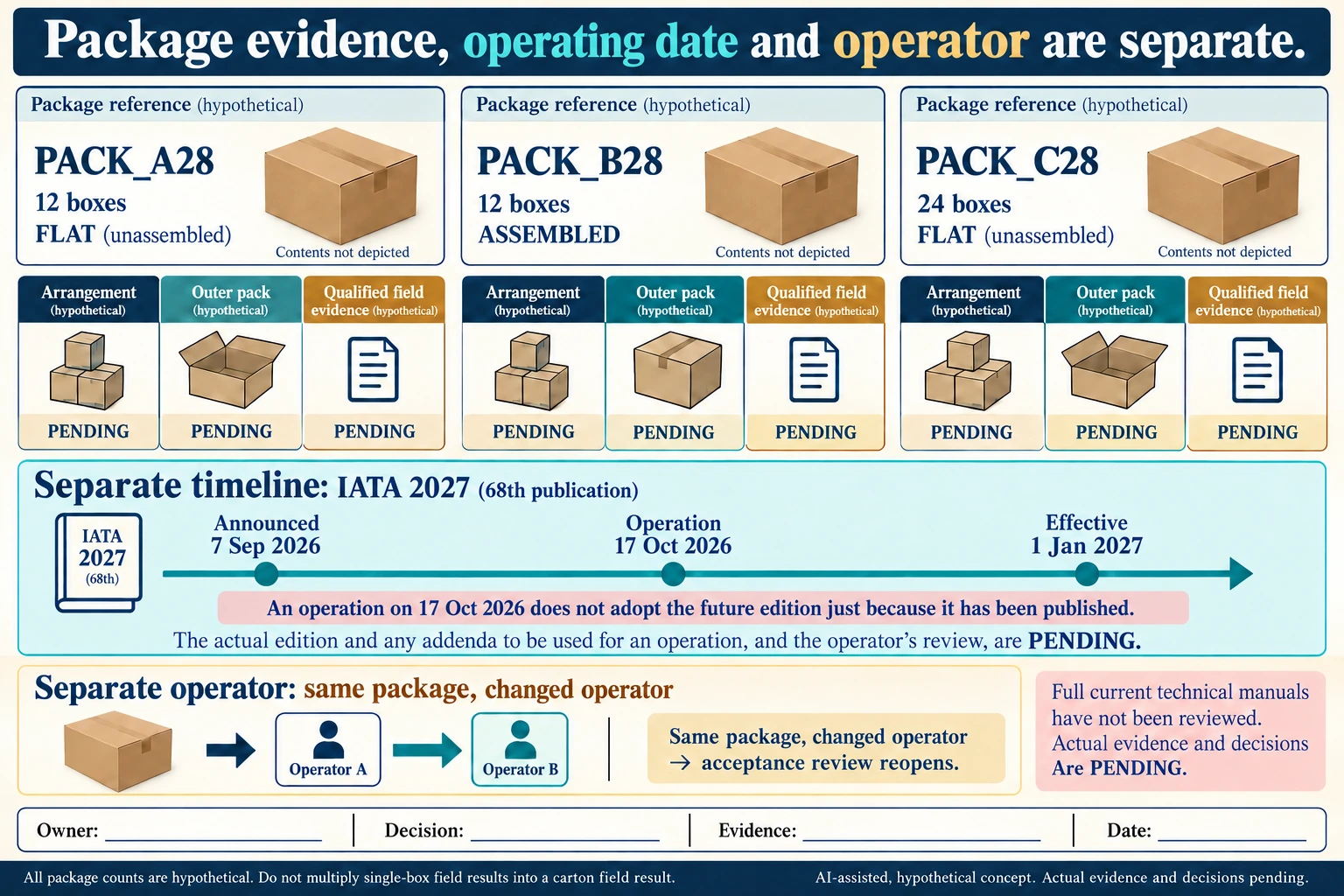
A published future edition does not cover a changed package or route
Compare three invented packed-package records without assigning a magnetic field. PACK_A28 contains twelve boxes in a flat delivery state. PACK_B28 also contains twelve but in an assembled state. PACK_C28 contains twenty-four flat boxes. Arrangement, outer packing, closure construction and suitable field evidence remain actual unknowns. The numbers define comparison scope, not a safe packing density or an air-shipping offer.
Scroll horizontally if columns extend beyond the view.
| Hypothetical configuration | Named object | Relationship | Input or next scope |
|---|---|---|---|
| PACK_A28 | MAGNETIC_BOX | assumed pack count | 12 boxes/package |
| PACK_A28 | MAGNETIC_BOX | assumed delivery state | FLAT |
| PACK_B28 | MAGNETIC_BOX | assumed pack count | 12 boxes/package |
| PACK_B28 | MAGNETIC_BOX | assumed delivery state | ASSEMBLED |
| PACK_C28 | MAGNETIC_BOX | assumed pack count | 24 boxes/package |
| PACK_C28 | MAGNETIC_BOX | assumed delivery state | FLAT |
| PACK_C28 | SINGLE_BOX_OR_PACK_A_FIELD | cannot multiply into | PACK_C28_MEASURED_FIELD |
| DATE_SCOPE28 | SHIPMENT_D1 | hypothetical operation date | 2026-10-17 |
| DATE_SCOPE28 | SHIPMENT_D2 | hypothetical operation date | 2027-01-02 |
| DATE_SCOPE28 | PUBLISHED_2027_68TH | does not make effective | 2026_OPERATIONS |
| DATE_SCOPE28 | 2027_01_01_EFFECTIVE_DATE | requires | SHIPMENT_DATE_EDITION_ADDENDA_AND_OPERATOR_REVIEW |
| OPERATOR28 | SAME_PACKAGE_NEW_OPERATOR | reopens | ROUTE_SERVICE_ACCEPTANCE |
| DATE_SCOPE28 | FULL_CURRENT_ICAO_IATA_TECHNICAL_PROVISIONS | status | NOT_ACQUIRED_NO_INTERNATIONAL_CUTOFF_OR_PROCEDURE |
A result for one package cannot simply transfer to either changed state. Nor can a single-box figure be multiplied by twelve or twenty-four to create a measured external field for the packed carton. Ask the qualified evaluator what evidence covers the exact offered arrangement. The current US clause uses strictly greater than 0.00525 gauss at 4.5 m from any package surface; this source reference supplies no measurement procedure, actual field result or automatic clearance at or below the number.
Keep the operation date on another axis. The original ICAO 2025–2026 and IATA 2026/67th edition references remain correct within their stated scope. IATA announced publication of its 2027 manuals on 7 September 2026, while its update page identifies the 2027/68th DGR as effective from 1 January 2027. A hypothetical operation on 17 October 2026 and another on 2 January 2027 therefore need their appropriate edition, addenda and applicability review; publication alone does not make the future edition operative in October.
Changing the operator or service reopens acceptance even if the physical package stays unchanged. DHL Aviation Cargo’s public category description is not approval by every DHL courier product or for this shipment. Full current ICAO/IATA technical provisions were not acquired, and no international numerical cutoff, handling procedure, shielding solution or label is prescribed. Leave air eligibility pending until qualified technical and shipping reviewers resolve the actual package, applicable rules and chosen route.
Download the magnetic packaging air shipment configuration edition date record (.csv). It includes the original table fields and scenarios alongside the added relationships. HYPOTHETICAL rows are editorial examples or required review scopes, not actual records. Actual quantity, configuration, component and file identities, materials, process, specification, copy, method, condition, observation, owner, decision, evidence and dates are blank. ACTUAL_BLANK is a separate empty starting row; enter permitted project evidence before using an actual record. A blank means unknown.
Use the Packaging Freight Quotes: Carton Data to Prepare for its separate question. Use the Folding Gift Box Specifications: Structure and Delivery for its separate question.
Additional official reference: IATA 2027 manuals publication announcement, IATA edition updates and effective dates. Publication on 7 September 2026 is distinct from 2027/68th DGR applicability from 1 January 2027. Full technical manuals were not acquired; no actual transport decision is supplied.
Source scope checked 17 October 2026: US 49 CFR 173.21(d), historical FAA and PHMSA materials, ICAO edition guidance, IATA publication and effective-date pages, and the named DHL Aviation Cargo page have distinct scopes. Original 2026 applicability remains correct; 2027 publication is separate from 1 January 2027 effect. Full current international technical manuals were not acquired, and no shipment or operator acceptance is established. The added configurations and calculations are hypothetical, with actual evidence and decisions pending.
Discuss this packaging specification with Packrivo. We coordinate independent suppliers. MOQ: 500 pieces per product/design; illustrative quantities are not production offers. Confirm materials, samples, price and timing for your project.