
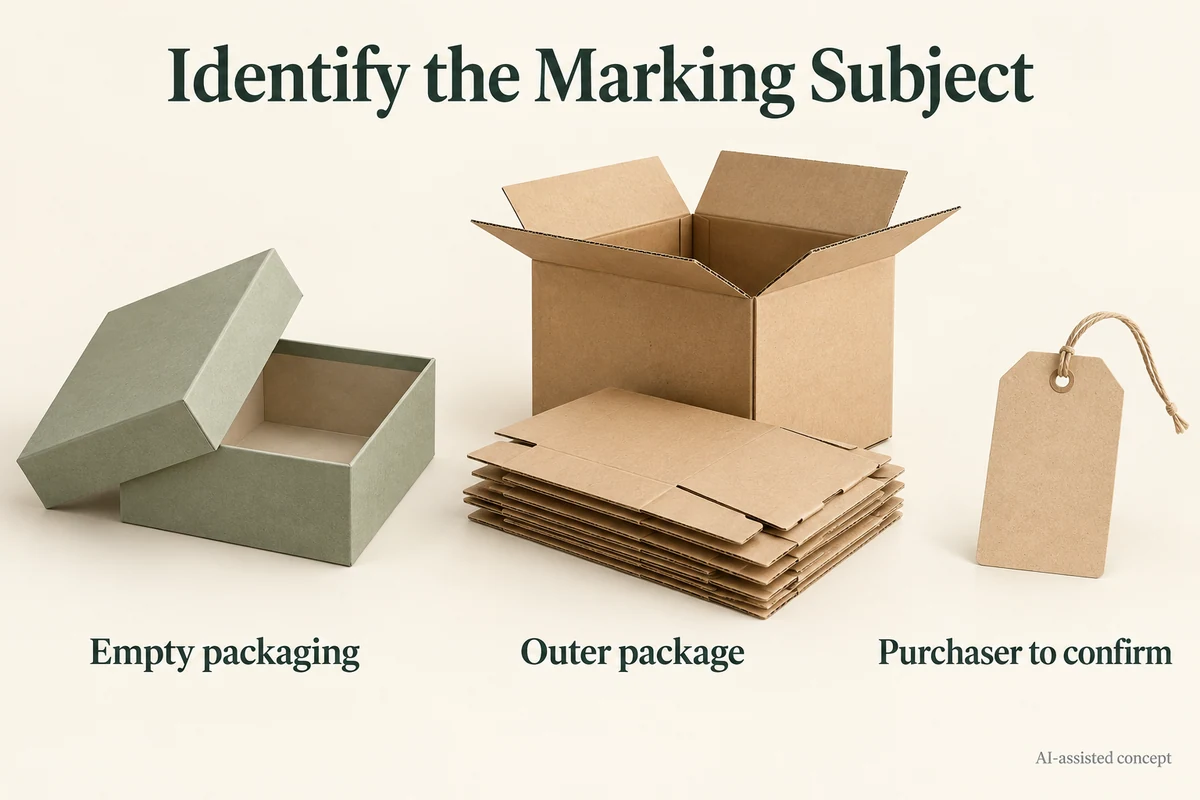
For empty packaging imported into the United States, identify the packaging’s origin, intended use and ultimate purchaser before deciding what must be marked. A brand importing boxes to fill and sell with its goods has a different fact pattern from a distributor reselling empty boxes. Any origin wording left visible after filling must identify its subject clearly.
This guide uses hypothetical arrangements. It does not determine the origin, classification or marking exception for an actual shipment.
Identify the imported article and its purchaser
Start with what crosses the border: the empty box, case, bag or other packaging component. Goods added after importation are not automatically part of that import. Under 19 CFR 134.1, origin concerns manufacture, production or growth, with additional processing rules. A departure point in China alone does not prove the origin of every component.
The same section defines the ultimate purchaser using the imported form and transaction conditions. It is not universally the importer of record. Identify who imports the boxes, who receives them as empty packaging, who fills them and whether they are resold individually or in bulk.
For a disposable-container arrangement covered by 134.24(c)(1), the importing business that fills the containers and sells the packaged goods can be the ultimate purchaser of those containers. A distributor that only resells empty boxes cannot assume it meets that filling-and-selling provision.
Match the marking route to the import and sale arrangement
The following branches are provisional. Physical construction, intended use, tariff treatment and any applicable exception still need review.
| Hypothetical arrangement | Marking question to resolve |
|---|---|
| A brand directly imports disposable empty boxes, then fills and sells them with its goods | Does 134.24(c)(1) apply, and are the outside packages properly marked for the boxes’ origin? |
| A distributor imports disposable boxes and sells bulk packages to a separate filling business | Under 134.24(b), which origin-marked outermost package reaches the identified ultimate purchaser? |
| Empty boxes are sold individually at retail | How does the required origin information reach the purchaser of the empty packaging? A discarded wholesale carton is not an automatic substitute |
| Cases have independent lasting or decorative use | Review 134.23 and actual classification before relying on disposable-container treatment |
| Packaging enters already filled with merchandise | Review the origin of the contents and container under the applicable filled-import rules; do not carry over the empty-box conclusion |
| Use, purchaser or construction is unknown | Hold the individual-versus-outer-package decision until those facts are identified |
An outer carton can satisfy a particular route only under its conditions. For disposable containers sold in multiple units, 134.24(b) refers to the outermost package reaching the ultimate purchaser. A mark seen by a distributor before the boxes are divided may not describe the package the relevant purchaser receives.
Follow the boxes through any repacking
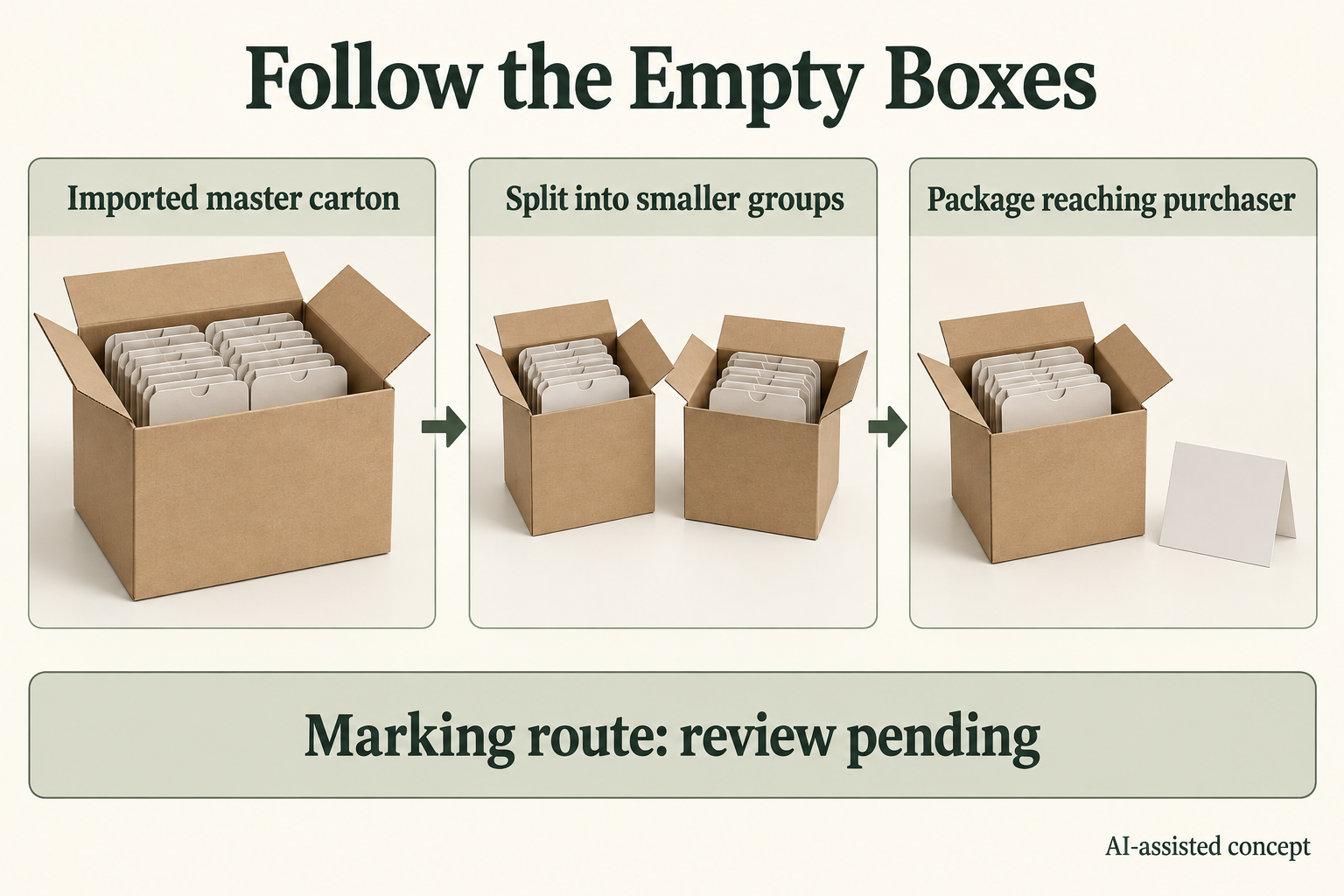
Imagine a distributor receives empty boxes in a marked master carton, then divides them into smaller groups for different filling businesses. These are hypothetical handling steps, not an observed shipment.
Draw the actual transfer path before relying on the master-carton mark. Identify each resulting package and its recipient. If the original carton stays at the distributor’s warehouse, it cannot simply be treated as the outermost carton delivered to the next purchaser.
19 CFR 134.26 addresses relevant repacking, certification and notification conditions. The importer should have its customs adviser review which requirements apply to the proposed arrangement. The article has not established an exception for any redistributed group of boxes.
This adds a purchaser-and-transfer question to the shipping record. The carton freight-data guide supplies count, size and weight; those figures do not establish a marking exception.
Reuse and usual-container treatment need their actual conditions
Do not classify every sturdy gift box as reusable or every paperboard box as disposable. 134.22(d) explains usual-container treatment and notes that sturdiness and repeated use with the contents do not alone exclude a container from that category.
Independent lasting value, decorative use and how the item is entered and sold can raise different questions. Section 134.23 refers to the relevant tariff interpretation rules; the buyer must not assign that treatment from a photo or a supplier’s premium-box description.
An empty fitted case is also not automatically given the same tariff treatment as a case imported with its intended contents. Provide the actual imported condition and intended use to the responsible classification reviewer.
Keep the box’s origin separate from the goods inside
Suppose an empty box has a verified Chinese origin and will later hold goods whose origin is not established. This assumption is only for the example; no real box or product origin has been verified here.
Section 134.24(c)(2) requires a visible origin mark on relevant individually marked containers imported for filling to identify the container rather than the contents. A hypothetical statement such as “Container made in China” describes the assumed box origin. It is not print-ready approved wording or a conclusion that every such box needs an individual mark.
An unqualified origin statement on a filled gift presentation can suggest that the contents share the box’s origin. Filling a box in the United States does not establish that the contents were made there either. The two origin decisions need their own facts.
If geographic wording or a US address appears, include it in the responsible review of the applicable marking provisions. An address is not proof of manufacture, but the article does not classify every address printed on empty packaging as a violation.
Once the origin and marking subject are resolved, the retail-copy responsibility guide can keep the approved words connected to the artwork. The proof should show the actual location and the final presentation after filling, alongside any outer-package marking relied upon.
Sources checked 9 October 2026. The cited eCFR pages displayed Title 19 current through dates from 1 to 7 October 2026; the text is authoritative but an unofficial electronic edition. These branches do not assign a tariff code, establish origin, approve a marking exception or authorize a US-origin claim. Packrivo coordinates packaging information; customs classification and transaction-specific decisions remain with the importing business and its appropriate advisers. Any accompanying illustration is an AI-assisted concept.
A mark on a master carton does not travel with every split group
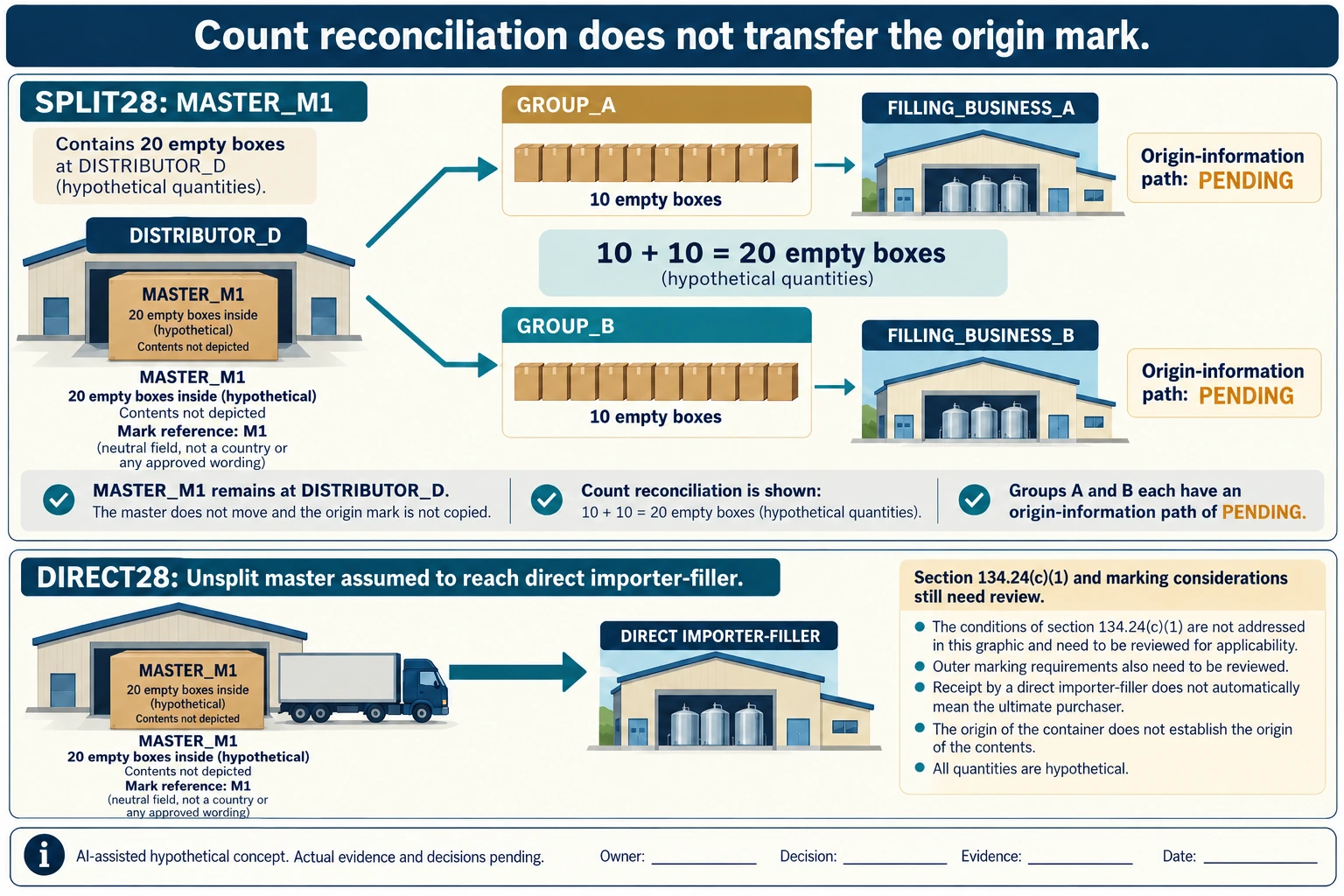
Draw a separate invented redistribution record. SPLIT28 starts with twenty empty boxes in MASTER_M1 at distributor D. The distributor divides them into GROUP_A and GROUP_B, ten boxes each, for two filling businesses. The master carton stays at D. These numbers describe a transfer example; actual origin, container category, ultimate purchaser and marking treatment remain unknown.
Scroll horizontally if columns extend beyond the view.
| Hypothetical configuration | Named object | Relationship | Input or next scope |
|---|---|---|---|
| SPLIT28 | MASTER_M1 | assumed quantity | 20 empty boxes |
| SPLIT28 | GROUP_A | assumed quantity | 10 empty boxes |
| SPLIT28 | GROUP_B | assumed quantity | 10 empty boxes |
| SPLIT28 | GROUP_A_PLUS_GROUP_B | calculated from | GROUP_A_COUNT+GROUP_B_COUNT; 20 empty boxes |
| SPLIT28 | MASTER_M1 | assumed remains at | DISTRIBUTOR_D |
| SPLIT28 | GROUP_A | assumed received by | FILLING_BUSINESS_A |
| SPLIT28 | GROUP_B | assumed received by | FILLING_BUSINESS_B |
| SPLIT28 | M1_MARK | does not by itself establish | ORIGIN_INFO_ON_GROUP_A_OR_GROUP_B |
| DIRECT28 | UNSPLIT_MASTER | assumed reaches | DIRECT_IMPORTER_FILLER |
| BOTH28 | RECIPIENT_ROLE | does not automatically assign | ULTIMATE_PURCHASER_OR_MARKING_EXCEPTION |
| FILLED_LATER28 | CONTAINER_ORIGIN | does not establish | CONTENTS_ORIGIN |
| BOTH28 | ORIGIN_WORDING | status | PENDING_NO_PRINT_READY_APPROVED_STATEMENT |
The count reconciles: ten plus ten equals twenty empty boxes. That does not reconcile the origin-information path. A mark remaining on M1 cannot by itself establish what reaches either recipient after the groups leave separately. Identify the package each relevant purchaser actually receives, and ask the customs reviewer which marking, repacking and notification conditions apply. Do not turn an outer mark once seen at the warehouse into a blanket exception for every subsequent package.
DIRECT28 is a different premise: an unsplit master reaches a direct importer-filler. The section 134.24(c)(1) route still depends on the actual qualifying container, filling-and-selling relationship and outside-package marking conditions. The split distributor example cannot borrow those facts merely because its customers intend to fill boxes. A recipient’s role also does not automatically settle who is the ultimate purchaser under the actual import arrangement.
Keep individual empty-box retail, independently lasting or decorative containers, and already-filled imports on their separate branches. Section 134.26 has defined repacking conditions and exceptions; this worksheet assigns neither a universal certification requirement nor an exemption. After filling, any applicable visible container-origin statement must have its proper subject. Container origin does not establish the goods’ origin, and no print-ready country statement is supplied here. Carry the actual route, construction and proposed final presentation to the importer’s appropriate adviser before artwork is finalized.
Download the empty gift box import origin marking split packages record (.csv). It includes the original table fields and scenarios alongside the added relationships. HYPOTHETICAL rows are editorial examples or required review scopes, not actual records. Actual quantity, configuration, component and file identities, materials, process, specification, copy, method, condition, observation, owner, decision, evidence and dates are blank. ACTUAL_BLANK is a separate empty starting row; enter permitted project evidence before using an actual record. A blank means unknown.
Use the Packaging Freight Quotes: Carton Data to Prepare for its separate question. Use the Assign Product Copy Responsibility Before the Packaging Proof for its separate question.
Source scope checked 17 October 2026: The cited US 19 CFR 134.1, 134.22, 134.23, 134.24 and 134.26 retain separate purchaser, empty/filled, lasting-use, filling, outer-marking and repacking conditions. Shipment location alone is not origin; no country statement, exception, tariff classification or actual customs decision is supplied. The added configurations and calculations are hypothetical, with actual evidence and decisions pending.
Discuss this packaging specification with Packrivo. We coordinate independent suppliers. MOQ: 500 pieces per product/design; illustrative quantities are not production offers. Confirm materials, samples, price and timing for your project.