
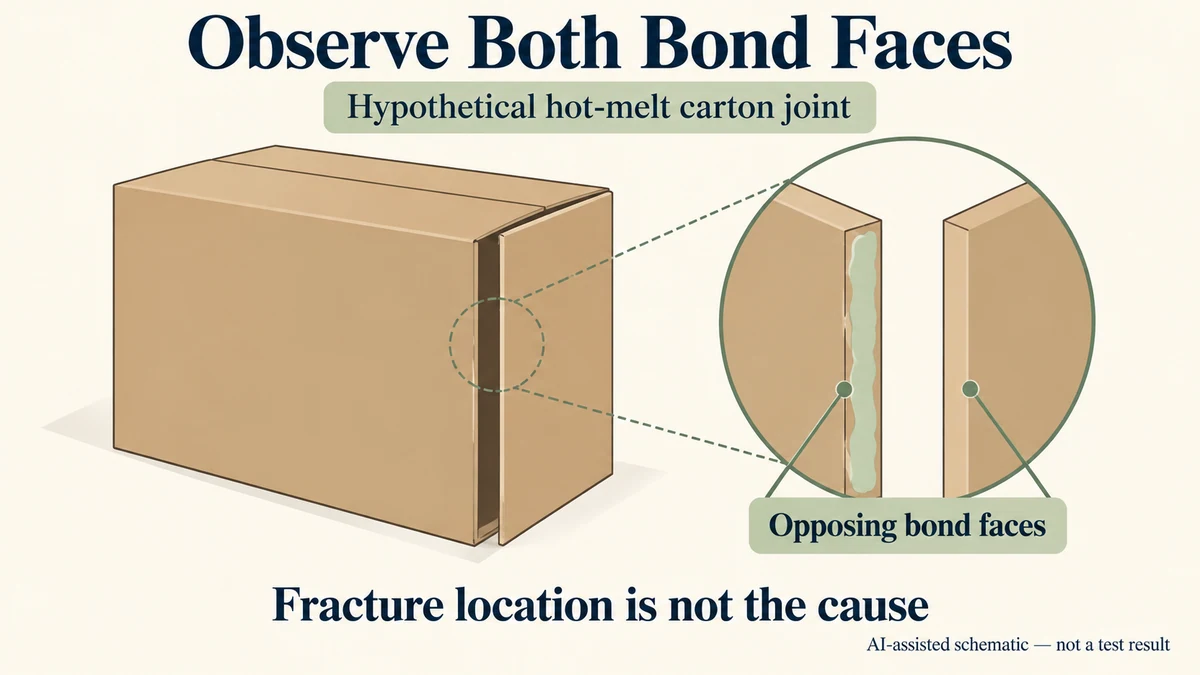
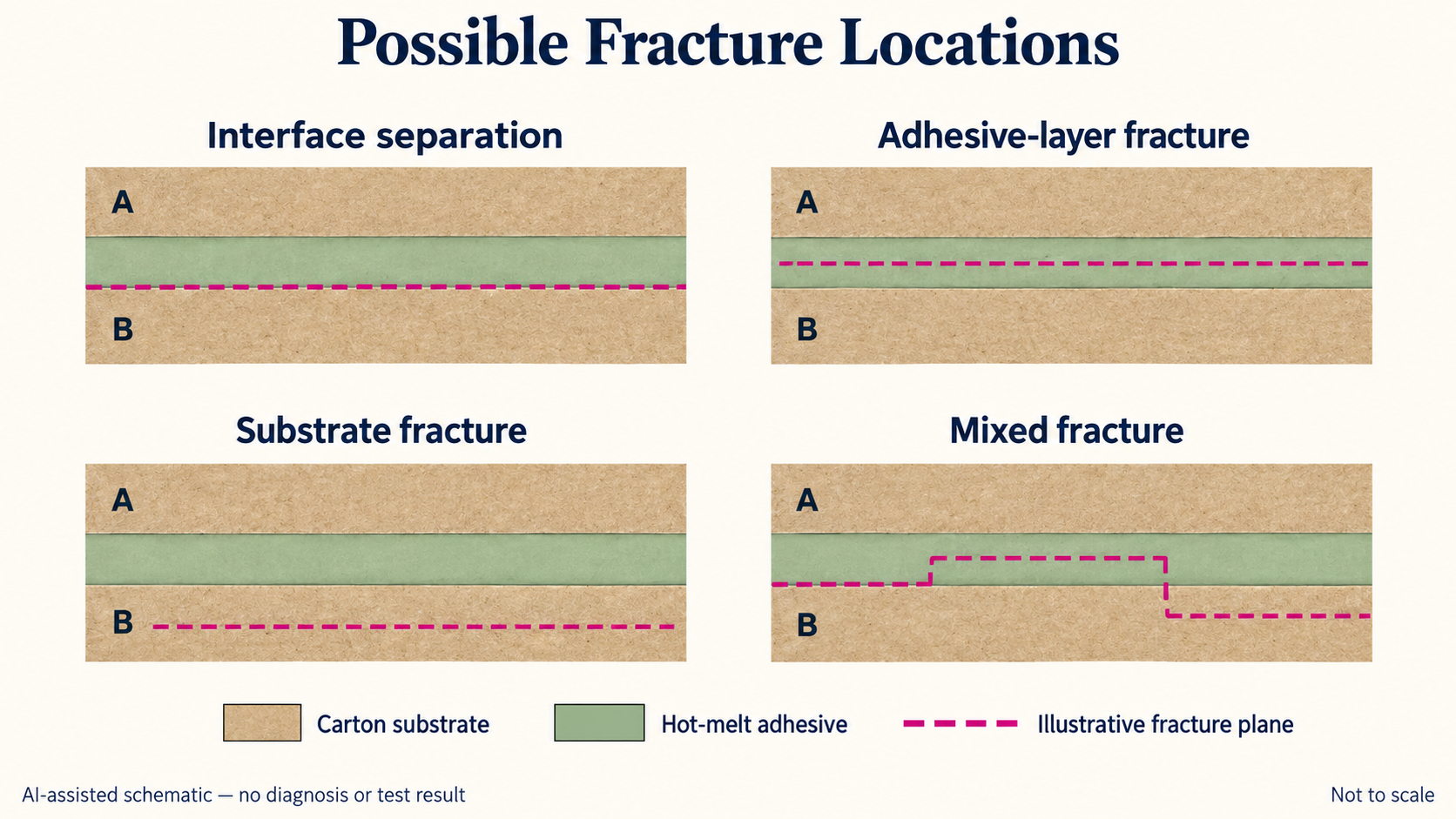
When an outer carton arrives with a hot-melt-bonded joint already open, the visible break does not explain why it happened. It may have run along the boundary between adhesive and carton surface, through the adhesive itself, or through the carton material. More than one pattern may be present.
Knowing where the joint separated helps frame the next technical investigation. It does not establish fault, acceptable bond strength, or a validated repair.
Both faces of the opened joint tell part of the story
Consider the opposing surfaces that were bonded together.
On one face, adhesive may remain as a relatively continuous strip, while the corresponding receiving area looks largely uncovered. This is consistent with separation near an adhesive–substrate interface.
If adhesive appears split and remains on both corresponding areas, the break may have passed within the adhesive, called cohesive fracture.
If a paper liner or board fibres have been pulled from the carton and remain attached across the joint, part of the fracture may be within the substrate.
These are possible patterns, not visual certificates. An apparently bare face may have a thin residue or surface layer that cannot be resolved by ordinary viewing. Exposed patches can coexist with adhesive remnants and torn fibres.
The undated BÜHNEN technical explanations distinguish interfacial failure, cohesive failure and substrate failure.
Three similar pop-opens raise different technical questions
Imagine three hypothetical outer cartons for a gift brand. Their specified joints use hot-melt adhesive; each carton arrives with a joint already open.
All three look similarly unsealed from the outside, yet their apparent fracture locations differ. These invented observations are not actual inspections or test results.
Joint A: One receiving face looks mostly uncovered.
A band of adhesive appears on one face, while the matching region on the other looks largely bare.
This suggests interfacial separation in those regions, not proof of contamination or unsuitable glue.
The technical reviewer needs to establish which carton liner, print, coating or film actually met the adhesive and whether the intended contact was formed.
Was the hot melt still able to engage that receiving face when the bond was made? Could it have set before the surfaces were brought together, or was contact otherwise incomplete?
These are competing questions, not findings. The intended face-and-layer information belongs with the glue-zone guide.
Joint B: Apparent adhesive remnants occur on both faces.
Matching areas show torn-looking hot-melt material on each side.
A split within the adhesive becomes a relevant possibility, but glue on both sides does not prove cohesive fracture across the whole joint.
The reviewer needs to assess how the actual adhesive was expected to behave under the joint’s opening loads and known temperature history, including whether the remnants correspond across the fracture area.
Henkel’s undated hot-melt pop-open guidance lists adhesive on both faces among observations associated with more than one failure scenario, including cold- and heat-related problems.
That appearance cannot establish either cause by itself.
Joint C: Carton material stays attached at the joint.
A section of paper liner appears torn away from one carton face and remains with adhesive on the other.
The next question shifts toward where the liner or board divided and what loads acted on that region.
Was the break within a carton ply, a laminated layer, or only in portions adjacent to another fracture type? Could the visible tear have developed during later handling rather than the initial opening?
A fibre tear alone does not prove defective board, excessive transit forces, or a sufficiently strong carton joint.
Mixed fracture areas and opening loads complicate the pattern
An opened seam need not fit one label.
One end may expose the receiving surface, the middle may show adhesive on both faces, and an edge may carry torn board fibres.
This is a mixed fracture pattern. Recognising the distinct regions is more accurate than assigning a single fracture type to the whole joint.
BÜHNEN’s undated fracture-pattern explanation explains that the manner of loading matters. Direct separation and peeling can produce different fracture appearances.
An unexpected opening during distribution does not have a known, uniform test load merely because its fractured surfaces remain visible. The applied forces, their direction and the sequence of opening may be uncertain.
This is why an image cannot establish a single correction. Contact conditions, environmental exposure, substrate layers and mechanical loading can interact. A mixed appearance does not automatically mean multiple independent defects.
An unwanted pop-open is not a passed bond evaluation
In a deliberately destructive bond evaluation, cohesive fracture or substrate tear can sometimes be favourable compared with separation at an adhesive interface.
BÜHNEN describes substrate fracture as potentially positive within a fracture-mechanics test, where the evaluation purpose and conditions are defined.
That interpretation does not transfer automatically to a carton that was intended to remain closed but opened unexpectedly.
Visible fibre tear cannot convert the incident into an acceptance pass. Nor can adhesive on both faces establish a numerical bond strength or compliance result.
The reviewer still needs the intended closure performance, actual construction, relevant loading conditions and appropriate evaluation basis.
A report covering a different construction should not be treated as proof for this joint. The test-report configuration guide addresses that separate applicability question.
The useful outcome is a narrower technical investigation
Preserve the two already-opened bond faces and their received relationship. Do not clean, re-glue, rearrange or peel them further to create a clearer-looking pattern. Do not create destructive test samples.
If part of the original fracture has been disturbed or is missing, acknowledge that limitation.
The existing transit-damage guide addresses received condition, incident location and packaging version. The additional task here is deciding which physical fracture mechanisms require investigation.
For interfacial-looking areas, the responsible carton and adhesive specialists should assess the actual bonding surfaces and how contact was formed.
For apparent cohesive separation, they should examine the adhesive’s behaviour under relevant loading and environmental conditions.
For substrate fracture, they should consider board or liner construction and the local loading of the joint.
For mixed areas, more than one path may remain open. The responsible technical parties must decide what additional evaluation is appropriate and whether any proposed correction is adequately supported.
This reasoning applies to a confirmed hot-melt-bonded carton joint. If the joining material is unknown, identify it before assuming a hot-melt failure mechanism. Evidence for hot melt cannot automatically be transferred to tape, pressure-sensitive adhesives, epoxies or foil-bonded constructions.
A fracture plane narrows the investigation. It does not, by itself, explain the opening or validate a remedy.
Pair corresponding regions before calling a fracture cohesive
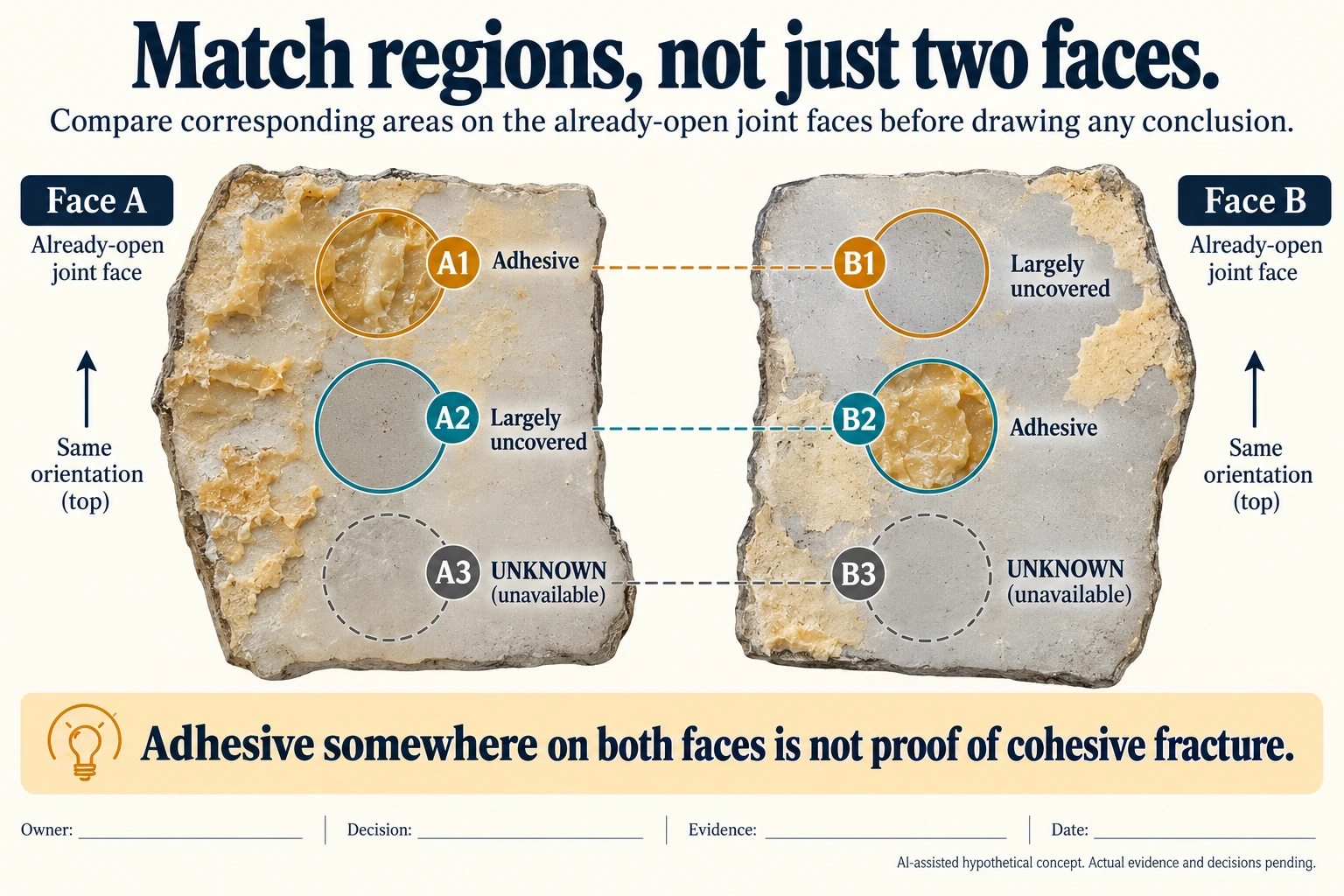
Use a new invented map of two already-open faces, A and B, without opening another joint. Pair A 1 with B 1, A 2 with B 2 and A 3 with B 3 using an established orientation reference. Assume visible adhesive at A 1 with B 1 largely uncovered; at A 2 largely uncovered with adhesive at B 2; and A 3/B 3 unavailable. These are fictional observations for teaching, not inspected cartons.
Scroll horizontally if columns extend beyond the view.
| Hypothetical configuration | Named object | Relationship | Input or next scope |
|---|---|---|---|
| REGION29 | A1 | corresponds to | B1 |
| REGION29 | A1 | assumed appearance | ADHESIVE_VISIBLE |
| REGION29 | B1 | assumed appearance | LARGELY_UNCOVERED |
| REGION29 | A2 | corresponds to | B2 |
| REGION29 | A2 | assumed appearance | LARGELY_UNCOVERED |
| REGION29 | B2 | assumed appearance | ADHESIVE_VISIBLE |
| REGION29 | A3 | corresponds to | B3 |
| REGION29 | A3 | assumed appearance | UNAVAILABLE |
| REGION29 | B3 | assumed appearance | UNAVAILABLE |
| REGION29 | A1_AND_B2_ADHESIVE | not evidence of | CORRESPONDING_COHESIVE_SPLIT |
| REGION29 | A3_B3 | leave | UNKNOWN |
| REGION29 | ALREADY_OPEN_FACES | do not | CLEAN_REGLUE_ROTATE_TO_FAKE_MATCH_OR_EXTRA_PEEL |
It would be true in a loose description that adhesive appears somewhere on both faces. It would be false to conclude from that alone that corresponding adhesive was split throughout the joint. A 1 and B 2 belong to different pairs. Each known pair instead raises an interface-related question under the assumed appearance, while missing pair 3 stays unresolved. Thin residue, surface layers and mixed fracture can still complicate either apparently uncovered region.
The useful output is the region-to-region correspondence, not a verdict of cold glue, hot glue, contamination or adequate bond. Keep received orientation, photo scope and any missing or disturbed area visible. Do not clean, re-glue, rotate pieces to suggest a match or peel additional material to produce a clearer pattern. The responsible technical reviewer must decide what examination is appropriate for the actual joint and loading history.
BÜHNEN’s interface, cohesive, substrate and fracture-pattern explanations and Henkel’s pop-open discussion support these distinctions without establishing unique causes from one appearance. A fibre-bearing region would add a substrate question, not an acceptance certificate. The region map complements the glue-zone construction record: one locates intended material contact, the other identifies which already-opened areas can actually be compared. Actual material, process, loading and corrective decision remain blank.
Download the hot melt joint corresponding fracture region map record (.csv). It includes the original table fields and scenarios alongside the added relationships. HYPOTHETICAL rows are editorial examples or required review scopes, not actual records. Actual quantity, configuration, component and file identities, materials, process, specification, copy, method, condition, observation, owner, decision, evidence and dates are blank. ACTUAL_BLANK is a separate empty starting row; enter permitted project evidence before using an actual record. A blank means unknown.
Use the Glue Zones Need the Current Drawing and Surface Layers in One View for its separate question.
Source scope checked 17 October 2026: BÜHNEN’s four technical pages and Henkel’s pop-open guidance explain fracture location and loading distinctions. Reliable individual publication dates were not confirmed. They prescribe no actual adhesive temperature, repair, unique cause, accepted strength or seal result. The added configurations and calculations are hypothetical, with actual evidence and decisions pending.
Discuss this packaging specification with Packrivo. We coordinate independent suppliers. MOQ: 500 pieces per product/design; illustrative quantities are not production offers. Confirm materials, samples, price and timing for your project.