
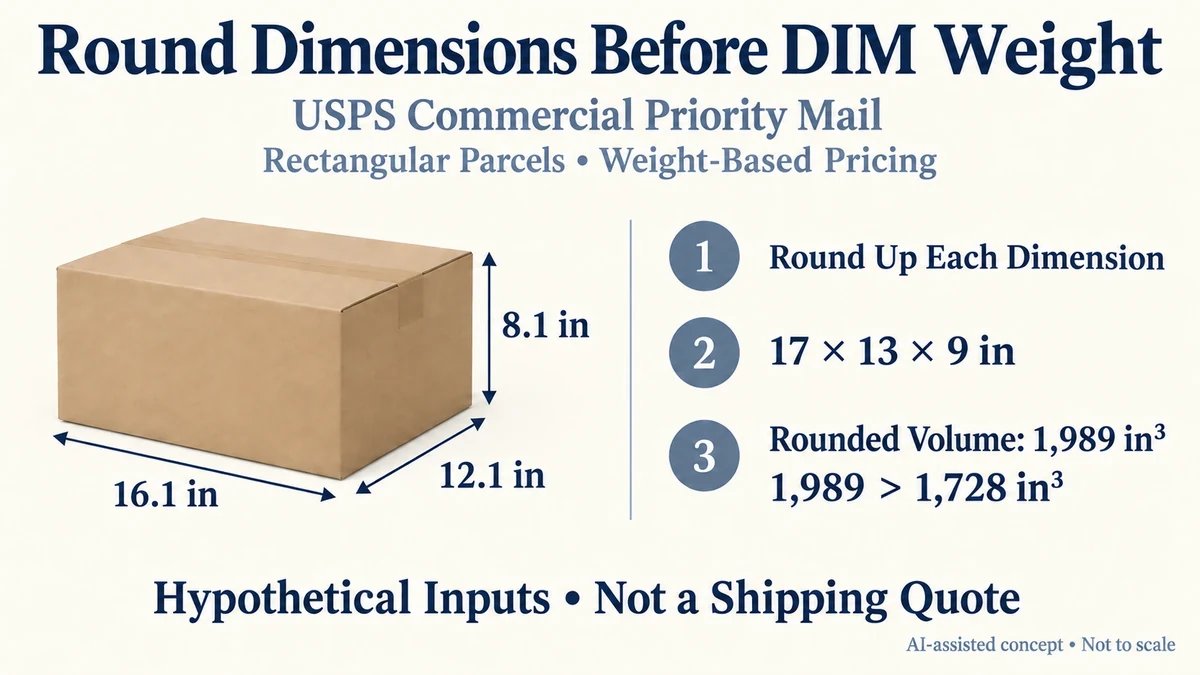
For a rectangular parcel using applicable USPS commercial Priority Mail weight-based pricing, dimensional weight is not calculated by simply multiplying the measured dimensions and dividing by 139. USPS first requires each outside dimension to be rounded up to a whole inch. Those rounded dimensions determine whether the parcel crosses the one-cubic-foot threshold.
The sequence matters for small jewelry, candle and gift brands. A seemingly minor difference in finished shipping-carton dimensions can change the calculated weight basis. Another small reduction may change nothing at all.
The calculation uses the finished parcel’s outside dimensions
Start with the complete rectangular parcel as it will be shipped, including its closure, packing materials and any features affecting its outside measurements.
A supplier’s quoted internal box dimensions describe usable space for packing. They are not automatically the parcel dimensions used for shipping calculations. Board thickness, the finished construction, tape and bulging surfaces may affect the exterior.
For a brand choosing dispatch-carton sizes, the Packrivo guide to shipping box sizes explains why internal fit and finished external dimensions belong to different decisions.
Record the parcel’s outside length, width and height in inches, together with its complete packed weight in pounds. Keep the original measurements available instead of replacing them with rounded values.
USPS rounds the dimensions before testing the volume threshold
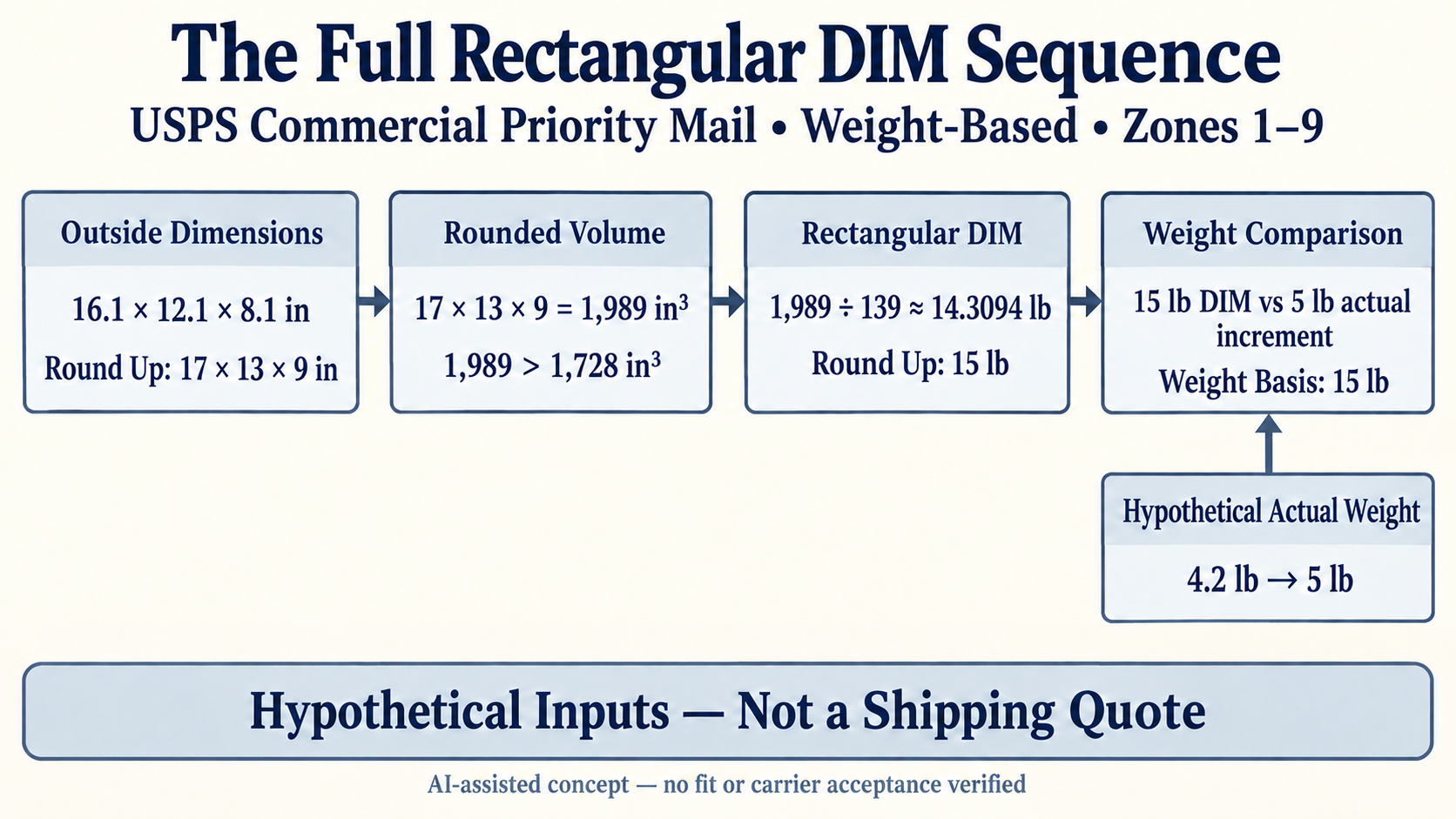
Under USPS Domestic Mail Manual 223, sections 1.4.1 and 1.4.2, the rectangular-parcel dimensional-weight calculation follows this order for the applicable Priority Mail pricing and delivery zones:
- Measure length, width and height in inches.
- Round each dimension upward to the next whole inch.
- Multiply those three rounded dimensions.
- If the result exceeds 1,728 cubic inches, divide it by 139.
- Round that division result upward to the next whole pound of dimensional weight.
- Compare dimensional weight with actual weight under the applicable postage increment. Use the greater weight for the specified pricing comparison.
The threshold is strictly greater than 1,728 cubic inches. A calculated volume of exactly 1,728 cubic inches does not trigger this dimensional-weight step.
The separate actual-weight rule in DMM 223, section 1.1(a) rounds a fractional pound up to the next whole-pound postage increment for the relevant weight-based Priority Mail pricing.
USPS also defines upward rounding in DMM 604, section 7.1.3. It is not nearest-whole-inch rounding, and it is not permission to round a measured dimension down.
An invented parcel crosses the threshold after rounding
Consider a completely hypothetical rectangular shipping carton with the following finished outside dimensions:
16.1 × 12.1 × 8.1 inches
Assume its actual packed weight is 4.2 pounds.
These are invented numerical inputs, not observations from a factory, carrier measurement, packing trial or customer shipment.
| Calculation stage | Hypothetical result |
|---|---|
| Original measured dimensions | 16.1 × 12.1 × 8.1 in |
| Round each dimension upward | 17 × 13 × 9 in |
| Multiply rounded dimensions | 1,989 in³ |
| Compare with the threshold | 1,989 exceeds 1,728 in³ |
| Divide by the rectangular DIM divisor | 1,989 ÷ 139 ≈ 14.3093525 lb |
| Round dimensional weight upward | 15 lb |
| Round hypothetical actual weight | 4.2 lb → 5 lb |
| Compare the two weight increments | 15 lb versus 5 lb |
The dimensional-weight comparison produces 15 pounds.
There is an important distinction hidden in the numbers. Multiplying the original, unrounded measurements gives only 1,577.961 cubic inches. But that is not the volume to use for the threshold test under this rectangular dimensional-weight sequence.
The rounded dimensions produce 1,989 cubic inches instead. That result crosses the threshold and leads to the 15-pound dimensional weight.
This arithmetic establishes the weight basis for the stated hypothetical calculation. It is not a postage quotation, an observed carrier charge or evidence that a real parcel has been accepted.
A smaller hypothetical parcel falls below the threshold
Now consider a separately proposed rectangular parcel with finished outside dimensions of:
16 × 12 × 8 inches
Each dimension is already a whole number. The calculated volume is:
16 × 12 × 8 = 1,536 cubic inches
Because 1,536 does not exceed 1,728, the dimensional-weight calculation described above is not triggered.
If this different hypothetical parcel also weighed 4.2 pounds, its actual-weight postage increment would be 5 pounds under the cited weight-based rule.
The important result is the change in calculation status: the first hypothetical parcel triggers the dimensional-weight comparison, while the second does not.
That does not establish that the smaller carton can hold the same product, presentation packaging, protective inserts or cushioning. It also does not prove a postage saving. The second configuration needs its own fit and protection review before it can become a usable packaging alternative.
A dimension reduction can leave the DIM result unchanged
Not every fraction of an inch makes a difference.
Return to the first invented parcel. Suppose only its longest outside dimension changes from 16.1 inches to 16.05 inches. Keep the other two hypothetical dimensions at 12.1 and 8.1 inches.
Both 16.1 and 16.05 round upward to 17 inches.
The entire rounded calculation therefore remains:
17 × 13 × 9 = 1,989 in³
1,989 ÷ 139 ≈ 14.3093525
Rounded dimensional weight = 15 lb
The parcel is physically shorter in the invented comparison, but its calculated dimensional weight does not change.
This reveals two different boundaries worth checking before proposing a redesign:
- Whether the change moves an outside dimension into a different whole-inch rounding interval.
- Whether the resulting rounded volume and dimensional-weight calculation cross a threshold that changes the final weight increment.
Even crossing an individual dimension’s rounding boundary does not automatically change the final dimensional-weight increment. The complete calculation still has to be performed.
Never report a dimension as smaller than it actually is to change its billing result. A legitimate packaging comparison requires a genuinely different, properly measured finished parcel.
Dimensional weight is not the final shipping charge
This calculation is deliberately limited to the applicable commercial USPS Priority Mail rectangular-parcel weight-based rule for delivery Zones 1–9.
Other Priority Mail pricing arrangements require separate treatment. USPS-produced Flat Rate packaging has its own price basis. Eligible Cubic pricing uses different measurements and rounding rules. Priority Mail Open and Distribute tray boxes and specific customer agreements can also have different pricing arrangements.
Nonrectangular parcels have a separate calculation in DMM 223, section 1.4.3. Their measurement, adjustment factor and divisor must not be replaced with the rectangular calculation.
The rectangular rule also specifies a 70-pound price treatment when calculated dimensional weight exceeds 70 pounds; neither invented example reaches that condition.
No surcharge, other applicable fee, actual postage amount or carrier acceptance outcome has been calculated here.
For a real project, confirm the intended USPS product and pricing arrangement. Give the shipping owner the complete packed parcel’s external dimensions, actual packed weight, origin, destination and relevant packaging characteristics. Request an applicable service quotation rather than assigning a monetary saving from dimensional-weight arithmetic alone.
For preparing carton measurements and weights, see Packrivo’s carton-data guide. For decisions involving another service or carrier, use the separate carrier classification guide rather than carrying this USPS divisor into an unrelated calculation.
Packrivo can coordinate packaging sourcing questions and compare proposed external dimensions with internal fit requirements. It does not independently certify dimensional-weight calculations, conduct shipping tests or determine carrier charges.
The useful design decision is whether a genuine change to the completed parcel alters the rounded calculation without compromising the packaging’s intended function.
Official source and date limitation
Primary reference: USPS Domestic Mail Manual, 223 — Commercial Mail Priority Mail, Prices and Eligibility, especially sections 1.1, 1.3, 1.4.1, 1.4.2, 1.4.3 and 1.5.
Supporting rounding reference: USPS DMM 604, section 7.1.3.
Both public online references were accessed on 10 October 2026. The rectangular-parcel measurement and divisor steps in DMM 223 section 1.4.2 display USPS revision markers dated 12 July 2026. This article follows that accessible rule text rather than treating an earlier quick-service guide as the controlling current divisor.
This is a dated explanation of one USPS commercial Priority Mail calculation, not a universal parcel-shipping formula. Applicable USPS rules and prices should be checked again when arranging an actual shipment.
Crossing an inch boundary can still leave the DIM pound unchanged
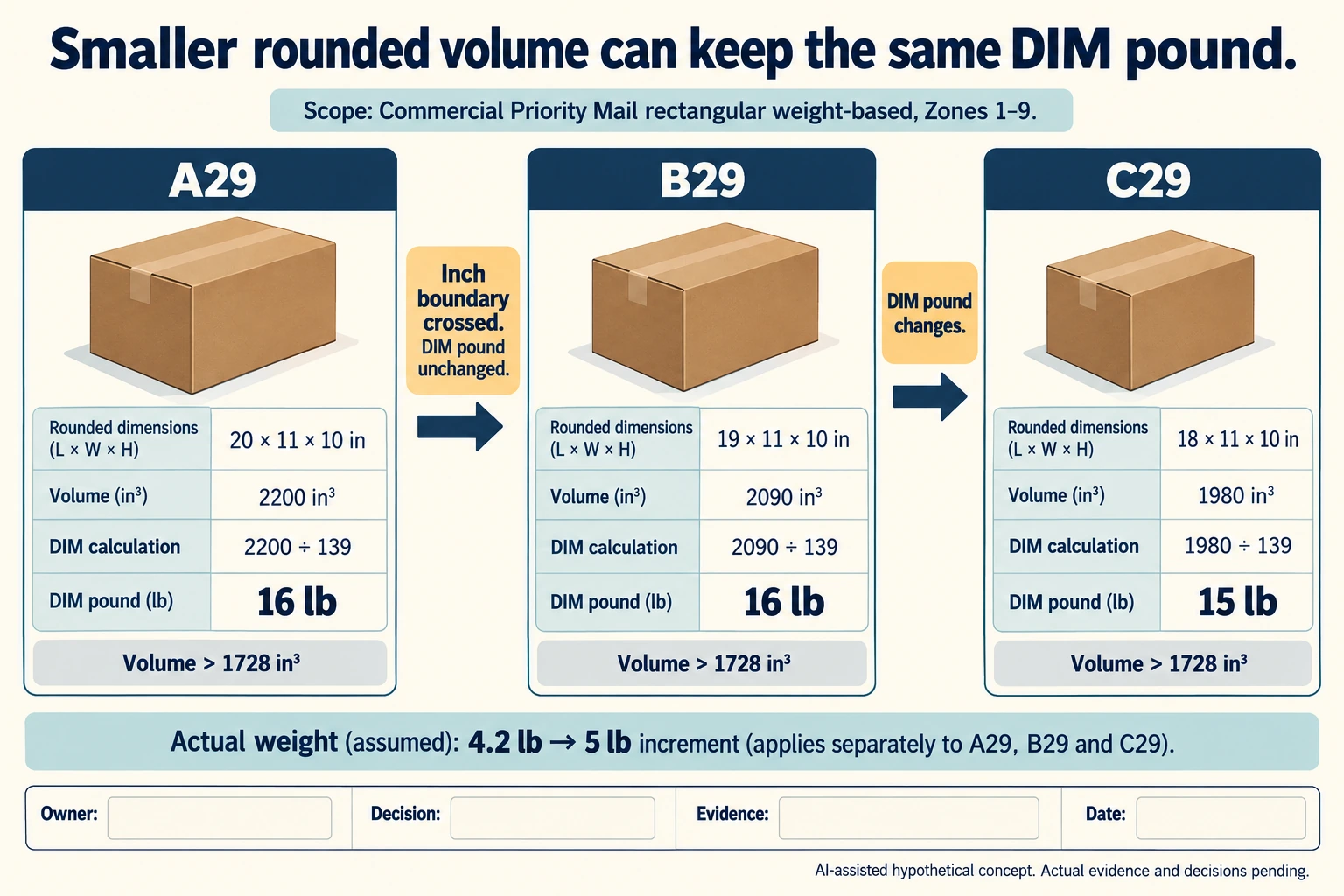
Use three new invented rectangular parcels under the same applicable commercial Priority Mail weight-based, Zones 1–9 scope. A29 measures 19.1×10.1×9.1 inches; B29 changes the first dimension to 19 inches; C29 changes it to 18 inches. Assume 4.2 lb actual packed weight for each. No physical fit or protection has been established for any proposed size.
Scroll horizontally if columns extend beyond the view.
| Hypothetical configuration | Named object | Relationship | Input or next scope |
|---|---|---|---|
| A29 | L | assumed input | 19.1 in |
| A29 | W | assumed input | 10.1 in |
| A29 | H | assumed input | 9.1 in |
| A29 | ROUNDED_VOLUME | calculated from | A29_L_UP*A29_W_UP*A29_H_UP; 2200 in3 |
| A29 | DIM_QUOTIENT | calculated from | A29_VOLUME/139; 15.827338129496402 lb |
| A29 | DIM_INCREMENT | calculated from | ceil(A29_DIM_DIV); 16 lb |
| A29 | POSTAGE_WEIGHT_INCREMENT | calculated from | ceil(A29_ACTUAL_ASSUMED); 5 lb |
| A29 | COMPARISON_WEIGHT | calculated from | max(A29_DIM_UP,A29_ACTUAL_UP); 16 lb |
| B29 | L | assumed input | 19 in |
| B29 | ROUNDED_VOLUME | calculated from | B29_L_UP*B29_W_UP*B29_H_UP; 2090 in3 |
| B29 | DIM_INCREMENT | calculated from | ceil(B29_DIM_DIV); 16 lb |
| C29 | L | assumed input | 18 in |
| C29 | ROUNDED_VOLUME | calculated from | C29_L_UP*C29_W_UP*C29_H_UP; 1980 in3 |
| C29 | DIM_INCREMENT | calculated from | ceil(C29_DIM_DIV); 15 lb |
| RECT29 | A29_TO_B29 | crosses inch boundary but | DIM_INCREMENT_UNCHANGED16 |
| RECT29 | B29_TO_C29 | changes | DIM_INCREMENT16_TO15 |
| SOURCE29 | DMM2231_4_3_VS_PB22705 | unresolved | NEAREST166_VS_UPWARD139_EFFECTIVE12JULY2026 |
| RECT29 | MATHEMATICAL_TARGET | assumed input | 15 lb |
| RECT29 | SOURCE_RULE_DIVISOR | source reference | 139 in3/lb |
| RECT29 | UPPER_VOLUME_FOR_DIM_AT_MOST15 | calculated from | TARGET_DIM_INCREMENT*RECT_DIVISOR; 2085 in3 |
| RECT29 | ROUNDED_VOLUME_EXCESS_OVER_TARGET | calculated from | B29_VOLUME-TARGET_MAX_ROUNDED_VOLUME; 5 in3 |
After upward whole-inch rounding, A29 is 20×11×10=2,200 in³. Its 2,200÷139≈15.8273 becomes 16 DIM lb. B29 is 19×11×10=2,090 in³; 2,090÷139≈15.0360 also becomes 16 DIM lb. Thus A-to-B crosses an inch boundary and reduces rounded volume, but not the final DIM pound. C29 gives 18×11×10=1,980 in³; 1,980÷139≈14.2446 becomes 15 DIM lb. All three exceed 1,728 in³; actual 4.2 lb becomes a separate 5 lb postage increment, lower than each DIM result.
Work backward from a proposed comparison increment as well as forward from dimensions. For an active rectangular DIM result no greater than 15 lb under this 139 divisor, rounded volume must be no greater than 15 × 139 = 2,085 in³, while still being above the separate 1,728 in³ trigger for this branch. B29’s 2,090 in³ is 5 in³ beyond that mathematical boundary, which explains why its reduction from A29 still leaves 16 DIM lb. This is not a five-cubic-inch physical trimming instruction: rounded dimensions change discretely, and the finished package needs its own fit and protection review. The inverse check identifies which calculation boundary an authentic redesign would have to cross; it supplies neither a target carton specification nor postage savings.
Dated source caution, 17 October 2026: the displayed DMM 223 §1.4.3 nonrectangular text uses nearest-inch rounding, 0.785 and 166, whereas Postal Bulletin 22705’s revision effective 12 July 2026 specifies upward-inch rounding and 139 for the relevant nonrectangular provision. The official texts conflict here and this check has not resolved that conflict. This added example remains rectangular and does not borrow either nonrectangular method. Keep the original correct rectangular example and sequence; obtain the responsible shipping owner’s current interpretation before using a nonrectangular calculation.
Download the USPS rectangular DIM rounding final pound boundary comparison record (.csv). It includes the original table fields and scenarios alongside the added relationships. HYPOTHETICAL rows are editorial examples or required review scopes, not actual records. Actual quantity, configuration, component and file identities, materials, process, specification, copy, method, condition, observation, owner, decision, evidence and dates are blank. ACTUAL_BLANK is a separate empty starting row; enter permitted project evidence before using an actual record. A blank means unknown.
Use the Packaging Freight Quotes: Carton Data to Prepare for its separate question.
Additional official reference: USPS Postal Bulletin 22705 revision. 12 July 2026 is the stated revision effective date. The conflict with displayed nonrectangular DMM text remains unresolved.
Source scope checked 17 October 2026: USPS DMM 223/604 support the limited rectangular sequence. Displayed nonrectangular 223 section 1.4.3 and Postal Bulletin 22705’s revision effective 12 July 2026 conflict; the discrepancy was not resolved. That effective date is not assumed to be the bulletin publication date. No actual postage, fit, protection or acceptance is established. The added configurations and calculations are hypothetical, with actual evidence and decisions pending.
Discuss this packaging specification with Packrivo. We coordinate independent suppliers. MOQ: 500 pieces per product/design; illustrative quantities are not production offers. Confirm materials, samples, price and timing for your project.