
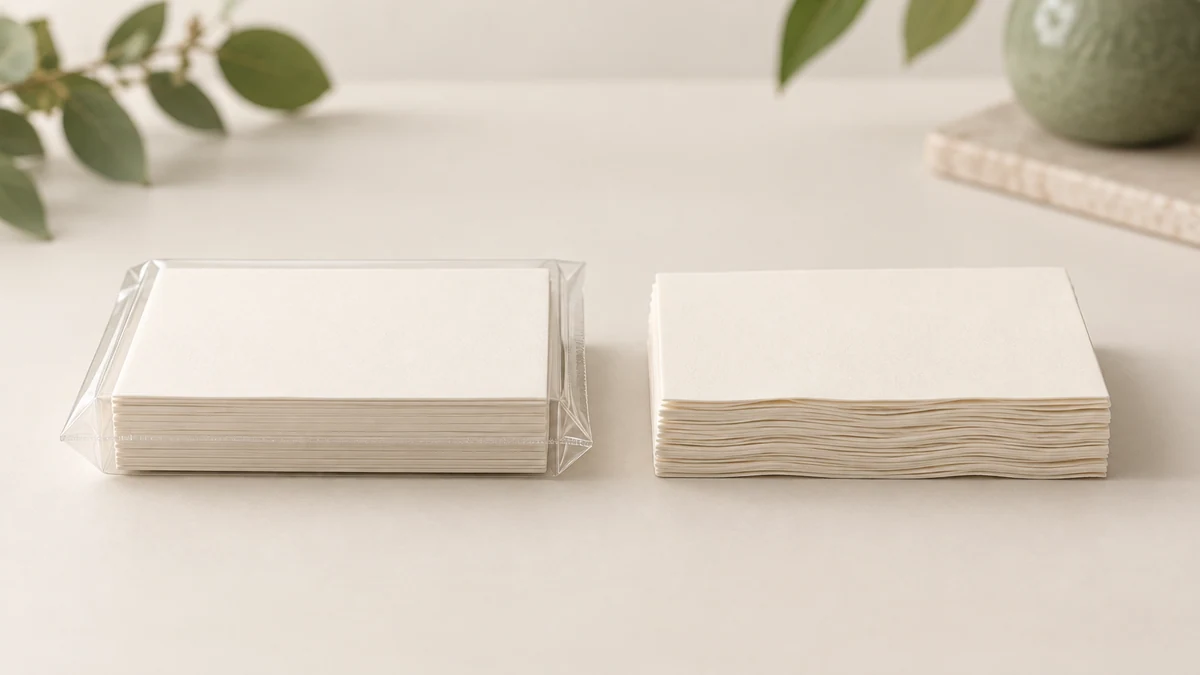
A stack of wavy care cards or a curling paperboard insert does not automatically mean the dieline is wrong. Paper can change shape when moisture enters or leaves different parts of the material unevenly.
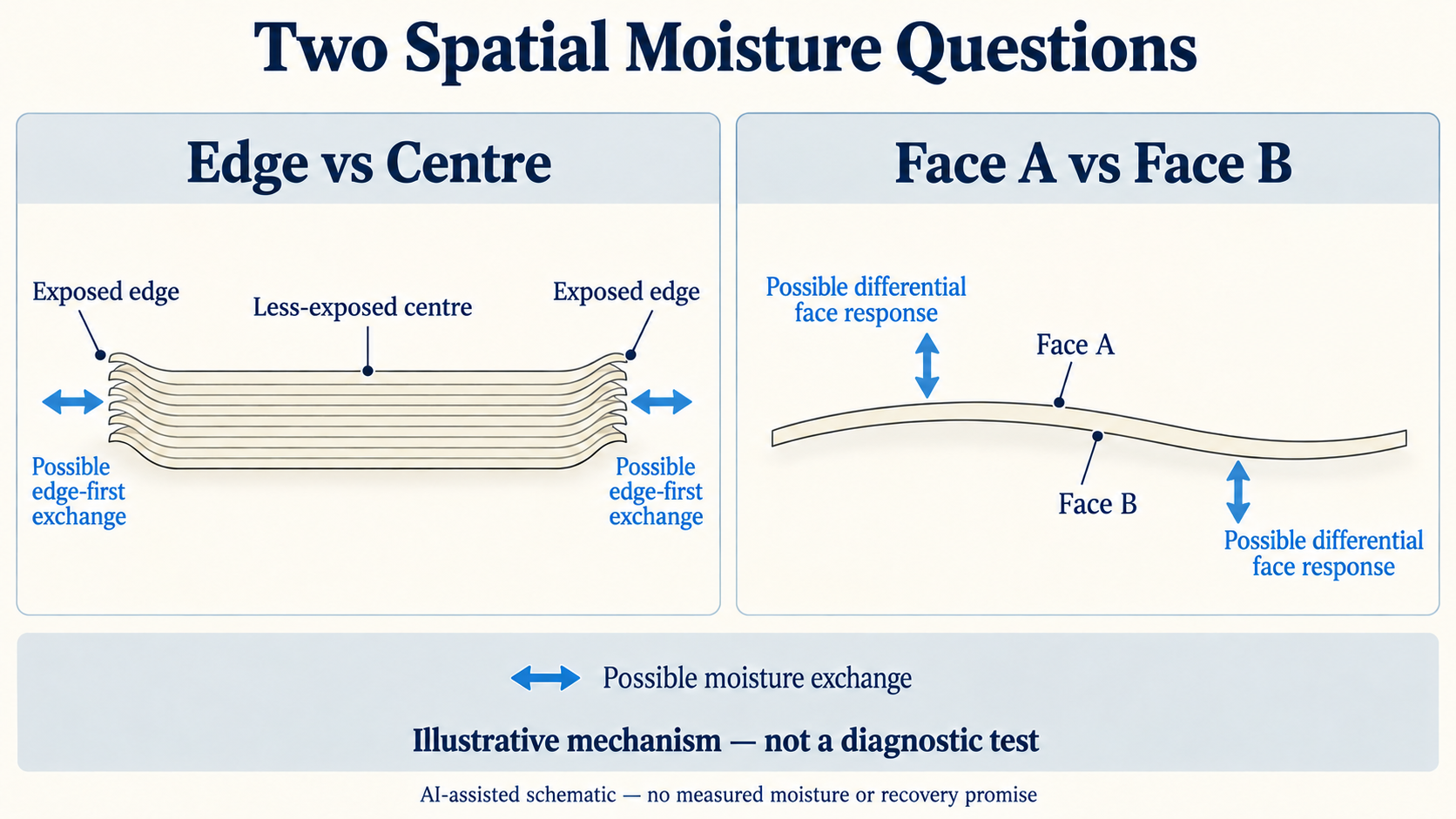
Before changing cut dimensions, distinguish three possibilities: moisture exchange at the exposed edges of a stack, different moisture responses across the two faces of a sheet, and deformation that may be associated with the material construction or physical damage.
These are different technical questions. A photograph of a curled sheet, or one dimension taken while it is distorted, cannot establish a permanent tooling fault.
Exposed edges can change before the centre of a stack
Paper is hygroscopic: it absorbs or releases moisture as it responds to its surrounding environment. This response varies with paper grade and exposure history.
Sappi’s Climate and Paper technical brochure distinguishes two important patterns in stacks of printing paper.
When exposed edges take up moisture and expand relative to the less-exposed centre, the edges can become wavy. When the edges lose moisture and contract relative to the centre, a tight-edge condition can develop.
The distinction is not simply between a humid room and a dry room. It concerns the difference between the paper’s existing moisture condition and its surroundings, and how that difference develops across the stack.
For a gift brand receiving flat care cards or paperboard components, the position of the deformation is therefore useful information.
Waves concentrated around exposed edges suggest a different question from deformation distributed evenly across an entire sheet. A stack that appeared flat while protected but changed after opening also has a different history from one that arrived visibly distorted in intact packaging.
Neither observation measures moisture content or proves the cause.
Sappi’s Paper Conditioning & Characteristics further explains that paper generally expands and contracts more across the grain than along it. The grain relationship can influence the visible distortion, but knowing the grain direction alone does not establish whether a sheet was cut incorrectly.
Curl across a sheet can involve its two faces
A sheet that curves upward or downward presents a different pattern from wavy edges around a stack.
In a simplified moisture-imbalance mechanism, one face of a sheet absorbs more moisture than the other. Differential expansion can make the sheet bend. Sappi’s Climate and Paper brochure describes one-sided moistening that can cause curling toward the drier side.
That explanation provides a useful physical model, not a reliable way to diagnose every finished packaging component from its curl direction.
A printed care card may have different coverage on each face. A sleeve may have a coating on one side. Paperboard used in a rigid gift box may be combined with a decorative wrap, adhesive or laminate.
Those constructions can change moisture movement, introduce other stresses or restrict how the material deforms.
Sappi’s separate Paper & Aqueous Coat Performance / Sheet Curl & Distortion discusses how substrate absorption, coating application and drying conditions interact in a specific printing process.
The buyer should therefore identify the actual two-face construction before treating curl direction as evidence of a particular cause.
Moisture imbalance may contribute to deformation, but so may uneven material structure, converting stresses or physical damage. A crushed corner, permanently creased panel or distorted bonded construction requires separate consideration.
Even if moisture conditions later become more balanced, a finished component is not guaranteed to return to its original shape.
A protected care-card sample can make the comparison more meaningful
Consider a hypothetical jewellery gift brand receiving a stack of printed care cards.
The stack appears flat when first observed through intact protective wrapping. The cards are then opened in a different room, and wavy exposed edges become noticeable.
This is an invented teaching example, not a measured customer incident. No temperature, relative humidity or paper-moisture readings are available.
The observation supports a moisture-history question: could the exposed edges have exchanged moisture with the new surroundings differently from the interior of the stack?
It does not confirm that humidity caused the waves, and it does not show that the cutting outline has changed.
Suppose the brand has a separately retained, still-protected sample of the same card revision.
That protected sample gives the reviewer a potentially useful comparison, provided its paper grade, print, finish and known history are sufficiently comparable.
The responsible reviewer should first agree the observation state. If the protected sample must be opened, the opening and comparison conditions should be documented because opening it changes its exposure.
Compare the location and character of the deformation. Are the exposed edges wavy while the central areas remain relatively flat? Does an individual card show a broader curve between its two faces? Was either sample already damaged or formed?
If the previously exposed stack is wavy while the protected comparison remains flat, the difference is consistent with an exposure-related mechanism. It is not proof that moisture was the sole cause.
If both show similar deformation, the buyer still needs to consider their common material, construction and earlier history.
Neither result establishes that the cards will flatten again. A useful comparison narrows the next technical question; it does not promise recovery.
Curl and cut geometry need separate reviews
A warped card may appear shorter, narrower or uneven when viewed from above. A raised edge can change the projected outline without necessarily changing the location of the original cut. Moisture exchange can also change the sheet’s actual dimensions within its plane, with the grain relationship affecting its response. Curl is therefore not only a projection question, and a changed dimension does not by itself establish a tooling error.
For that reason, measuring a distorted component without a defined method can mix two different questions:
Is the paper currently flat enough for the intended use? And were its cut features produced at the correct positions?
Changing the dieline to compensate for an unexplained curl risks altering artwork margins, fold positions or component fit without resolving the deformation mechanism.
A technical comparison should establish the actual material revision, relevant cut features, reference points and suitable preparation state before judging geometry. The converter should define an appropriate measurement approach that does not conceal or introduce damage.
If the intended cut features show a reproducible positional mismatch under an agreed comparable review, the tooling or dieline deserves examination.
If the only observation is waviness after exposure, that evidence is insufficient to justify a dieline change.
For packaging that is already folded, wrapped or glued, the reviewer must also separate sheet distortion from the effects of forming and bonding. A warped rigid-box lid is not necessarily governed by the same simple mechanism as an uncoated loose care card.
Material construction and moisture history should guide the next supplier question
The useful next question is not simply, "Can you make the card flatter?"
For the hypothetical care-card batch, a more specific request would describe the protected and exposed observations, identify the card revision, and ask the paper or converting supplier which material characteristics and comparison conditions are relevant.
The response should clarify whether edge moisture exchange, two-face construction, grain direction, coating or an existing physical set needs assessment.
There is no justified universal humidity percentage or fixed 24-hour conditioning rule for every gift box, sleeve, care card and insert. Sappi’s published pressroom recommendations concern specified printing-stock operations; they are not automatically finished-packaging warehouse specifications.
The broader Packrivo packaging sample review guide can help place this observation within an actual component review. The packaging supplier brief provides a route for communicating the relevant material, construction and unresolved questions.
Packrivo coordinates packaging sourcing and project questions; it does not establish moisture causes through its own laboratory testing.
The practical decision is to preserve the distinction between moisture-related shape changes, construction-related deformation and actual cut-position errors. Make the technical comparison first. Change the dieline only when the appropriate evidence points to a geometry problem.
Source review: 10 October 2026. The publication date of Sappi’s Climate and Paper brochure was not established. The two cited Printer Technical Service tips show copyright 2012 and Version 001; those labels are not a confirmed publication date. Their printing-paper, conditioning and coating explanations do not diagnose a finished packaging component or prescribe warehouse humidity or recovery time.
Do not attribute a changed coating and changed exposure to one cause
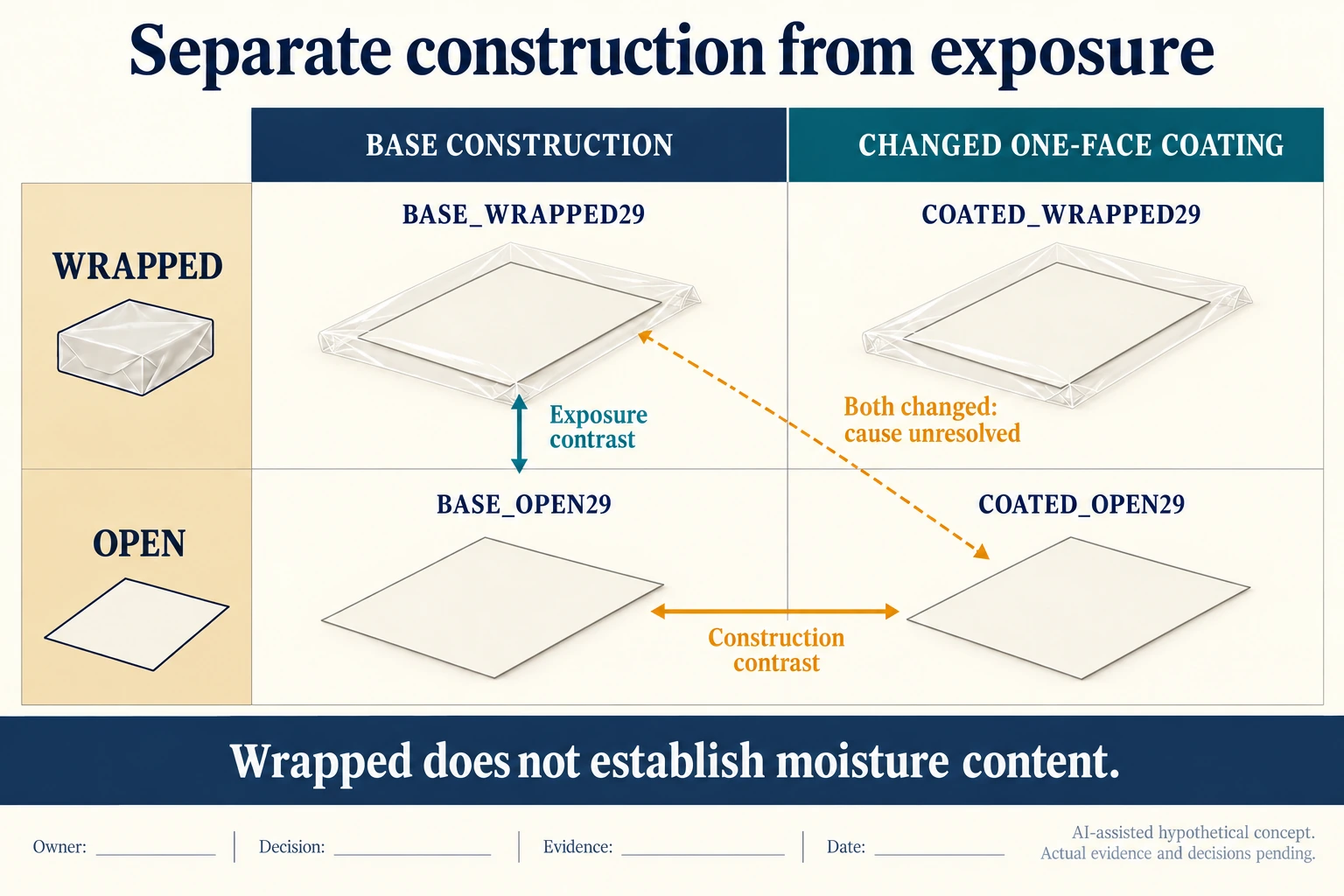
Build four invented history records before assigning a cause. BASE_WRAPPED29 and BASE_OPEN29 share a stated base card construction but differ in wrapped/open exposure state. COATED_WRAPPED29 and COATED_OPEN29 instead use a different one-face coating construction, again with wrapped/open states. These are proposed comparison identities, not actual samples or observed deformation.
Scroll horizontally if columns extend beyond the view.
| Hypothetical configuration | Named object | Relationship | Input or next scope |
|---|---|---|---|
| BASE_WRAPPED29 | BASE_WRAPPED29 | assumed construction | BASE |
| BASE_WRAPPED29 | BASE_WRAPPED29 | assumed exposure state | WRAPPED |
| BASE_OPEN29 | BASE_OPEN29 | assumed construction | BASE |
| BASE_OPEN29 | BASE_OPEN29 | assumed exposure state | OPEN |
| COATED_WRAPPED29 | COATED_WRAPPED29 | assumed construction | CHANGED_ONE_FACE_COATING |
| COATED_WRAPPED29 | COATED_WRAPPED29 | assumed exposure state | WRAPPED |
| COATED_OPEN29 | COATED_OPEN29 | assumed construction | CHANGED_ONE_FACE_COATING |
| COATED_OPEN29 | COATED_OPEN29 | assumed exposure state | OPEN |
| PAPER29 | BASE_WRAPPED29_VS_BASE_OPEN29 | proposed contrast | EXPOSURE_IF_OTHER_HISTORIES_COMPARABLE |
| PAPER29 | BASE_OPEN29_VS_COATED_OPEN29 | proposed contrast | CONSTRUCTION_WITH_OTHER_HISTORIES_REVIEW |
| PAPER29 | BASE_WRAPPED29_VS_COATED_OPEN29 | both changed | NO_SINGLE_CAUSE_ATTRIBUTION |
| PAPER29 | WRAPPED_STATE | does not establish | MOISTURE_CONTENT_OR_EQUAL_PRIOR_HISTORY |
| PAPER29 | PROPOSED_COMPARISON | does not predict | CURL_DIRECTION_CAUSE_RECOVERY_OR_CUT_ERROR |
Comparing base-wrapped with base-open can frame an exposure question if their other histories and review conditions are sufficiently comparable. Comparing base-open with coated-open changes construction, so it frames a different question. Base-wrapped versus coated-open changes both axes; a shape difference between those two alone cannot be attributed to exposure or coating separately. The worksheet makes that double change visible rather than producing a preferred explanation.
The wrapped label does not establish moisture content or equal prior history. Opening a retained sample changes its state, and a coating operation can have its own drying and stress history. Ask the responsible reviewer how to establish a meaningful comparison before opening or conditioning samples. Preserve earlier observations under the actual state in which they were made; no common humidity, duration, heat or flattening treatment is prescribed.
Sappi’s stack-edge moisture gain/loss explanations remain separate from single-sheet two-face imbalance and coating/drying effects. Grain can influence a response without proving a cut error. Even a useful contrast would narrow investigation, not diagnose a sole cause or guarantee recovery. The output is a request naming the construction and exposure variables that need separation before changing a dieline or committing to a corrective process.
Download the paper curl coating exposure comparison confounded cause record (.csv). It includes the original table fields and scenarios alongside the added relationships. HYPOTHETICAL rows are editorial examples or required review scopes, not actual records. Actual quantity, configuration, component and file identities, materials, process, specification, copy, method, condition, observation, owner, decision, evidence and dates are blank. ACTUAL_BLANK is a separate empty starting row; enter permitted project evidence before using an actual record. A blank means unknown.
Use the Packaging Sample Inspection Checklist Before Approval for its separate question.
Source scope checked 17 October 2026: The publication date of Sappi’s Climate and Paper was not established. Two Printer Tech Tips show copyright 2012 and Version 001, not verified publication dates. Printing-stock, conditioning and coating explanations do not diagnose finished packaging or prescribe humidity, drying, recovery or cut compensation. The added configurations and calculations are hypothetical, with actual evidence and decisions pending.
Discuss this packaging specification with Packrivo. We coordinate independent suppliers. MOQ: 500 pieces per product/design; illustrative quantities are not production offers. Confirm materials, samples, price and timing for your project.