

When a loose piece of packaging film follows another sheet during separation, the problem is not necessarily adhesive tack. Contact and separation can leave insulating surfaces electrically charged, allowing electrostatic attraction to influence lightweight pieces even when no adhesive joint was intended.
For a jewellery, candle or gift brand, the first decision is whether the disputed contact actually contains an adhesive interface. If it does not, requesting a stronger or weaker adhesive may address a mechanism that was never present.
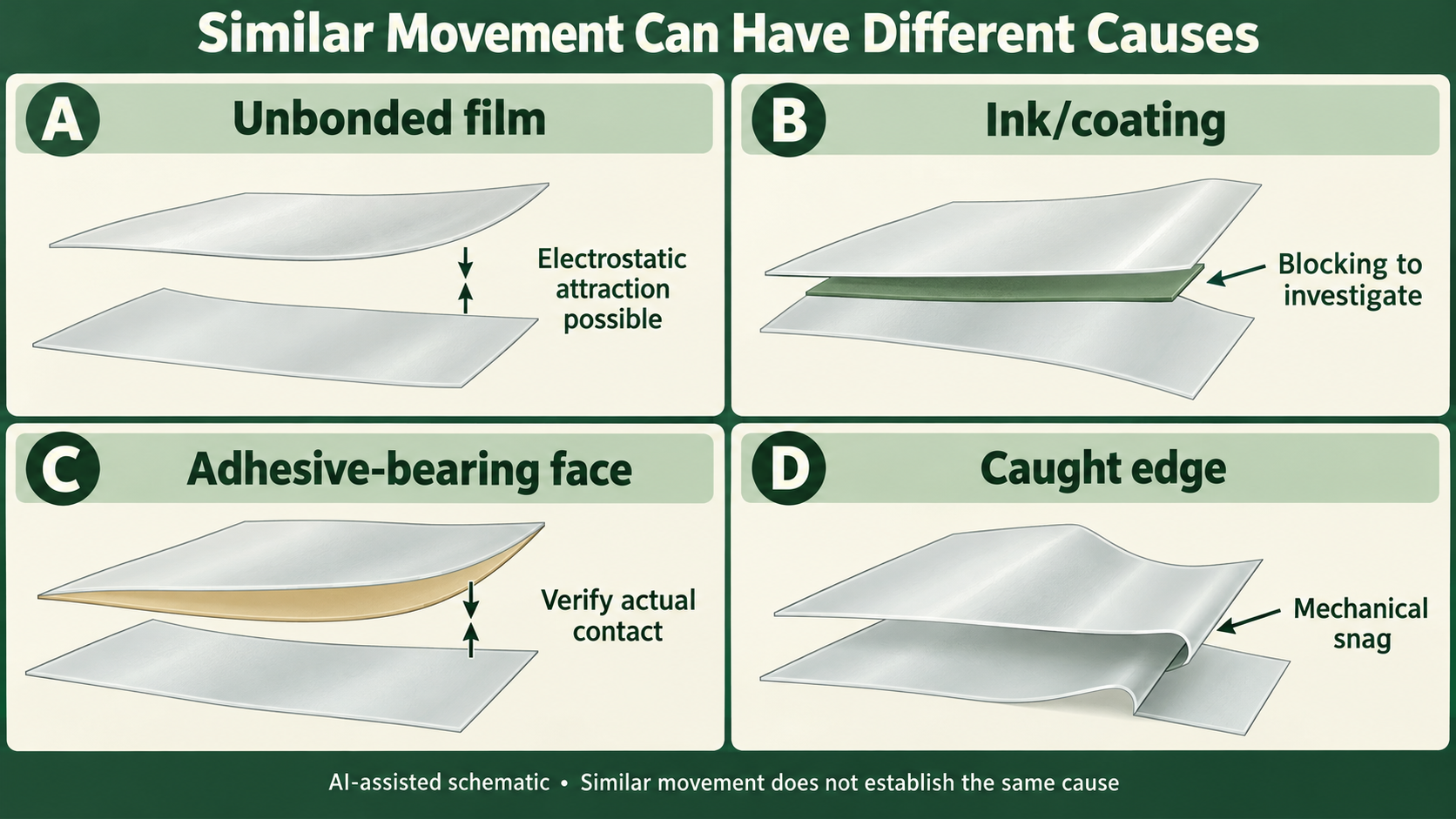
Electrostatic attraction is one plausible explanation. Cling alone does not prove that either sheet is charged, identify a charge polarity or rule out ink/coating blocking, unintended adhesive contact or a mechanical snag.
Electrostatic Attraction Does Not Require an Adhesive Film
Many flexible packaging films are electrical insulators. Charge generated through contact, friction and separation may remain on their surfaces rather than dissipating immediately.
Simco-Ion’s web-handling and converting overview identifies friction and material separation as sources of electrostatic charge. It also describes sheet attraction, sticking and handling difficulties during converting.
A lightweight piece may move toward or remain close to another surface under electrostatic attraction. The force is electrical rather than the result of a deliberately applied pressure-sensitive or curing adhesive.
This distinction is not merely theoretical. Simco-Ion’s separate static-charging explanation describes industrial electrostatic pinning, in which controlled charge is used to hold materials together temporarily.
Controlled industrial pinning and unwanted cling during packaging handling are different situations. The manufacturer’s description demonstrates a possible physical mechanism, not a measured explanation for an unidentified packaging pair.
Nor does attraction establish that the two surfaces carry equal and opposite charges.
A charged surface can attract an initially neutral material through electrical polarization. OpenStax’s University Physics Volume 2, Section 5.2 explains how the charge distribution within a neutral material can shift in response to a nearby charged object.
Therefore, observing two films attract does not justify assigning a positive charge to one and a negative charge to the other.
The actual materials, charge state and competing physical interactions remain unknown until appropriately investigated.
Sticking, Blocking and Snagging Are Different Physical Questions
Several mechanisms can produce a similar complaint: two packaging pieces are difficult to separate, or one follows the other unexpectedly.
Electrostatic attraction involves electrical forces between surfaces. An adhesive coating is not required. The separation and handling history of the actual material pair become relevant, but the movement itself does not confirm charge.
Ink or coating blocking involves adjacent finished surfaces sticking together through an ink or coating film. This can occur in printing and coating operations, particularly where the material has not reached an appropriate setting or drying state for subsequent contact and stacking.
A corresponding printed deposit may suggest ink setoff. Sheets sticking through a coating film can instead raise a blocking question. Absence of a visible coloured deposit does not, by itself, exclude coating-related adhesion.
Adhesive contact involves a specified or unintended adhesive interface. A pressure-sensitive label, exposed tape edge or other adhesive-bearing construction needs its actual contacting faces identified.
If an adhesive is intentionally present, its contact and release behaviour require review. If the drawing specifies no adhesive at the disputed face, the buyer should not assume that changing adhesive tack is the correct response.
Mechanical snagging involves physical interference. A film edge may catch under a fold, overlap or cut feature and travel with the adjacent piece.
That can resemble cling even though the reason is geometric restraint rather than electrostatic attraction.
The important distinction is not how the complaint is casually described. It is whether the parts are being held by an electrical force, a coating or adhesive film, or a physical obstruction.
More than one mechanism may be present.
A Hypothetical Loose Film Liner Follows Another Sheet
Consider an entirely hypothetical gift-packaging project involving a loose, thin protective film liner placed against another flat packaging sheet.
The converter confirms that the disputed contacting faces have no intended adhesive layer or adhesive joint.
During separation, the loose liner follows the neighbouring sheet instead of falling away immediately.
This is an invented observation for explanation only. No actual film was handled, no charge was measured and no separation force was recorded.
Electrostatic attraction is a plausible mechanism. The materials have been in contact and are separating, a situation in which charge generation can occur.
Because the loose liner is lightweight, electrical attraction could be relevant to its movement without forming an adhesive bond.
But the described movement remains insufficient for diagnosis.
It does not establish that charge was generated by the particular materials, that either surface carried a particular polarity, or that electrostatic attraction was the dominant force.
The original construction also needs review for possible coatings, exposed adhesive from an adjacent feature or a cut edge that could catch during separation.
Confirming that no adhesive was specified is not equivalent to proving that every other surface interaction is absent.
Suppose the next proposed liner uses a different film or surface finish. Even if the following motion changes, that observation cannot automatically be attributed to electrostatics. The modified material may also differ in flexibility, coating, surface interaction or handling behaviour.
No effective neutralization treatment, improved material or successful correction is assumed in this example.
The Original Interface Determines the Next Investigation
A useful supplier investigation begins with the particular two faces that were together.
For the hypothetical liner, the buyer needs the film construction and the opposing sheet construction identified, including which surfaces actually meet. The converter should clarify whether those faces carry printing, coating, release treatment or an intended adhesive.
The separation sequence matters as well.
Identify whether the liner follows another sheet as the faces part, whether an edge remains physically engaged, and whether any deposited material, tacky region or surface change is visible.
These observations help route the technical question. They are not substitutes for charge measurement or material analysis.
Where the faces are unbonded and no specific mechanical catch or coating-related explanation has been established, the converter can review whether electrostatic charging during the actual cutting, stacking, handling or separation process warrants further investigation.
If ink or coating blocking is suspected, the relevant printing or coating process becomes the next subject of review.
If an adhesive-bearing face is actually involved, investigate that specified construction. For example, separating a pressure-sensitive label from its backing is a different question, addressed in the label-liner release guide.
If a component catches at an identified physical feature, the investigation should focus on the geometry and movement of that contact. A sliding tray catching an internal seam, for instance, belongs to the separate sleeve seam travel investigation.
The next comparison should retain identifiable material faces and handling conditions. If the material, coating, orientation or separation process changes, identify the changed configuration rather than treating the result as proof of one mechanism.
No universal humidity setting, static-control device or adhesive substitution follows from the original cling observation. Any appropriate technical assessment or proposed process treatment requires the responsible converter or specialist to establish its scope for the actual materials.
Decide Whether an Adhesive Change Is Relevant at All
The practical outcome is a better-directed supplier question.
For two thin packaging pieces with no intended adhesive interface, unexpected following or sticking should not automatically become a request to adjust adhesive strength.
Electrostatic attraction is a credible physical possibility, but not a diagnosis. Ink/coating blocking, actual adhesive contact and mechanical snagging must remain separate explanations until the relevant evidence distinguishes them.
Packrivo can coordinate the packaging construction details, sourcing questions and subsequent sample-review discussion. It does not measure electrostatic charge, certify material performance or guarantee a treatment.
Before changing adhesive, establish whether the pieces were ever supposed to be joined by adhesive. That decision prevents an unbonded film-handling question from being sent down the wrong technical route.
Source and scope note — checked October 10, 2026: Both cited Simco-Ion pages were accessible and do not display a confirmed publication date. They are commercial explanations of industrial static charging and converting applications, not test evidence for the hypothetical liner. OpenStax’s University Physics Volume 2 was originally published October 6, 2016 and supports the general physical explanation of attraction through polarization. No actual sample, surface charge, adhesive interface or neutralization treatment was tested for this article.
Keep the nominal faces separate from a nearby adhesive edge
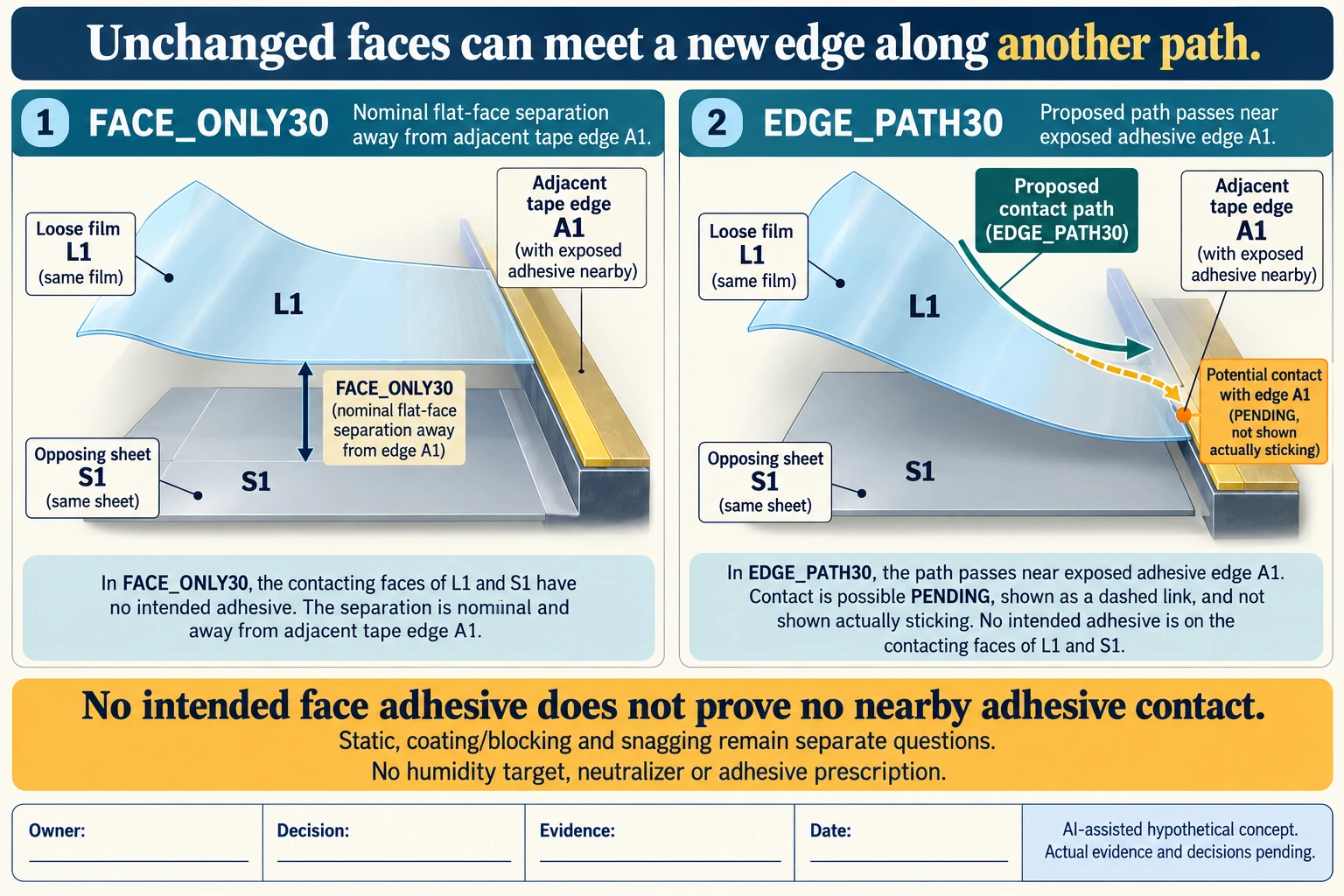
Keep the same invented loose film L1 and opposing sheet S1 in two path records. Their nominal contacting faces have no intended adhesive. FACE_ONLY30 separates those faces away from nearby tape edge A1. EDGE_PATH30 proposes a path passing near an exposed adhesive-bearing edge A1. Whether L1 actually touches it is unknown; no sticking result is drawn or recorded.
Scroll horizontally if columns extend beyond the view.
| Hypothetical configuration | Named object | Relationship | Input or next scope |
|---|---|---|---|
| FACE_ONLY30 | L1 | nominal unbonded face with | S1 |
| FACE_ONLY30 | L1 | proposed path | AWAY_FROM_ADJACENT_A1 |
| FACE_ONLY30 | L1_S1_CONTACTING_FACES | assumed | NO_INTENDED_ADHESIVE |
| EDGE_PATH30 | L1 | nominal unbonded face with | S1 |
| EDGE_PATH30 | L1 | proposed path | NEAR_EXPOSED_A1_CONTACT_UNKNOWN |
| EDGE_PATH30 | L1_S1_CONTACTING_FACES | assumed | NO_INTENDED_ADHESIVE |
| EDGE_PATH30 | A1 | is | ADJACENT_ADHESIVE_BEARING_EDGE |
| EDGE_PATH30 | L1_A1_CONTACT | remains | UNKNOWN_NOT_SHOWN_STICKING |
| CONTACT30 | NO_DESIGNED_L1_S1_ADHESIVE | does not prove | NO_ADJACENT_ADHESIVE_ENCOUNTER |
| CONTACT30 | FOLLOWING_MOTION | does not assign | STATIC_POLARITY_OR_EXCLUDE_BLOCKING_SNAGGING |
The absence of a designed adhesive joint between L1 and S1 does not establish that every possible travel path avoids other adhesive-bearing features. An actual contact at A1 would concern a different interface from the unbonded flat faces. Ask for the located path and component construction rather than changing an unspecified adhesive on the nominal face.
If no A1 contact is established, the observation still does not prove electrostatics. Coating interaction, mechanical engagement and electrical attraction remain different questions. The purpose of the path map is to state which interface an offered explanation concerns, not to identify charge from appearance. An intended-face drawing alone cannot settle an undocumented edge encounter.
Preserve available handling evidence without rubbing, charging, heating or treating a sample to manufacture an explanation. A changed path may also change overlap or restraint, so a difference after revision is not automatically an electrical diagnosis. The converter or relevant specialist must define any actual investigation. Industrial pinning demonstrates a possible mechanism, not the cause of this hypothetical pair or a suitable treatment.
Download the loose film contact path adjacent adhesive edge record (.csv). It includes the original table fields and scenarios alongside the added relationships. HYPOTHETICAL rows are editorial examples or required review scopes, not actual records. Actual quantity, configuration, component and file identities, materials, process, specification, copy, method, condition, observation, owner, decision, evidence and dates are blank. ACTUAL_BLANK is a separate empty starting row; enter permitted project evidence before using an actual record. A blank means unknown.
Use the Label Liner Release vs Adhesion: Review Both Interfaces for its separate question.
Source scope checked 17 October 2026: Simco-Ion industrial charging/converting explanations and OpenStax polarization support possible attraction without an adhesive film or opposite net charges on both pieces. They do not diagnose cling, prove permanent adhesion or prescribe humidity, meters, neutralizers or adhesive changes. The added configurations and calculations are hypothetical, with actual evidence and decisions pending.
Discuss this packaging specification with Packrivo. We coordinate independent suppliers. MOQ: 500 pieces per product/design; illustrative quantities are not production offers. Confirm materials, samples, price and timing for your project.