
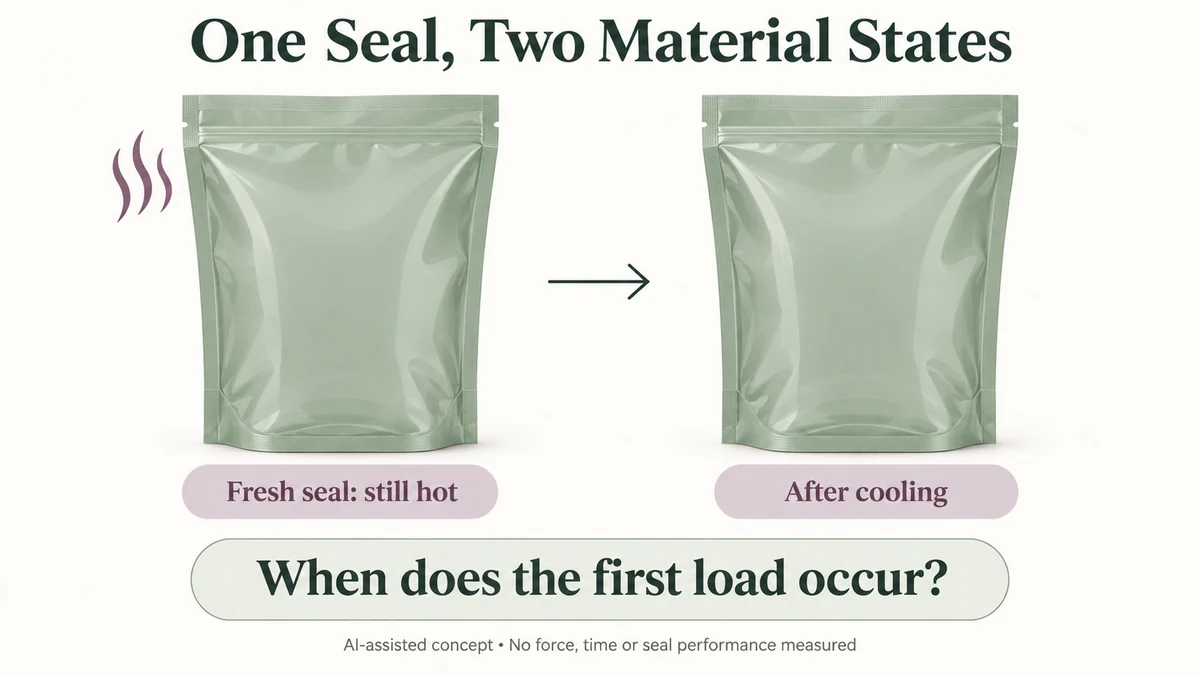
A cooled seal-strength result does not establish how a thermoplastic pouch seam behaves just after the sealing jaws release. If the proposed process loads that seam before it has substantially cooled, the buyer needs evidence for that early state as well as for later handling.
Use Pouch Seal Strength and Leak-Tightness Evidence for the separate distinction between mechanical separation and a through-leak path. Keep hot-stage loading, cooled seal force and leak evidence as different questions for the actual sealing process.
The distinction is between hot tack, the resistance of a newly formed seal while it remains hot, and resistance measured after cooling. It is not a choice between a good seal and a bad seal. The same proposed construction can face different demands at different stages, and a result for one stage does not automatically cover another.
This article concerns confirmed thermoplastic heat-sealable surfaces in flexible packaging. A decorative pouch, film or coated paper cannot be assumed to have that construction from its appearance. A hot-melt adhesive joint in a carton is a different system.
The Seal May Be Loaded Before Its Material State Has Settled
Heat sealing brings suitable sealing surfaces together under a controlled thermal and contact history. When the jaws separate, the interface does not instantly become equivalent to a specimen examined later at a cooled condition.
The surface layers and the joined region may still be hot. Their response to a separating force can differ from their later response. The particular materials, construction and process determine that difference; elapsed time alone does not supply a universal strength prediction.
The public scope of ASTM F1921/F1921M-12(2023) identifies hot-strength assessment for thermoplastic sealing surfaces of flexible webs. Its explanation notes that freshly sealed areas can encounter disruptive forces during forming and filling while still hot. That makes the first loading event a separate technical question, rather than something a cooled result can silently answer.
An instrument manufacturer’s hot-tack explanation likewise distinguishes evaluating a hot seal from evaluating it after cooling. The distinction is useful here; its equipment settings, application claims and accuracy specifications are not requirements for a gift brand’s proposed pouch.
Neither public description supplies a passing result for an actual package. The applicable method and acceptance basis belong with the responsible converter or technical evaluator.
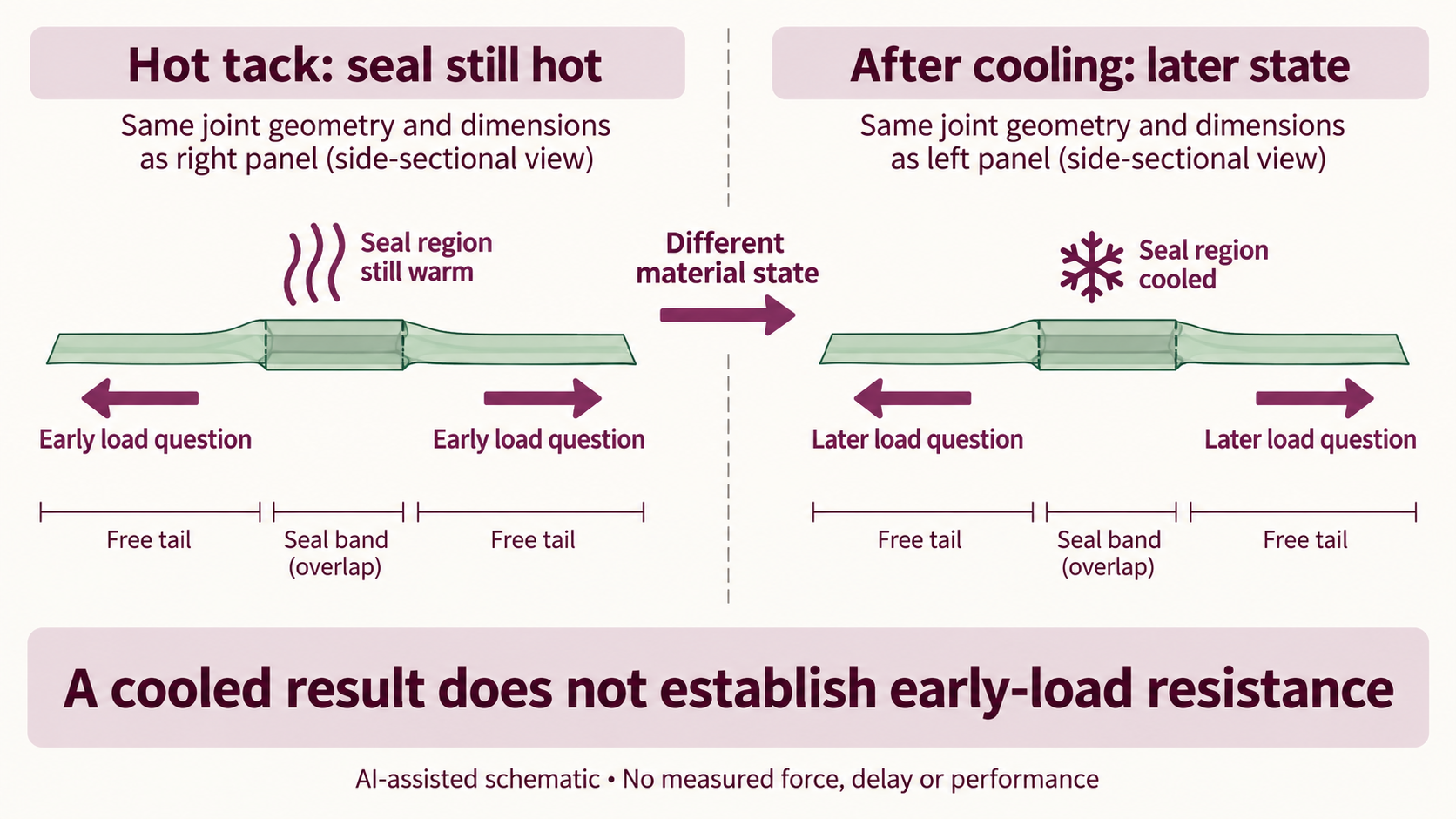
Locate the First Force on the Proposed Seam
For a hypothetical inner pouch, the important event might be contents entering a newly formed package, a subsequent movement of the web, or transfer to another handling stage. Those are different possible loading arrangements, not operations verified for Packrivo.
Identify what would tend to separate the seam and when that event occurs relative to sealing. A pouch supported beneath its contents does not necessarily place the same demand on the fresh seam as a pouch whose seam participates in supporting a load. Direction and support matter alongside the material state.
The useful comparison is therefore between the state covered by the available evidence and the state at the actual loading event. A report headed “seal strength” without a clear conditioning or timing basis leaves that comparison unresolved.
No universal delay follows from calling a seal hot or cooled. A supplier needs to explain the relevant construction and evaluation basis, rather than selecting a cooling time from an unrelated material or instrument advertisement.
A Hypothetical Early-Load Proposal Exposes the Missing Evidence
Imagine a gift brand comparing two proposals for a thermoplastic inner pouch. In one proposed route, the newly made seam encounters a separating load soon after the jaws release. In the other, the relevant handling load occurs at a later, cooled stage.
Suppose the supplier can describe similar cooled seal resistance for both candidates. This is a conditional example, not two measured materials or an actual supplier report.
That comparison could inform the later handling question if the reported construction and loading basis match the application. It does not rank the two candidates at the early event. Their hot-state responses remain unknown.
The brand should not interpret the missing early result as a failure. It should also not mark that requirement as satisfied. The unresolved part is specific: what evidence describes the proposed sealing surfaces at the state and loading arrangement where the seam first needs to resist separation?
Changing the process so that the seam is supported or loaded at another stage may change the question. That is a proposal for technical consideration, not a guarantee that any particular delay or support arrangement solves the problem.
Keep the Material and Loading Basis Attached to Each Result
A hot-tack result and a cooled result can be useful together when each identifies the sealing construction and conditions it actually represents. They should retain their separate meanings.
Different sealant layers, substrates or laminates cannot be treated as interchangeable merely because the packages look similar. The formed interface, its thermal history and its subsequent loading can differ.
Nor should the buyer assume that every seal becomes steadily stronger as it cools. A simple rising curve drawn without relevant material data would invent a relationship that has not been established. A material’s quoted melting point also cannot determine suitable sealing temperature, contact time or cooling conditions by itself.
For comparison, ask the technical party to distinguish the early-state evidence from the later-state evidence and explain whether both relate to the proposed construction. If only one state has been evaluated, keep the other requirement open.
Resistance to Separation Is Not Proof of Pouch Integrity
A strength result describes resistance within its declared evaluation. It does not independently establish the absence of channels, leakage or transmission through the pouch wall. A strong specimen also does not validate every seam around a complete package.
The same boundary applies in the other direction: an observation that a pouch appears closed does not establish its resistance to early loading.
For adhesive carton seams, the hot-melt fracture-location guide addresses a different interface and observation. Do not rename that adhesive analysis as thermoplastic hot-tack evidence. The distribution-test scope guide can help keep specimen results separate from the complete package and its intended handling.
Packrivo can coordinate the proposed construction and sourcing questions. It does not claim a sealing line, testing capability or approved hot-tack performance. Technical parties must determine the actual process, evidence and acceptance requirements.
The first useful decision is when the proposed seam must carry its first relevant load. A cooled result covers that event only if its stated basis genuinely represents the required state.
Source scope: Public information checked 11 October 2026. ASTM’s official indexed catalogue lists F1921/F1921M-12(2023) as active, updated 5 April 2023; the generic catalogue endpoint timed out in this production session. Public scope information was available, but the complete paid procedure was not obtained. Torontech’s undated manufacturer page was accessible and used only for the hot-versus-cooled distinction. No process settings, force threshold, cooling time, measured package or compliance result is established.
Map the first-load event without inventing a cooling time
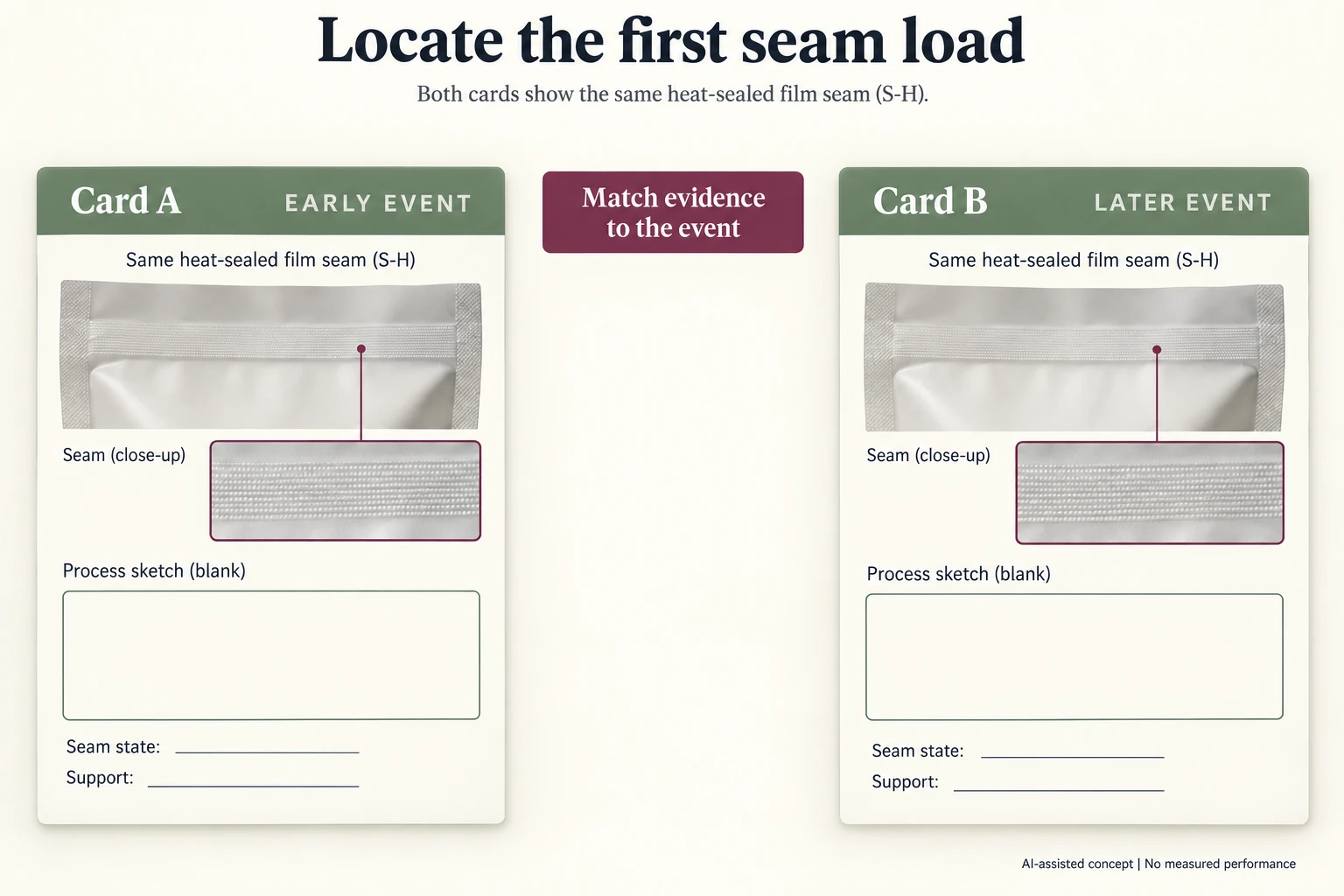
Use an event map to decide whether a cooled document addresses the proposed process. The two rows below describe invented routes for one confirmed thermoplastic sealing construction S-H, not a Packrivo production line.
Scroll horizontally if columns extend beyond the view.
| Route | First relevant event | Evidence request |
|---|---|---|
| R-E | Proposed separating demand after jaw release, before cooled state is established | Identify early seam state, direction, support and matching evidence |
| R-L | Proposed handling event at a separately identified later state | Identify later condition and matching evidence |
| R-E revised | Technical party proposes altered support or event sequence | New route reference; effectiveness remains unestablished |
Keep process order and elapsed time in separate fields. Knowing that an event follows jaw release does not provide its delay, temperature or seam response. Those values stay empty until the responsible technical party supplies the applicable evidence.
A support proposal can change what load reaches the seam. It therefore creates a revised route rather than retroactively validating R-E. Record both the support arrangement and the force direction before comparing material documents.
The map is a document-selection tool, not an operating instruction. It does not specify jaw temperature, contact time, cooling delay, acceptable force or a rising strength curve. Local continuity and complete-pouch protection remain separate requirements.
Download the hot tack versus seal strength record (.csv). HYPOTHETICAL rows are invented examples. Use ACTUAL_BLANK for permitted project inputs; replace that row label only when recording actual facts. Empty evidence, observation and date fields mean unknown or not performed, never acceptance. Keep checkpoints and revisions separate.
Bring the sealing-construction identity and first-load route to the enquiry above so the relevant supplier can identify which state still lacks evidence. Packrivo coordinates independent suppliers. These records establish no supplier offer, service availability or MOQ exception; its published baseline is 500 pieces per product/design.