
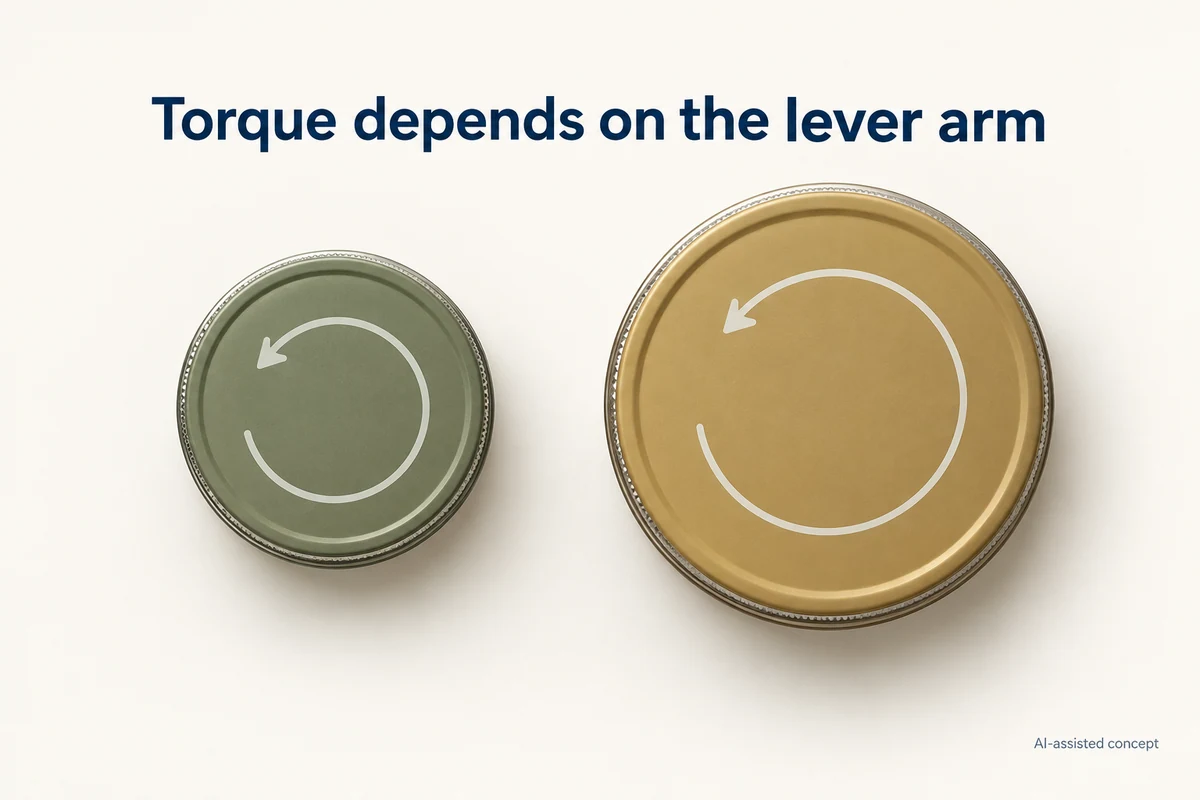
A screw lid's removal torque describes a turning effect. To relate that figure to an ideal tangential force, you also need the distance from the rotation axis to the force's line of action. Real hand effort adds grip, friction and the way the container is supported.
For a candle brand comparing threaded lids, this distinction prevents a torque number from becoming an unsupported claim that a lid is easy to open. It also explains why a straight pull-force observation for a gift-box lid can't answer the screw-lid question.
Torque includes a lever arm
Torque combines force and its effective lever arm about an axis. OpenStax's torque explanation gives the general relation torque = r × F × sin(angle). With a force acting perpendicular to the radius, the relation simplifies to torque = r × F.
The radius is measured from the axis, not across the whole lid. Using diameter in that equation would double the stated lever arm and change the calculated force. A force directed toward the centre also has a different turning effect from a tangential force of the same magnitude.
Torque is expressed in newton metres, N m. A linear force is expressed in newtons, N. Leaving out the metre changes the quantity; it doesn't merely shorten the unit label.
Follow an ideal comparison with two grip radii
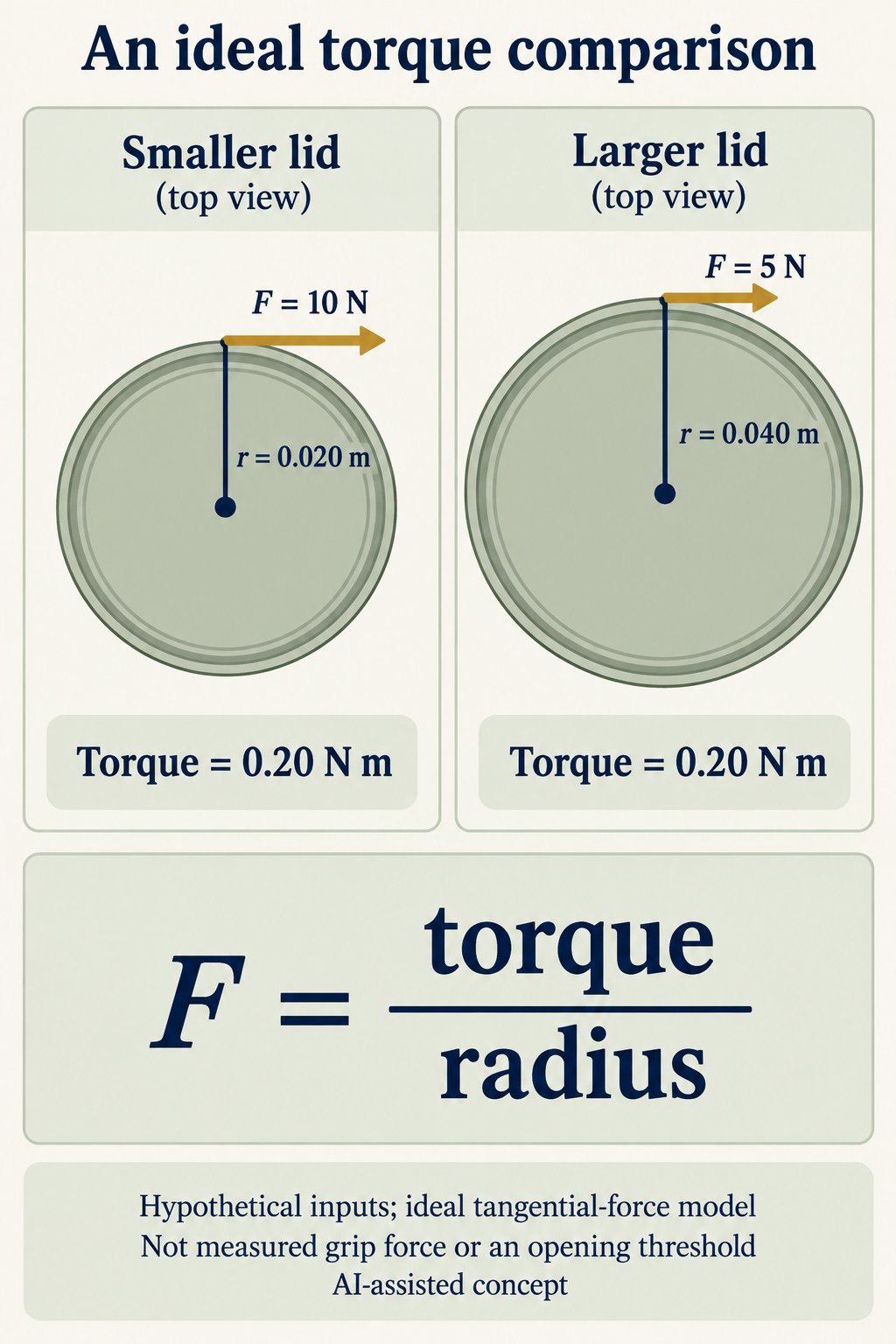
Consider a hypothetical removal torque of 0.20 N m. This is an invented mathematical input, not a measured jar result, a recommended setting or an opening threshold.
For a single equivalent tangential force at an effective radius of 0.020 m, F = 0.20 ÷ 0.020 = 10 N. At a radius of 0.040 m, the corresponding calculation is F = 0.20 ÷ 0.040 = 5 N.
The second radius is twice the first, so the ideal force required to produce the same torque is half as large. The comparison holds the torque fixed and assumes perpendicular force, a fixed axis and no slipping.
That result doesn't mean a person needs a 10 N grip on the smaller lid or a 5 N grip on the larger one. Grip force presses fingers against the surface to maintain contact. The equivalent tangential force describes the turning contribution in this simplified model; these are different quantities.
The arithmetic is useful when reading specifications because it exposes a missing geometric input. It doesn't rank two real lids by accessibility or predict a recipient's experience.
A hand contacts a surface rather than one mathematical point
A person may touch a lid at several places while the other hand restrains the jar. The available grip depends on the lid edge, surface texture, contact area and whether the fingers slip. A decorative band or surrounding gift insert may also restrict access.
Two lids with the same outside diameter can therefore offer different usable contact positions. A smooth recessed edge may not be gripped in the same way as an exposed edge. The outside diameter alone doesn't establish the effective grip arrangement.
Compare those arrangements with the complete contents and presentation layers in place. If the jar rotates along with the lid, the recipient's difficulty includes restraining the container, not just supplying torque to the closure. A calculation about the lid doesn't settle that other action.
Packrivo's accessible gift-packaging guide discusses the whole opening journey. The torque calculation adds a narrower mechanical explanation; it doesn't replace observing intended users and their actual opening actions.
Application torque and later removal torque need separate identities
A supplier's figure may describe tightening during application, removal after storage, or another defined condition. These figures concern different events. Before comparing candidates, establish what each reported value represents and the conditions under which it was obtained.
The public scope of ASTM D2063/D2063M-24 concerns removal torque for matching continuous-thread container and closure systems. Its public description supports identifying the system and measurement condition; the full paid procedure was not reviewed here.
A removal-torque result doesn't demonstrate seal integrity. Nor does a closure-application value establish the effort required to open it later. Avoid substituting either figure for the question the brand needs answered.
Choose the next comparison from the missing input
If the report lacks a defined torque event or condition, resolve that measurement identity first. If the torque is identified but the recipient cannot reach the lid edge, investigate the grip route and surrounding packaging. If the jar moves during opening, include the support action in the comparison.
For a lift-off gift lid, the motion is different again: fingers lift rather than rotate a continuous thread. The lift-off lid grip guide belongs to that action and shouldn't supply a screw-lid effort score.
Bring the identified jar, matching closure and intended opening arrangement into the packaging discussion. A useful comparison keeps the torque quantity, effective geometry and observed hand action distinct, so the design response addresses the actual difficulty.
An angled force has a smaller effective lever arm
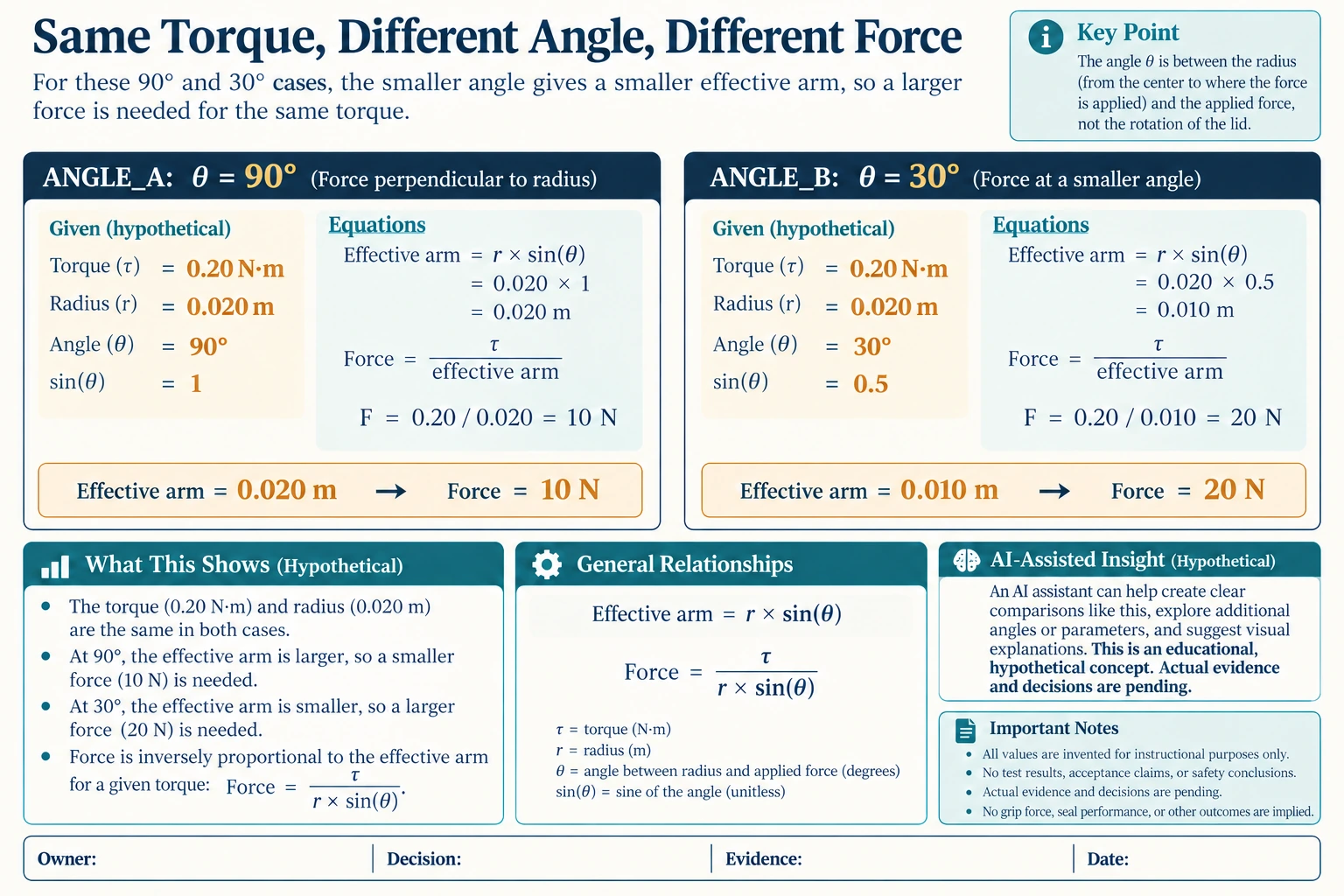
Use a separate idealized calculation with torque 0.20 N·m and radius 0.020 m. ANGLE_A applies a single force perpendicular to the radius: sin 90°=1, so its effective lever arm is 0.020 m and F=0.20÷0.020=10 N. ANGLE_B changes only the mathematical force direction to 30° from the radius. Its effective arm is 0.020×sin 30°=0.010 m, requiring 20 N for the same torque.
Scroll horizontally if columns extend beyond the view.
| Hypothetical configuration | Named object | Relationship | Input or next scope |
|---|---|---|---|
| ANGLE_A | EFFECTIVE_LEVER_ARM | calculated from | ANGLE_A_RADIUS*ANGLE_A_SINE; 0.02 m |
| ANGLE_A | IDEAL_TURNING_FORCE | calculated from | ANGLE_A_TORQUE/ANGLE_A_ARM; 10 N |
| ANGLE_B | EFFECTIVE_LEVER_ARM | calculated from | ANGLE_B_RADIUS*ANGLE_B_SINE; 0.01 m |
| ANGLE_B | IDEAL_TURNING_FORCE | calculated from | ANGLE_B_TORQUE/ANGLE_B_ARM; 20 N |
| ANGLE_COMPARISON | SAME_TORQUE_RADIUS | changes | FORCE_DIRECTION_ONLY |
| ANGLE_COMPARISON | IDEAL_FORCE | not equal to | SQUEEZE_FRICTION_ACCESSIBILITY_SEAL_RESULT |
The unchanged radius is not enough to preserve the turning contribution. Using rF without the angle condition would assign ANGLE_B twice the stated torque. These are equation inputs, not measured lid geometry or a recommended way to grip a container. The figure uses calculation cards rather than a calibrated angle drawing.
Actual opening can involve several contacts, friction, slipping and the other hand restraining the vessel. The ideal turning force is not the squeeze force needed to maintain a grip. A report still needs the closure event, matching components and measurement conditions before it can inform that discussion.
Ask whether an unexplained effort comparison changed the usable radius, force direction or support action before requesting another application torque. The calculation approves neither consumer accessibility nor seal integrity. The public D2063 scope is an instrument-removal-torque context, not a universal hand-force specification.
Download the threaded lid torque force direction effective arm record (.csv). It includes the original table fields and scenarios alongside the added relationships. HYPOTHETICAL rows are editorial examples or required review scopes, not actual records. Actual quantity, configuration, component and file identities, materials, process, specification, copy, method, condition, observation, owner, decision, evidence and dates are blank. ACTUAL_BLANK is a separate empty starting row; enter permitted project evidence before using an actual record. A blank means unknown.
Use the Accessible Gift Packaging for Limited Dexterity for its separate question.
Source scope checked 17 October 2026: OpenStax supports the conditional torque relation. ASTM D2063/D2063M-24 public scope concerns instrument removal torque; catalogue Last Updated is not an established effective date. The paid method, actual grip friction, seal and consumer-opening performance were not established. The added configurations and calculations are hypothetical, with actual evidence and decisions pending.
Discuss this packaging specification with Packrivo. We coordinate independent suppliers. MOQ: 500 pieces per product/design; illustrative quantities are not production offers. Confirm materials, samples, price and timing for your project.