
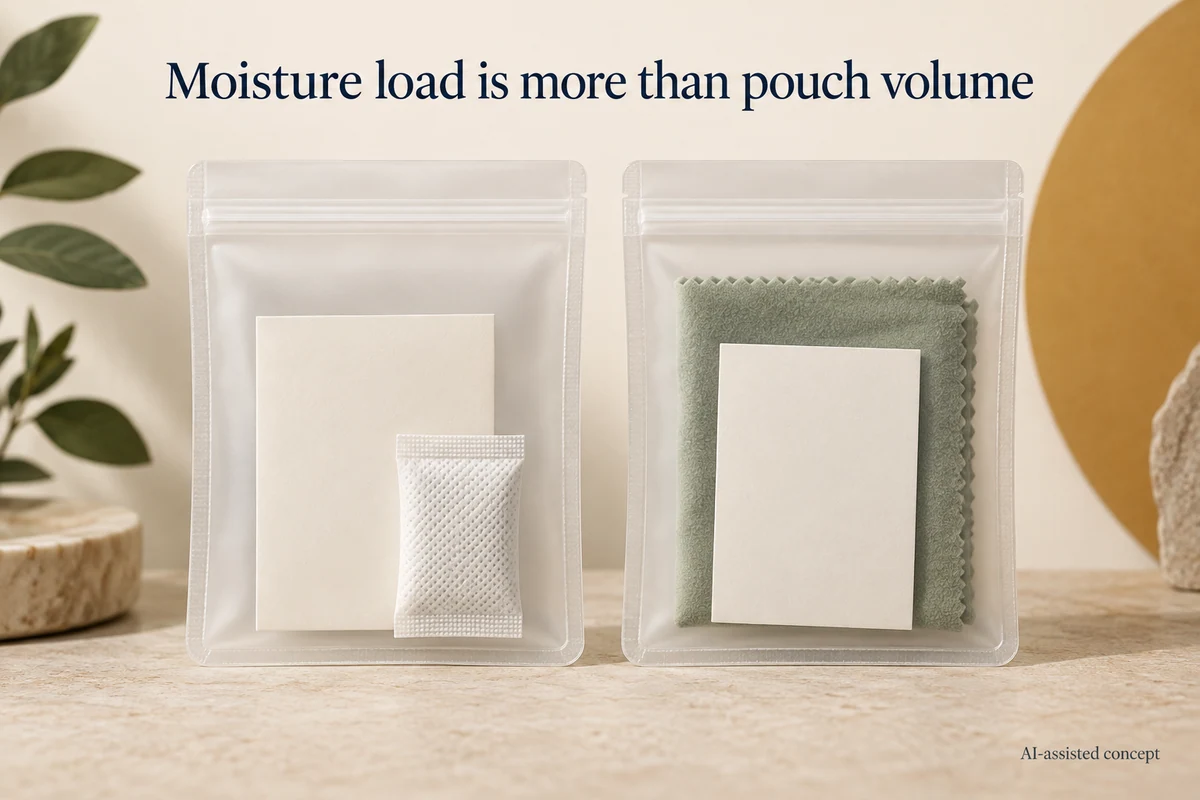
Pouch volume is only one input to a desiccant decision. Moisture already in the enclosed air, moisture exchanged by the contents and inserts, and moisture entering during use can create different demands in packages of the same outer size.
Use Film WVTR and Moisture Paths in a Finished Pouch to identify material transmission and finished-pack entry routes before requesting a desiccant proposal. The actual enclosed materials, initial moisture, intended duration and closure remain inputs to that proposal.
For a jewelry brand considering protective pouches, define the moisture-control job before choosing a packet size. A packet advertised for enclosed packaging doesn't establish the humidity that a particular assembled pouch will maintain.
The initial air isn't the whole moisture inventory
An empty-volume calculation considers the space available for air. A finished presentation adds paper cards, textiles, linings and the product. Some materials exchange moisture with their surroundings, so the air's initial water vapour doesn't describe all the water that may later participate in that exchange.
The Canadian Conservation Institute's Technical Bulletin 33 on silica gel explains equilibrium moisture content and the relationship between sorbent condition, temperature and relative humidity. Its conservation-enclosure context supports the concept, not a dosage formula for jewelry packaging.
A card and liner that look dry may still have a moisture condition worth identifying. Visible droplets are a different observation. Neither a dry-looking card nor an unopened desiccant packet supplies a measurement of the complete package's initial moisture state.
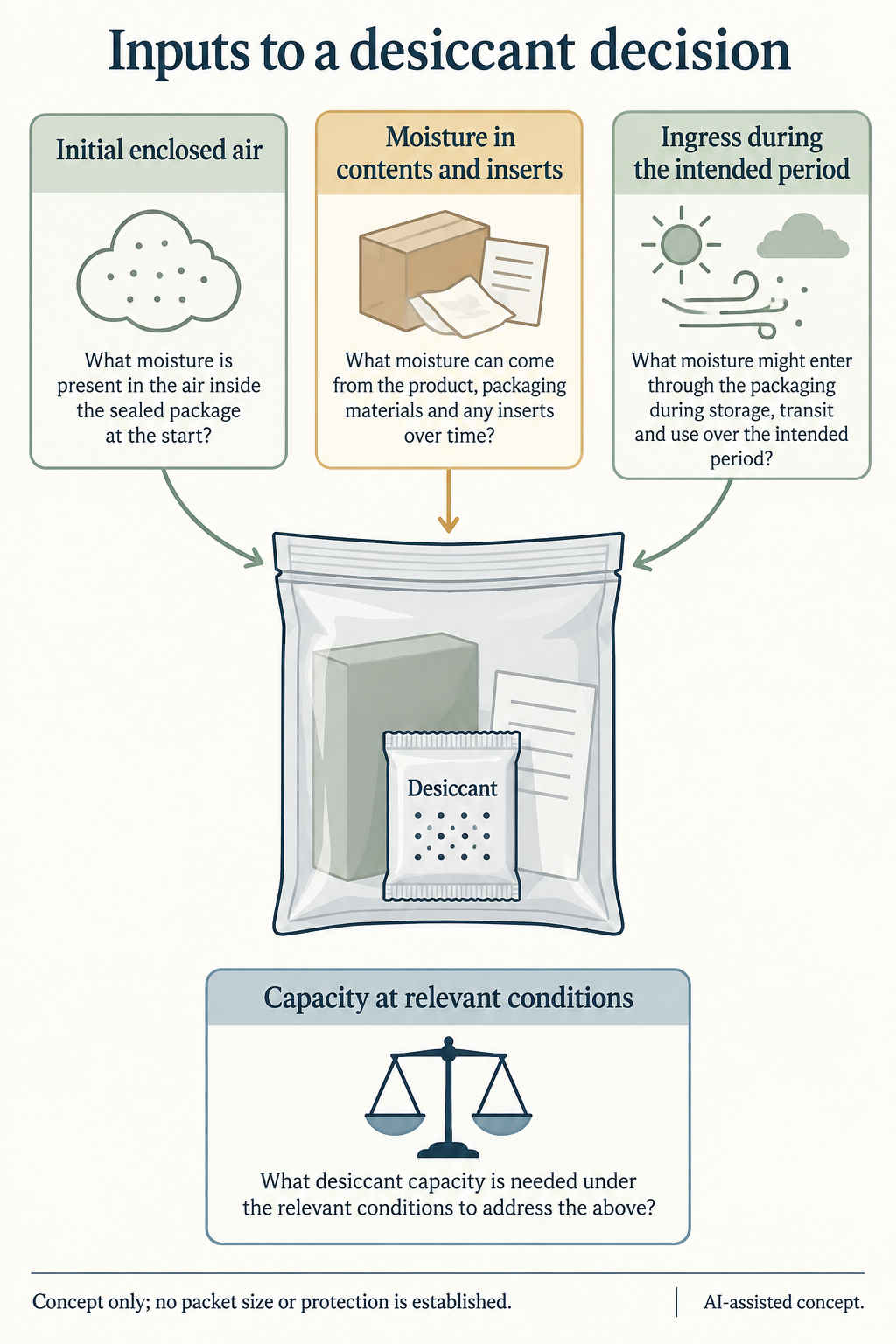
Capacity belongs to relevant conditions
A desiccant interacts with water vapour; its useful response depends on its identity and condition. The relevant material information needs to address the intended temperature and humidity range rather than only a general maximum-capacity claim.
Clariant's public desiccant-packet page, dated 7 July 2026, describes moisture-adsorbing packets for enclosed packages. Its protected technical documents were not accessed here, and its product-specific protection and regulatory claims aren't adopted for a Packrivo proposal.
The practical consequence is that packet mass and useful moisture capacity are different inputs. A nominally larger packet doesn't settle the selection without relevant material information and a defined job. No universal grams-per-litre rule is established by the public descriptions used here.
Ingress creates a demand over time
The packet starts inside a package with a particular construction. The wall material, opening and seams can allow moisture exchange with the surroundings. A longer intended period can therefore introduce a different question from the initial filling condition.
An intact-looking closure isn't evidence that ingress is zero. Likewise, a flat-film barrier result doesn't describe every route through a finished pouch. Those routes affect the demand placed on a moisture sorbent; the sorbent doesn't make them disappear.
The intended function may also include repeated opening. Each use can change the enclosed environment. A proposal meant for unopened storage should not automatically be carried into a reusable retail pouch without addressing that change.
Compare two hypothetical presentations of the same size
Imagine two proposals with the same external pouch dimensions. One holds a jewelry card; the other adds a fabric presentation liner. Both propose a desiccant packet, but neither has measured moisture-control results. This is a teaching comparison, not a supplier trial.
Their matching outside dimensions don't establish equal free-air volume or equal material moisture. The liner also introduces another material whose starting condition and exchange behaviour need consideration. A size-only rule would overlook those differences.
If the second proposal also changes the closure, the comparison now includes a possible ingress change. Keep that separate from the liner change. Otherwise, a later humidity observation could be attributed to the wrong input.
The buyer can use this comparison to decide what information is missing: initial material condition, relevant sorbent behaviour, enclosure exchange or intended use period. It doesn't justify assigning either proposal a packet dose.
Keep moisture control separate from a product-protection claim
Even an identified humidity outcome would need to be related to the actual product concern. A generic moisture packet doesn't establish that a piece of jewelry will remain unchanged, that tarnish will be prevented, or that a storage-life claim is supported.
Use the packaging supplier brief to describe the contents, insert materials, pouch construction and intended period. The sample review guide helps keep the proposed assembly distinct from its actual sample.
The next selection should connect the expected moisture demand with suitable capacity information and relevant finished-package evidence. Empty pouch volume alone cannot complete that comparison.
Build an unknown-input map before discussing packet mass
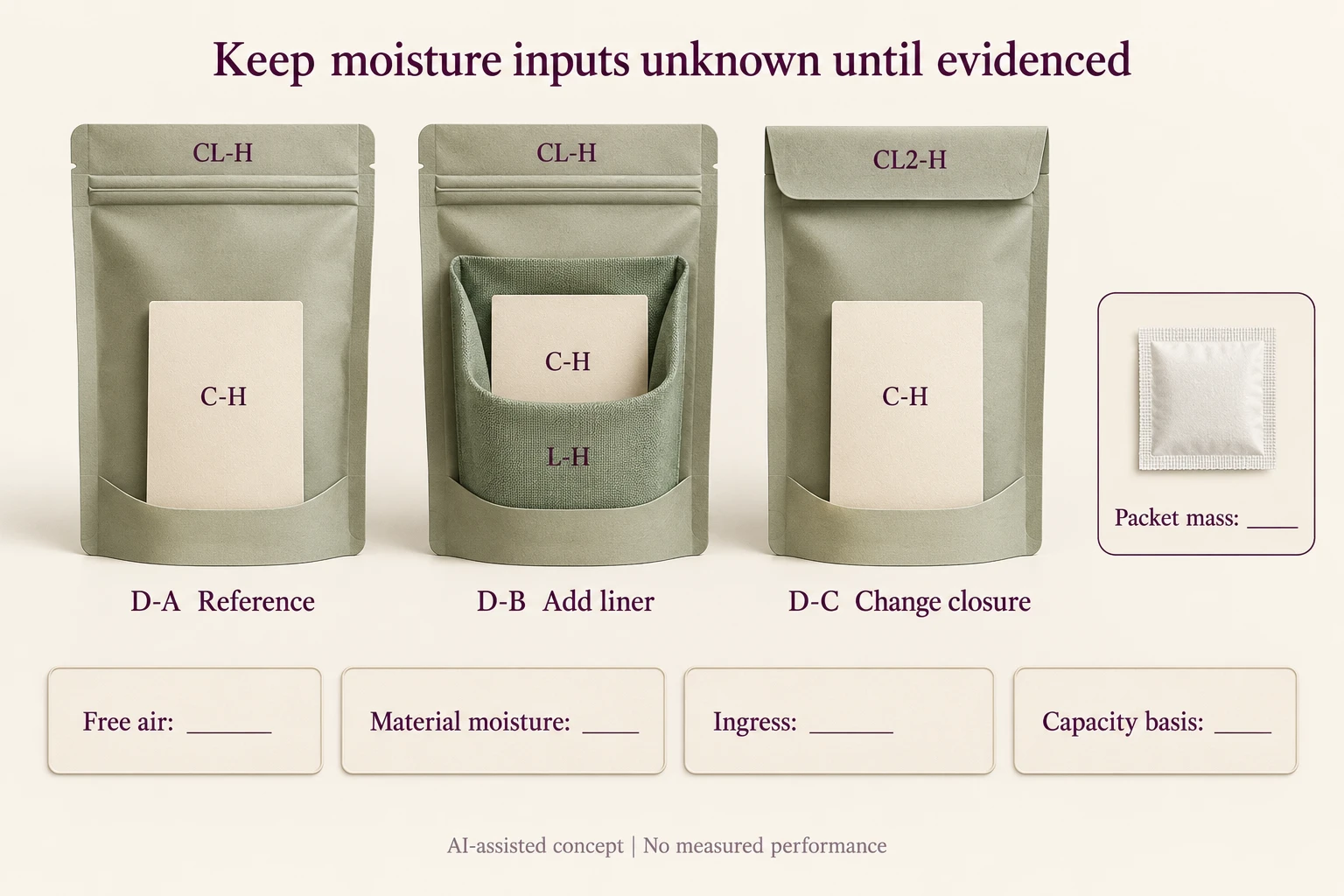
The two invented pouches share only a nominal outer-size reference. Configuration D-A contains card C-H; D-B adds liner L-H. A separate D-C proposal changes the closure. None has a measured moisture inventory or selected desiccant dose.
Scroll horizontally if columns extend beyond the view.
| Configuration | Defined change | Inputs that remain unknown |
|---|---|---|
| D-A | Reference pouch P-H with C-H | Free air, card condition, ingress, use period and sorbent state |
| D-B | Add L-H, retain closure CL-H | Liner condition, changed free air and relevant exchange |
| D-C | Reference contents, closure CL2-H | Finished-enclosure exchange under revised closure |
| Capacity request | Sorbent identity and relevant conditions | Applicable capacity basis; packet mass unselected |
Treat an unknown moisture term as unknown rather than zero. A dry-looking insert or sealed packet is not a measured initial condition. If the required conditions are missing, this map cannot produce a dose or a humidity prediction.
Changing the liner and closure in the same proposal combines two questions. D-B and D-C show how to name those changes independently before asking for technical evidence. Identical outside dimensions do not establish identical free-air volume.
Keep environmental exposure, intended opening pattern and relevant sorbent condition in the request. The conservation source explains moisture exchange in its own enclosure context; it supplies no jewelry-pouch dosage rule. Tarnish prevention and product compatibility still need their own basis.
Download the desiccant sizing packaging record (.csv). HYPOTHETICAL rows are invented examples. Use ACTUAL_BLANK for permitted project inputs; replace that row label only when recording actual facts. Empty evidence, observation and date fields mean unknown or not performed, never acceptance. Keep checkpoints and revisions separate.
Bring the contents, closure and unknown-input map through the enquiry linked above; a suitable technical party must establish any dose and protection basis. Packrivo coordinates independent suppliers. These records establish no supplier offer, service availability or MOQ exception; its published baseline is 500 pieces per product/design.