
A water drop beading on gift paper doesn't establish that the paper will resist oil or grease. The liquid and receiving construction belong to the performance question, so water behaviour shouldn't become a general stain-resistance claim.
If the proposed wrapper is a Printed Tissue Sheet: Plan the Fold and Product Contact, identify the actual food or product contact, liquid and duration before asking for relevant material evidence. The concept page does not establish grease resistance, water resistance or food-contact suitability.
For a brand choosing a wrapper or liner, identify the substance that may contact it. Paper suitable for one contact question can still lack evidence for another, even if its colour and finish are attractive.
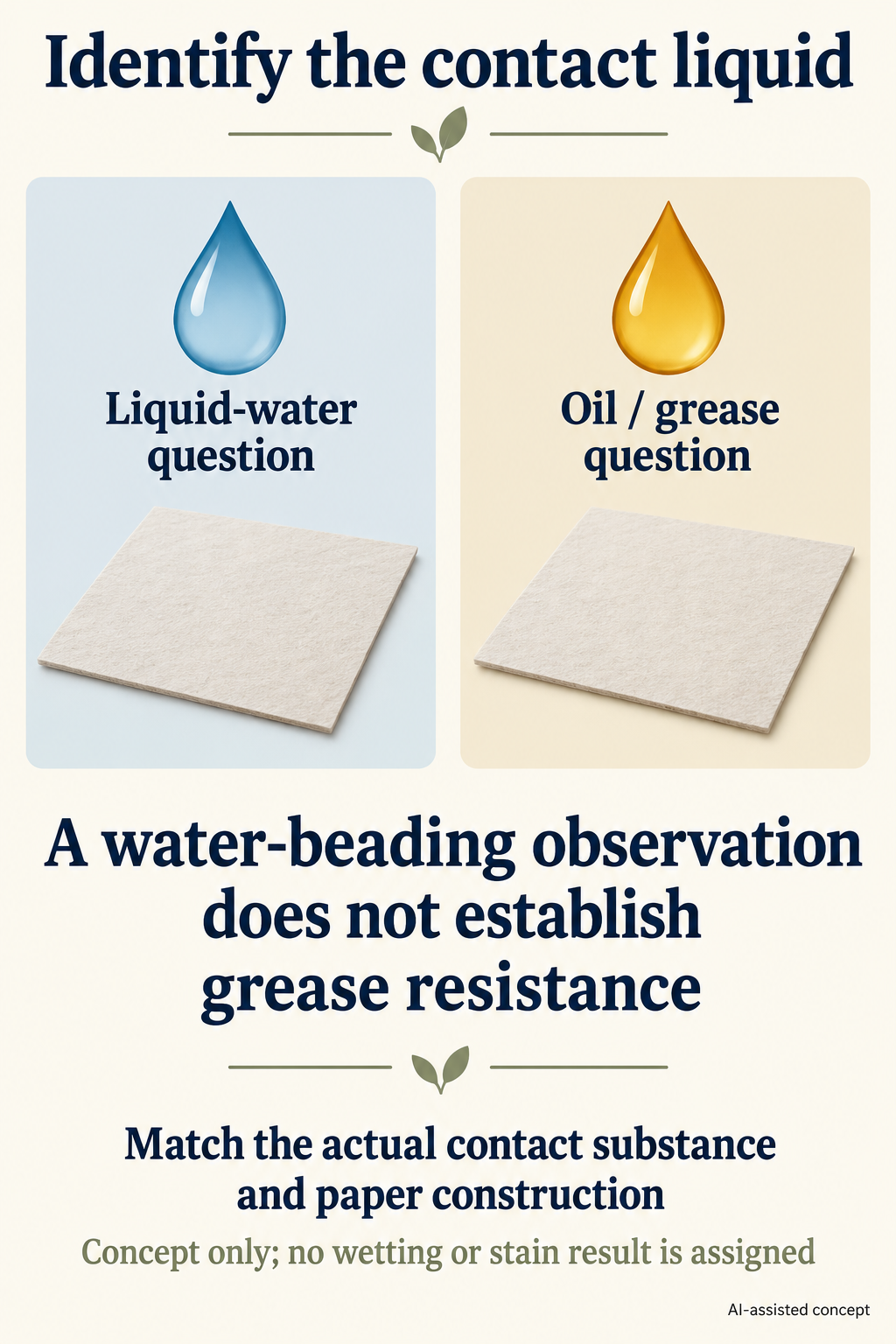
A visible bead describes one liquid at one surface
A photograph of a rounded water drop concerns water on the observed face under those conditions. It doesn't show oil penetration, an edge route or what may happen after a longer contact. Nor does it identify the treatment applied to the paper.
Wetting and movement into the material depend on the liquid and the surface it meets. Changing the contact liquid changes the comparison. A supplier's general water-resistant description therefore leaves an oil-related requirement unanswered unless suitable additional evidence is provided.
Keep the actual paper construction named too. Base paper, added treatment, printing and liners may introduce different contact surfaces. Evidence for an unprinted material shouldn't automatically become evidence for every finished wrapper made from it.
Water absorption and grease resistance have different evidence
Holmen's General Technical Information, issued 10 December 2025, identifies surface water absorption measured by the Cobb test. That manufacturer description concerns a water property, not a universal prediction of oil behaviour.
TAPPI's T 559 grease-resistance test catalogue identifies a separate grease-resistance evaluation. The complete paid method was not obtained here. Its existence doesn't assign a result to the proposed gift paper or prove performance against every possible contact substance.
Neither a water observation nor a grease-related material result should be expanded to all liquids, all contact times or the entire assembled pack. The relevant evidence needs to describe the property, material and conditions actually investigated.
Follow a hypothetical wrapper choice
Imagine a gift brand choosing a printed paper wrapper for an item whose surface may be oily. The supplier provides an image of water beading on a paper sample, but no information addressing the actual oil contact. This is a hypothetical evidence gap, not an examined product or incident.
The image may explain the shown water interaction. It cannot answer whether the offered printed face will remain presentable during the intended contact. The buyer still needs the contact-substance identity, finished-paper identity and a relevant assessment of their interaction.
If the next proposal introduces an intervening liner, the contact pair changes. The wrapper may no longer touch the product directly, but the liner now has its own role to establish. Adding it doesn't prove protection; it creates another identified configuration to compare.
If the product instead contains solid wax, don't quietly treat it as the same liquid-oil example. Its actual state, possible contact and intended conditions need to be established before selecting the relevant question. No heating or improvised substance trial follows from this article.
Appearance, penetration and product compatibility remain distinct
A visible mark can have several possible origins. It might involve liquid entering the paper, material transferred onto its face, rubbing or another interaction. Location and appearance alone don't prove the mechanism.
Packrivo's product-contact observation guide records the actual surface pair and visible outcome. The uncoated-paper proof guide addresses artwork appearance on the selected substrate. Neither replaces evidence about resistance to the relevant contact liquid.
A paper-performance result also doesn't settle product compatibility, food-contact compliance or the effect on a jewelry finish. Those are separate requirements, with their own applicable evidence.
Choose the next paper or liner comparison around the actual contact job. Retain water-related evidence for its stated scope, and request oil- or grease-relevant evidence when that is the concern. A beading photograph alone can't complete the selection.
Trace which surface meets which substance
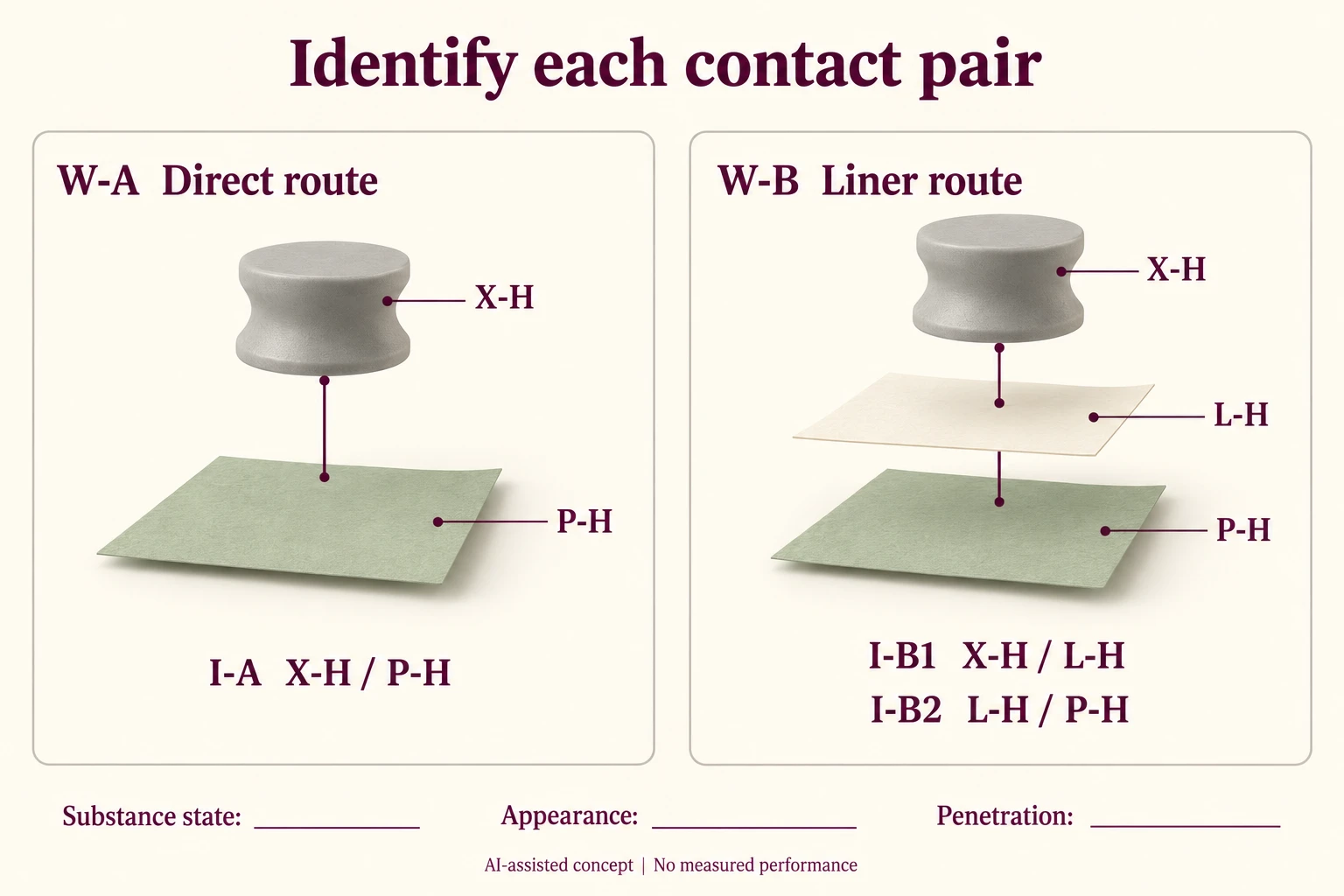
A liner changes the contact configuration, not just the paper name. In the invented wrapper route below, W-A has direct contact between finished face P-H and substance X-H; W-B adds liner L-H. X-H has not been identified or assessed.
Scroll horizontally if columns extend beyond the view.
| Route | Contact pair | Evidence gap |
|---|---|---|
| W-A | X-H against finished printed face P-H | Substance state, actual contact and relevant interaction |
| W-B inner | X-H against liner L-H | Liner identity and relevant resistance/compatibility |
| W-B outer | L-H against printed face P-H | Transfer or appearance question at new interface |
| Water image | Water on separately identified sample face | Retain only its stated scope |
Identify X-H before naming it oil, liquid wax or grease. A solid state and a liquid state create different questions; this record prescribes no heating or improvised contact trial. Appearance, penetration and product compatibility remain separate outcome fields.
A supplier water-beading photograph can stay in the evidence register without filling the oil-related result cell. Likewise, a grease-related material document must identify the actual paper construction and its scope before it can inform W-A.
W-B introduces two interfaces. Record both instead of simply marking the wrapper protected. A visible mark on P-H would require its received location and conditions; it would not prove that X-H penetrated the liner. No food-contact, jewelry-finish compatibility or stain-free result is established.
Download the grease resistant versus water resistant paper record (.csv). HYPOTHETICAL rows are invented examples. Use ACTUAL_BLANK for permitted project inputs; replace that row label only when recording actual facts. Empty evidence, observation and date fields mean unknown or not performed, never acceptance. Keep checkpoints and revisions separate.
Bring the actual contact substance, finished paper and any liner interfaces through the linked enquiry route before selecting the next evidence. Packrivo coordinates independent suppliers. These records establish no supplier offer, service availability or MOQ exception; its published baseline is 500 pieces per product/design.