
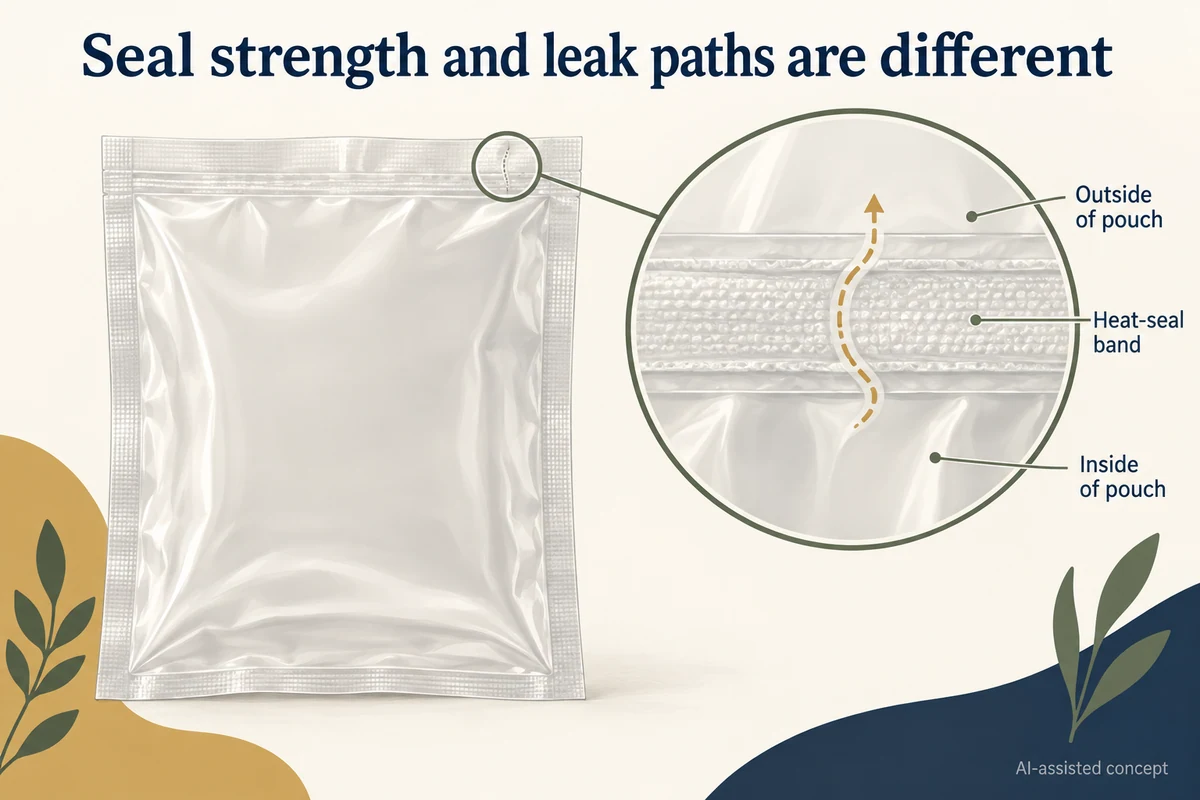
A seal-strength result measures resistance to separation under its stated conditions. It doesn't establish that the sealed edge has no through-channel or that the complete pouch is hermetic. Strength and leak detection address different physical features.
Use Hot Tack and Cooled Pouch Seal Strength when the pack can load a seal before it has cooled. That timing question is separate from whether the finished package has a leakage path and from the later cooled separation result.
For a jewelry brand selecting a protective pouch, first decide which feature matters to the intended use. A mechanically durable seam can still require separate evidence about leakage, and a leak-detection observation doesn't replace strength evidence.
Separation force describes a mechanical question
ASTM F88/F88M-23 identifies a seal-strength method for flexible barrier materials. Its public description concerns the force needed to separate a strip containing a seal and the associated failure behaviour.
The force belongs to the identified specimen and loading arrangement. It isn't a direct measurement of gas or liquid passing through the seam. A result described only as strong also omits the quantity, method and conditions needed to interpret the claim.
The full paid procedure was not reviewed here. The public scope supports identifying the measurement target, not performing an improvised pouch test or assigning a universal acceptable strength.
A through-channel asks about continuity
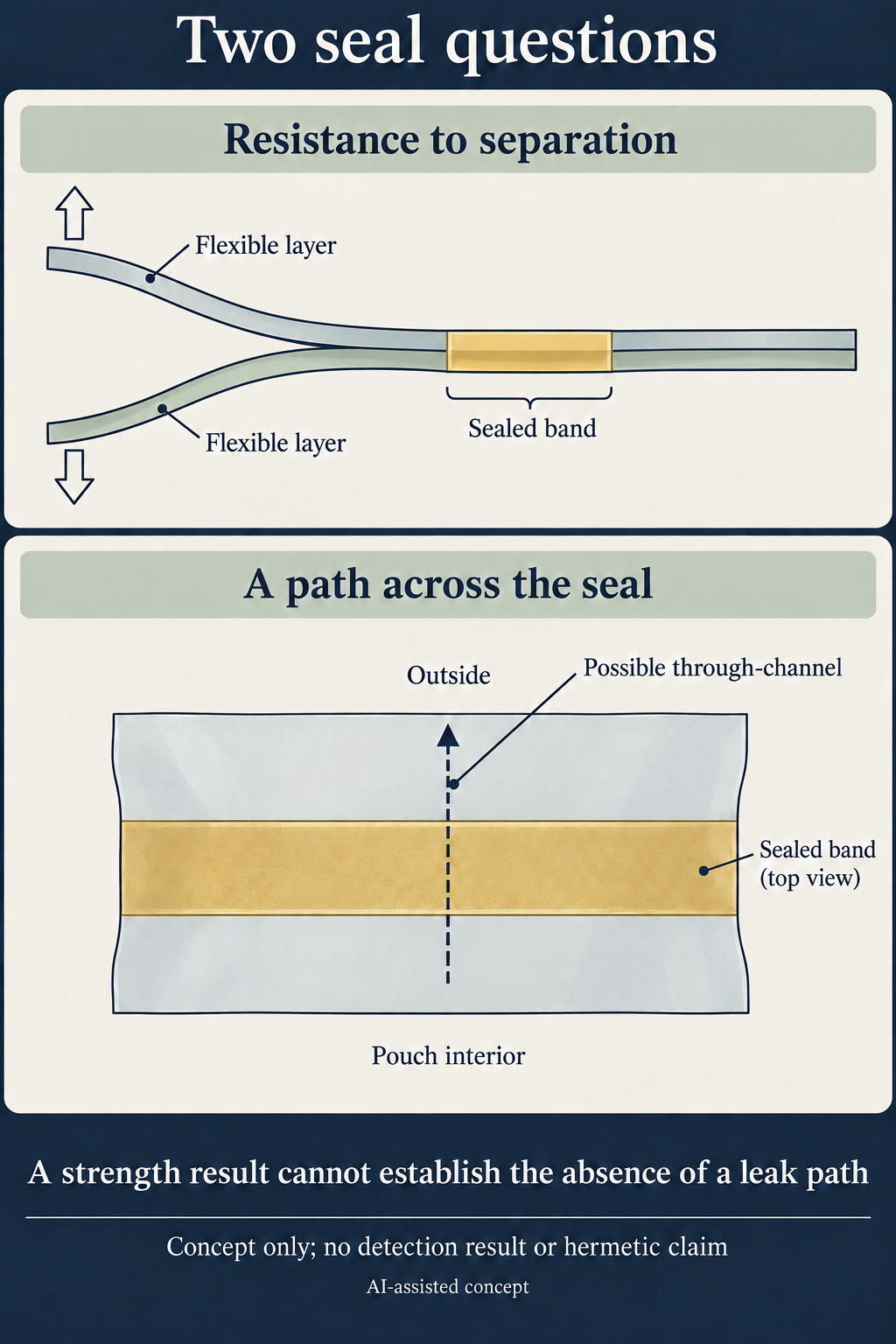
A seal joins material over an area. A small unjoined route crossing that area presents a different question from how much force the surrounding joined regions resist. The presence or absence of such a route isn't encoded as a general leakage conclusion in a separation-force number.
This distinction is useful even before any actual defect is found. A brand asking about seam strength has asked whether the joint resists a specified mechanical action. A brand asking about a through-channel has asked whether a particular passage exists across the sealed edge.
The accompanying diagram illustrates a possible channel only. It doesn't represent an observed pouch defect, assign a channel dimension or predict a leak rate.
A detection result has its own limits
The public scope of ASTM F3039-23 describes dye-penetration leak detection for nonporous packaging or flexible barrier materials. It concerns defined detection questions and is distinct from the seal-strength method.
A detection method's specimen, target and limitations matter. A negative observation under one method doesn't prove absolute absence of every possible leak path. Nor does it supply a quantitative rate for all gases, water vapour or liquids.
The complete paid procedure was not acquired. Its public description is a reason to select an appropriately scoped evaluation with the responsible technical party, not instructions for a customer dye test.
Compare two hypothetical pouch proposals
Suppose a jewelry brand receives two proposals for the same protective-pouch function. Both provide seal-strength information. Only one also addresses the brand's separate concern about passages through the finished edge seal. Neither proposal has been examined for this teaching example.
The buyer shouldn't rank the documents simply by which has the higher strength number. If the immediate job requires information about continuity, both mechanical numbers still leave that job unresolved unless relevant additional evidence exists.
The second proposal's additional document is useful only within its actual detection scope. Check what seam, construction and method it concerns before treating it as evidence for the ordered pouch. A result for another layer structure cannot silently close the current question.
If the requirement instead concerns the seam resisting handling loads, maintain the strength comparison on appropriate comparable conditions. The detection document doesn't answer that mechanical job. A proposal may need both types of evidence without one being a substitute for the other.
Keep the finished pouch and barrier film in view
The pouch can have other seams, an opening or a wall material that permits transmission. A finding about one edge doesn't establish the complete enclosure's barrier performance, and a film-transmission result doesn't establish that every edge is continuous.
Packrivo's report-configuration guide helps keep the examined specimen and ordered construction distinct. The return-mailer second-seal guide addresses another job: what an opening action preserves for later closure. It doesn't provide leak-tightness evidence.
State the intended protection requirement and identify the evidence that measures it. Keep mechanical separation, local leak detection and complete-package performance as related but separate conclusions. A strength result alone cannot establish a leak-tight seam.
Keep seam evidence and whole-pouch evidence in separate rows
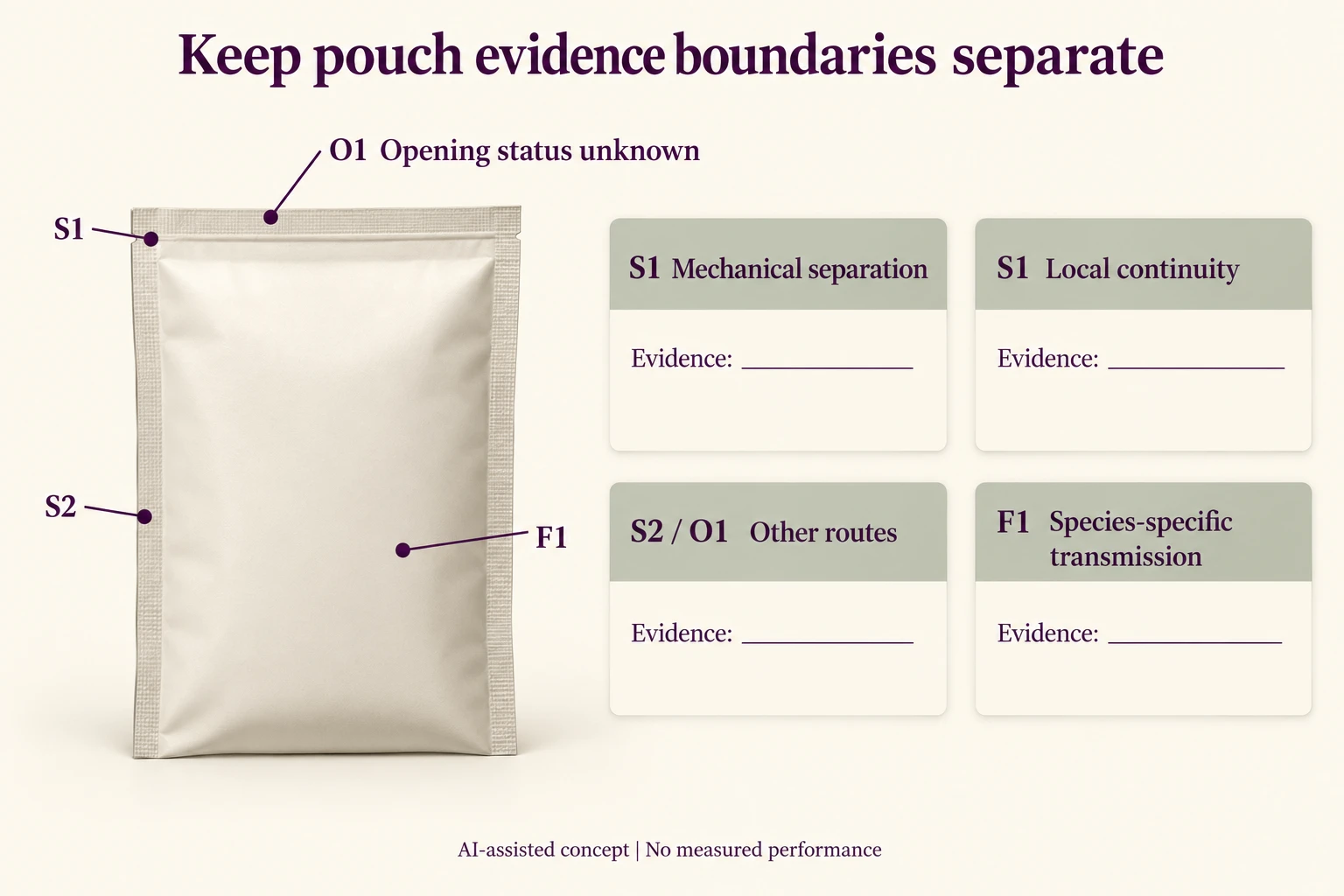
An edge-seal document can answer a useful local question without resolving the complete pouch. This invented evidence map names top seam S1, side seam S2, wall F1 and any opening O1 for construction P-H.
Scroll horizontally if columns extend beyond the view.
| Boundary | Question | Evidence field |
|---|---|---|
| S1 mechanical | Resistance to separation in stated specimen arrangement | Method, loading basis, result and failure description |
| S1 continuity | Relevant detection question across identified seam | Method scope, detection limitations and observation |
| S2 / O1 | Other seams or opening in finished enclosure | Separate scope and unresolved route |
| F1 | Species-specific wall transmission | Relevant film/package basis, not a seam-strength value |
Link records to the same construction revision before combining their conclusions. If the mechanical strip came from P-A and the detection document came from P-B, keep that mismatch visible; two relevant method names do not create evidence for P-H.
Use an empty detection observation when none has been performed. A negative observation, if later documented, must retain its detection scope and limitations; it is not an absolute no-leak statement or a quantitative rate for every species.
The map prescribes no dye preparation, specimen cutting or acceptance threshold. It helps the buyer choose which question is still open. Mechanical separation, local continuity and whole-package barrier claims remain independently traceable.
Download the seal strength versus leak tightness record (.csv). HYPOTHETICAL rows are invented examples. Use ACTUAL_BLANK for permitted project inputs; replace that row label only when recording actual facts. Empty evidence, observation and date fields mean unknown or not performed, never acceptance. Keep checkpoints and revisions separate.
Bring the intended protection question and construction-linked evidence map through the original enquiry route; the relevant technical party must determine the appropriate evaluation. Packrivo coordinates independent suppliers. These records establish no supplier offer, service availability or MOQ exception; its published baseline is 500 pieces per product/design.