
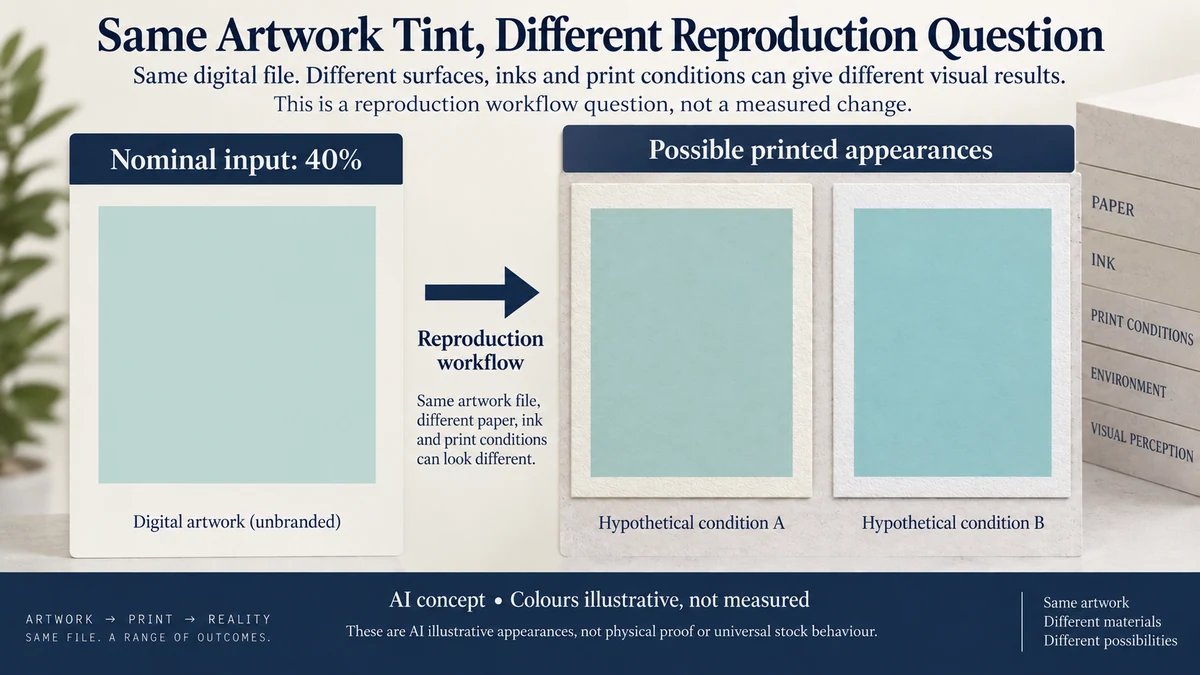
A percentage tint in an artwork file does not determine the printed tone by itself. The printing process reproduces the nominal pattern, and the substrate’s optical behaviour affects the light returned from it. Tone value increase concerns that reproduction relationship.
For a gift brand reviewing a muted background on a box or care card, this is a more specific question than whether two colours look different. Before changing the artwork percentage, ask how the proposed process and stock reproduce the intended tint.
Keep the file input separate from the printed response
Suppose an invented design contains a 40% single-channel tint. That number describes the nominal artwork input under the stated file interpretation. It is not a measured coverage or tone value on a printed sheet.
The input can remain 40% while the resulting appearance changes between printing conditions. A screenshot of the unchanged design cannot establish the printed response on either stock.
The input itself also needs a clear identity. A single-channel tint, a composite colour and a spot-colour tint are different descriptions. A designer should identify what the number refers to before a printer interprets it.
No resulting percentage or colour difference is assigned to the hypothetical design here. The example simply keeps the input and the result from being treated as the same quantity.
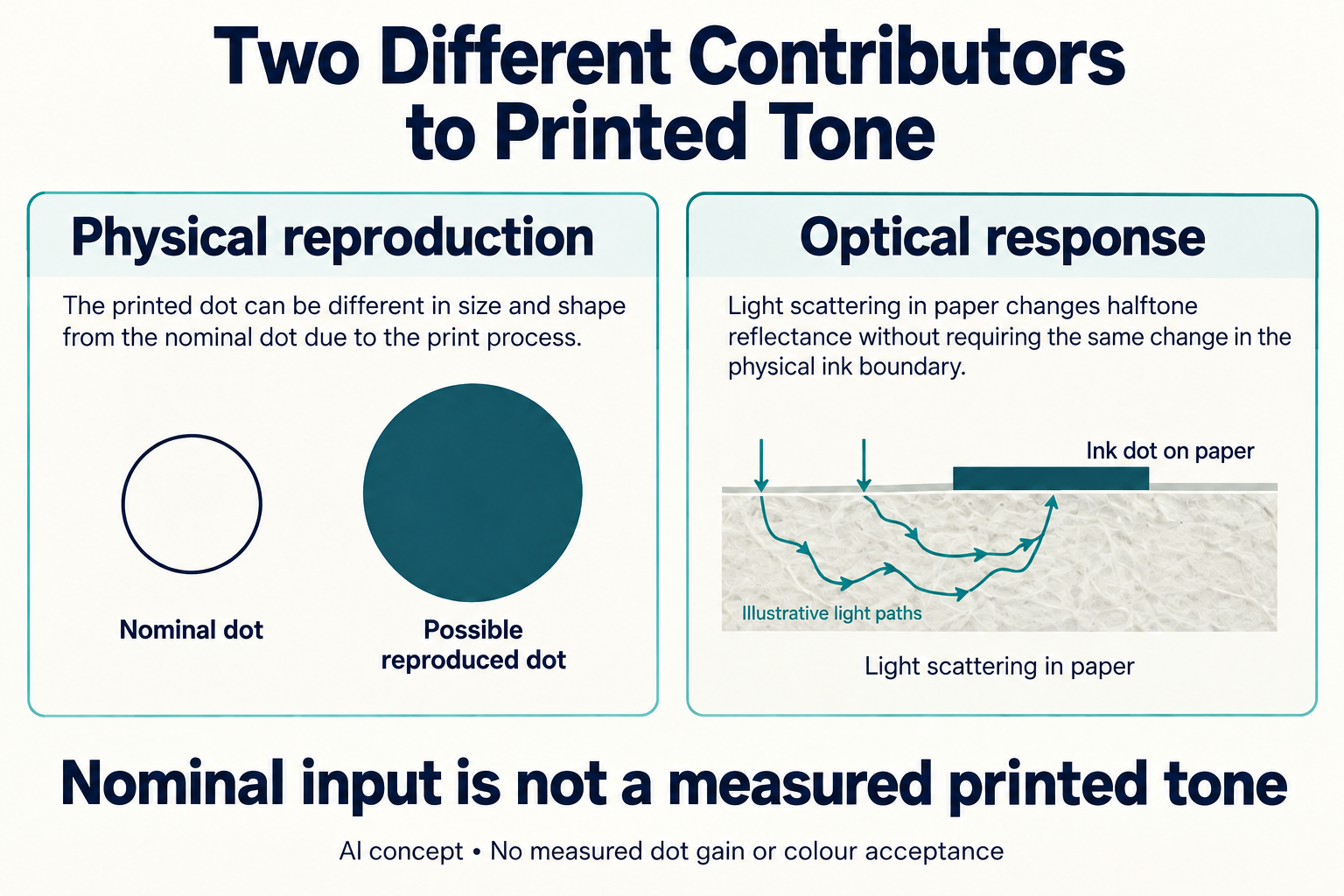
Physical dot reproduction and optical response are different contributors
In a screened reproduction, process steps can change the geometry of the dots reproduced on the material. An increase in their physical area can change the tone returned by the pattern.
Light scattering within a paper substrate can also affect the response. Optical dot gain does not require the physical ink boundary to grow by the same apparent amount.
Heidelberg’s public Prinect explanation of dot gain distinguishes process-related changes in geometric dot size from optical dot gain. Its version-specific explanation describes both contributions to the resulting tone.
The public abstract of Optical Dot Gain in a Halftone Print, published in November 1997, explains how light migration within paper can alter halftone reflectance. That optical mechanism cannot be diagnosed merely by calling a printed dot bigger.
An enlarged illustration of two dots can therefore teach only part of the question. It cannot measure the optical contribution or determine which mechanism produced an actual mismatch.
A solid patch and a tint ask different questions
An area printed as a solid and an area reproduced through a tint pattern are not interchangeable review points. A satisfactory solid-colour comparison does not by itself characterize the tonal reproduction between paper white and the solid.
Likewise, a changed tint need not mean that the artwork file was secretly edited. The nominal input can be unchanged while the process response differs.
For the hypothetical 40% background, retain the input identity and ask the printer what relevant evidence describes its tonal reproduction. Do not request a universal tone-value-increase number copied from an unrelated ink, stock or print condition.
The uncoated-paper proof guide helps keep the proposed substrate in the appearance review. Paper selection and process response need to remain visible when the designer compares alternatives.
Compensation belongs to the selected printing condition
A printer may use a controlled reproduction workflow to relate nominal input to intended output. That does not authorize the buyer to subtract an arbitrary percentage from every pale colour.
Changing the artwork without understanding the workflow can create another mismatch. A compensation already applied in the production path could be compounded by an unexplained manual correction.
Before modifying the design, ask whether the concern is the intended tone, the current process response or a difference between proof and production conditions. Those questions lead to different actions.
If the printer recommends a file change, retain the revised input and the conditions under which it will be assessed. A screen-only before-and-after view cannot show that the printed problem has been resolved.
Keep tonal response separate from colour acceptance
The physical colour-reference guide addresses what the buyer intends to accept. A tone reproduction explanation helps describe how a printed tint can differ, but it does not establish that a colour is acceptable.
Nor is tone value increase a replacement for a colour-difference measurement. The quantities answer different questions. A printed appearance concern may involve several factors, and an actual conclusion needs evidence from the relevant specimen and conditions.
Packrivo can coordinate the intended tint, proposed material and printer’s response. The printer and buyer resolve the appropriate production treatment and appearance decision. This guide supplies no calibrated swatch, correction curve or acceptance tolerance.
Source scope: Checked 11 October 2026. Heidelberg’s cited help is explicitly Version 2021; the IS&T abstract is historical research from 1997. Both are used for the mechanism, not as current press settings. The nominal 40% example is invented. No printed tone, physical dot area, optical gain or colour match was measured.
A single gain value cannot supply a whole correction curve
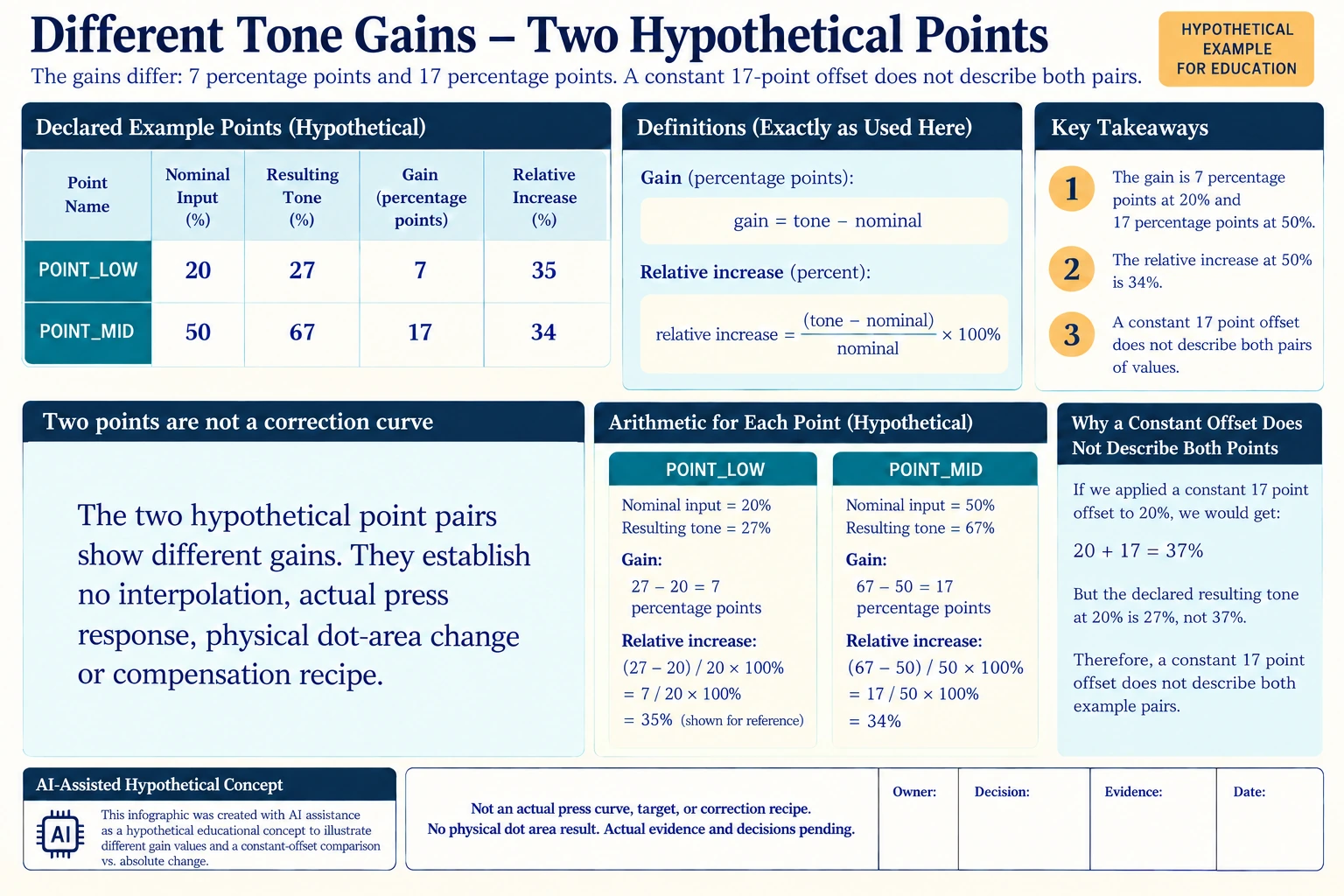
Keep the original 40% design separate and use a new invented arithmetic model. POINT_LOW has nominal 20% and reported tone 27%, a 7-percentage-point increase. POINT_MID has nominal 50% and reported 67%, a 17-percentage-point increase. No print was measured and these are not a supplied press curve.
Scroll horizontally if columns extend beyond the view.
| Hypothetical configuration | Named object | Relationship | Input or next scope |
|---|---|---|---|
| POINT_LOW | TONE_INCREASE | calculated from | POINT_LOW_TONE-POINT_LOW_NOMINAL; 7 percentage_points |
| POINT_LOW | INCREASE_RELATIVE_TO_NOMINAL | calculated from | POINT_LOW_GAIN/POINT_LOW_NOMINAL*100; 35 percent |
| POINT_MID | TONE_INCREASE | calculated from | POINT_MID_TONE-POINT_MID_NOMINAL; 17 percentage_points |
| POINT_MID | INCREASE_RELATIVE_TO_NOMINAL | calculated from | POINT_MID_GAIN/POINT_MID_NOMINAL*100; 34 percent |
| OFFSET_COUNTEREXAMPLE | LOW_PLUS_MID_GAIN | calculated from | POINT_LOW_NOMINAL+POINT_MID_GAIN; 37 percent |
| GAIN_MODEL | 17_POINT_OFFSET | does not describe | 20_TO27_AND50_TO67 |
| GAIN_MODEL | TWO_PAIRS | do not establish | ACTUAL_PRESS_CURVE_OR_CORRECTION_RECIPE |
A constant subtraction of 17 points would not describe both stated pairs. Nor does 17 points mean a 17% relative increase: 50 to 67 is 34% relative to 50. The two quantities use different denominators. Heidelberg’s familiar 50-to-67 illustration explains that definition, not a target for every stock.
Two invented points still cannot define an actual compensation curve or separate physical dot growth from optical response. Geoffrey L. Rogers’ 1997 optical-dot-gain abstract concerns the scholarly optical mechanism; it is not the Rogers Corporation foam source used elsewhere.
Before changing tint input, identify the selected process, stock and any compensation already in its workflow. A one-point manual offset can compound an existing treatment without explaining the original appearance. Request the responsible printer’s relevant response evidence and preserve the intended physical colour decision separately.
Download the tone value increase percentage points correction scope record (.csv). It includes the original table fields and scenarios alongside the added relationships. HYPOTHETICAL rows are editorial examples or required review scopes, not actual records. Actual quantity, configuration, component and file identities, materials, process, specification, copy, method, condition, observation, owner, decision, evidence and dates are blank. ACTUAL_BLANK is a separate empty starting row; enter permitted project evidence before using an actual record. A blank means unknown.
Use the Printing on Uncoated Paper: Review the Proposed Stock for its separate question. Use the Packaging Color Approval With a Physical Reference for its separate question.
Source scope checked 17 October 2026: Heidelberg Prinect Version 2021 and Geoffrey L. Rogers’ 1997 scholarly optical-dot-gain abstract concern print tone, not Rogers Corporation foam. The 50-to-67 illustration is 17 percentage points and 34% relative increase. No full research paper, measured TVI, actual press curve or correction prescription was established. The added configurations and calculations are hypothetical, with actual evidence and decisions pending.
Discuss this packaging specification with Packrivo. We coordinate independent suppliers. MOQ: 500 pieces per product/design; illustrative quantities are not production offers. Confirm materials, samples, price and timing for your project.