
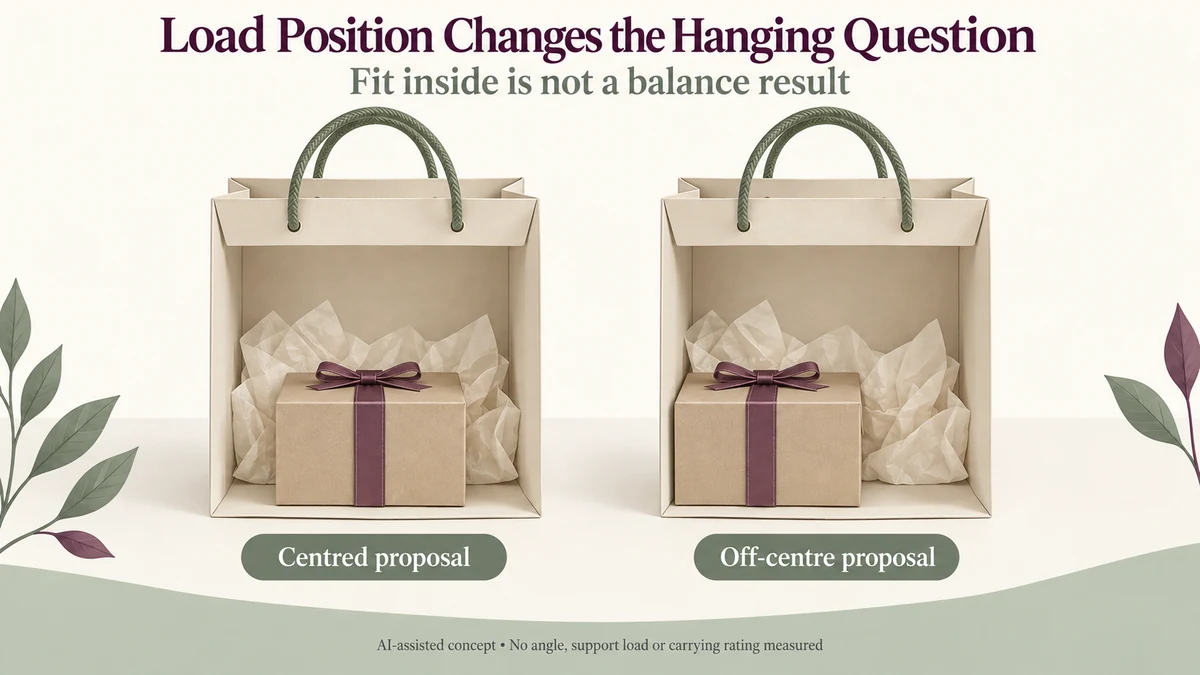
A gift can fit inside a paper bag yet produce a different hanging arrangement when it is placed away from the centre. Fitting through the mouth and balancing while suspended are different questions.
The loaded system’s mass distribution and its handle support affect force and moment balance. An off-centre item does not automatically prove a misplaced handle, and it does not provide a carrying-capacity finding or a predictable tilt angle.
The examples here are hypothetical. No bag, handle, load, angle or strength has been measured.
Weight Acts Through the Loaded System’s Centre of Mass
For a stationary suspended system, support forces have to balance its weight, while the overall turning effects also have to balance. OpenStax’s statics explanation treats these as separate equilibrium conditions: net force and net external torque are zero in the stated static situation.
The location of a force matters to its turning effect. OpenStax’s torque chapter explains that the perpendicular lever arm is part of that relationship, not just the magnitude of the force.
For a bag and gift, the relevant centre of mass belongs to the whole loaded arrangement. Moving an item within the bag can change it even when the item and total weight remain the same.
The point is not that every off-centre load makes a bag tilt. It is that the support arrangement must accommodate a different distribution of turning effects and forces.
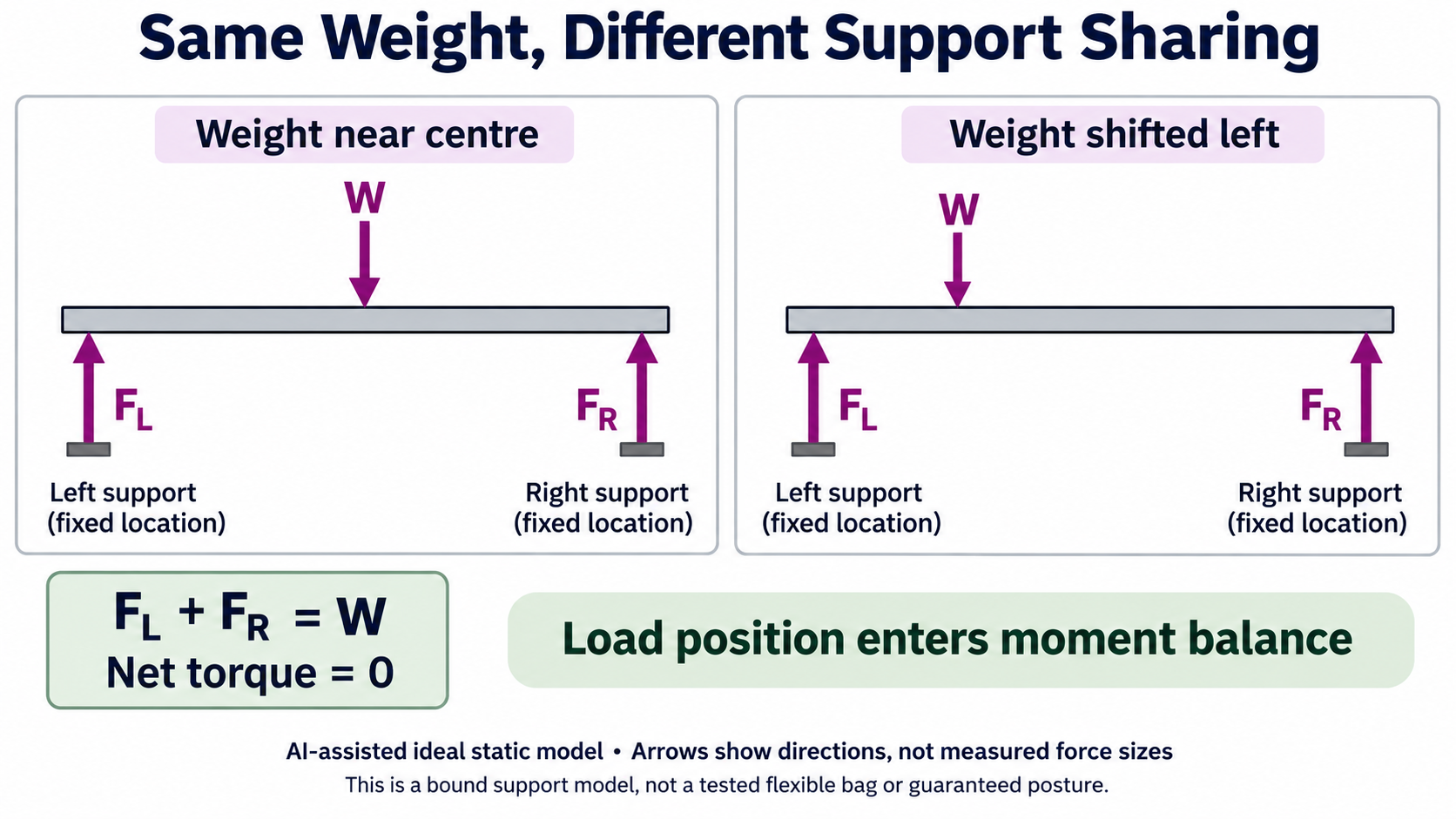
Two Support Locations Can Share the Load Differently
In an idealized arrangement with two separated vertical supports, a weight located between them can be balanced by different shares of upward support. Moving that weight changes the moment relationship, so an unchanged total weight does not establish equal loading at both supports.
This simplified model describes force balance, not the detailed behavior of a paper carrier. It assumes identifiable support locations and a suitable stationary arrangement, without assigning actual reaction forces.
A real bag has flexible handles and walls. It can deform, the grip can change, and the gift can contact or move within the base. These changes affect the actual load route and the final suspended arrangement.
If the bag or contents rotate or rearrange, the geometry used for a static model changes as well. A drawing of two arrows and a weight cannot calculate a final hanging angle without the relevant construction and constraints.
A Hypothetical Candle Position Changes the Question
Imagine a glass candle carton placed in a paper gift bag. In one proposal it is near the centre of the base; in another it sits nearer the left side. The bag, carton and added tissue are otherwise assumed unchanged.
This is a conceptual comparison, not an observed carrying trial or a real customer configuration.
Moving the carton can change the centre of mass of the loaded system relative to its supports. That can change the support loading or how the flexible arrangement settles when lifted. It does not establish that the left-hand proposal will tilt by a particular amount or cause a particular joint to fail.
Nor does it prove that the centred proposal is safe to carry. Balance is one question; strength, grip access and complete loaded use remain separate requirements.
The useful observation to preserve is the proposed item’s position and the actual support arrangement. A comment such as “the handle looks uneven” may otherwise conceal a change in contents, grip or base geometry.
Where the Hand Supports the Handles Also Matters
The handle attachment locations on the bag are not necessarily the same as the support locations imposed by the hand. Handle length, flexibility and the way the handles are brought together can affect the route from the loaded bag to the grip.
A comparison that changes the grip while also changing the gift position is not an isolated test of one variable. Likewise, taking out tissue or moving a second component to make lifting easier changes the loaded arrangement being considered.
The bag-handle joint guide identifies attachments and hidden joining work. Those details remain necessary, but identifying a joint does not establish moment balance or actual support loads.
The gift-bag loading-clearance guide addresses the route by which the gift enters the bag. That geometry should not be relabeled as evidence that the same package hangs as intended afterward.
Balance and Carrying Strength Are Not Interchangeable
A system can have a balanced stationary arrangement while a component remains unsuitable for its actual load. Conversely, a component may remain attached while the loaded bag changes posture.
Those statements describe different possible questions, not failures observed in this example. The geometry and force balance help locate the use configuration that strength evidence would need to represent; they do not generate that evidence.
Movement introduces another boundary. Starting, stopping or swinging a carried bag is not the same as a stationary equilibrium model. Static explanation should not be used as a complete handling or carrying qualification.
Compare the Loaded Arrangement That Matters to the Customer
For an actual proposal, keep the complete gift position, support geometry and intended grip identifiable. Consider whether a changed posture is consistent with a changed loaded arrangement before attributing it to an artwork or handle-position error.
If a carrying requirement is intended, the responsible supplier or technical party needs an appropriate basis for the actual complete configuration and use. No weight allowance or safe carrying claim follows from the centre-of-mass explanation alone.
Packrivo can coordinate the dimensions, construction and supplier questions. It does not perform or certify a carrying test through project coordination.
A bag that contains the gift and a loaded bag that hangs as intended are different propositions. Preserve the product position and support arrangement before deciding what an uneven posture means.
Source scope: OpenStax’s public College Physics 2e statics and torque explanations were accessed 11 October 2026. They describe general equilibrium, not a paper-bag standard or measured carrier. No actual support load, tilt, joint strength, movement response or carrying performance is established.
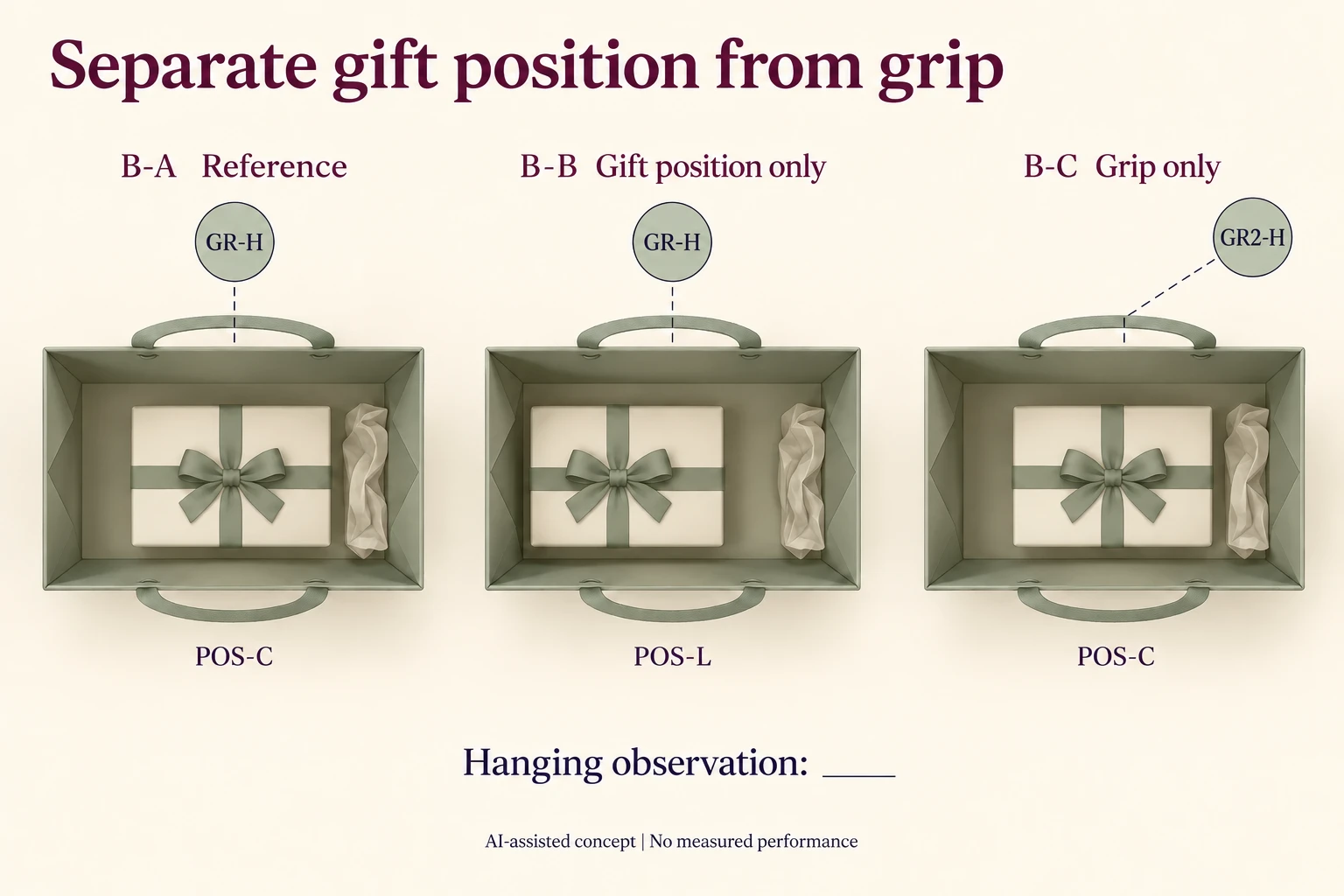
Keep gift-position and grip changes in separate comparisons
The invented carrier family below changes either the gift location or the grip route. Bag B-H, joint J-H, gift G-H and tissue T-H remain identified throughout. No hanging posture, reaction force or carrying capacity is calculated.
Scroll horizontally if columns extend beyond the view.
| Configuration | Gift position | Grip route | Comparison purpose |
|---|---|---|---|
| B-A | POS-C | GR-H | Reference complete arrangement |
| B-B | POS-L | GR-H | Gift position only |
| B-C | POS-C | GR2-H | Grip route only |
| Any tissue move | New tissue position | Record if grip changes | New configuration rather than hidden adjustment |
Use a top-view position reference and an inside view of the complete contents. A visible carton shift does not measure the whole system’s centre of mass; tissue, accessories and the carrier itself remain part of that system.
The hand’s support route need not coincide with the handle attachment. Record how the handles are brought together, without treating this as a handling instruction or a claim about equal support loads. Comparing B-B with B-C combines two different variables.
Keep a stationary hanging observation separate from starting, stopping or swinging use. A level-looking bag does not demonstrate joint strength. Actual carrying evidence must identify the complete configuration and intended use; the worksheet leaves those outcomes blank.
Download the gift bag load balance record (.csv). HYPOTHETICAL rows are invented examples. Use ACTUAL_BLANK for permitted project inputs; replace that row label only when recording actual facts. Empty evidence, observation and date fields mean unknown or not performed, never acceptance. Keep checkpoints and revisions separate.
Bring the complete contents-position and grip references through the linked enquiry route before attributing a hanging observation to a handle defect. Packrivo coordinates independent suppliers. These records establish no supplier offer, service availability or MOQ exception; its published baseline is 500 pieces per product/design.