
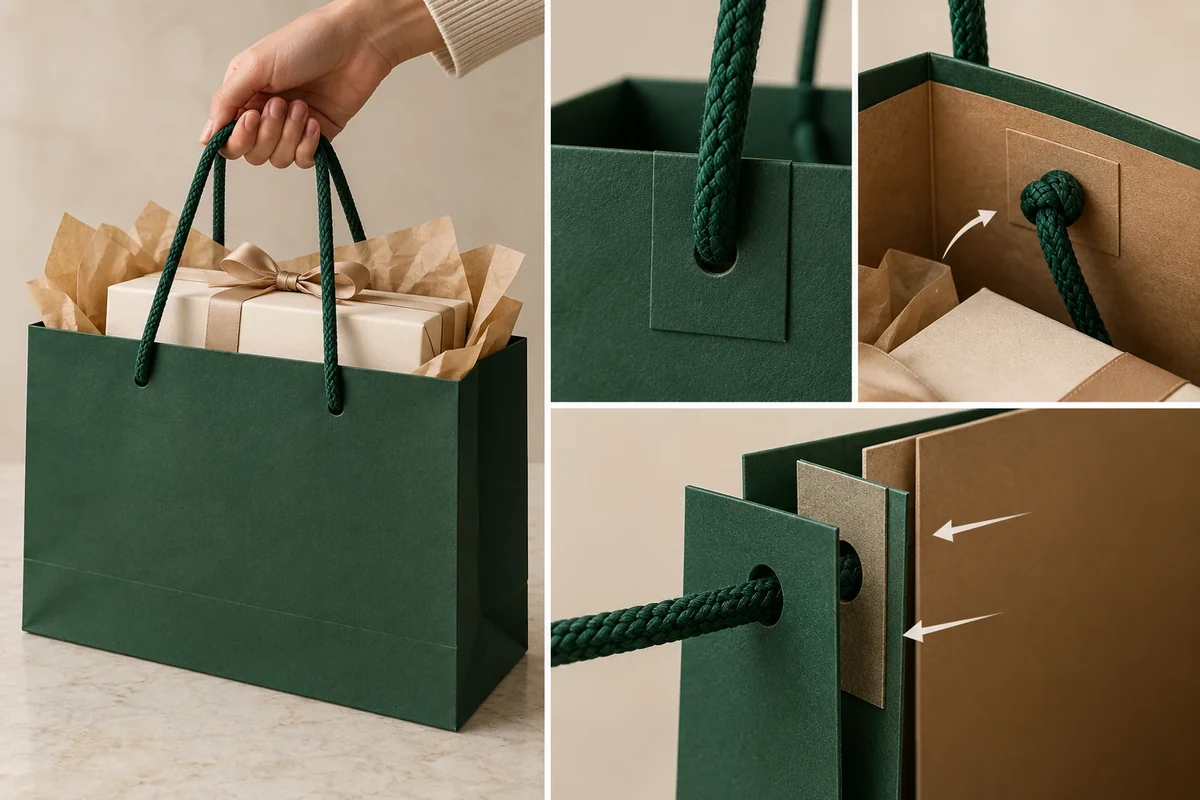
Identify the handle and its hidden joining work separately in a paper-bag brief, then review both with the complete gift loaded. Ask for inside and outside views of the proposed attachment. A colour-matched handle swatch leaves the joint, reinforcement and delivered assembly unresolved.
The useful record names the visible part, the hidden interface and the use configuration. It gives the supplier a precise question without assigning a carrying rating from a photograph.
Ask for the actual joining proposal
The paper-carrier reference includes handle options. That supports specifying the handle as a component, while the attachment and reinforcement need their own source response.
Name the handle material, visible grip and proposed attachment method. Identify any covering layer or reinforcement. If the joining detail is hidden, request a section or inside view instead of inferring it from the outside.
Record whether handles arrive fitted or as separate components. Include who completes any remaining work. The same outside appearance can hide different assembly responsibilities.
For a euro tote proposal, keep top reinforcement and base construction in separate fields. Neither should be assumed merely because the carrier looks stiff.
Connect joint identity to loaded use
Provide the whole gift envelope and actual weight, including tissue and cards. Show how the hand grips the handle around those contents. Ask the source what evaluation scope is appropriate if a carrying requirement is specified.
Keep a local action observation distinct from a capacity claim. Record user support, starting orientation and any rearrangement. A short handoff does not establish how an untested joint performs over unspecified use.
| Handle record | Input or source reply | Loaded evidence |
|---|---|---|
| Visible handle | Material and grip shape | Starting hand access |
| Hidden joint | Attachment and location | Inside/outside matched views |
| Reinforcement | Proposed layer and extent | Relationship to mouth and gift |
| Base | Actual construction proposal | Gift seated position |
| Delivered state | Fitted or separate parts | Assembly owner and instruction |
| Use scope | Full load and intended action | Observation or separate evaluation request |
Use the gift-set checklist to keep added tissue and cards in the loaded envelope. An omitted component can leave a different handle-access condition from the final pack.
Work through a hypothetical carrier sample
Suppose a boxed ornament sits in a paper carrier with tissue above it. The buyer sees the chosen handle outside but does not know the inside attachment. The sheet marks joint J1 as awaiting a construction view while handle material H1 is documented.
The source supplies the proposed J1 detail. The buyer then reviews H1/J1 with the complete gift configuration G1, retaining the tissue in its intended position. If tissue is moved to make the grip easier, that action is recorded.
A revision can change the handle length or the hidden reinforcement. The next review identifies which field changed instead of describing the whole bag as version two without a construction record.
Keep the next question component-specific
A useful request is: ‘Please confirm J1 for H1 and show its inside relationship to the proposed top reinforcement.’ It asks for the hidden interface. A handle colour reply alone leaves J1 open.
If a source gives a performance statement, keep its scope and evidence separate from the local sheet. The construction record should not turn a vendor’s general claim into confirmation for G1.
Once the proposed joint and supplied work are clear, retain their identities with the sample. Any final functional acceptance should name the actual configuration and method; appearance approval remains another decision.
Send the hidden interface
Bring handle and joint identities, inside views and the full loaded configuration to the packaging enquiry. This original sheet helps organize the next supplier response without claiming a tested carrying capacity.
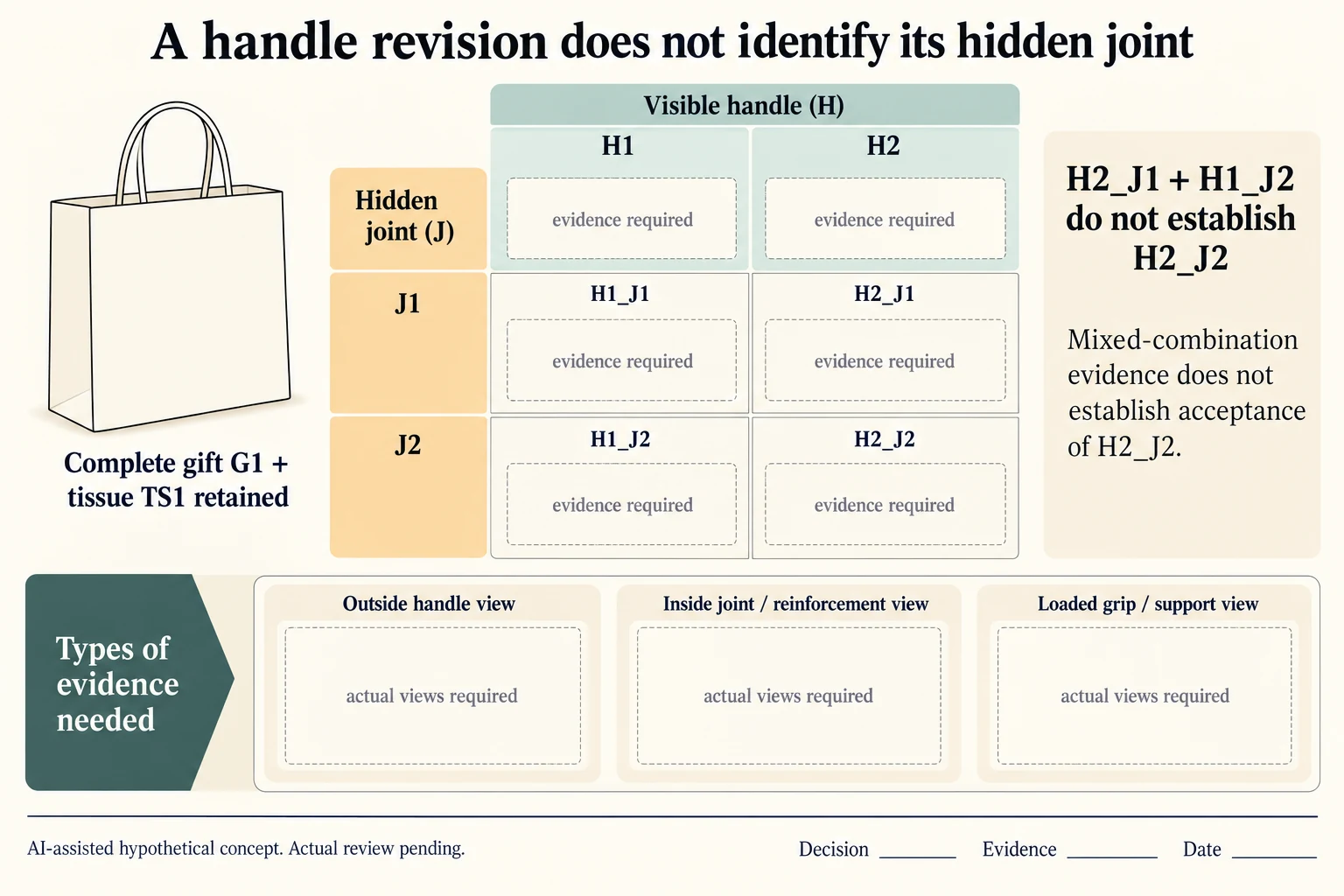
A new handle and a new joint create a new evidence combination
Use two invented visible-handle references H1 and H2 and two hidden-joint references J1 and J2. The four proposed combinations are H1_J1, H1_J2, H2_J1 and H2_J2. Keep the same complete gift G1 and tissue TS1 in each combination. The labels identify construction questions; they do not specify a knot, adhesive, stitch or reinforcing patch that the source has not confirmed.
Scroll horizontally if columns extend beyond the view.
| Hypothetical configuration | Named object | Relationship | Input or next scope |
|---|---|---|---|
| H1_J1 | H1_J1 | uses handle | H1 |
| H1_J1 | H1_J1 | uses joint | J1 |
| H1_J2 | H1_J2 | uses handle | H1 |
| H1_J2 | H1_J2 | uses joint | J2 |
| H2_J1 | H2_J1 | uses handle | H2 |
| H2_J1 | H2_J1 | uses joint | J1 |
| H2_J2 | H2_J2 | uses handle | H2 |
| H2_J2 | H2_J2 | uses joint | J2 |
Each CSV combination has separate outside, inside joint/reinforcement, loaded grip/support and supplied-state-owner scopes. The original H1 material description does not establish J1. An inside photograph needs to show the actual offered joining work and any covering layers, while a loaded view must identify the complete contents and grip. A tissue move to expose the joint is a separate inspection action, not the untouched customer starting state.
Evidence for H2_J1 and H1_J2 does not automatically establish H2_J2. The visible-handle revision and hidden-joint revision can meet in a configuration that has never been reviewed together. Ask the supplier to identify which sample represents that combination and what the loaded review covers. Keep decorative appearance, construction identification and any functional acceptance as separate decisions.
Confirm whether handles arrive fitted or as separate parts and who completes the joining work. Top reinforcement and base construction remain distinct fields. The catalogue identifies a tote-bag category and selectable handles but does not reveal a project-specific hidden joint. This combination map supplies no carrying capacity, reaction force, repeated-use rating or production availability.
Download the paper bag handle joint combinations record (.csv). It includes the original table fields and scenarios alongside the added relationships. HYPOTHETICAL rows are editorial examples or required review scopes, not actual records. Actual quantity, configuration, component and file identities, materials, process, specification, copy, method, condition, observation, owner, decision, evidence and dates are blank. ACTUAL_BLANK is a separate empty starting row; enter permitted project evidence before using an actual record. A blank means unknown.
Use the Review a Drawer Pull With the Loaded Tray for its separate question. Use the A Gift Bag’s Load Position Changes How It Hangs from Its Handles for its separate question. Use the Tissue and Gift Bag Set: A Buyer Specification Checklist for its separate question.
Source scope checked 16 October 2026. References cover only the named materials, processes or guidance. Added configurations and geometry are hypothetical, not supplier specifications, tests or production approval; they set no universal tolerances or machine limits. Confirm the actual material, process, drawing and formed sample for the project.
Discuss this packaging specification with Packrivo. We coordinate independent suppliers. MOQ: 500 pieces per product/design; illustrative quantities are not production offers. Confirm materials, samples, price and timing for your project.