
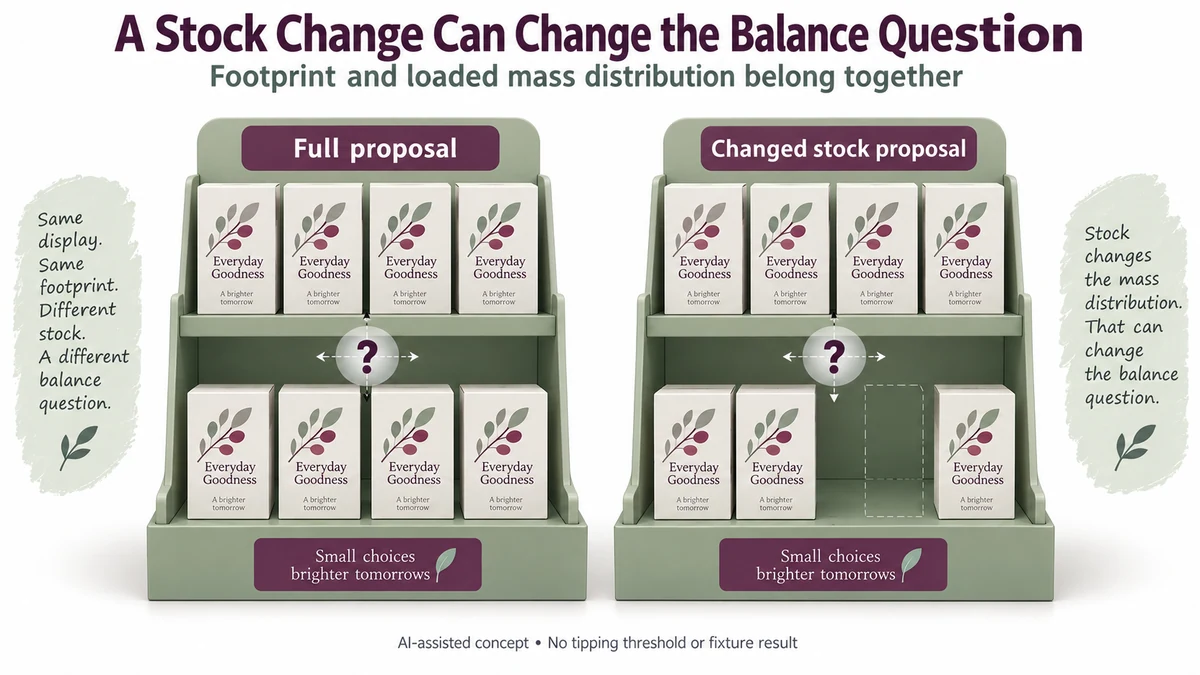
A counter display standing as intended when full has not, through that observation alone, established its behavior with a different remaining stock arrangement. Removing or repositioning products can change the loaded centre of mass and the way a disturbance acts on the display.
For a gift brand, separate the base and loaded mass distribution from capacity, front-wall access and artwork. Those factors help define the tipping question; they do not provide a measured stability rating or prove that any particular display will fall.
The example below is hypothetical. No display, product weight, force or tipping threshold has been measured.
The Support Footprint Sets the Relevant Edges
For an ideal unsupported-by-anything-else object on a level surface, gravity acts through its centre of mass. The relationship between that line of action and the base of support matters when considering rotation about a base edge.
OpenStax’s stability explanation connects the centre-of-gravity position with the base of support. Its general statics discussion also distinguishes an equilibrium state from the conditions under which displacement changes that state.
The relevant footprint is the actual contact and support arrangement, not necessarily the largest artwork outline or the width of an overhanging header.
A wide-looking panel can sit on a narrower support. A supported or attached display can also have additional constraints that an isolated free-standing model does not include. Those differences have to remain visible before applying a simple explanation to a real fixture.
A Disturbance Introduces a Turning Effect
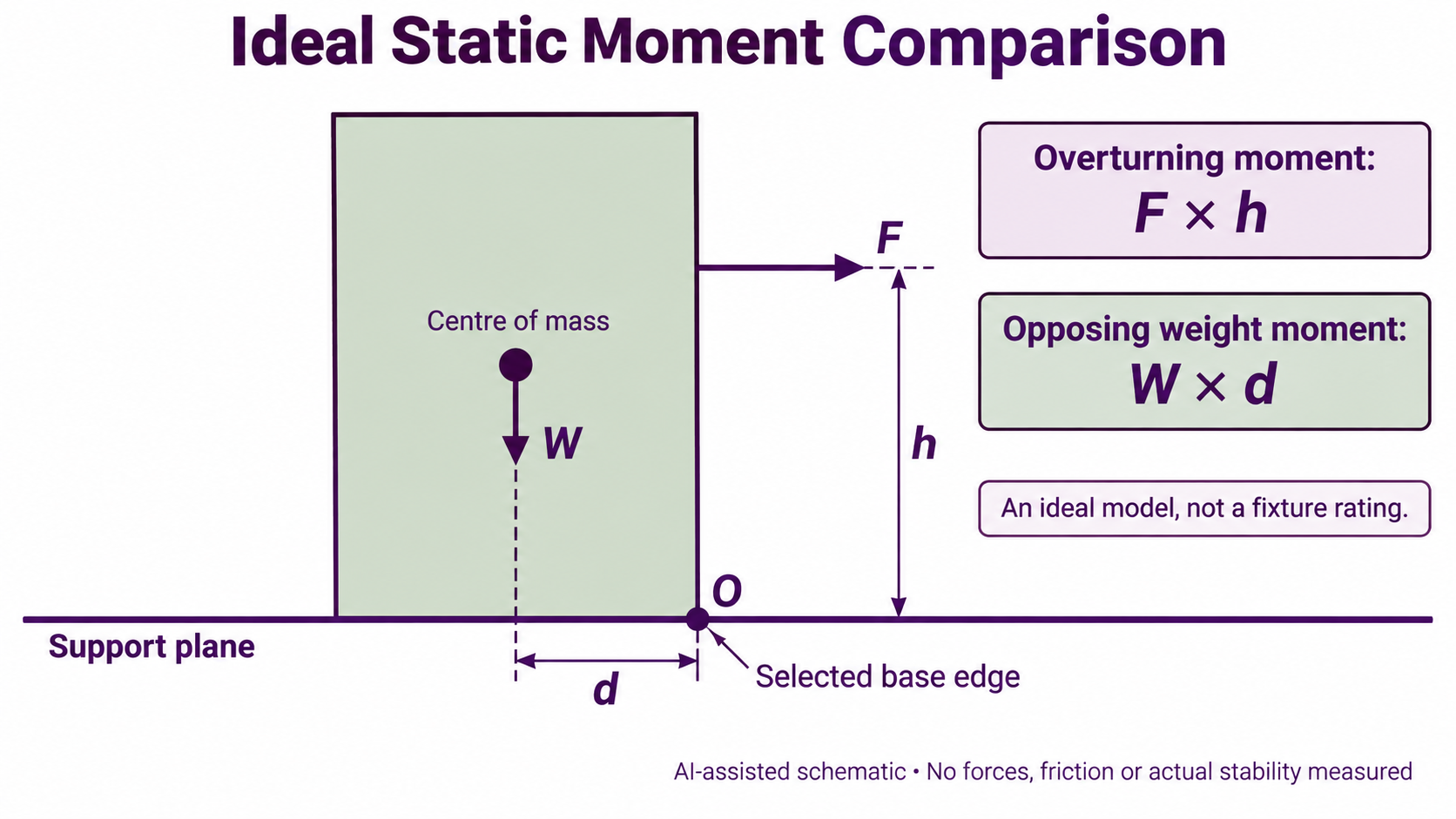
In a simplified static model, a horizontal force acting above the counter can create a turning effect about a base edge. The loaded weight can provide an opposing effect when its line of action is appropriately inside that edge.
The general moment-balance basis is described in OpenStax’s conditions for static equilibrium. The location of the force matters alongside its size.
For that idealized comparison, write the possible overturning moment as F × h, with h the perpendicular distance for the horizontal force. The opposing weight moment is W × d, with d the inward horizontal distance of the weight’s line of action from the selected base edge.
These symbolic relationships are not an acceptance calculation for a paperboard display. Their comparison assumes an appropriate rigid, stationary model and excludes unestablished effects such as prior sliding, flexible deformation or additional supports.
No numerical force or safe product arrangement follows without the relevant actual basis.
A Partially Emptied Display Can Have a Different Mass Distribution
Imagine a hypothetical counter display with products at a lower and an upper level. Staff or customers remove some of the lower products while others remain above.
Depending on the assumed product masses and positions, the loaded centre of mass can change. The total weight also changes. The footprint can remain the same while the force-and-moment relationship is different.
This does not establish that fewer products always make a display less stable. Removing a particular product can shift the distribution in different ways, and no values are assigned to the example.
It also does not establish that the remaining arrangement tips. The relevant conclusion is narrower: the original full-state observation does not answer the changed-state question by itself.
If an intended pickup or replenishment action adds a horizontal or eccentric force, that action introduces another condition beyond the remaining products’ static positions. It should not disappear inside a generic description of “the same display.”
Access and Stability Ask Different Questions
The front-wall access guide considers how a customer reaches and removes the sale-ready unit. A workable grip route does not establish the loaded display’s response to the forces introduced by that action.
The replenishment-pattern guide identifies different stock and refill arrangements. Those arrangements can also provide inputs to the mass-distribution question, without turning the refill record into stability evidence.
The same distinction applies to a clear neighboring-product path. Avoiding a collision is useful, but it does not supply a tipping threshold for the fixture.
Sliding, Deformation and Additional Support Remain Separate Possibilities
An actual display can slide or deform rather than behave as a rigid body rotating about a selected edge. Counter contact, structure and any intended attachment can affect which response is relevant.
Thus the position of a drawn centre-of-mass point cannot, on its own, certify the entire display. The point also is not measured merely because an illustration places a dot inside the base.
The static model explains why footprint, mass position and force application matter. It does not replace evidence for the actual constructed fixture and intended use.
Compare the Stock States That Change the Mechanical Question
For a proposed counter display, identify the support footprint, the intended full and remaining product positions, and the actions that can introduce relevant forces. Keep those inputs connected to the construction being offered.
If the available evidence covers only a full stationary arrangement, retain the limits when considering a different stock state or pickup action. The responsible technical party should determine any appropriate evaluation and acceptance basis.
Packrivo can coordinate layout, construction and supplier questions. It does not certify retail-fixture stability or prescribe a safe force or loaded arrangement through project coordination.
A display’s capacity and front profile do not define its tipping behavior. The relevant comparison retains the support footprint, loaded centre of mass and the action being considered.
Source scope: Public OpenStax stability and static-equilibrium material accessed 11 October 2026. It supports general mechanics, not a counter-display conformity standard. The F × h and W × d expressions are ideal symbolic moments only; no actual masses, dimensions, forces, friction, restraint or fixture performance is established.
Name the remaining stock state without predicting its balance
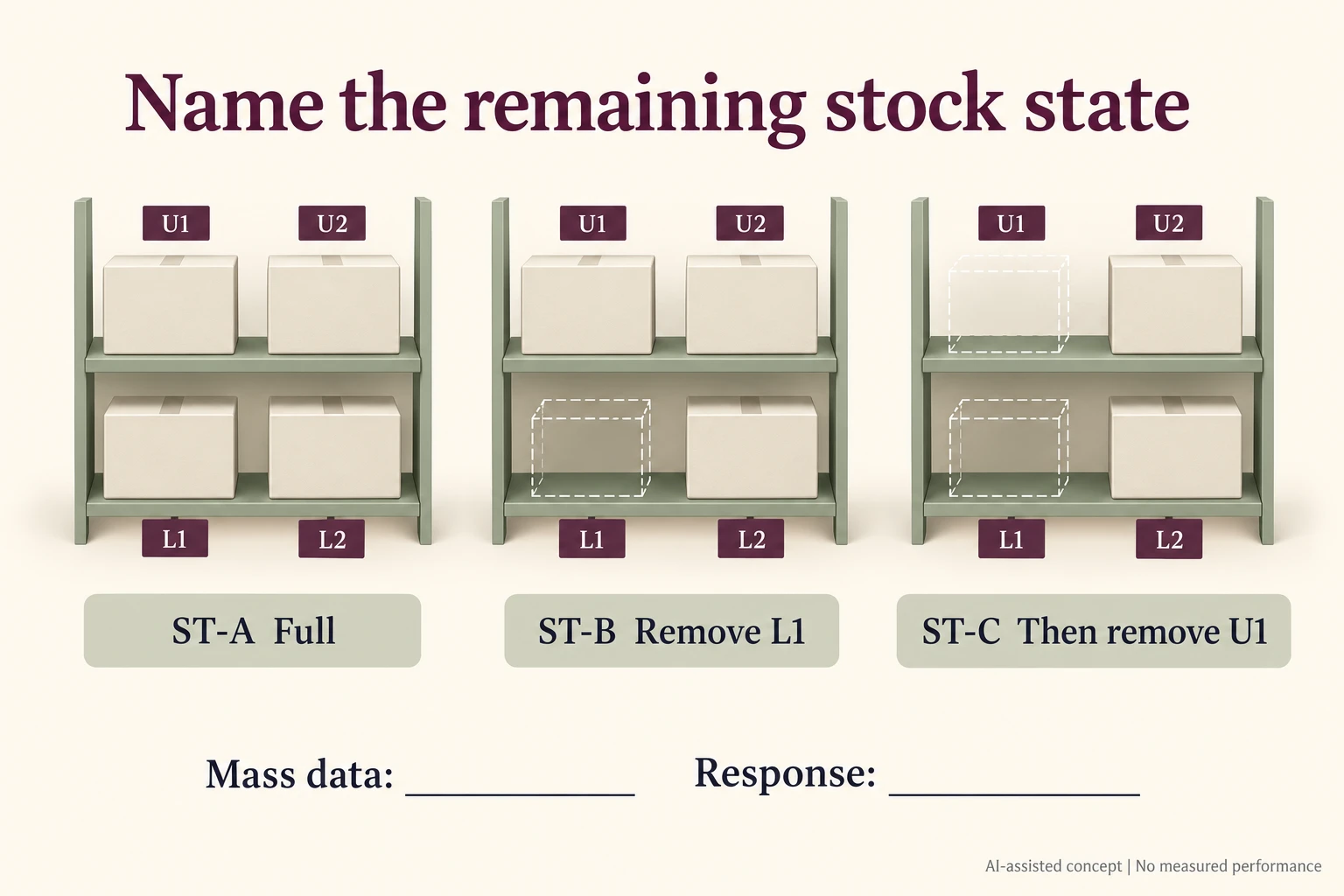
An invented two-level fixture D-H uses position IDs U1, U2, L1 and L2. The state register distinguishes which units remain, which move and which action is considered. Product masses and centre-of-mass coordinates are unknown.
Scroll horizontally if columns extend beyond the view.
| State | Occupied positions | Staff action | Unresolved mechanical question |
|---|---|---|---|
| ST-A | U1 U2 L1 L2 | None assumed | Complete full-state support and response |
| ST-B | U1 U2 L2 | L1 removed | Changed mass distribution |
| ST-C | U2 L2 | U1 removed after ST-B | Another remaining arrangement |
| ACT-H | State must be named | Pickup or refill as separate action | Applied action, contact and support scope |
A count of three units does not specify ST-B unless their positions are recorded. If staff move L2 toward the front, give that a new state reference instead of treating the layout as unchanged.
Keep actual counter contact and any intended attachment with the fixture revision. The support footprint is not inferred from the header width. Sliding, flexible deformation and rotation are different possible responses, none of which this state map predicts.
Do not place a computed-looking centre-of-mass dot on an unevaluated layout. The original symbolic F×h and W×d explanation remains useful within its assumptions, but this register supplies no force, moment, tipping limit or safer stock arrangement.
Download the counter display tipping stability record (.csv). HYPOTHETICAL rows are invented examples. Use ACTUAL_BLANK for permitted project inputs; replace that row label only when recording actual facts. Empty evidence, observation and date fields mean unknown or not performed, never acceptance. Keep checkpoints and revisions separate.
Bring the occupied-position map and actual support arrangement through the existing enquiry route before extending full-state evidence to a depleted display. Packrivo coordinates independent suppliers. These records establish no supplier offer, service availability or MOQ exception; its published baseline is 500 pieces per product/design.