
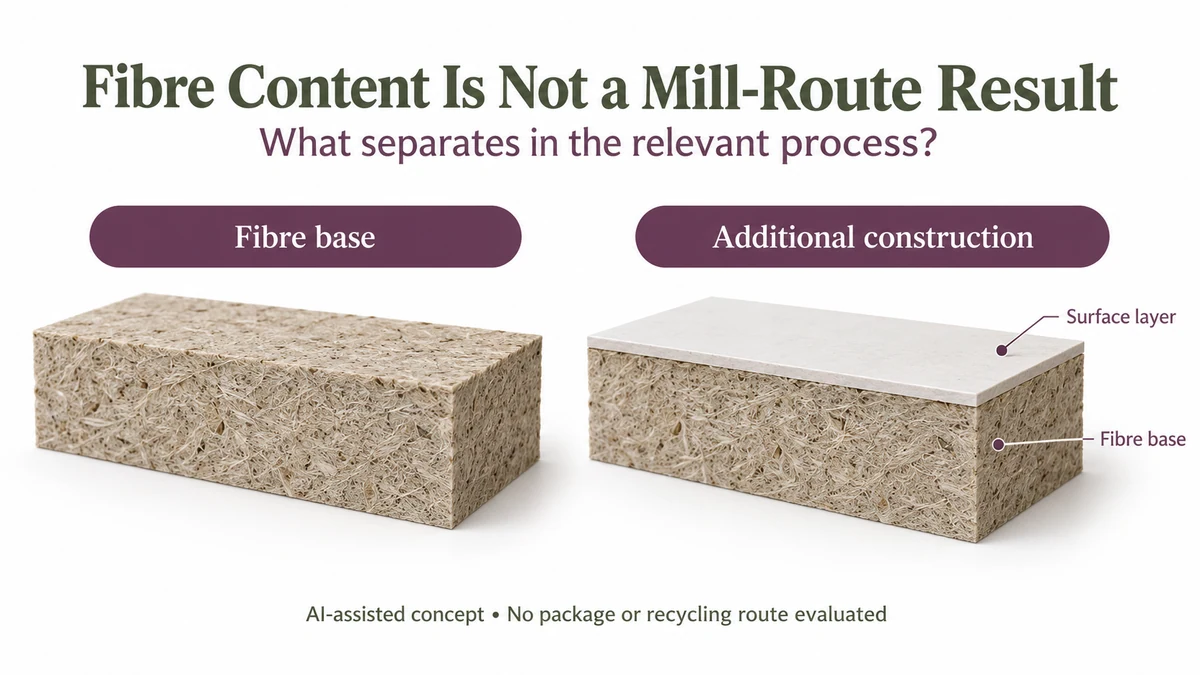
The presence of paper fibre does not establish that every supplied packaging construction can be processed successfully through a particular recycling mill. Recovering fibres, separating other constituents and obtaining suitable pulp are related but different parts of the technical question.
For a gift brand considering a coated or composite paper package, identify the finished construction and the processing route behind its evidence. A technical result for one route does not establish acceptance by every mill or by the customer’s local collection programme.
No package, fibre yield, screening result or local recycling route is verified in the hypothetical example below.
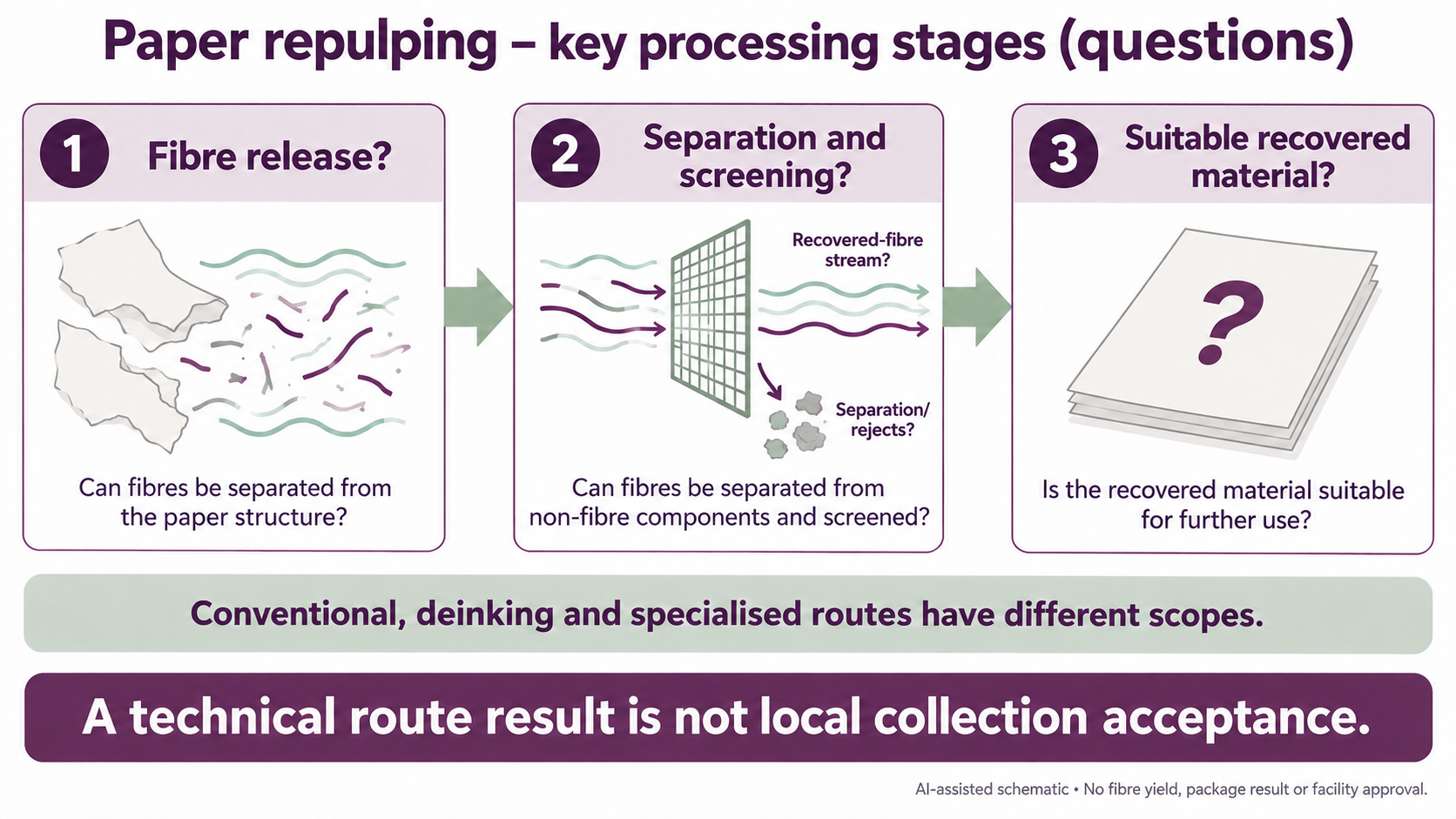
Fibre Release Is One Stage, Not the Complete Result
A fibre-based construction can also contain print, coatings, films, adhesives and other materials. During repulping, the relevant question is how the supplied construction behaves in the processing arrangement, not only whether its base contains cellulose fibre.
The public Cepi conventional-process laboratory method distinguishes disintegration, screening and subsequent assessments of the accepted material. Those stages illustrate why releasing fibre is not identical to obtaining suitable pulp from the complete construction.
Parts of the item may separate into reject material, while other constituents remain relevant to the recovered stream or its sheet behavior. The outcome depends on the actual construction and evaluation; it cannot be inferred from a generic paper label.
This explanation does not prescribe a laboratory or home repulping procedure. No mass fraction, screen dimension or passing criterion is transferred to a gift package.
The Other Layers Can Change What the Route Has to Handle
A broad fibre description can leave the attached construction unresolved. A film, coating or adhesive is not automatically represented by the same evidence as the underlying board.
How constituents separate, what remains in the accepted material and what has to be removed are relevant technical questions. A change in those behaviors can matter even if the declared fibre base stays the same.
That does not mean that every coated paperboard item is unrecyclable or that removing every layer is possible or necessary. An actual technical assessment has to describe the construction and route it evaluated.
It also does not support telling consumers to scrape, heat or peel an unknown bonded layer. Consumer separation and industrial processing are different operations.
Different Mill Routes Have Different Processing Boundaries
4evergreen’s current public evaluation toolbox distinguishes conventional recycling, flotation deinking and specialised processing routes. Its 2025 update announcement explains the broader route coverage rather than treating all mills as one interchangeable system.
A flotation-deinking route addresses ink-related processing within its particular system. A specialised route can have another target construction and arrangement. Naming one of those routes does not establish that any nearby recycling facility uses it or accepts the gift package.
Similarly, evidence for a specialised construction should not silently become a conventional-mill result. The process scope is part of the meaning of the evidence.
The technical question is therefore “compatible with which stated route?” rather than “does it contain paper?”
Two Hypothetical Boxes Can Share a Fibre Base but Differ Elsewhere
Imagine two paper-box proposals based on the same assumed fibre material. One proposal adds a composite covering layer and a different bonding construction.
The example assigns no grades, test results or recycling outcomes. It does not declare either box recyclable or unrecyclable.
The shared fibre base does not settle how the new covering and bonding behave during processing. A relevant record for the first proposal cannot automatically establish the response of the second if it did not include that construction.
The brand can retain the useful fibre information while leaving the added-construction question open. The next decision is whether suitable technical evidence covers the offered assembled material within the relevant route.
Changing the processing route can also change the evidence needed. Neither a broader label nor another facility icon closes that gap.
Technical Compatibility Does Not Provide a Household Disposal Instruction
The component-disposal map addresses customer separation and a named household collection service. This article addresses the technical processing question inside an appropriate mill route.
Those stages inform different decisions. A route-specific technical result does not identify whether a local programme collects the item, whether sorting sends it to the relevant process or whether the receiving operator accepts that finished construction.
The recycled-content and recyclability guide also separates a material’s prior content from its end-of-life claim. Recycled fibre in a proposal is not, by itself, evidence for another successful processing trip.
Likewise, paper repulping should not be renamed as compostability. Recovering fibre for a material stream and biological processing into compost are different routes.
Match the Offered Construction to the Relevant Technical Evidence
For an actual proposal, keep the base, attached layers, print and bonding identifiable. Check which route and supplied construction the offered technical evidence covers before interpreting its conclusion.
If a layer or bonding change falls outside that record, retain the unestablished part rather than assigning a whole-item result from the fibre description. The responsible material or recycling technical party must determine the relevant assessment.
Packrivo can coordinate construction and documentation questions. It does not operate a recycling mill, perform repulping evaluation or verify a locality’s acceptance through project coordination.
Paper fibre can be a useful input without being a complete processing verdict. Keep fibre release, separation, pulp suitability and the particular route distinct.
Source scope: Public industry information accessed 11 October 2026. 4evergreen’s update announcement refers to 31 January 2025 and is posted 5 February 2025; its current toolbox identifies several routes. The linked conventional-process Cepi PDF is version 3, February 2025, updated edition June 2026. Its scope, principle and relevant stage descriptions were used, not claimed as a full sixteen-page method execution or complete protocol assessment. European technical-route information is not a local collection standard or a finding for actual gift packaging.
A construction-route matrix locates the uncovered change
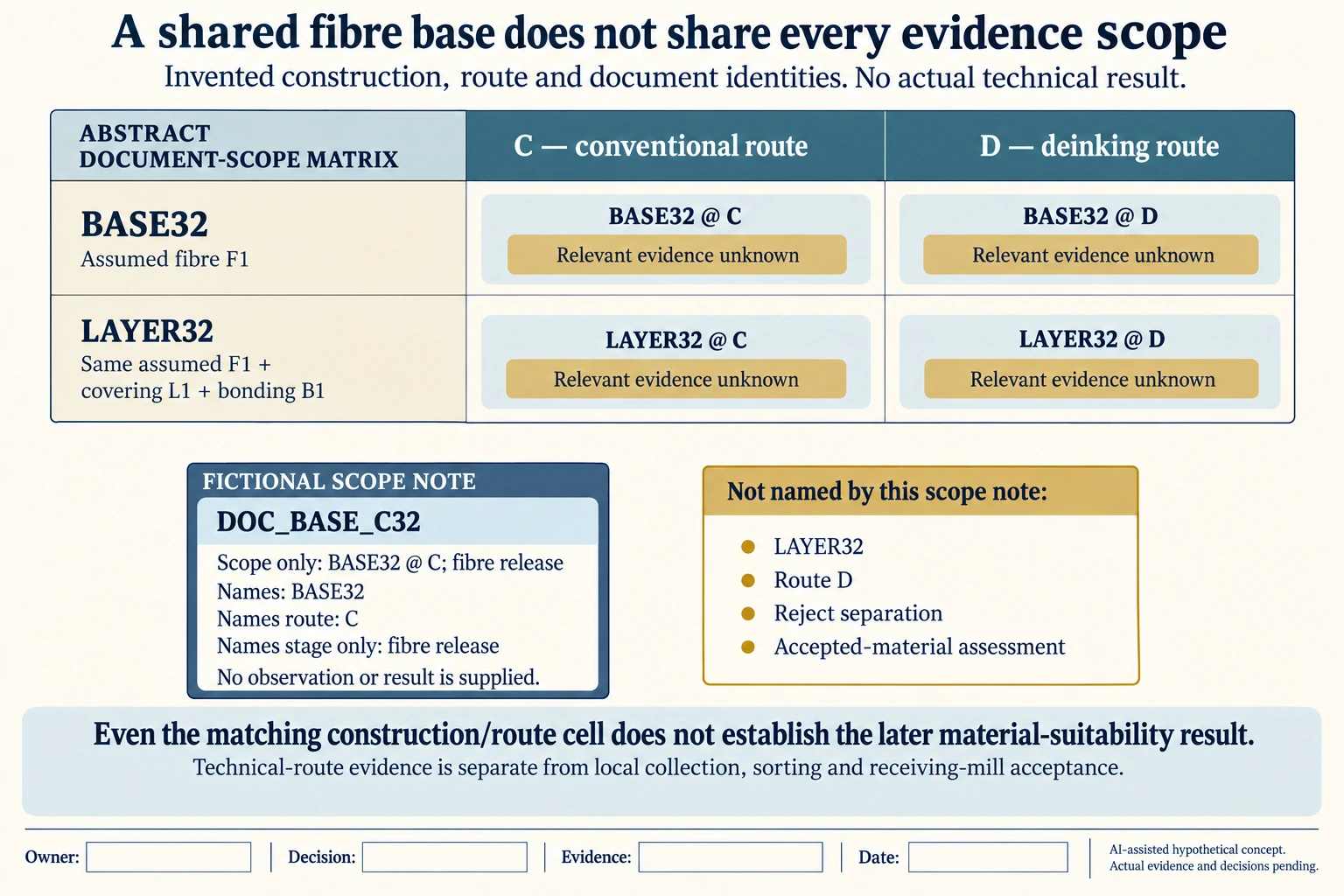
Keep two comparison axes separate. In an invented matrix, BASE32 uses an assumed fibre base F1, while LAYER32 adds covering L1 and bonding B1 to that same base. Each is considered against a named conventional route C and a separately named deinking route D. These tokens identify hypothetical configurations and scopes; they are not tested specimens, grades or results.
A record addressing BASE32 at C answers neither LAYER32 at C nor BASE32 at D merely because F1 is unchanged. The first move changes the construction; the second changes the processing route. Moving diagonally changes both. Put the offered record beside the exact construction and route it actually describes, then identify which move requires another technical response. No route is assigned a pass or fail in this matrix.
Make that coverage test concrete with DOC_BASE_C32, an invented scope note naming BASE32, conventional route C and fibre release only. Its stated subject does not name LAYER32, route D, reject separation or accepted-material assessment. Even the matching BASE32/C cell therefore leaves the later material-suitability question open. This exercise concerns what a fictional document names; it supplies no release observation or favourable result.
Within that response, keep fibre release, reject separation and the accepted-material assessment distinct. A fibre-release observation alone cannot fill the other stages. The matrix is an evidence-applicability aid, not a laboratory protocol or a route score. Local collection, sorting and receiving-mill acceptance remain additional questions; no consumer scraping, heating or peeling action is proposed.
| Hypothetical scope | Object and relationship | Input, formula or open question |
|---|---|---|
| BASE32_FIBRE | F1 — ASSUMED_SAME_FIBRE_BASE | Same assumed fibre identity only; no actual grade |
| BASE32_C | FINISHED_CONSTRUCTION — REQUIRES_MATCHED_EVIDENCE | BASE32@C; No report, score, yield or route outcome assigned |
| BASE32_D | FINISHED_CONSTRUCTION — REQUIRES_MATCHED_EVIDENCE | BASE32@D; No report, score, yield or route outcome assigned |
| LAYER32_FIBRE | F1 — ASSUMED_SAME_FIBRE_BASE | Same assumed fibre identity only; no actual grade |
| LAYER32_C | FINISHED_CONSTRUCTION — REQUIRES_MATCHED_EVIDENCE | LAYER32@C; No report, score, yield or route outcome assigned |
| LAYER32_D | FINISHED_CONSTRUCTION — REQUIRES_MATCHED_EVIDENCE | LAYER32@D; No report, score, yield or route outcome assigned |
| LAYER32_ADDED | L1_PLUS_B1 — ADDS_TO | F1; Hypothetical covering and bonding not covered by shared-fibre identity |
| DOC32_CONSTRUCTION | DOC_BASE_C32 — NAMES_CONSTRUCTION | BASE32; Invented scope note, no actual record or test result |
| DOC32_ROUTE | DOC_BASE_C32 — NAMES_ROUTE | C_CONVENTIONAL; Invented scope note, no actual record or test result |
| DOC32_STAGE | DOC_BASE_C32 — NAMES_STAGE_ONLY | FIBRE_RELEASE; Invented scope note, no actual record or test result |
| DOC32_LAYER_GAP | DOC_BASE_C32 — DOES_NOT_NAME | LAYER32; Invented scope note, no actual record or test result |
| DOC32_ROUTE_GAP | DOC_BASE_C32 — DOES_NOT_NAME | D_DEINKING; Invented scope note, no actual record or test result |
| DOC32_LATER_GAP | DOC_BASE_C32 — DOES_NOT_NAME | REJECT_SEPARATION_OR_ACCEPTED_MATERIAL_ASSESSMENT; Invented scope note, no actual record or test result |
| ROUTE32_FIBRE_RELEASE | FIBRE_RELEASE — DISTINCT_STAGE_SCOPE | Unknown actual result, not a test procedure |
| ROUTE32_REJECT_SEPARATION | REJECT_SEPARATION — DISTINCT_STAGE_SCOPE | Unknown actual result, not a test procedure |
| ROUTE32_ACCEPTED_MATERIAL_ASSESSMENT | ACCEPTED_MATERIAL_ASSESSMENT — DISTINCT_STAGE_SCOPE | Unknown actual result, not a test procedure |
| ROUTE32_COLLECTION | TECHNICAL_ROUTE — DOES_NOT_ESTABLISH | LOCAL_COLLECTION_OR_MILL_ACCEPTANCE |
Download the comparison and project record (.csv). Includes the article’s model branches and fields, labeled teaching examples and blank project rows. Enter actual materials, measurements, decisions, decision owners and source evidence before using it for a project.
For the separate question, read Mixed-Material Gift Packaging Needs a Component Disposal Map.
For the separate question, read Compostable Packaging Needs a Disposal-Condition Claim, Not Just a Material Name.
Source scope checked 17 October 2026: Cepi conventional-process method is Version 3 February 2025, updated June 2026; the current 4evergreen protocol has a June 2026 updated edition. The 2025 announcement remains historical. Selected public scope/stages do not constitute execution or full protocol assessment; conventional, deinking and specialised routes and local collection are distinct.
Public references for that scope: Cepi conventional-process method, Version 3 updated June 2026.
Discuss this packaging specification with Packrivo. We coordinate independent suppliers. MOQ: 500 pieces per product/design; illustrative quantities are not production offers. Confirm materials, samples, price and timing for your project.