
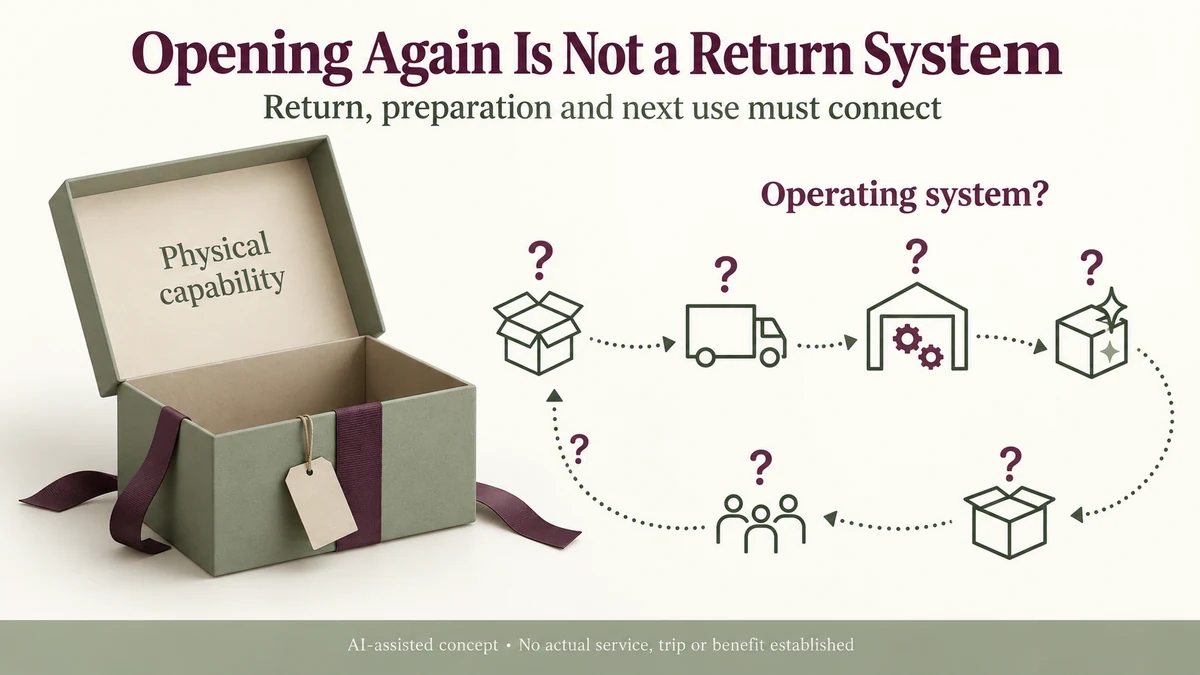
A durable gift box that a customer can keep is not, by itself, an operating packaging-return system. Repeated business use also needs a route by which the packaging returns, is assessed and appropriately prepared, and is made available for another packaging trip.
For a brand planning that model, distinguish physical capability from an actual circulation arrangement. The fact that a lid can open again does not establish a return rate, completed reuse trips or environmental benefit.
This article describes a hypothetical proposal. Packrivo does not claim to operate the system or supply a tested reusable box.
A Repeated Packaging Trip Includes More Than Another Opening
In an organised return model, the package leaves with a product, becomes available for return after use and must reach the party responsible for its next role. The returned item is then assessed and appropriately prepared before another intended packaging use.
The public abstract of ISO 18603:2013 includes associated systems within the reusable-packaging assessment scope. A material or box capability cannot silently replace that broader system question.
The Ellen MacArthur Foundation’s reuse-model explanation distinguishes user refill from business-managed return arrangements, including responsibilities for cleaning and redistribution in the relevant models. These are general models, not evidence that a particular gift-box service exists.
Who receives the box, what happens to it next and how it re-enters use are part of the proposal’s function. An arrow drawn back toward a warehouse does not establish any of those operations.
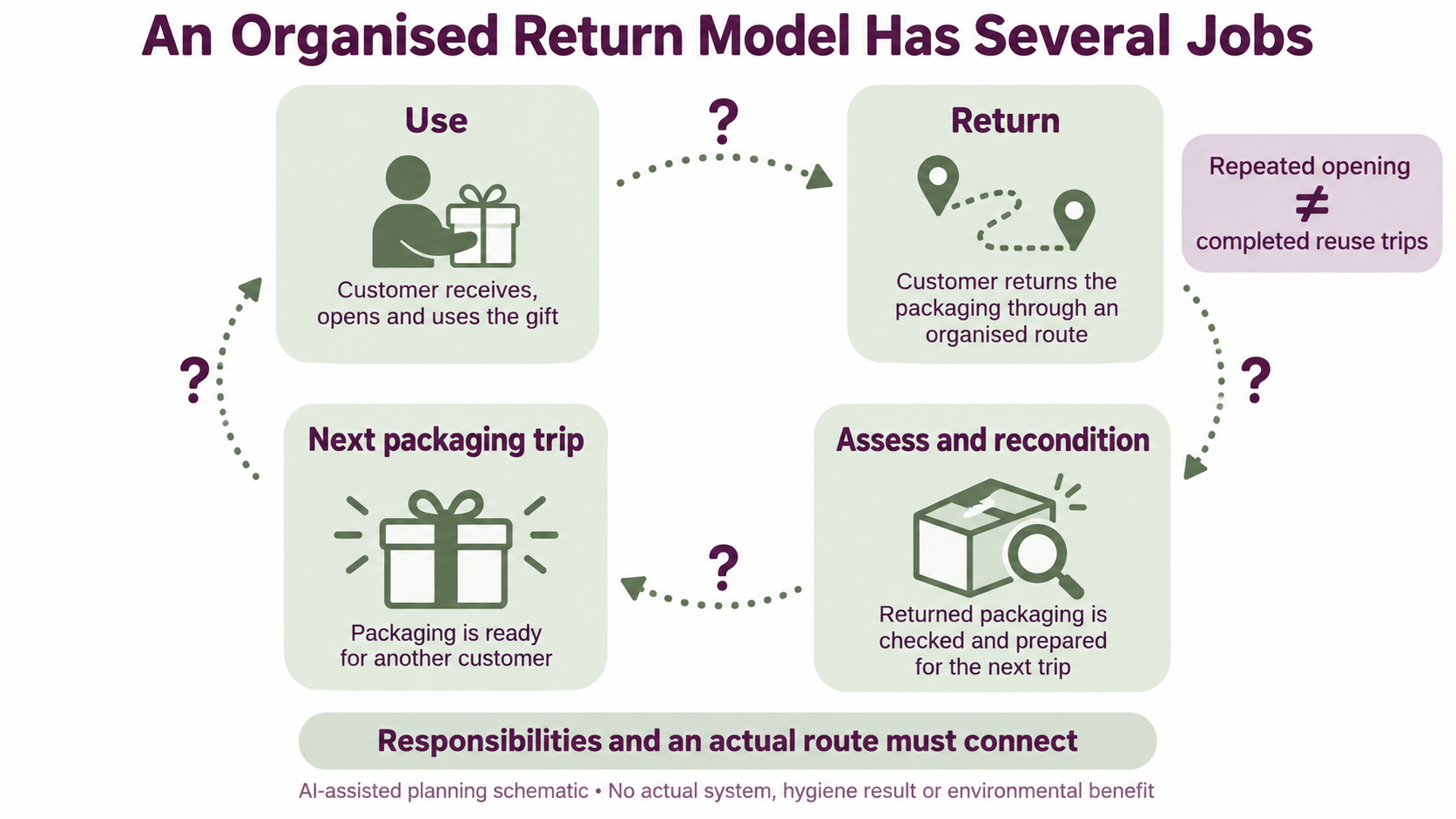
Returned Condition Has to Match the Next Intended Use
A returned package can differ from its delivered condition. The contents, handling and return journey can affect components, appearance or function.
The system therefore needs a basis for deciding whether the actual returned item is suitable for the next intended packaging role. That is different from assuming every returned box is usable or treating a surviving hinge as the only relevant condition.
Appropriate reconditioning depends on the construction and intended use. It may involve evaluation and preparation of the relevant components; the article does not prescribe washing, heating, solvents or a universal cleaning process for paperboard or another material.
Nor does a visual tidy-up establish hygiene, product-contact suitability or performance. The responsible parties must define what the next use requires and the evidence that supports it.
A Hypothetical Box Can Open Ten Times Without Completing Ten Trips
Imagine a brand’s proposal for a keepsake gift box. Even if the construction could be opened ten times under a defined basis, that capability would not mean ten completed return-and-reuse trips occurred.
The ten openings are an assumed comparison, not a performed test or established lifetime. No actual successful opening count is supplied.
Suppose the brand has no identified return point, no party responsible for preparing returned boxes and no operating redistribution route. The missing evidence concerns the system, not another photograph of an open lid.
A customer might still retain the box for private storage. That is a possible further use, but it does not establish the brand’s organised return service or a measured replacement of other packaging.
The useful next decision is whether the brand intends to support that customer-retention use or develop a separate return model. Those choices need different evidence and descriptions.
The Return Route Connects Users and Operations
For a return proposal, the customer needs an actual route for the named package. The receiving operation needs to identify the returned construction and handle it according to its supported next use.
A future intention is not the same as an available collection point or service. A route for another container variant may not represent this box. Changes to the package or sales area can change the operational question.
The system also needs to account for items that are not returned or cannot be used again. Their existence does not automatically invalidate a proposal, but ignoring them would turn physical capability into an unsupported circulation assumption.
No return percentage, number of trips or operational efficiency is assigned here. An actual model would need its own data and responsibilities.
Refill, Customer Retention and Business Return Have Different Boundaries
The refill-route guide concerns how the original container receives replacement contents and the US claim context. A refill product or collection-and-refill offer is not automatically the same as returning a gift box for another outward packaging trip.
Keeping a gift box for another household purpose is a third possible arrangement. It does not, by itself, establish a provided refill or business-return route.
These distinctions let a brand describe the proposition it actually supports, instead of treating all possibilities as one generic reusable system.
Physical durability remains relevant within each proposition. Its scope still has to match the intended repeated function; the system does not create an unlimited box lifetime simply by providing a return address.
An Operating Route Does Not Independently Prove Environmental Superiority
A functioning return arrangement is one necessary part of an organised model. An environmental comparison would also need an appropriate basis for the actual trips, preparation, transport, losses and the alternative packaging function.
The Foundation’s returnable-packaging study overview discusses modeled systems under stated conditions. Its results should not be transferred as benefit percentages for an unmeasured gift-box proposal.
Likewise, a count of lid movements does not provide a lifecycle assessment. The material-claim scope guide keeps the proposed wording and evidence separate from a broad capability statement.
Decide What Must Exist Before Calling the Proposal a System
For the hypothetical brand, identify the return route, receiving responsibility, appropriate assessment/reconditioning basis and next packaging use. If those operations are only planned, keep the system description provisional.
Packrivo can coordinate the construction and supplier questions. It does not establish a customer return service, prepare actual returned packaging, certify a reuse system or approve environmental wording through project coordination.
Opening again is a physical action. An organised reuse trip also requires the return, preparation and next-use arrangement that makes the action part of a functioning system.
Source scope: Public sources accessed 11 October 2026. ISO 18603:2013 is edition 1, published January 2013 and confirmed 24 January 2024; only its catalogue abstract was read, not the paid twelve-page procedure. The Foundation’s public model descriptions and 2023 study overview concern their stated system contexts, not Packrivo performance. No actual box lifetime, return rate, completed trip, cleaning outcome, legal claim approval or environmental saving is established.
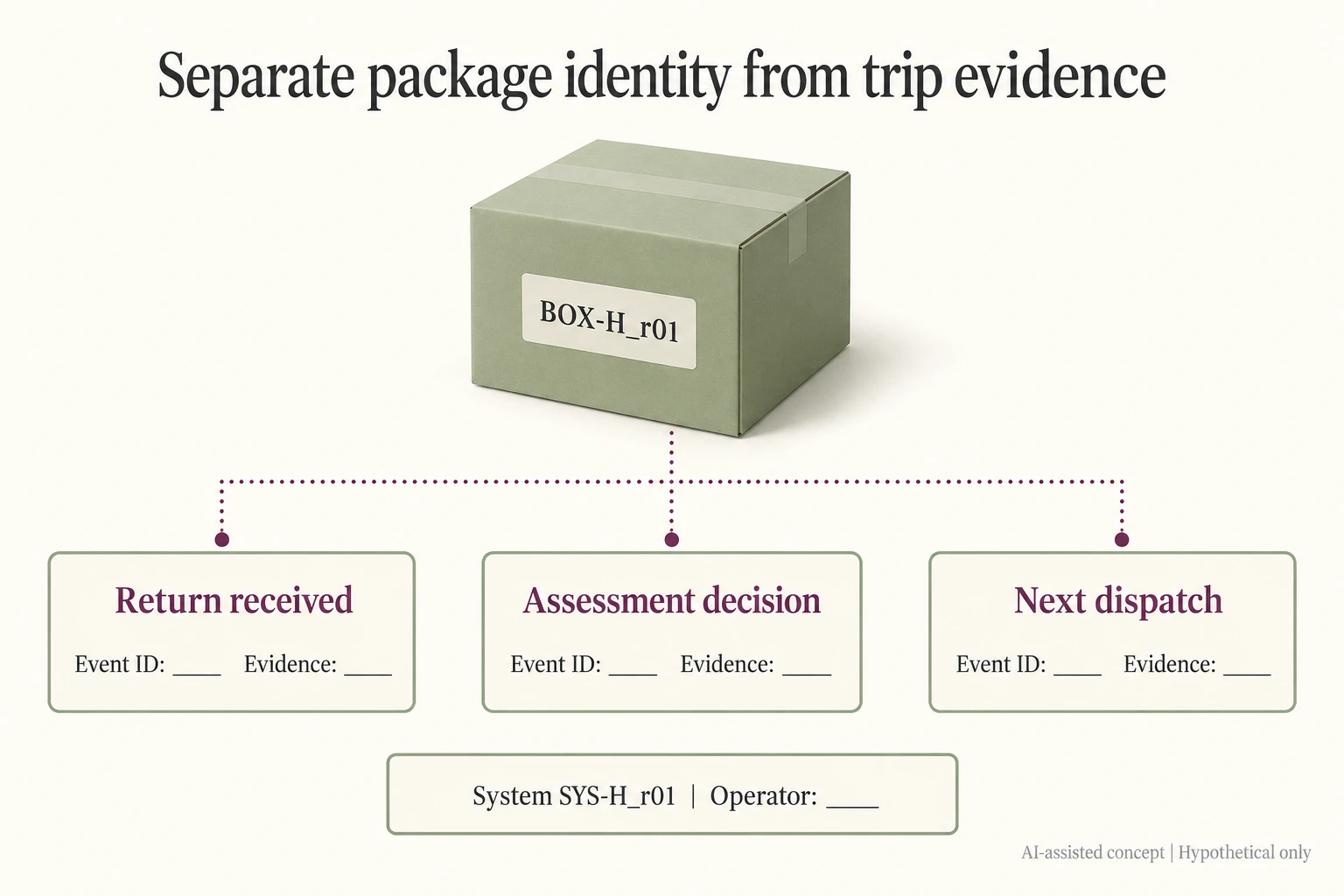
Keep package identity separate from circulation events
A proposed system needs event evidence, not just a reusable-looking object. This new hypothetical register names package BOX-H_r01 and system proposal SYS-H_r01; neither refers to an operating Packrivo programme.
Scroll horizontally if columns extend beyond the view.
| Record | Identity retained | Evidence still missing |
|---|---|---|
| Return received | BOX-H_r01 / SYS-H_r01 and an individual item ID | Actual route, receiver and event reference |
| Assessment decision | Same returned individual item and next-use requirement | Decision evidence; not preparation completion |
| Preparation completed | Same assessed individual item | Separate actual completion, operator and date evidence |
| Next dispatch | Same identified item after documented preparation | Dispatch evidence alone does not establish completed next use |
| Next use confirmed | Same individual item used again | Actual additional-use event evidence; no assumed count |
| Not returned | Expected item not received | Separate non-return status; no assumed circulation |
| Returned but not suitable | Received item excluded by an assessment | Separate disposition; no assumed preparation or dispatch |
| Replacement proposal | A separate new individual identity and history | Link the replaced item, but inherit none of its completed counts |
For this illustrative ledger, completed_trip_count records evidenced completed outward transport; completed_reuse_count records an evidenced additional use of the same individual item. Return, assessment, preparation and dispatch are separate events and none alone establishes completed reuse. A replacement needs a new individual item ID and history and inherits no completed count. The HYPOTHETICAL rows are possible record types, not performed events; actual item IDs, operators, observations, counts and dates remain blank.
Use an item-level identifier when actual circulation is recorded. A design revision identifies construction, while an individual item reference identifies which physical package returned. Several boxes sharing BOX-H_r01 are not one circulating item.
Do not count an offered return label as a received return, or a received return as another outward trip. Each event needs its own evidence. Leave the event ID and dates empty until a permitted actual record exists; the blank cells do not mean zero returns.
A preparation proposal cannot be marked completed from a tidy image. Keep the next-use requirement and responsible operator visible, without prescribing cleaning or claiming hygiene, lifetime or environmental benefit. A changed construction requires an applicability review before reusing the earlier assessment basis.
Download the returnable gift packaging system record (.csv). HYPOTHETICAL rows are invented examples. Use ACTUAL_BLANK for permitted project inputs; replace that row label only when recording actual facts. Empty evidence, observation and date fields mean unknown or not performed, never acceptance. Keep checkpoints and revisions separate.
Bring the package revision and unresolved operator/event roles through the packaging enquiry; physical packaging coordination does not establish a return operation. Packrivo coordinates independent suppliers. These records establish no supplier offer, service availability or MOQ exception; its published baseline is 500 pieces per product/design.