
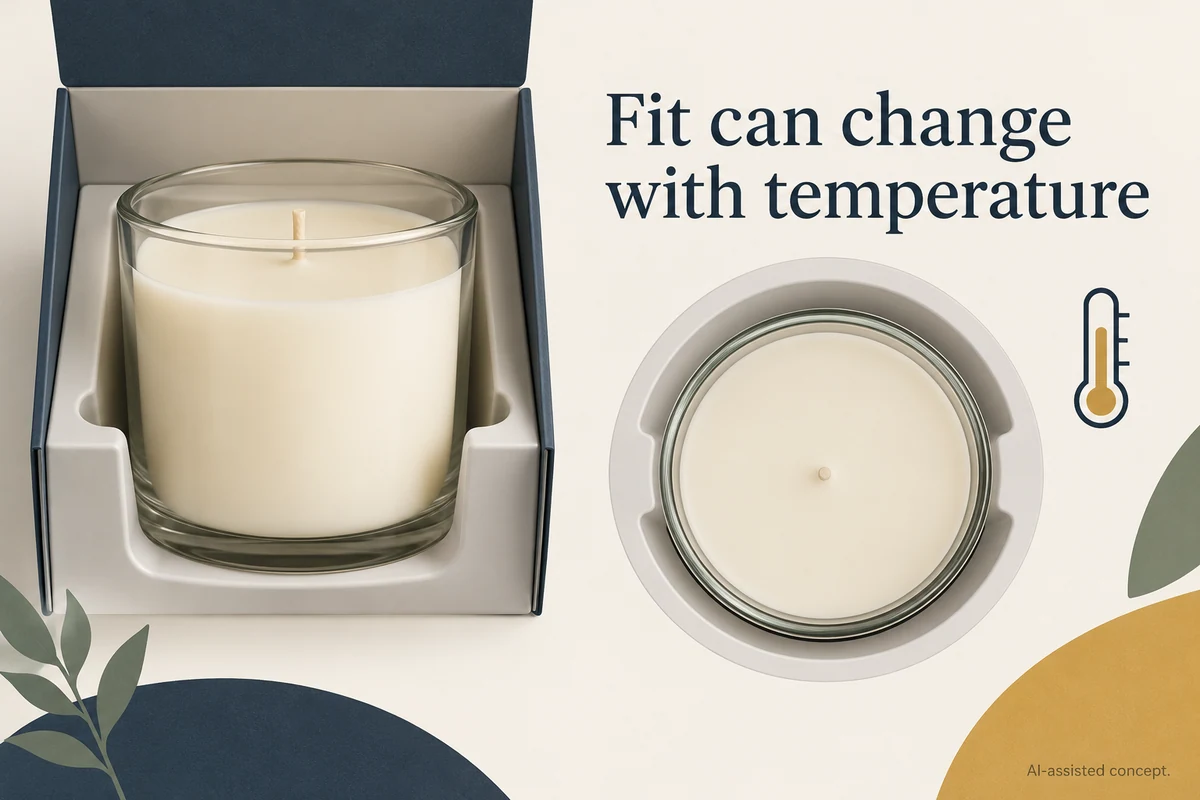
A jar and its insert needn't maintain the same relative dimensions when temperature changes. Different materials and constraints can produce different dimensional responses, so an acceptable fit at one state doesn't establish the gap at another.
A Die-cut insert is one possible holder construction to describe with the candle vessel. Record the actual jar and opening measurements at the intended states; the concept does not establish thermal expansion or a safe clearance.
For a candle brand comparing an insert, identify the jar exterior and the opening or contact geometry at the relevant conditions. A nominal room-temperature drawing leaves a separate thermal-fit question unresolved.
Clearance depends on two dimensions
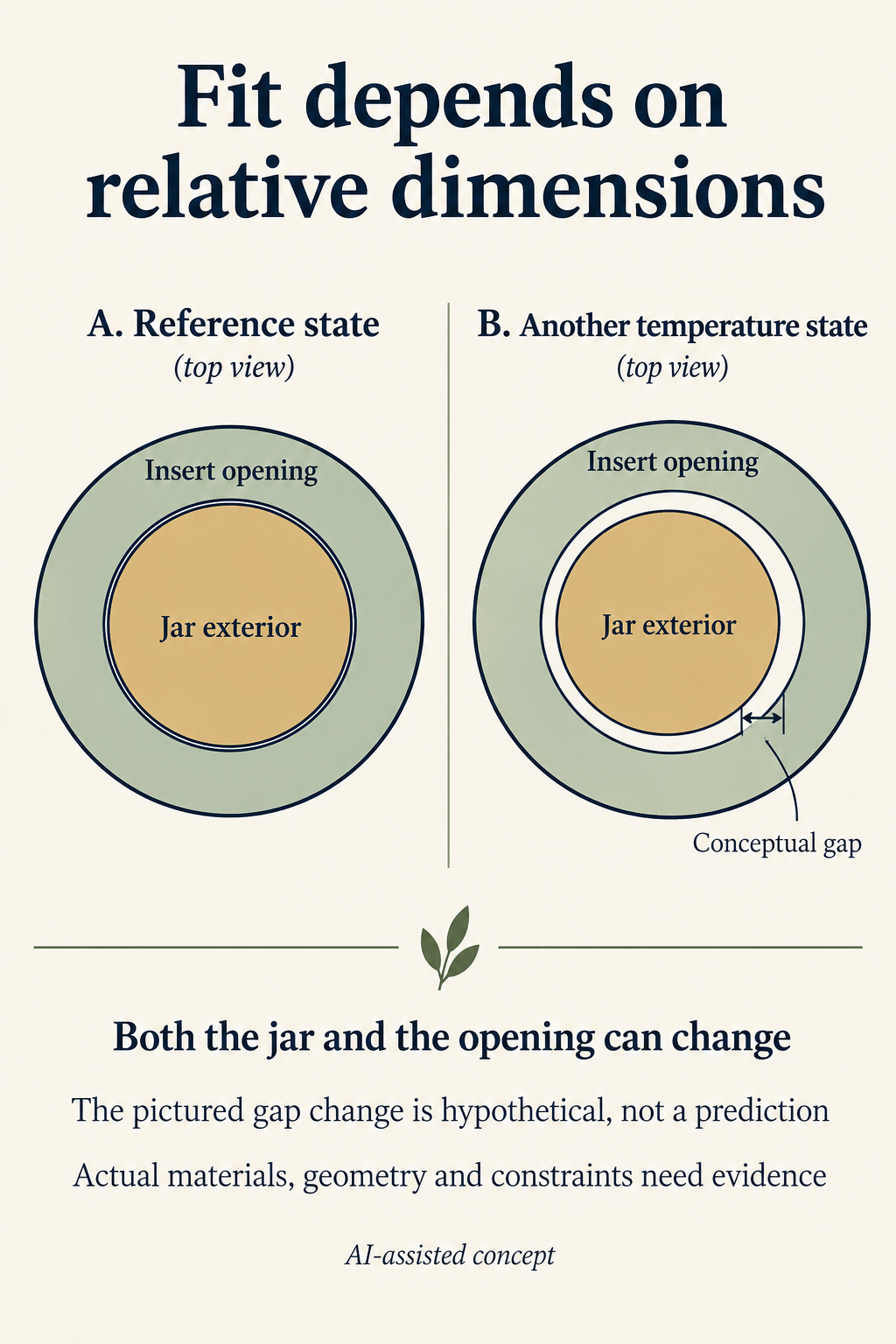
For a simplified circular section, diametral clearance is the opening diameter minus the jar's exterior diameter. Both quantities can change. Looking only at how much the jar expands would leave the opening's response out of the comparison.
OpenStax's thermal-expansion explanation describes temperature-related dimensional change and material dependence. Its typical coefficients aren't specifications for an unidentified candle jar or insert.
If the opening grows more than the jar at the compared section, the ideal geometric gap can increase. If the jar's relative change is greater, it can decrease. Those are conditional relationships, not predictions for a real pack.
An opening in a simple solid also changes
An opening isn't automatically squeezed smaller merely because the surrounding material expands. In an ideal homogeneous, unconstrained part under uniform warming, the opening changes with the rest of the geometry.
That simple model helps avoid a misleading mental picture, but a formed insert may be constrained, layered or unevenly heated. Its actual response can involve more than uniform expansion of one circular section.
The jar geometry may also vary with height. A clearance at the widest body section doesn't describe a shoulder, raised feature or contact near the lid. Keep the location of the intended comparison identified.
Follow a hypothetical two-temperature comparison
Imagine one identified glass jar and one plastic insert that fit at a reference state. The brand wants to understand the arrangement at another temperature. No material coefficients, measured gaps or temperature values are supplied in this teaching example.
The first question is which dimensions govern contact. If a circular opening locates the jar body, compare that opening and body section. If the insert supports the jar at discrete features, a full-diameter subtraction may not describe the actual contacts.
The next question is whether suitable material and geometry information exists for the relevant state. The label plastic is insufficient to assign a coefficient, just as glass doesn't identify every property of a particular jar construction.
A change in the predicted gap would then need interpretation against the required function. A larger gap isn't automatically better because retention may matter; a smaller one isn't automatically better because loading and removal may matter. No protection outcome follows from the gap alone.
Thermal change and manufacturing variation remain distinct
Component dimension ranges describe variation in the identified construction and measurement state. A temperature change introduces another input. Those questions may interact, but they shouldn't be collapsed into one nominal number.
The existing tolerance calculation concerns combined component ranges in a defined geometry. A thermal-fit comparison instead asks how the relevant dimensions may move between states. It needs its own suitable assumptions and material information.
Paper-based components can also respond to moisture. If an assembly contains board, wrap or a hygroscopic liner, don't attribute every dimensional change to temperature without considering the relevant construction and history.
Review the actual contact arrangement
Packrivo's candle glass contact map locates the jar, lid, insert and accessories. The insert fit guide helps distinguish product geometry from usable interior space.
Use those identities to specify the thermal-fit question to the appropriate technical party. Include actual materials, relevant geometry, constraints and intended conditions before applying a model or arranging a representative comparison.
This explanation provides no heating procedure, expansion coefficient, safe temperature range or guarantee against binding. The useful selection is based on the relative dimensions and contacts under relevant conditions, rather than the assumption that a fit checked once remains unchanged.
Keep both dimensions attached to the same state
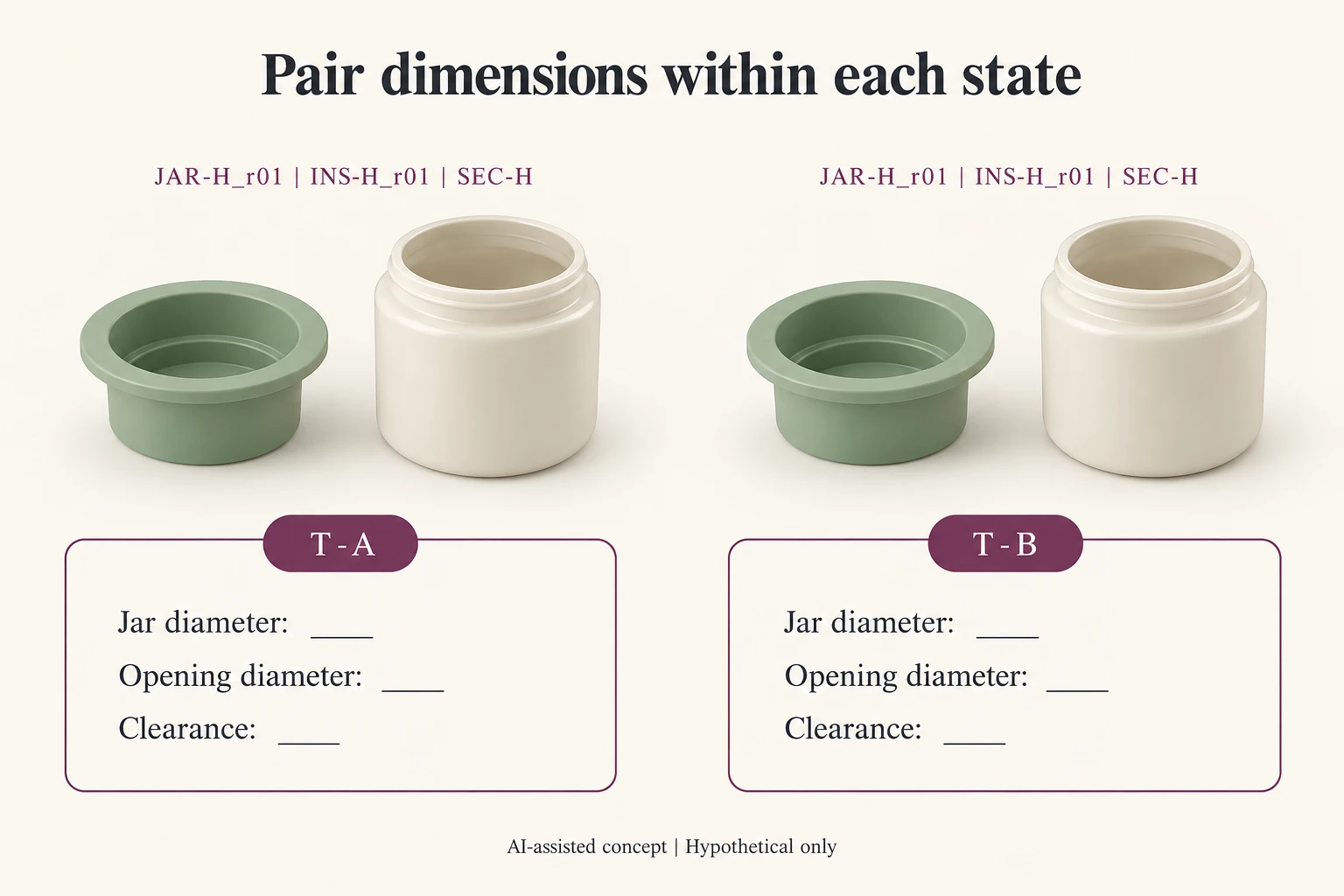
For a new hypothetical circular-section comparison, jar JAR-H_r01 and insert INS-H_r01 share section SEC-H. State T-A and state T-B are placeholders for relevant conditions, with no assigned temperature or dimension.
Scroll horizontally if columns extend beyond the view.
| State | Jar measurement | Opening measurement | Interpretation |
|---|---|---|---|
| T-A | JAR-H_r01 at SEC-H | INS-H_r01 at SEC-H | Same-state pair required |
| T-B | Same exact jar revision and section | Same exact insert revision and section | Both responses remain unknown |
| Constraint change | New configuration reference | New constraint reference | Do not attribute every change to material expansion |
| Discrete contacts | Full diameter may be inapplicable | Locate each contact | Use appropriate geometry rather than force subtraction |
Do not subtract an opening at T-A from a jar at T-B and label the difference a state clearance. The CSV keeps both measurements within the same row; a missing paired dimension leaves that clearance uncalculated.
Material names alone cannot populate expansion coefficients. Constraints, layers, moisture history and measurement section need to remain identifiable before a technical model is selected. A larger or smaller gap is not an acceptance decision by itself.
This record prescribes no heating, temperature range or coefficient. Both diagrams deliberately retain the same neutral geometry and blank dimension fields, so the illustration does not simulate a predicted temperature response or a binding-free result.
Download the candle jar insert thermal fit record (.csv). HYPOTHETICAL rows are invented examples. Use ACTUAL_BLANK for permitted project inputs; replace that row label only when recording actual facts. Empty evidence, observation and date fields mean unknown or not performed, never acceptance. Keep checkpoints and revisions separate.
Bring the exact component revisions, section and paired-state question through the packaging enquiry before extending one-state fit to another condition. Packrivo coordinates independent suppliers. These records establish no supplier offer, service availability or MOQ exception; its published baseline is 500 pieces per product/design.