

Compare stock and custom packaging against the same accepted packing requirement, then separate first-order cash from the number of packs you expect to use. A lower custom unit price can still require a larger initial payment. Unused boxes remain a separate stock decision.

Put the same product inside both routes
A stock box with a brand card and a custom-printed box may create different presentations. Before comparing their costs, decide which differences are acceptable. Both routes need to accommodate the actual product, insert, care information and intended handover.
Keep the comparison at one defined level. A customer-facing jewelry box needs its own fit decision; its parcel protection may depend on a separate outer pack. Don’t give one route a complete insert and shipping arrangement while pricing the other as an empty box.
Describe a stock route as the actual box plus the branding operations you would add. Record any card, label, assembly work or equipment separately. For custom packaging, identify the drawing, printed surfaces, setup charges and supplied state. The complete-set quote method helps expose those differences before a total is trusted.
Compare the cash for 200 expected uses
This example uses invented USD prices and assumes both arrangements have already been found suitable for the same product. Neither route describes available stock or a Packrivo quotation.
Scroll horizontally if columns extend beyond the view.
| First-period field | Stock box plus branding | Custom box |
|---|---|---|
| Boxes purchased | 200 | 500 |
| Assumed box price | $2.00 | $1.20 |
| Labels or setup | $60 labels | $120 setup |
| Initial cash | $460 | $720 |
| Boxes used in the period | 200 | 200 |
| Cash committed per used box | $2.30 | $3.60 |
| Boxes remaining | 0 | 300 |
The custom route needs $260 more cash during this period. It also leaves 300 boxes that might serve future demand. Their usefulness depends on the design staying current, appropriate storage and actual later orders.
Cash divided by boxes used is a planning ratio. It does not establish the accounting expense of that period or justify writing off every remaining box. Keep the purchase amount and residual stock visible beside the ratio.
Change demand without changing the comparison
If expected use rises, request a new quantity basis for the stock route. Don’t assume its original price applies to every later purchase. Similarly, ask whether further custom orders reuse setup and which charges recur.
A stock route may add more local branding labor than the custom route. Include that work only on a consistent basis: either both totals include measured packing work or both show it separately. The same rule applies to freight, tax and storage.
Choose a planning horizon you can explain. Comparing one month of stock purchases with a year’s expected custom-box consumption makes the larger order appear easier to justify without resolving the initial cash requirement.
Request the two offers you can actually evaluate
Prepare one product and fit brief, then request two complete supply routes. Your comparison should return a first-period payment total, a usable stock count after expected demand, and the work still required at your bench. If a route cannot meet the necessary function, remove it before ranking its price.
Sources and scope
Australian Government supports the stated general concepts within this scope: General inventory categories, reorder points and stocktake. Access checked 14 October 2026.
Australian Government supports the stated general concepts within this scope: Cash inflows/outflows and clear labeling of estimated figures. Access checked 14 October 2026.
The worked scenario is original editorial analysis with assumed inputs, not a supplier offer, customer record or measured Packrivo result. Commercial feasibility and physical suitability remain project-specific.
Keep purchase cash fixed while testing a lower-use period
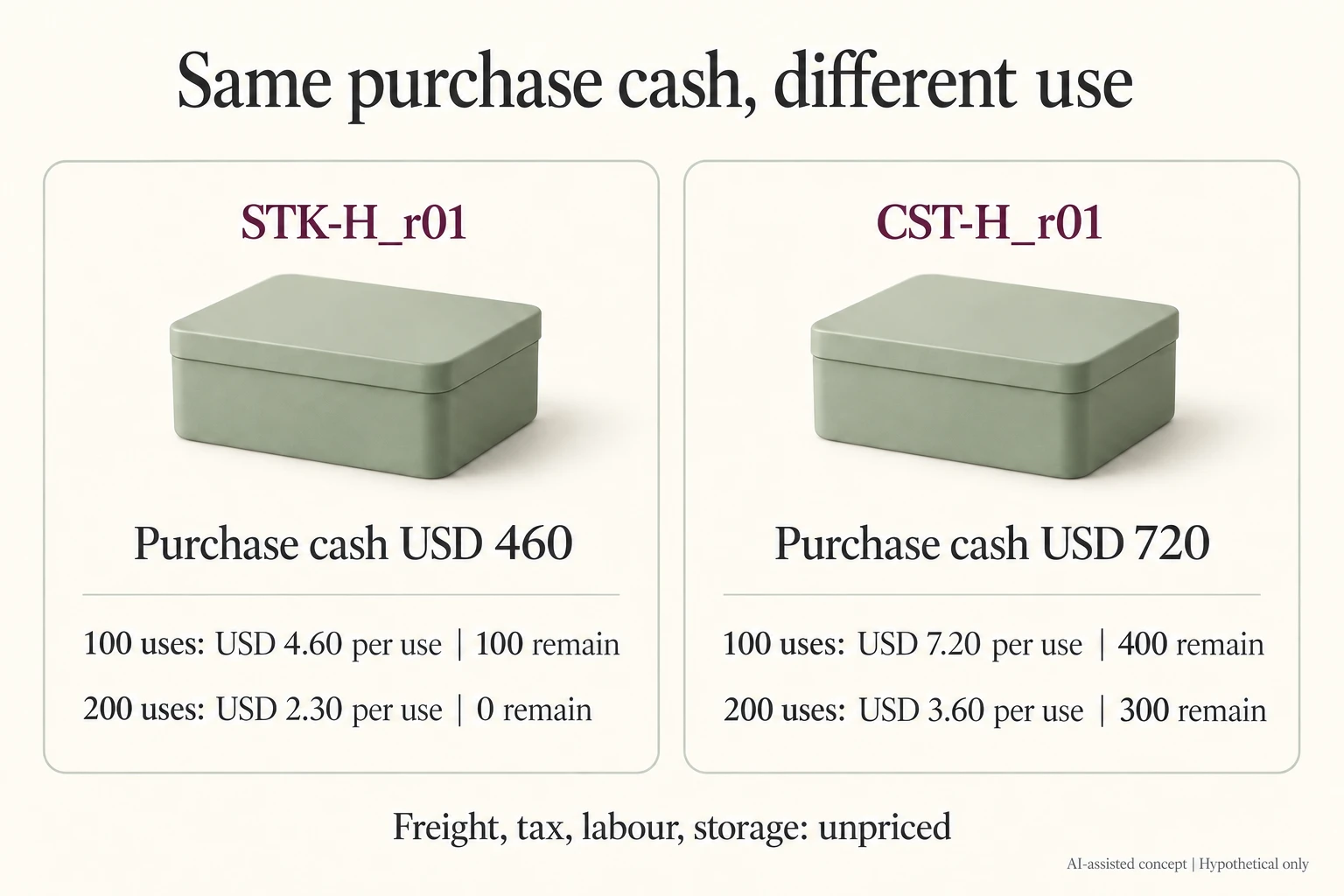
This additional hypothetical sensitivity keeps the original purchases and assumed USD inputs unchanged: 200 stock boxes at $2.00 plus $60 labels, or 500 custom boxes at $1.20 plus $120 setup. Only use during the period changes from 200 to 100.
Scroll horizontally if columns extend beyond the view.
| Scenario | Stock route STK-H_r01 | Custom route CST-H_r01 |
|---|---|---|
| 100 uses | Cash $460; 100 remain; $4.60 per used box | Cash $720; 400 remain; $7.20 per used box |
| 200 uses, original basis | Cash $460; 0 remain; $2.30 per used box | Cash $720; 300 remain; $3.60 per used box |
| Common omitted items | Freight, tax, labour and storage unpriced | Freight, tax, labour and storage unpriced |
STK-H_r01 and CST-H_r01 are new scenario references, not supplier products or approved revisions. The same assumed suitable packing requirement applies to both use cases; this sensitivity creates no additional purchase and no later-use value for remaining stock.
Cash remains 200×2.00+60=$460 or 500×1.20+120=$720. Dividing by 100 uses gives $4.60/$7.20; dividing by 200 gives the original $2.30/$3.60. These are planning ratios, not accounting expense or a write-off decision.
The stock-route 200-unit assumption is not a Packrivo order offer or MOQ exception. Freight, tax, labour and storage remain explicitly unpriced, so neither total is a delivered all-in comparison. Replace assumptions with actual offers on the same scope before making a purchasing decision.
Download the stock versus custom packaging cost record (.csv). HYPOTHETICAL rows are invented examples. Use ACTUAL_BLANK for permitted project inputs; replace that row label only when recording actual facts. Empty evidence, observation and date fields mean unknown or not performed, never acceptance. Keep checkpoints and revisions separate.
Bring one accepted packing requirement and the same-period cash/remaining-stock sensitivity through the packaging enquiry; actual commercial terms still need confirmation. Packrivo coordinates independent suppliers. These records establish no supplier offer, service availability or MOQ exception; its published baseline is 500 pieces per product/design.