

Splitting a packaging purchase into delivery releases can lower stock physically held at one time, while adding freight and receiving tasks. Compare the same total quantity, destination and use schedule. Confirm that the proposed supplier arrangement exists before relying on later releases.
Use Direct Packaging Delivery or Central Redistribution when delivery releases also change the destination route. Compare the number and timing of receipts separately from the actual freight legs, redistribution work and usable arrival state.

Separate purchasing from receipt
A 1,000-box purchase delivered once and a 1,000-box purchase released in stages may have the same component total. They can still have different payment, storage and handover terms. Record who holds the unreleased balance and whether its continued availability is actually agreed.
Use the freight inquiry data for each release’s cartons, contents, weights and dimensions. Dividing the quantity by four doesn’t establish four equal freight charges or identical carton arrangements.
At the receiving site, identify when the boxes arrive and when they’re consumed. Peak on-site stock follows that schedule. It is separate from total money committed to the purchase.
Compare one receipt with four releases
Assume 1,000 identical boxes will be consumed at a steady 100 per week. The fictional staged arrangement releases 250 every 2.5 weeks, immediately before the previous release runs out.
Scroll horizontally if columns extend beyond the view.
| Planning field | One delivery | Four releases |
|---|---|---|
| Total purchased | 1,000 | 1,000 |
| Peak on-site quantity in the ideal schedule | 1,000 | 250 |
| Receipt events | 1 | 4 |
| Extra receipts compared with one delivery | 0 | 3 |
| Assumed 20-minute work per receipt | 20 minutes | 80 minutes |
The staged route adds 60 minutes of receiving work. It reduces the modeled peak quantity by 750 boxes only under the stated timing and consumption assumptions.
Translate counts into storage using the actual delivered bundles or cartons. A stack of blanks and a group of formed boxes can occupy very different space. Neither a count reduction nor a smaller room requirement establishes a freight saving.
Test a delayed release
The ideal example has no buffer. If a release arrives one week late, the site faces an assumed 100-box demand gap unless a separate stock allowance or alternate arrangement covers it.
Adding a 100-box local buffer changes the peak and purchase-allocation plan. Show that change rather than continuing to advertise a 250-box maximum. Likewise, demand arriving faster than expected can bring the release date forward.
Extra supplier storage, handling or minimum-release charges belong in the comparison when quoted. Don’t assume unreleased boxes are stored without charge or that title and risk remain unchanged.
Ask for the complete release arrangement
Request the permitted release quantities, dates or triggers, holding responsibilities, payment basis and freight scope. Then compare on-site peak stock with repeated receipt costs and delayed-release scenarios. The useful decision is a feasible schedule, not simply the smallest initial shipment.
Sources and scope
Australian Government supports the stated general concepts within this scope: General inventory categories, reorder points and stocktake. Access checked 14 October 2026.
Australian Government supports the stated general concepts within this scope: Cash inflows/outflows and clear labeling of estimated figures. Access checked 14 October 2026.
The worked scenario is original editorial analysis with assumed inputs, not a supplier offer, customer record or measured Packrivo result. Commercial feasibility and physical suitability remain project-specific.
Give every release its own event row
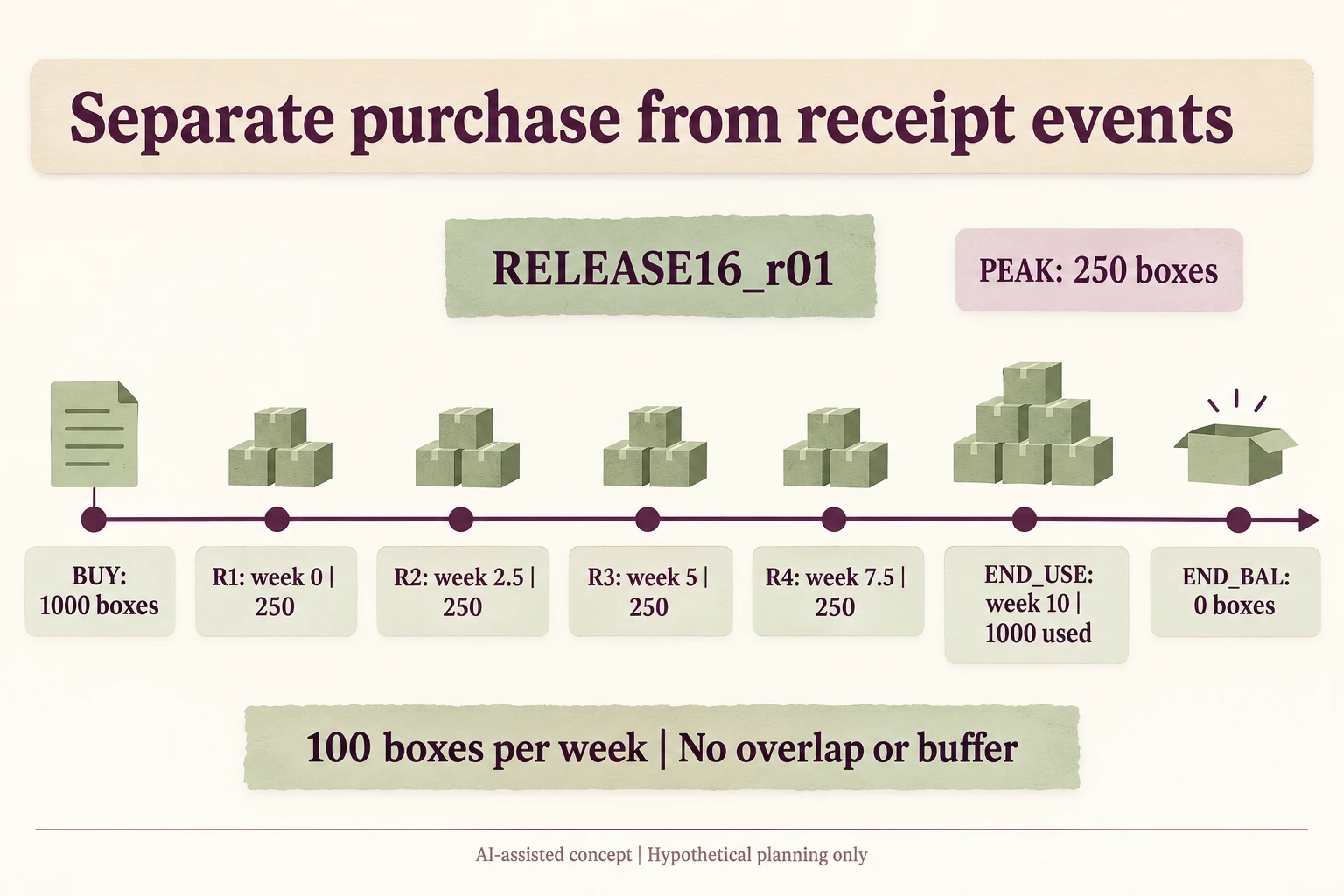
The original ideal four-release schedule becomes an event register for fictional RELEASE16_r01. It assumes 100 boxes used per week, 250 received at weeks 0, 2.5, 5 and 7.5, and no receipt overlap or local buffer. PEAK records the separate ideal maximum of 250 boxes.
Scroll horizontally if columns extend beyond the view.
| Scope ID | Exact entity | Stage / role | Hypothetical basis |
|---|---|---|---|
| BUY | RELEASE16_r01 | PURCHASE_PLAN | One hypothetical purchase, separate from receipts |
| R1 | RELEASE16_r01 | RECEIPT_PLAN | 250 / 100 = 2.5 weeks; assumed just-before-runout receipt at week 0 |
| R2 | RELEASE16_r01 | RECEIPT_PLAN | 250 / 100 = 2.5 weeks; assumed just-before-runout receipt at week 2.5 |
| R3 | RELEASE16_r01 | RECEIPT_PLAN | 250 / 100 = 2.5 weeks; assumed just-before-runout receipt at week 5 |
| R4 | RELEASE16_r01 | RECEIPT_PLAN | 250 / 100 = 2.5 weeks; assumed just-before-runout receipt at week 7.5 |
| PEAK | RELEASE16_r01 | IDEAL_PEAK | 250 per receipt with assumed just-before-runout timing and no overlap |
| END_USE | RELEASE16_r01 | END_OF_HORIZON | 1000 / 100 = 10 weeks |
| END_BAL | RELEASE16_r01 | END_OF_HORIZON | 4 x 250 receipts – 1000 assumed uses |
BUY is the purchase plan; R1–R4 are separate receipt events, not four additional purchases. END_USE and END_BAL keep the consumed quantity and final on-site balance separate. The planned horizon is 1,000/100=10 weeks, and the four receipt quantities sum to 1,000.
The schedule supplies no actual arrival date, supplier holding commitment or freight amount. Actual receipt and decision fields remain empty. The peak of 250 belongs only to this no-overlap ideal; it cannot be carried into a different timing or buffer plan without a separately recorded scenario.
Download the split packaging deliveries record (.csv). HYPOTHETICAL rows are invented examples. Use ACTUAL_BLANK for permitted project inputs; replace that row label only when recording actual facts. Empty evidence, observation and date fields mean unknown or not performed, never acceptance. Keep checkpoints and revisions separate.
Use the named scope rows and unresolved evidence to prepare a project enquiry. Replace planning assumptions with actual authorised records before a commercial or use decision. Packrivo coordinates independent suppliers. These records establish no supplier offer, service availability or MOQ exception; its published baseline is 500 pieces per product/design.