
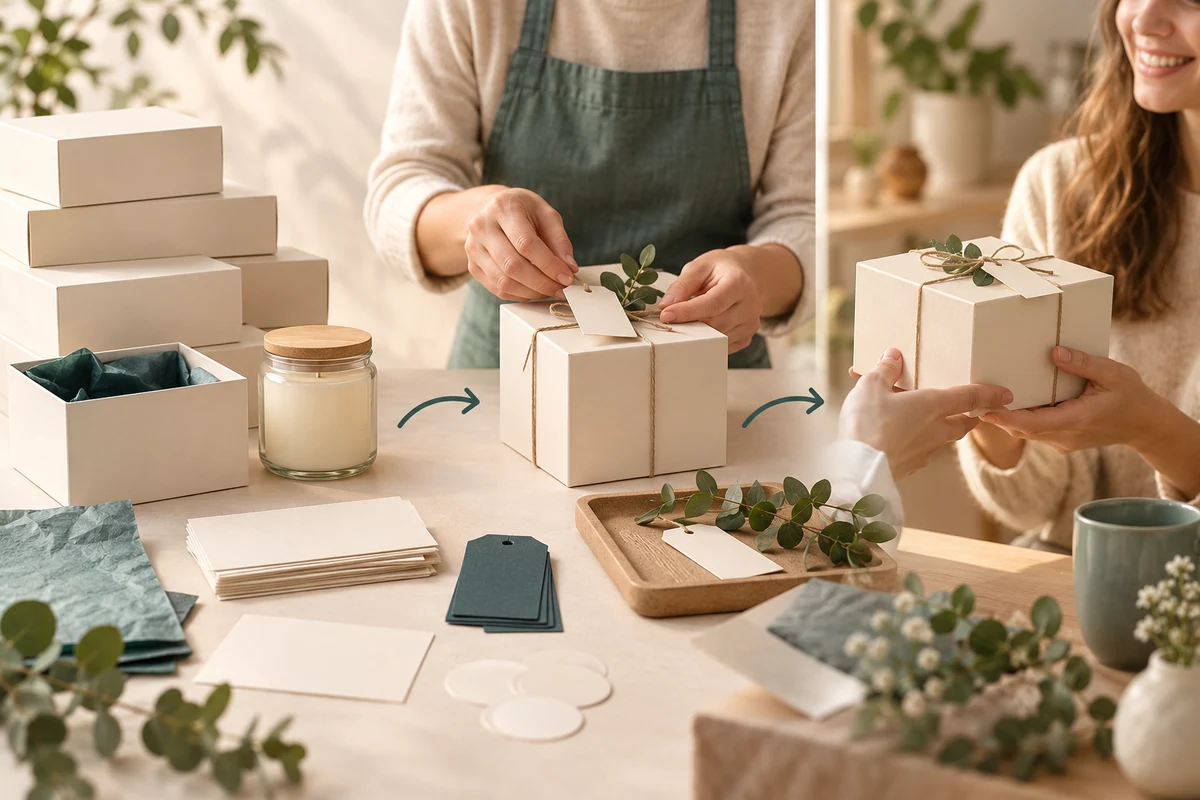
Local gift personalisation needs a complete route from final name data to the correct packed card. Confirm the finished printing medium and actual equipment combination, then count printing, matching and retry work. A late name list is only manageable if that route fits the available time.
For a personalised Informational insert card, specify the common stock, final printed area and physical matching step independently of the name data. The product concept does not establish printer compatibility, an approved data-transfer route or a personalisation service.
In this guide
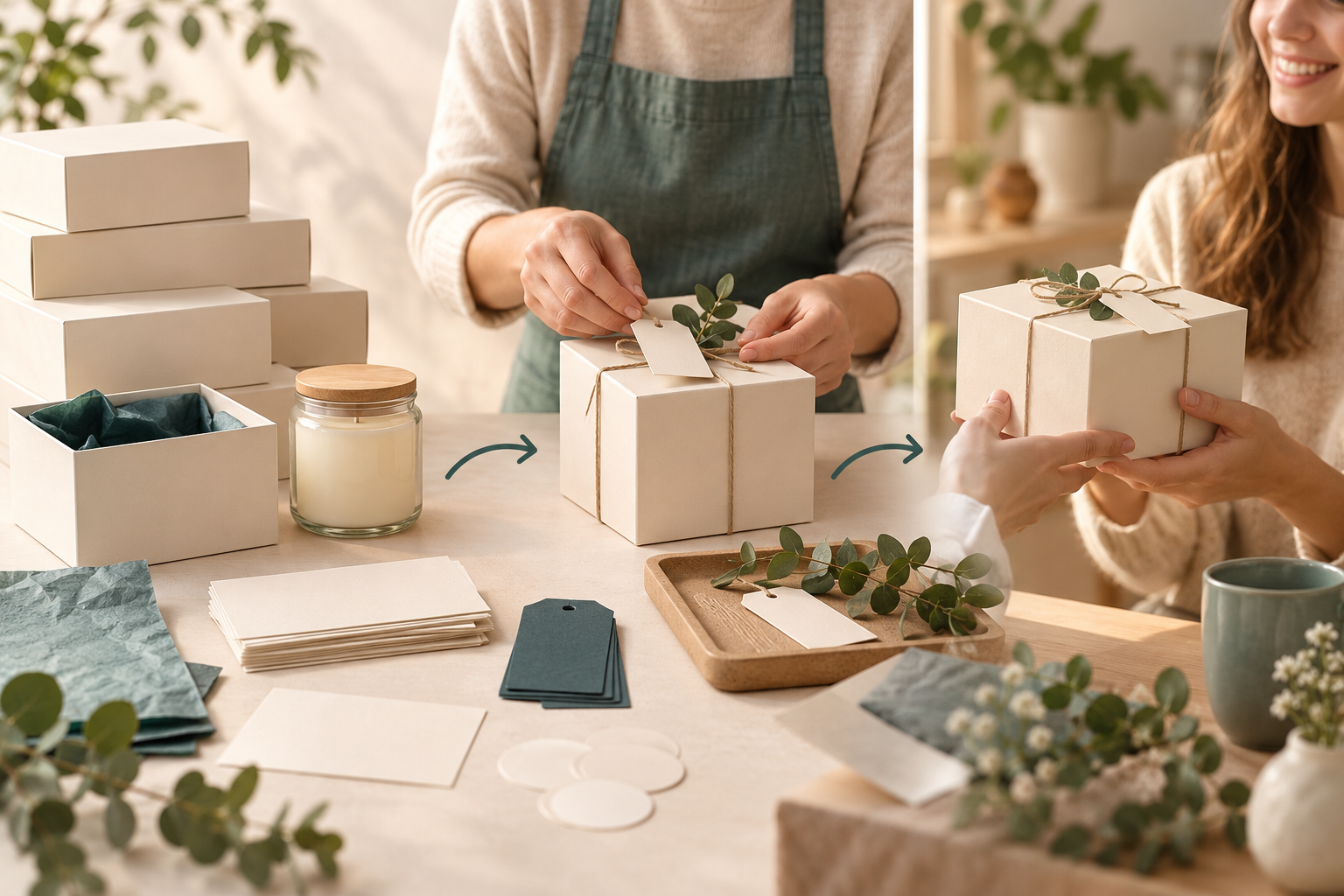
Keep stable artwork separate from changing content
Choose the base packaging independently of the recipient field. A loose card or another approved personal component can carry the changing information, provided it has a real place in the gift.
The second-pass printing guide shows why the finished surface, device and consumable matter together. A device that prints an uncoated sheet does not establish compatibility with a preprinted or finished label.
Confirm actual-size layout for long names and supported characters. Use fictional names in public examples. A short demonstration name cannot establish the layout for every recipient.
Include the merge operation in the time
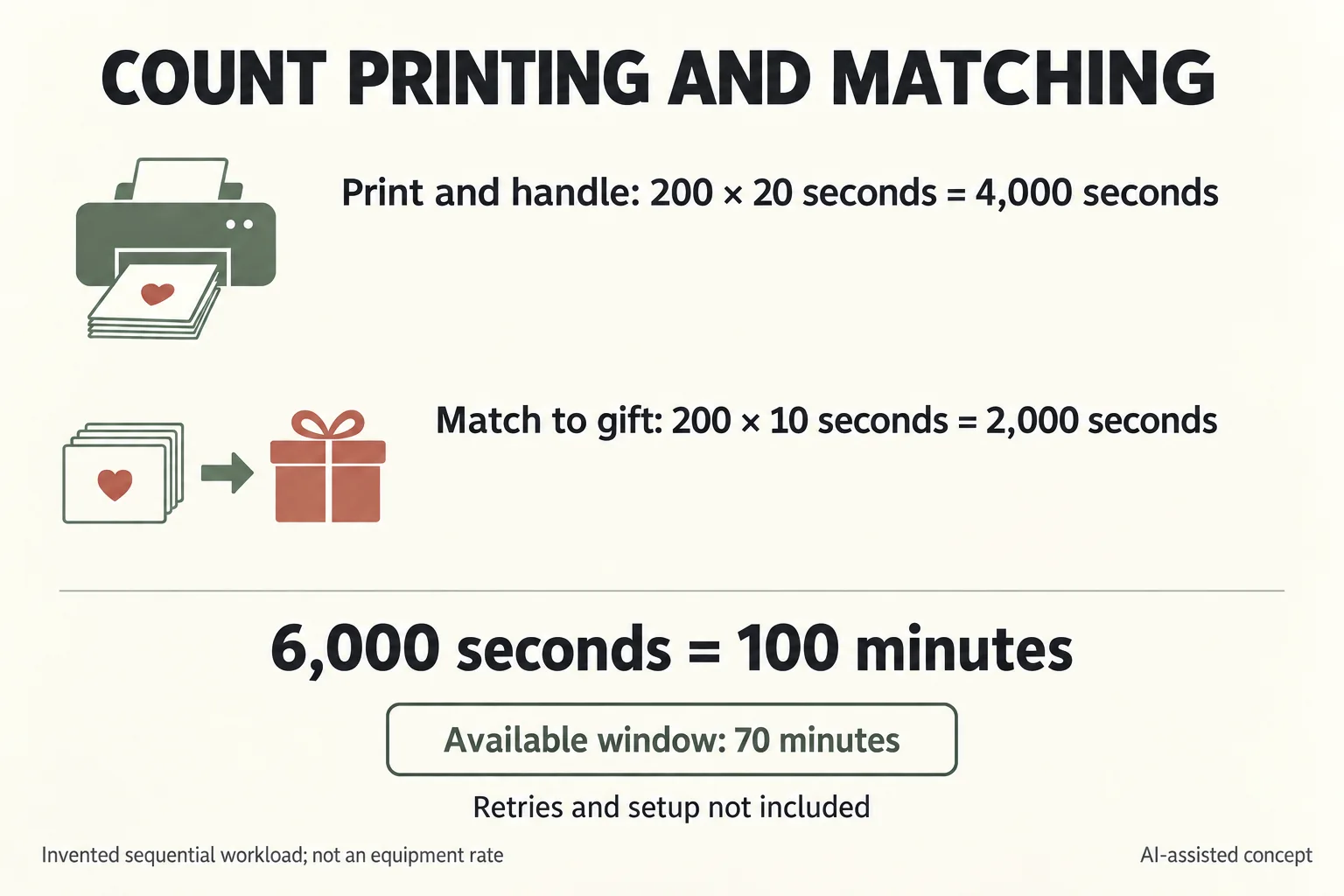
Assume a fictional 200-card job has a 20-second print-and-handle cycle and a separate ten-second order matching step per card. These times are assumed, not a measured equipment or Packrivo rate.
Scroll horizontally if columns extend beyond the view.
| Included operation | Assumed total for 200 |
|---|---|
| Printing and handling | 200 x 20 seconds = 4,000 seconds |
| Matching to the correct gift | 200 x 10 seconds = 2,000 seconds |
| Combined work before retries | 6,000 seconds = 100 minutes |
A 70-minute available window cannot hold this sequential workload. Printing faster alone would not remove all matching work. Overlap is a separate process assumption that requires actual people, equipment and a workable sequence.
Plan failures without losing identity
Maintain a stable order or gift identifier through print, match and assembly. If a card is reprinted, remove its superseded copy from the active area. Count the reprint and matching work instead of treating it as invisible overhead.
Keep paper, ribbon or other consumable replenishment inside the actual operating plan. Device queues, drying or handling requirements, if applicable, must come from the named combination and its instructions.
Local processing also does not remove every information-handling obligation. Keep real recipient data within the authorised route and use only the fields needed for the gift. This article does not approve any personal-data arrangement.
Set a name-release window supported by work
Trial the whole route with authorised non-sensitive test data and actual media. Record what printing and matching cover, the available resources and the correction process. The resulting deadline should be tied to that evidence, rather than a general promise that local printing can accept changes until dispatch.
Show the extra work before promising a late-name deadline
The 100-minute example covers only the two stated per-card tasks. Keep additional operations separate so the same setup or retry is not hidden inside several lines. Start with the same 200 intended gifts in every scenario.
Scroll horizontally if columns extend beyond the view.
| Additional hypothetical input | Arithmetic | Scenario time |
|---|---|---|
| Base sequential print/handle and matching | 200 × (20 + 10) seconds | 100 |
| Setup before those cards | Assumed separate task | 15 |
| Consumable replenishment | Assumed separate task | 8 |
| Ten corrected cards, printed and matched again | 10 × 30 seconds ÷ 60 | 5 |
| Total of these stated tasks | 100 + 15 + 8 + 5 | 128 minutes |
The ten corrected cards replace earlier outputs. They do not create ten extra gifts or a measured five-percent failure rate. The extra five minutes includes both printing and matching for those ten replacements; adding another matching allowance for the same replacements would double-count it.
Against the same 70-minute window, this invented sequential case is 58 minutes too long. Do not turn that difference into an instruction to rush or assume two people can halve it. Any overlap needs named resources, device and media capability, staging and an actual complete-route trial.
Keep the finished medium and second-pass printing review separate from the time model. A compatible print result does not establish your throughput. Once the work is observed, use the gift message change cutoff record to define which revisions the actual service can still complete, with obsolete printed copies removed from the active area.
Download the local gift personalisation record (.csv). It contains field definitions, clearly hypothetical examples and a blank actual-project row. Replace the invented entries; a blank field is unknown, not an approved result.
Send the specific open decision with the brief
Bring the current record, packaging configuration, actual evidence available and the unresolved question to Packrivo’s packaging inquiry. State who must answer and which next step remains on hold. Packrivo coordinates sourcing and project questions with independent suppliers; this record is not a manufacturing or fulfilment service commitment.
Sources and scope
The worked scenario is original editorial analysis with assumed inputs, not a supplier offer, customer record or measured Packrivo result. Commercial feasibility and physical suitability remain project-specific.