

Kitting gift-pack components before assembly moves retrieval and matching into a preparation stage. Compare that preparation with the work remaining at the bench. A shorter assembly cycle alone does not prove the full operation uses less labor.

Define the kit independently of the gift
List the exact components issued together and their accepted variants. A kit can contain packaging material without the product, or a fuller order-specific arrangement. State which definition the trial uses.
The component matching map establishes permitted combinations. Kitting should preserve that relationship rather than giving several similar inserts a shared label.
Keep the kit’s identity during its wait before assembly. A missing or changed card needs a clear status so the preparer doesn’t pass an incomplete kit onward as ready work.
Count preparation and assembly in one comparison
Assume a fictional run of 100 gifts. Pre-kitting takes 20 seconds per gift and later assembly 60 seconds. Loose retrieval and assembly together take an assumed 85 seconds per gift.
Scroll horizontally if columns extend beyond the view.
| Route | Included assumed time | Total for 100 |
|---|---|---|
| Prepare kits, then assemble | 20 + 60 seconds per gift | 8,000 seconds |
| Retrieve loose parts during assembly | 85 seconds per gift | 8,500 seconds |
The modeled difference is 500 seconds, about 8.3 minutes. If kit corrections add 600 seconds, the kitted route becomes 8,600 seconds and no longer has the lower time in this scenario.
These figures are assumptions, not observations or a claim that kitting is generally faster. The comparison also requires the same completed gift and time boundaries.
Include shortage discovery and waiting space
Pre-kitting can expose an incomplete component combination before the assembler begins. Whether that helps depends on the response route and actual lead time; it doesn’t create the missing component.
Prepared kits occupy containers or positions until used. Measure that footprint and identify how kits are replenished. A preparation area that blocks normal work can move the problem elsewhere.
For personal messages, decide whether kitting includes the card and whether recipient information is final. An early prepared kit may need controlled correction when a message changes.
Trial the complete material issue method
Observe preparation, handoff, waiting, assembly and exceptions under both routes. Use the full record to decide which work genuinely changes. Your output is an issue method with a supported total-work comparison and shortage response, not a faster-looking assembly stage with its preparation omitted.
Sources and scope
Australian Government supports the stated general concepts within this scope: General inventory categories, reorder points and stocktake. Access checked 14 October 2026.
OSHA supports the stated general concepts within this scope: US warehousing ergonomic hazards. Access checked 14 October 2026.
The worked scenario is original editorial analysis with assumed inputs, not a supplier offer, customer record or measured Packrivo result. Commercial feasibility and physical suitability remain project-specific.
Keep the correction allowance with the full route
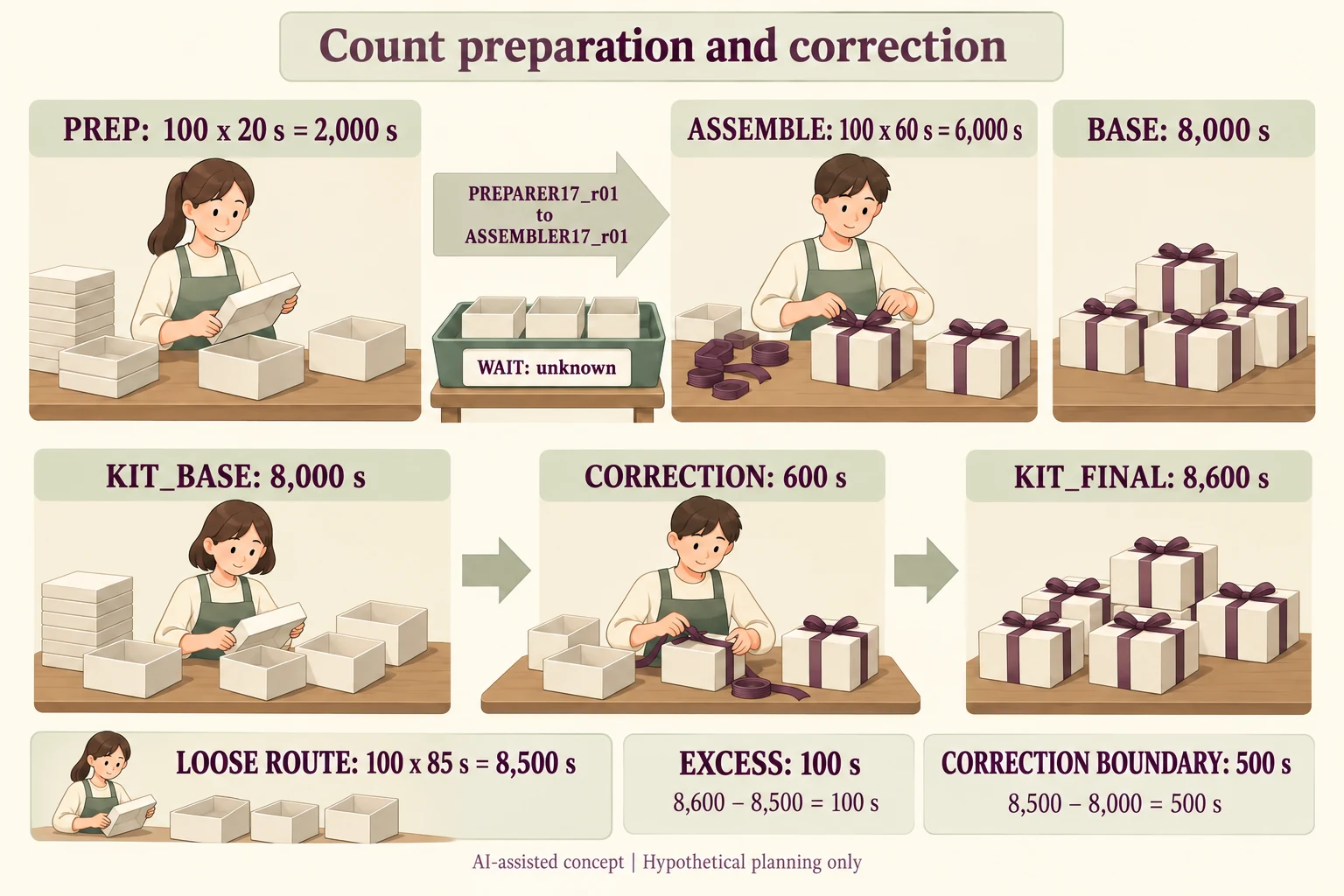
Use the original fictional 100-gift timing inputs with KIT17_r01 and GIFTKIT17_r01 kept as different object levels. Preparation is 20 seconds per gift, later assembly 60, and the loose route 85; a selected correction scenario adds 600 seconds.
Scroll horizontally if columns extend beyond the view.
| Scope ID | Exact entity | Stage / role | Hypothetical basis |
|---|---|---|---|
| PREP | KIT17_r01 | PREKIT | 100 x20 |
| PREP_OUT | KIT17_r01 | HANDOFF_SCOPE | Actual issued kit state unknown |
| WAIT | KIT17_r01 | WAITING_SCOPE | Identity retained while waiting; actual duration unknown |
| ASM_IN | KIT17_r01 | ACCEPTANCE_SCOPE | Actual accepted kit state unknown |
| ASSEMBLE | GIFTKIT17_r01 | AFTER_KITTING | 100 x60 |
| BASE_TOTAL | KITROUTE17_r01 | BEFORE_CORRECTION | 2000 +6000 |
| LOOSE | LOOSEROUTE17_r01 | LOOSE_RETRIEVAL_AND_ASSEMBLY | 100 x85 |
| CORRECTION | KITROUTE17_r01 | CORRECTION_SCENARIO | Assumed additional work, not observed corrections |
| FINAL_TOTAL | KITROUTE17_r01 | WITH_CORRECTION | 8000 +600 |
| EXCESS | KITCOMPARE17_r01 | WITH_CORRECTION | 8600 -8500 |
| CROSS | KITCOMPARE17_r01 | CALCULATION | 8500 -8000 |
| GIFT_READY | GIFTKIT17_r01 | READINESS_SCOPE | Actual complete-gift quantity and acceptance unknown |
PREP and ASSEMBLE give 2,000 and 6,000 seconds, so BASE_TOTAL is 8,000. LOOSE is 8,500. CROSS separately records the 500-second correction boundary. With the assumed 600-second CORRECTION, FINAL_TOTAL is 8,600 and EXCESS is 100 seconds relative to loose work.
PREP_OUT, WAIT and ASM_IN keep issue, waiting and acceptance separate at the two handoff ends. Their actual evidence is empty. GIFT_READY also remains unknown: an assumed time total cannot confirm complete or correctly matched gifts. No measured speed advantage, correction count or waiting duration is supplied.
Download the gift packaging kitting record (.csv). HYPOTHETICAL rows are invented examples. Use ACTUAL_BLANK for permitted project inputs; replace that row label only when recording actual facts. Empty evidence, observation and date fields mean unknown or not performed, never acceptance. Keep checkpoints and revisions separate.
Bring the exact scope rows and unresolved evidence in a Packrivo enquiry. Replace planning inputs with actual authorised records before treating the scenario as an available arrangement. Prepare a Packrivo packaging enquiry. Packrivo coordinates independent suppliers. These records establish no supplier offer, service availability or MOQ exception; its published baseline is 500 pieces per product/design.
What this changes in a packaging enquiry
Request separate pricing for loose components and any proposed pre-kitted delivery. Define the contents of one kit and how its variant identity is preserved. Include preparation, kit containers and later assembly in the comparison so a lower packing-bench time is not mistaken for a lower total packaging cost.