

A gift-packing queue should accept new work only when its remaining workload fits the productive time before dispatch cutoff. Count already accepted orders by their actual operations, then retain an explicit allowance for unresolved work. A queue count alone cannot distinguish quick standard orders from slower gift services.

Define the time that remains usable
State the cutoff that the actual dispatch operation can meet. Deduct known setup, breaks, handover and other work outside the order cycles. The remaining productive minutes are the time available to complete this queue.
The packing-trial method defines the cycle scope. Use a supported scenario for each order type rather than assigning all orders the shortest observed task.
Ten more gifts under one assumed workload
Suppose 150 productive minutes remain. The fictional accepted backlog contains sixty standard orders at one minute each and thirty gifts at two minutes each. Retain ten minutes as a stated exception allowance.
Scroll horizontally if columns extend beyond the view.
| Queue field | Modeled minutes |
|---|---|
| Standard backlog | 60 x 1 = 60 |
| Gift backlog | 30 x 2 = 60 |
| Named exception allowance | 10 |
| Total protected workload | 130 |
| Available time for added work | 150 – 130 = 20 |
At two minutes per gift, the remaining twenty minutes support ten added gifts in this scenario. They do not support thirty simply because thirty order slots seem available in a list.
The allowance and cycles are assumed inputs, not a validated service level or dispatch guarantee. A real operation needs its own evidence and feasible sequence.
Keep material readiness as another condition
A time slot doesn’t create an insert or corrected message. Filter orders for their complete usable components and instructions before treating them as straightforward workload.
If a gift needs a reprint or exception pack, include that work in its current state. Don’t retain the standard two-minute estimate after the order has become a different task.
More staff can change the time model only through a feasible assignment. Shared devices and serial handovers may prevent independent parallel completion.
Use an admission decision that can be updated
Record accepted workload, productive time and each added order together. When an actual delay occurs, revise remaining capacity and stop using the earlier admission count. The output is a bounded promise decision before cutoff, with assumptions and unresolved orders visible, rather than a claimed maximum daily speed.
Sources and scope
Australian Government supports the stated general concepts within this scope: General inventory categories, reorder points and stocktake. Access checked 14 October 2026.
OSHA supports the stated general concepts within this scope: US warehousing ergonomic hazards. Access checked 14 October 2026.
The worked scenario is original editorial analysis with assumed inputs, not a supplier offer, customer record or measured Packrivo result. Commercial feasibility and physical suitability remain project-specific.
Test each dispatch wave before using the end-of-window slack
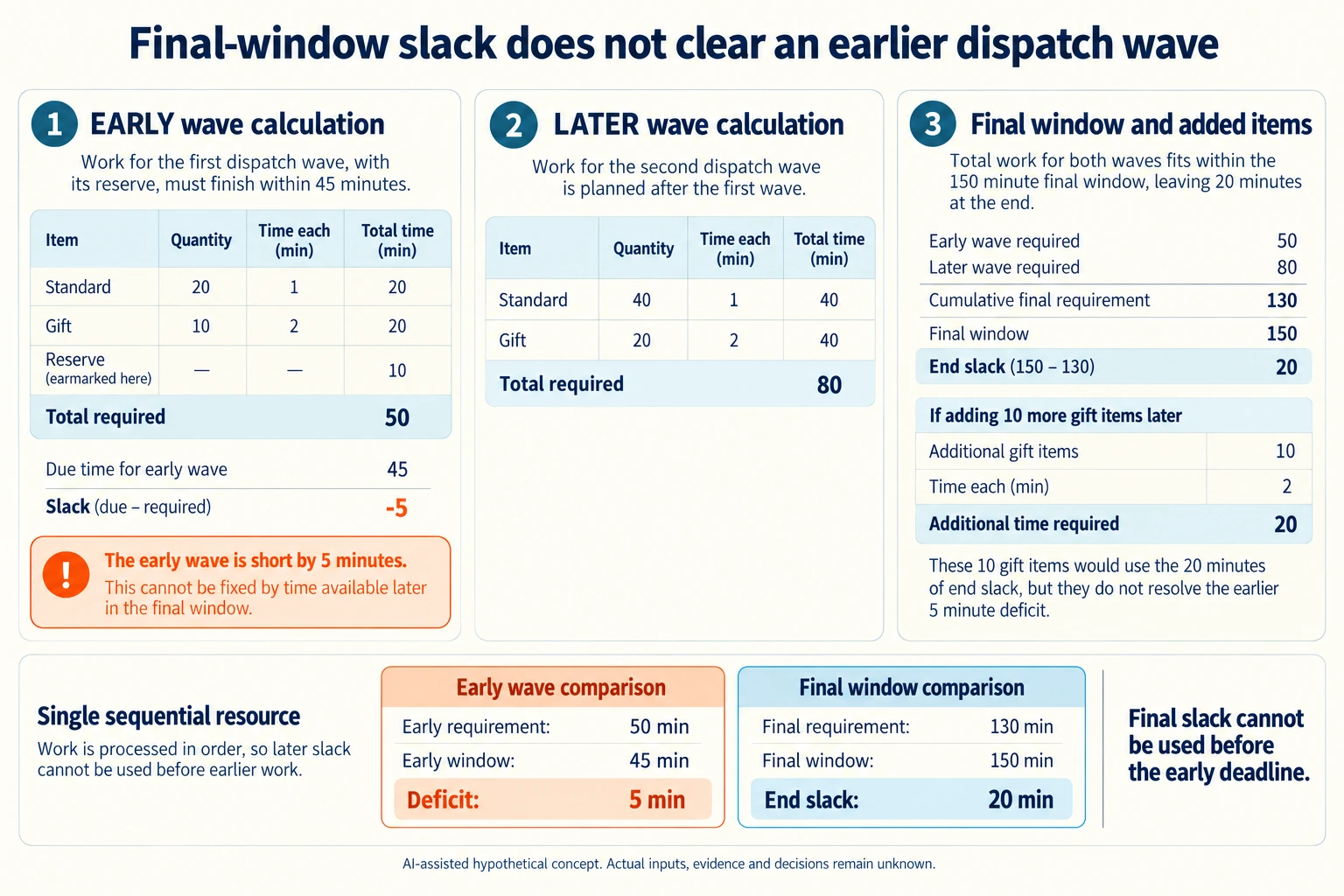
Retain the original 150-minute window, 60 standard orders at one minute each, 30 gifts at two minutes each and ten-minute reserve. Add a hypothetical split: the early wave has 20 standard orders and ten gifts due at minute 45; the later wave has 40 standard orders and 20 gifts due by minute 150. Earmark the entire ten-minute reserve to the early wave and count it once.
Scroll horizontally if columns extend beyond the view.
| Hypothetical scenario | Item or operation | Planning relationship | Assumed input or calculation |
|---|---|---|---|
| WAVES33 | EARLY_STANDARD | assumed input | 20 orders |
| WAVES33 | EARLY_GIFT | assumed input | 10 orders |
| WAVES33 | LATE_STANDARD | assumed input | 40 orders |
| WAVES33 | LATE_GIFT | assumed input | 20 orders |
| WAVES33 | STANDARD_CYCLE | assumed input | 1 minute/order |
| WAVES33 | GIFT_CYCLE | assumed input | 2 minutes/order |
| WAVES33 | RESERVE | assumed input | 10 minutes |
| WAVES33 | EARLY_DUE | assumed input | 45 minutes |
| WAVES33 | FINAL_DUE | assumed input | 150 minutes |
| WAVES33 | ADD_GIFT | assumed input | 10 orders |
| EARLY33 | PACKING_WORK | calculated from | EARLY_STANDARD*STANDARD_CYCLE+EARLY_GIFT*GIFT_CYCLE; 40 minutes |
| EARLY33 | WORK_PLUS_EARMARKED_RESERVE | calculated from | EARLY_WORK+RESERVE; 50 minutes |
| EARLY33 | DUE_MINUS_NEED | calculated from | EARLY_DUE-EARLY_NEED; -5 minutes |
| LATE33 | PACKING_WORK | calculated from | LATE_STANDARD*STANDARD_CYCLE+LATE_GIFT*GIFT_CYCLE; 80 minutes |
| WAVES33 | TOTAL_WITH_SINGLE_RESERVE | calculated from | EARLY_NEED+LATE_WORK; 130 minutes |
| WAVES33 | END_SLACK | calculated from | FINAL_DUE-FINAL_NEED; 20 minutes |
Early packing work is 40 minutes. Including that reserve requires 50 minutes against 45 available, a five-minute deficit. Later work is 80 minutes. The cumulative final requirement is still 130 minutes, leaving 20 minutes at the end. Adding ten more gifts uses those 20 minutes but does not resolve the early deficit.
Ask which deadline and complete work scope actually control admission of another order. A final total is insufficient when earlier commitments are binding. The fictional wave times are not carrier cutoffs, and the worksheet does not authorize changing a customer deadline, skipping a reserve or assuming products, messages, people and equipment are ready.
Download the gift packing cumulative dispatch wave workload record (.csv). It includes the original table fields and scenarios alongside the added relationships. HYPOTHETICAL rows are editorial examples or required review scopes, not actual records. Actual quantity, configuration, component and file identities, materials, process, specification, copy, method, condition, observation, owner, decision, evidence and dates are blank. ACTUAL_BLANK is a separate empty starting row; enter permitted project evidence before using an actual record. A blank means unknown.
Use the Local Gift Personalisation: Count the Complete Work for its separate question. Use the Gift Message Change Cutoff: Confirm Card and Order for its separate question.
Source scope checked 17 October 2026: General operational references do not supply carrier cutoffs, packing rates or a capacity guarantee. The reserve allocation and wave deadlines are explicit hypothetical planning choices. The added configurations and calculations are hypothetical, with actual evidence and decisions pending.
What this changes in a packaging enquiry
A dispatch queue can reveal a need for a different arrival state, such as preformed boxes or pre-matched components. Compare only the specific task that a supplier actually offers to complete. Do not buy more packaging merely because the queue is long, or convert the hypothetical remaining-work calculation into a promised dispatch capacity.
Discuss this packaging specification with Packrivo. We coordinate independent suppliers. MOQ: 500 pieces per product/design; illustrative quantities are not production offers. Confirm materials, samples, price and timing for your project.