

Assess in-store gift wrapping against the checkout workload occurring in the same service window. Count the employee minutes required for both tasks and identify the work surfaces they occupy. A box that is quick to wrap during a quiet trial may still be impractical when the same employee must serve a queue.
Separate offering the service from completing it. The store must state when gift wrapping is available, what it includes and how customers receive a completed gift. Any promised waiting time needs evidence for the actual operation.

Calculate the work before predicting the queue
Use a clearly defined peak window, such as thirty minutes. Record checkout work, gift selection, wrapping and handover only once, with a consistent start and finish. If a wrapping task includes a message-card step, keep that work inside the same definition.
The following figures are invented. Assume thirty customers each need one minute of checkout work, and ten also request a gift presentation requiring three minutes of additional employee work.
Scroll horizontally if columns extend beyond the view.
| Work in the 30-minute window | Quantity | Minutes each | Required employee minutes |
|---|---|---|---|
| Checkout | 30 customers | 1 | 30 |
| Additional gift wrapping | 10 gifts | 3 | 30 |
| Combined demand | Both tasks | Defined above | 60 |
One employee has at most thirty employee minutes in that window before allowing for breaks, interruptions or other work. The scenario requires sixty. The gap is visible without inventing an exact queue length or waiting time.
Two employees provide sixty nominal minutes, but that does not automatically make the plan feasible. They still need suitable work areas, materials and a clear handover between checkout and wrapping.
Compare two service arrangements
One arrangement keeps the checkout employee on transactions while a second person wraps paid orders at a separate station. A customer reference travels with the selected gift so similar purchases do not become confused during handover.
Another arrangement offers a quicker defined presentation during peak periods and reserves a more involved service for a separately agreed collection time. The store must actually offer those options; packaging instructions cannot silently change a customer promise.
Consider where unwrapped and completed gifts wait. Work surfaces needed for payment, product handling and wrapping may overlap. A resource plan that assumes the same space is available to two simultaneous tasks needs another layout decision.
The gift-carrier handoff review addresses the final bag or tote with the complete contents. That physical review remains separate from the service workload model.
Give the wrapping option a defined operating limit
Record the task definition, assumed request count, available employee minutes and assigned station. State who accepts an exception when the available service cannot meet the promised handover.
Etsy’s gift-service documentation provides a platform-specific example of defining a wrapping option and describing its contents. Its online settings do not establish an in-store staffing arrangement or queue policy. The workload example here is an original hypothetical calculation, with public documentation checked on 14 October 2026.
Packrivo can help connect the intended gift service with its packaging brief through a packaging project inquiry. Actual staff availability, task times and service commitments belong to the store operating the checkout.
Available labor does not remove a wrapping-station bottleneck
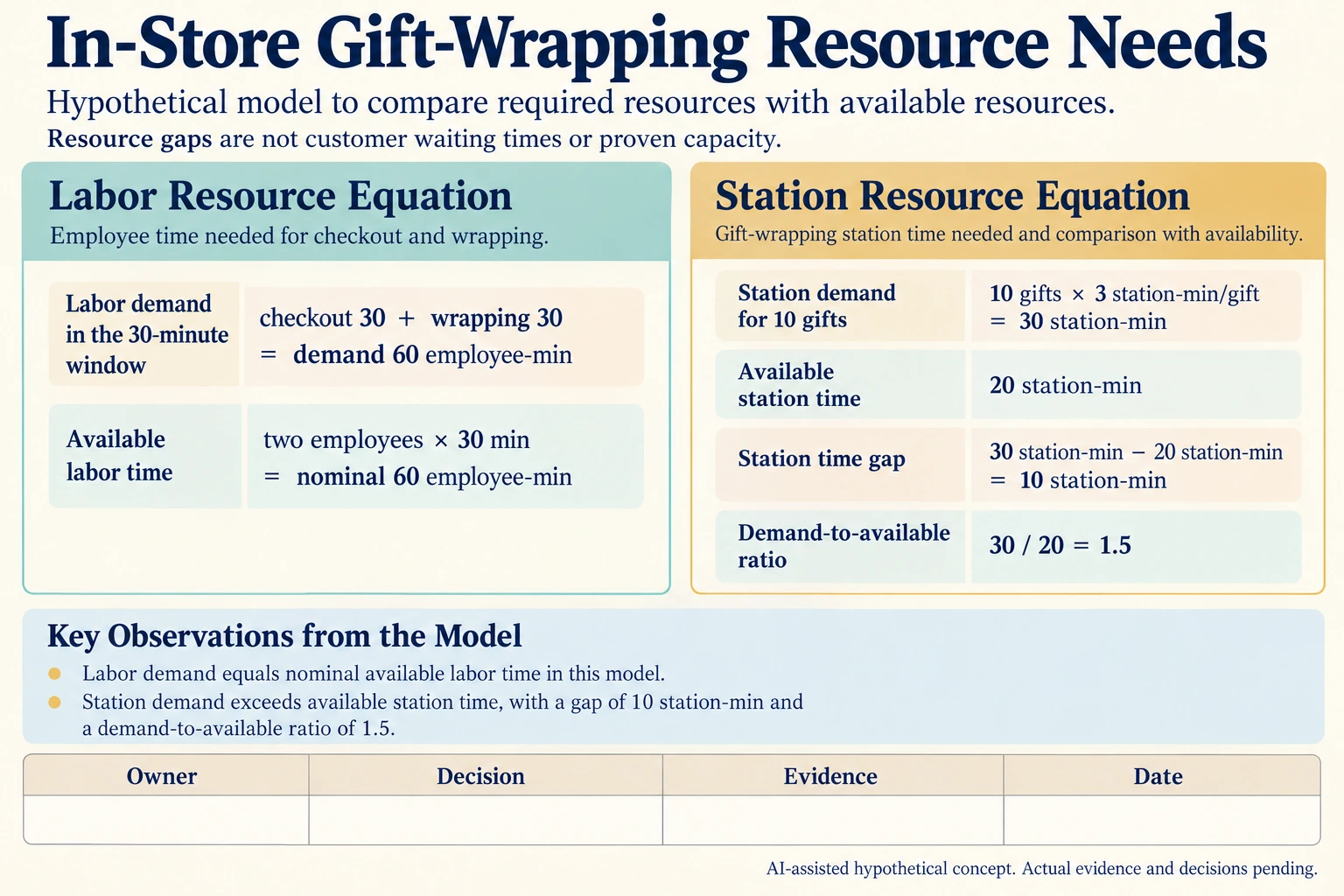
Extend the original thirty-minute example with a separate workstation constraint. Keep thirty employee-minutes of checkout and thirty of wrapping. Two employees provide sixty nominal employee-minutes, matching the combined workload. Now assume the wrapping surface is usable for only twenty minutes in that window, while ten gifts each occupy it for three minutes.
Scroll horizontally if columns extend beyond the view.
| Hypothetical configuration | Named object | Relationship | Input or next scope |
|---|---|---|---|
| LABOR | COMBINED_WORK | calculated from | CHECKOUT_DEMAND+WRAP_DEMAND; 60 employee-min |
| LABOR | NOMINAL_AVAILABILITY | calculated from | WORKERS*WINDOW; 60 employee-min |
| STATION | OCCUPANCY | calculated from | WRAP_COUNT*STATION_EACH; 30 station-min |
| RESOURCE_MODEL | STATION_AVAILABILITY | assumed input | 20 station-min |
| STATION | DEMAND_MINUS_AVAILABLE | calculated from | STATION_DEMAND-STATION_AVAILABLE; 10 station-min |
| STATION | DEMAND_TO_AVAILABLE | calculated from | STATION_DEMAND/STATION_AVAILABLE; 1.5 ratio |
The station requires thirty minutes but has twenty: an arithmetic gap of ten station-minutes and a demand-to-availability ratio of 1.5. This is not a prediction of a ten-minute customer wait. Nor can spare labor automatically create a second suitable surface. Labor and station occupation use different resource records even when both are expressed in minutes.
The store can ask whether a genuinely available second station, a different task definition or a different offered collection arrangement addresses this constraint. Each proposal needs its own operation and material-flow review. Moving work onto a payment surface can reopen the checkout arrangement rather than resolve the bottleneck.
The invented calculation assumes no station overlap within a gift and no shared occupation by two gifts. It includes no arrival sequence, measured task times, interruptions or service guarantee. Etsy explains its online gift-service option; it does not validate an in-store station capacity or authorize a changed customer promise.
Download the gift wrapping station time labor bottleneck record (.csv). It includes the original table fields and scenarios alongside the added relationships. HYPOTHETICAL rows are editorial examples or required review scopes, not actual records. Actual quantity, configuration, component and file identities, materials, process, specification, copy, method, condition, observation, owner, decision, evidence and dates are blank. ACTUAL_BLANK is a separate empty starting row; enter permitted project evidence before using an actual record. A blank means unknown.
Use the Gift Carrier Handoffs Need Acceptance Across Bag, Gable and Tote Formats for its separate question.
Source scope checked 17 October 2026: Etsy Gift Services supports defining a platform wrapping offer, with no confirmed publication date. The labor and station calculations are original hypothetical arithmetic, not Etsy queue rules or actual store capacity. The added configurations and calculations are hypothetical, with actual evidence and decisions pending.
What this changes in a packaging enquiry
If store gift wrapping drives material selection, compare the complete bag, tissue, box and closure sequence in the same peak-service window. Ask what arrives formed and which components staff still assemble. The workload example is not evidence that a proposed pack can be assembled at that speed. A relevant configuration to compare is the Gift Bag and Tissue Set; it is a concept reference, not confirmed suitability.
Discuss this packaging specification with Packrivo. We coordinate independent suppliers. MOQ: 500 pieces per product/design; illustrative quantities are not production offers. Confirm materials, samples, price and timing for your project.