

Define what supports the product after a transport restraint is removed. A temporary strap, tie or cradle may perform a transit job that the recipient is expected to end. The remaining presentation needs its own support arrangement if the product must stay positioned after that action.
This design decision comes before removal instructions. An accessible tab can help someone remove a part while leaving the product without the position or display relationship the brand intended.

Assign functions to the states of use
Record the fully packed transport arrangement, the opened presentation and the product’s removal. For each state, name the component supplying support or retention. A part can have more than one role, but that relationship must be visible in the proposal.
Scroll horizontally if columns extend beyond the view.
| State | Function to identify | Component question |
|---|---|---|
| Closed transport pack | Agreed restraint of the contents | Which proposed parts perform the transport job? |
| Open presentation after temporary-part removal | Intended display position | What remains to support or locate the product? |
| Product taken out | Retained pack and accessories | Which parts leave with the item or remain available? |
The table names requirements, not tested performance. Actual transit protection and product retention require their own evidence for the complete configuration.
Compare a strap-only proposal with separate support
Consider a hypothetical necklace gift. A temporary transport strap holds the mounted jewelry in place. The brand wants the recipient to remove that strap while leaving a recognizable presentation before taking out the necklace.
If the strap supplies the only positioning function, the open state may not match that intention. A separate retained slotted card is one candidate to investigate. Its actual contact, mounting and removal must still be reviewed with the necklace.
Keep the strap-only and strap-plus-card proposals distinct. Adding a card changes the system; it is not merely a clearer instruction for the original arrangement. The supplier should identify the offered attachments and which functions each version is intended to cover.
No necklace, strap or card has been tested for this example. It neither prescribes a tie construction nor establishes that a particular product needs the proposed extra part.
Review access after choosing the architecture
Once the permanent and temporary roles are defined, assess how the recipient reaches and removes the temporary component. The removal-tab access map addresses the hand route in a complete loaded pack. That task should use the chosen support arrangement, rather than an isolated loose tab.
For a formed cavity or cradle, record whether the support exits with the contents or stays in the enclosure. A catalog picture cannot answer that installed release question.
Microsoft’s packaging guidance supports connected physical cues and complete interactions in its own examples. UPS’s US packing guidance concerns preparing a shipment. Neither source validates the hypothetical two-role support architecture or replaces a relevant technical review.
Return a before-and-after function map
Give the supplier named components, their intended roles and the state created by removing each temporary part. Ask for a revised proposal where the remaining display function is unresolved. Keep that design change separate from the instruction artwork.
Packrivo can coordinate the support and sample questions through a packaging project inquiry. Public guidance was checked on 14 October 2026. No universal cutting method, restraint force or transport result is supplied here.
Record the support left after the temporary part is gone
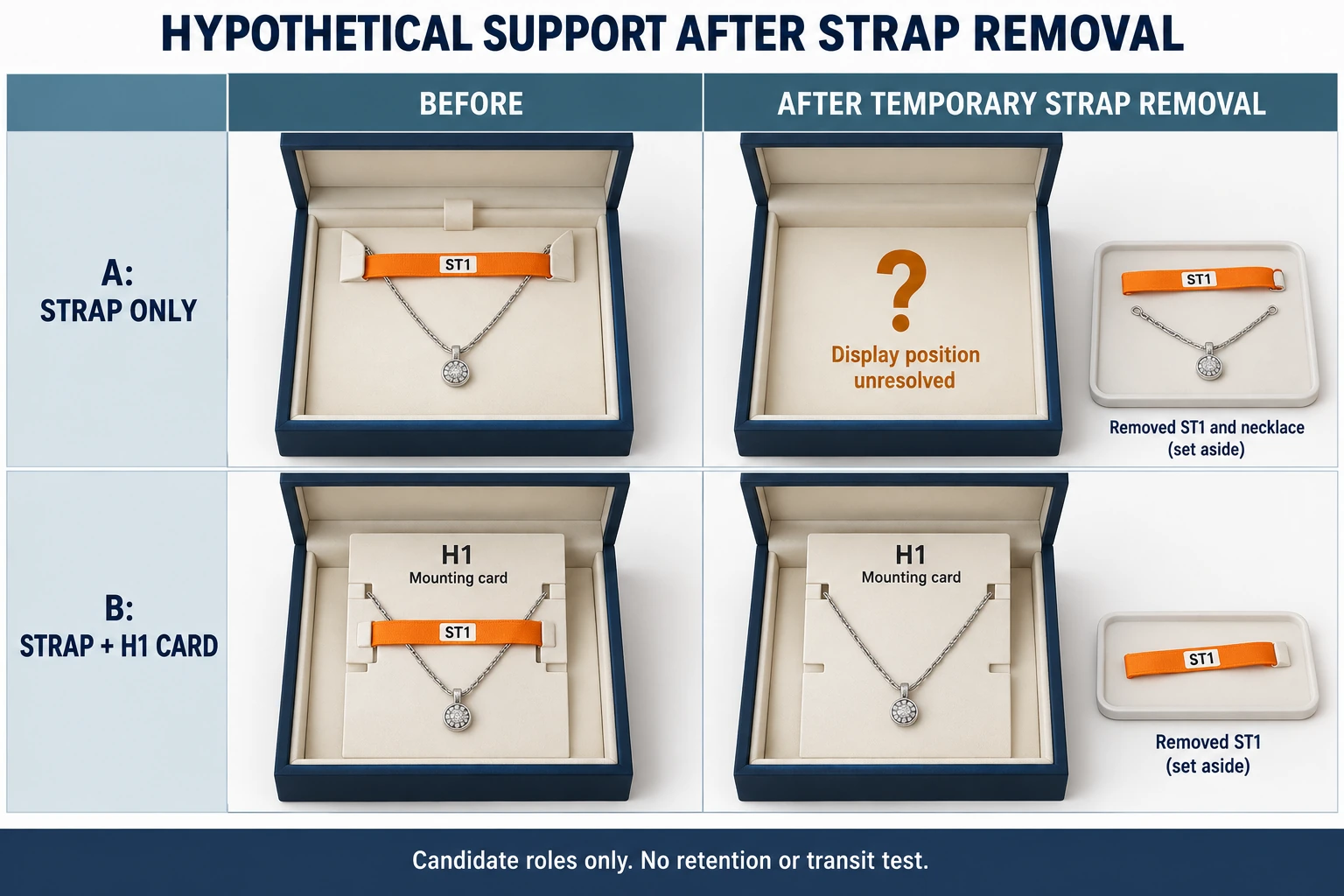
A brief for removable transport restraints needs two separate states for each proposal. Call the temporary strap ST1, a candidate retained slotted card H1 and the necklace N1. These are conceptual component identities, not supplied hardware or verified mounting details.
Scroll horizontally if columns extend beyond the view.
| Proposal | Closed state requirement | After ST1 removal | Decision still required |
|---|---|---|---|
| A: ST1 only | ST1 proposed to restrain N1 | No separate locating support identified | Do not claim retained display position |
| B: ST1 plus H1 | ST1 transport role; H1 proposed support role | H1 remains as support candidate | Confirm actual attachment, contact and accessible removal |
Proposal A should not be illustrated with the necklace floating in the original display position after its only support is removed. Show the location as unresolved. In B, retain H1 in both the before and after view and keep the necklace mounted to that same candidate support. This depicts an intended architecture, not retention performance. Record whether H1 stays in the box or exits with the item at the next step; that choice changes the removal task. Any changed card, strap attachment or necklace envelope reopens the relevant configuration questions rather than inheriting the drawing’s appearance as acceptance.
Download the removable transport restraints record (.csv). Example rows are explicitly hypothetical. Use ACTUAL_BLANK for your own permitted project entries; replace that row label only when recording actual inputs. Blank evidence or observation fields mean unknown or not performed, never approval. Keep revisions and checkpoints separate.
For a scoped packaging inquiry, provide closed and opened configurations, temporary/retained component roles and actual attachment/removal questions. Send the identified configuration and open questions to Packrivo. Quantities in this record are planning demand, not quoted purchase quantities, MOQ exceptions or confirmed service availability.
What this changes in a packaging enquiry
Show the supplier the transport-restraint state and the gift-presentation state as two configurations. Identify what continues to support the item after the temporary restraint is removed. Request the relevant insert or support separately; removing a shipping tie must not silently remove the only product support. A relevant configuration to compare is the Die-cut insert; it is a concept reference, not confirmed suitability.