

Review a date-limited promotional sleeve according to the supply-chain distinction it creates. A promotion needing separate timed handling can have an identification consequence even when the underlying consumer product remains unchanged. An exclusive retailer logo alone does not answer which GTIN rule applies.
Define the actual offer, display window and handling requirement before comparing graphics. The GS1 GTIN Management Standard, release 1.1, separates time-critical promotions in section 2.7 from new-product introduction in section 2.1 and other change rules.

State what the trading partner must distinguish
Record whether the consumer unit is unchanged, whether the brand introduces a separately orderable new product and whether partners must keep the promotional version distinct for a defined selling period. The same sleeve artwork can participate in different commercial arrangements.
Section 2.7 addresses a promotion for a specific event or date that affects required supply-chain handling. In that rule’s stated hierarchy, the consumer or base-unit GTIN need not change, while existing higher packaging levels need distinct identification. Other applicable rules can still affect the decision.
If the brand defines a new product that consumers or partners are expected to order separately, review the new-product rule as well. Do not force that situation into an unchanged-base-unit example merely because the contents resemble the earlier gift.
Compare three hypothetical sleeve arrangements
Assume a fictional candle gift remains physically unchanged. No identifiers, promotional products or retailer requirements have been established.
Scroll horizontally if columns extend beyond the view.
| Proposed arrangement | Distinction needing review |
|---|---|
| Undated artwork refresh | Identify actual changes and consider all applicable rules; the graphic alone does not settle identity |
| Dated sleeve for an event with a required two-week display window | Review the defined time-critical handling and higher-level identification under section 2.7 |
| A newly offered, separately orderable consumer gift version | Review the actual new-product definition under section 2.1 and other relevant triggers |
A decision owner needs more than a sample image. They need the commercial description and handling instructions that distinguish the rows.
For the dated example, record the version that should reach the store within the intended window. Identify the orderable case and any existing higher trade-item levels. Do not invent GTIN numbers in the illustration or treat a transport label as proof the hierarchy has been reviewed.
Keep seasonal stock and identity decisions linked
The seasonal sleeve allocation guide addresses common base boxes, campaign-specific sleeve quantities and unused stock. A flexible base architecture does not establish the identifier assigned to the finished promotional configuration.
Likewise, completing an identifier review does not make a dated sleeve useful after the campaign. Maintain both the approved identity and its actual commercial handling period in the records supplied to the packing and receiving parties.
If the agreed promotion changes, return the changed description to the barcode owner before carrying forward earlier source data. Artwork placement and printed-symbol verification remain downstream reviews of the selected identifier.
Give the specialist a bounded change description
Provide earlier and proposed consumer offers, sleeve versions, required handling, existing hierarchy and the distinction trading partners need to make. The responsible brand owner or specialist considers all relevant GS1 rules, brand-owner discretion and stricter local requirements.
The official open standard was checked on 14 October 2026. Packrivo can coordinate the packaging and artwork questions through a packaging project inquiry. This article supplies no automatic GTIN verdict for every exclusive sleeve and allocates no real identifiers.
An exact twenty-percent change is a boundary for one rule
Use a hypothetical single dimension of 200 mm as the reference. A proposal of 240 mm changes it by 40 mm, or exactly 20%. A proposal of 242 mm changes it by 42 mm, or 21%. These numbers describe invented dimensions, not measured products or an allocated identifier.
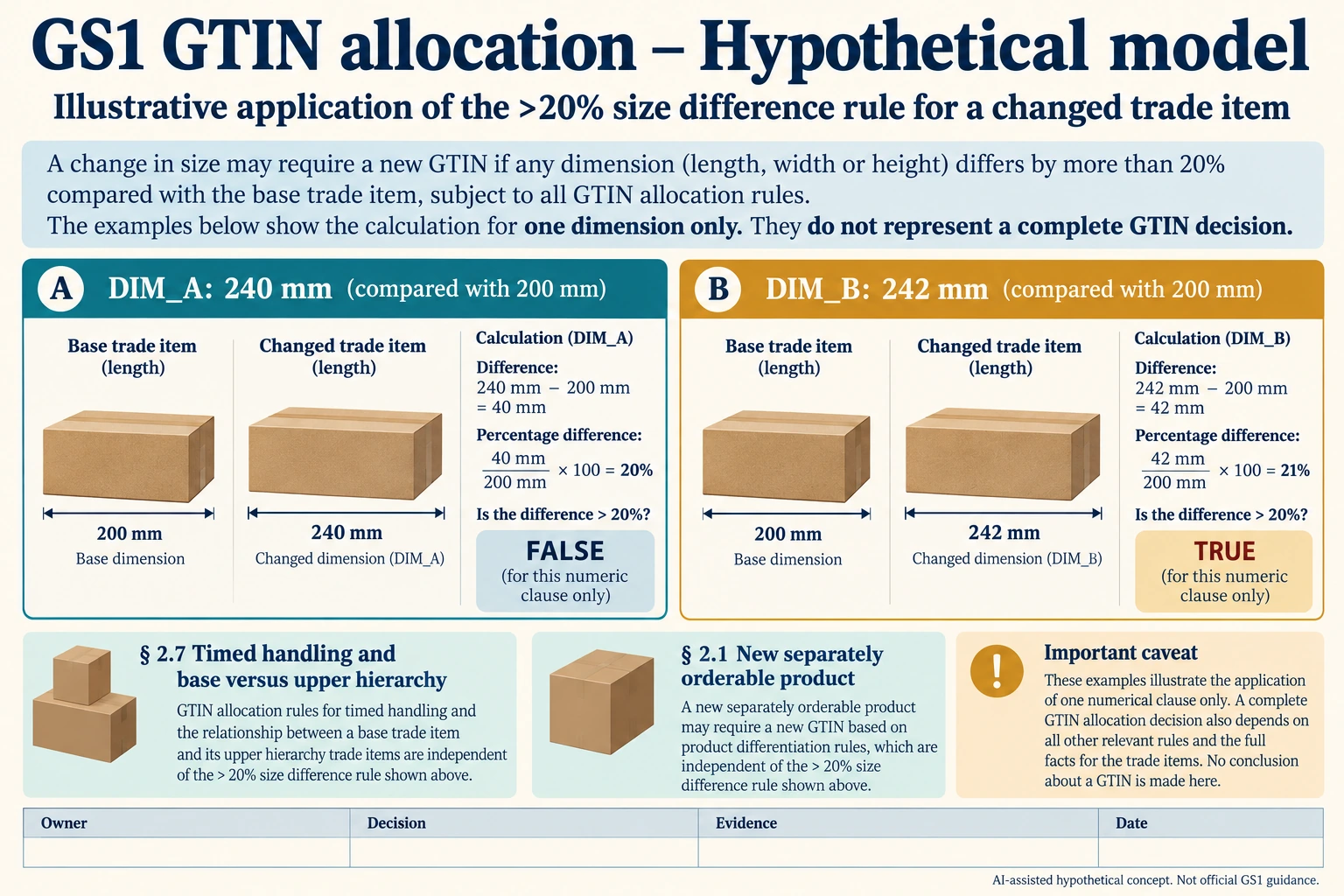
Scroll horizontally if columns extend beyond the view.
| Hypothetical configuration | Named object | Relationship | Input or next scope |
|---|---|---|---|
| DIM_A | CHANGE | calculated from | DIM_A_DIM-BASE_DIM; 40 mm |
| DIM_A | RELATIVE_CHANGE | calculated from | DIM_A_DIFF/BASE_DIM*100; 20 percent |
| DIM_A | OVER20_PERCENT_NUMERIC_CLAUSE_ONLY | does not satisfy | STRICTLY_GREATER_THAN20_NOT_FULL_GTIN_DECISION |
| DIM_B | CHANGE | calculated from | DIM_B_DIM-BASE_DIM; 42 mm |
| DIM_B | RELATIVE_CHANGE | calculated from | DIM_B_DIFF/BASE_DIM*100; 21 percent |
| DIM_B | OVER20_PERCENT_NUMERIC_CLAUSE_ONLY | satisfies | STRICTLY_GREATER_THAN20_NOT_FULL_GTIN_DECISION |
| IDENTIFICATION | DIMENSION_ARITHMETIC | does not replace | ALL_OTHER_RULES_HIERARCHY_GROSS_WEIGHT_LOCAL_REQUIREMENTS |
GS1 GTIN Management section 2.4 uses over 20% for its stated physical-dimension or gross-weight rule. Exactly 20% does not satisfy that particular numeric condition; 21% does. That is not a conclusion that the first proposal may retain every identifier. Other dimensions, gross weight, rules, hierarchy and stricter local requirements still need review.
A dated promotion with supply-chain handling requirements raises section 2.7 independently of this arithmetic. A newly introduced separately orderable product raises section 2.1. Neither should be screened out by applying a dimension percentage as a universal first gate.
Give the responsible identifier owner the whole change description and existing packaging hierarchy. GTIN Management release 1.1, ratified September 2023, is separate from General Specifications 26.0.0: its archive states publication in January 2026, while 27 January is a directory modification field. The large General Specifications PDF was not fully reviewed here.
Download the gtin dimension change over twenty percent rule scope record (.csv). It includes the original table fields and scenarios alongside the added relationships. HYPOTHETICAL rows are editorial examples or required review scopes, not actual records. Actual quantity, configuration, component and file identities, materials, process, specification, copy, method, condition, observation, owner, decision, evidence and dates are blank. ACTUAL_BLANK is a separate empty starting row; enter permitted project evidence before using an actual record. A blank means unknown.
Use the Seasonal Packaging Sleeves for a Shared Gift Box for its separate question.
Source scope checked 17 October 2026: GS1 GTIN Management 1.1 (September 2023) sections 2.4, 2.7 and 2.1 support distinct conditional rules. General Specifications January 2026 publication month is not 27 January directory Last Modified. No actual GTIN decision or full General Specifications review. The added configurations and calculations are hypothetical, with actual evidence and decisions pending.
What this changes in a packaging enquiry
Before ordering a promotional sleeve, tell the barcode owner and trading partner what they must distinguish and give the printer the approved dated copy. Keep that decision separate from the sleeve's fit and production quantity. An occasion change alone does not settle the identification requirements. A relevant configuration to compare is the Paper Belly Bands: Check Wrap Fit, Seam and Removal; it is a concept reference, not confirmed suitability.
Discuss this packaging specification with Packrivo. We coordinate independent suppliers. MOQ: 500 pieces per product/design; illustrative quantities are not production offers. Confirm materials, samples, price and timing for your project.