

Begin customer opening illustrations with the pack in the actual closed state the recipient receives. Show how each working feature becomes accessible before asking the user to act on it. A clear drawing of an internal tab cannot explain the first action when a sleeve still conceals that tab.
Keep the illustration tied to the complete configuration. Shipping layers, decoration, cards and temporary restraints can change the sequence even when the presentation box’s main structure is unchanged.

Draw what the recipient can see at each step
Identify the moving part, the part held still and the state after the action. Maintain a consistent viewpoint unless another view is needed to explain a relationship. Label a changed viewpoint so readers do not mistake rotation of the drawing for an action they must perform.
Avoid showing factory-only details as though the recipient can reach them. An internal attachment visible on an assembly drawing may remain hidden in the closed gift.
The packing-bench instruction method starts with the delivered empty carton and its forming sequence. Customer opening has a different starting state and purpose. Reversing the factory steps does not automatically produce a usable recipient instruction.
Rewrite a hypothetical hidden-tab sequence
Assume a fictional gift box has a sleeve covering the intended pull tab. The first draft depicts a hand pulling that tab while the sleeve is still in place. No physical sample or approved instruction exists for this example.
Scroll horizontally if columns extend beyond the view.
| Frame | Required starting state | Intended action | Resulting visible state |
|---|---|---|---|
| 1 | Fully closed, sleeved gift | Identify and remove the sleeve by the confirmed route | Working tab becomes visible |
| 2 | Sleeve removed | Reach the actual tab | Grip is established without moving unrelated parts |
| 3 | Tab accessible and gripped | Perform the confirmed opening movement | Product presentation is accessible |
| 4 | Presentation exposed | Release the product by its separate approved action | Gift and retained components are identifiable |
Every action still needs confirmation against the proposed construction. The table is a storyboard brief, not permission to assume that the sleeve slides or the tab is attached securely.
A drawing must not pass a hand through a wall, show an unsupported third hand or omit a restraint that remains in the actual pack. Such omissions can make a proposed action appear possible when its starting state has not been represented.
Review the instruction without verbal repair
Give the current illustrated sequence and representative pack to intended reviewers under an appropriate evaluation arrangement. Ask them to follow the supplied direction without coaching. Record where they hesitate, choose another action or need assistance.
Microsoft’s accessible-packaging guidance connects identifiable cues with physical interactions. The UK communication guidance supports plain language and audience involvement. Neither establishes that this hypothetical sequence works or supplies a universal instruction format.
Keep symbol comprehension separate from physical feasibility. A reader may understand “pull” while being unable to reach the tab; another may reach it but interpret the direction as “lift.” Those findings require different changes.
Bind the final artwork to the actual pack
Name the drawing, component and instruction revisions together. When a sleeve, restraint or opening feature changes, update affected frames and retain the earlier version as history. Do not leave a correct final-open picture attached to an obsolete first step.
Packrivo can coordinate the structural and print questions through a packaging project inquiry. Sources were checked on 14 October 2026. No instruction artwork, recipient trial or opening performance is approved by this planning example.
Keep the hidden tab out of the first recipient frame
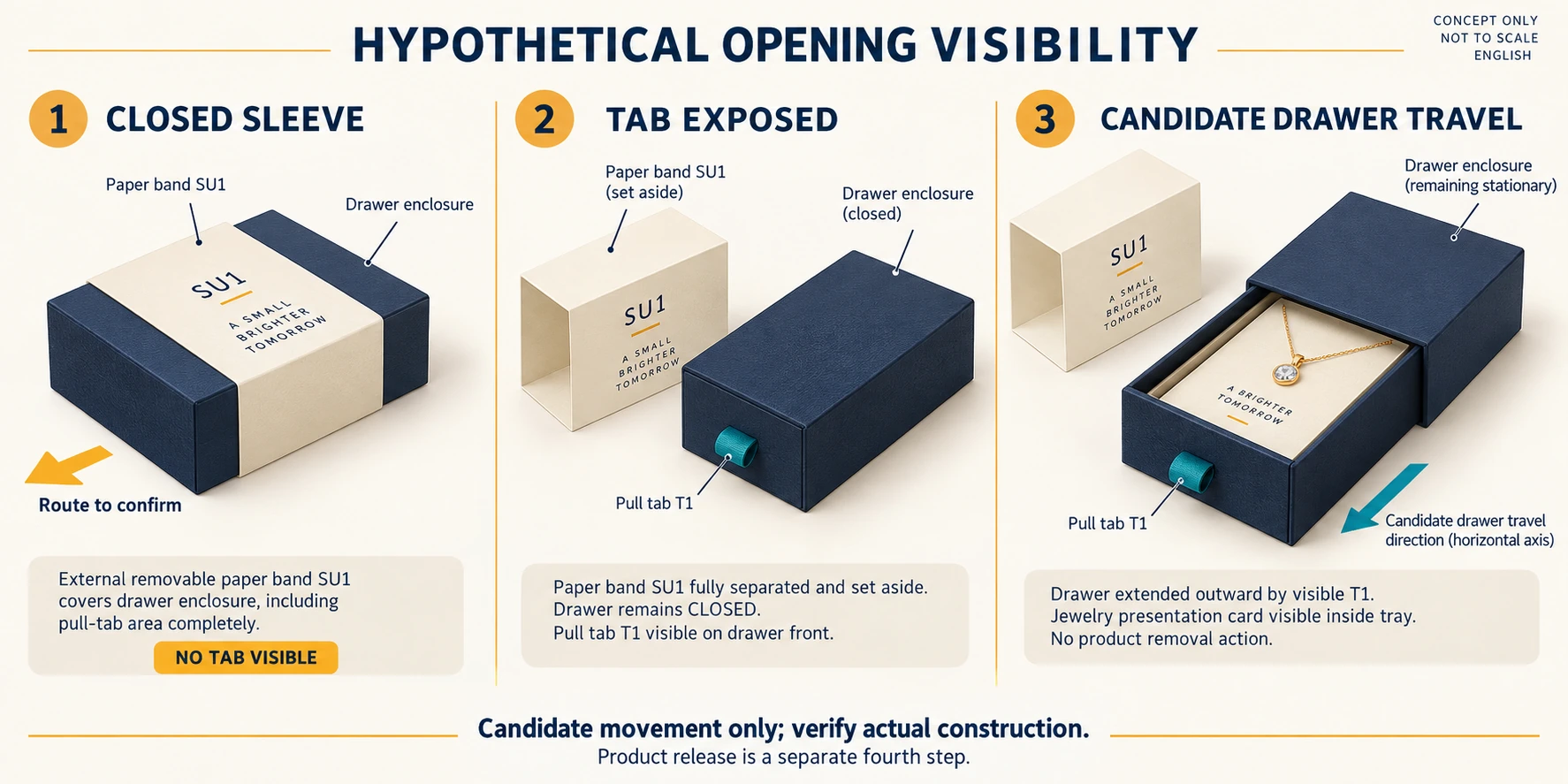
Packaging opening instructions need a visibility record alongside the storyboard. For the hypothetical sleeve SU1 and working tab T1, the first frame must show SU1 still present and T1 concealed. The diagram below assumes a candidate sliding sleeve and drawer solely to explain visibility; neither movement nor construction has been confirmed for a physical pack.
Scroll horizontally if columns extend beyond the view.
| Frame reference | Visible before action | Proposed action to confirm | Evidence still required |
|---|---|---|---|
| F1 | Closed SU1; T1 concealed | Remove SU1 by the actual confirmed route | Representative closed sample and sleeve travel |
| F2 | SU1 separated; T1 now visible | Reach T1 while supporting enclosure | Actual grip and attachment; no wall crossing |
| F3 | T1 accessible | Move candidate tray in confirmed direction | Tray travel, stops and retained contents |
| F4 (separate product step) | Presentation exposed | Remove product by agreed action | Actual product release, distinct from opening |
Do not copy the conceptual arrow into final instructions before the supplier identifies the real movement. The actual sleeve may not slide as drawn, and a different tab could move the holder rather than a drawer. Record that mismatch as a construction question, not a successful review. Keep F4 separate even when the teaching diagram stops at F3: an accessible presentation is not proof that the jewelry can be removed. In an eventual no-coaching review, log the first unprompted action, any hesitation and each extra movement before giving assistance; those empty CSV fields are not completed participant observations.
Download the packaging opening instructions record (.csv). Example rows are explicitly hypothetical. Use ACTUAL_BLANK for your own permitted project entries; replace that row label only when recording actual inputs. Blank evidence or observation fields mean unknown or not performed, never approval. Keep revisions and checkpoints separate.
For a scoped packaging inquiry, provide the fully closed configuration, actual sleeve and tab construction, confirmed movements and the image/artwork revisions to bind together. Send the identified configuration and open questions to Packrivo. Quantities in this record are planning demand, not quoted purchase quantities, MOQ exceptions or confirmed service availability.
What this changes in a packaging enquiry
Give the supplier an opening sequence that begins with the pack exactly as received, including any temporary seal or transport restraint. Position instructions only where the recipient can see them before the relevant action. A diagram of an already-open box cannot establish a usable first-opening route. A relevant configuration to compare is the Folding gift box; it is a concept reference, not confirmed suitability.