
Estimate subscription packaging from delivery events due inside the planning window, then confirm which events can proceed. A subscriber total is a roster size, not a shipment count. Different delivery cadences, skipped dates and prepaid schedules can produce a different number of presentation packs this month.
Define the event before counting the boxes
For this example, one eligible delivery event uses one presentation box and one message card. That is an invented operating rule, not a Shopify default. A delivery containing two separately presented gifts would need two boxes. An order split across locations might need several outer parcels without changing its presentation-box count.
Choose a date window and a dispatch cutoff. Record the contract reference, scheduled delivery date, quantity of presentation packs and the order or fulfillment reference where one exists. Keep customer identities out of a supplier-facing quantity brief.
Shopify distinguishes pay-per-delivery subscriptions, where the subscription app creates recurring orders, from prepaid subscriptions with multiple scheduled fulfillments attached to one order. A payment event therefore does not provide a universal shipment count. The prepaid explanation applies where the selected subscription arrangement supports it; it does not establish that every subscription app offers the same plans.
Turn a hypothetical roster into due deliveries
Suppose a planning roster contains 120 contract records. These are mutually exclusive planning groups, not 120 unique people or a Shopify Active-filter export. Every number below is hypothetical.
Scroll horizontally if columns extend beyond the view.
| Planning group | Records in roster | Delivery events due in this window | Reason |
|---|---|---|---|
| Monthly contracts with one delivery due | 60 | 60 | Each has a date inside the window |
| Quarterly contracts | 30 | 10 | Ten are due now; twenty are due later |
| Explicitly paused or skipped for this window | 20 | 0 | No delivery is scheduled in this scenario |
| Prepaid contracts with one scheduled delivery due | 10 | 10 | Payment happened earlier; delivery is due now |
| Total | 120 | 80 | Count delivery events, not roster records |
The twenty quarterly records due later stay outside this cycle’s demand. The paused or skipped group is separate from the other groups, so no record is subtracted twice. The prepaid group still contributes ten deliveries even though this window contains no new payment for them.
Keep due events separate from ready events
Now inspect the 80 due events. Assume 74 are confirmed eligible for fulfillment and six need an operational decision. They remain visible as held events; they do not disappear from the schedule. If four clear before the cutoff, the count becomes 78 eligible and two held. The due total remains 80 throughout.
Under the one-box-and-one-card assumption, the confirmed packing instruction is 78 boxes and 78 cards, with two additional due events awaiting a decision. Report both figures and the cutoff time. Calling all 80 ready overstates the instruction; calling demand 78 hides the unresolved two.
“Eligible” and “held” here are the brand’s planning labels, not additional Shopify inventory statuses. Check the actual order or fulfillment record and the applicable service policy before assigning them. Shopify’s Scheduled prepaid fulfillments become Unfulfilled when their date is reached, but a calendar date alone does not verify every requirement of your packing operation.
Handle changes in the app that governs them
The first-party Shopify Subscriptions app allows upcoming orders to be skipped and contracts to be paused or resumed. Its billing settings also configure retry attempts and the action taken after repeated failure. Those documented settings do not justify assuming every failed payment immediately removes a shipment, or that another subscription app behaves identically.
Refresh the due-event export after changes and reconcile it with existing order and fulfillment references. Preserve the six-to-two held-event history in this example so the packing team can see why the release quantity changed. This is a schedule reconciliation, not a forecast of future sign-ups or a model for carrying seasonal stock forward.
Once the presentation quantity is established, gift-ready ecommerce packing addresses messages, receipts and packing instructions. For sourcing coordination, give Packrivo the cycle window, confirmed presentation-pack quantity and unresolved quantity through the packaging inquiry brief. Supplier purchasing lead times still need a separate decision; a due-event count does not guarantee supply or delivery performance.
Source scope: Shopify’s subscription fulfillment guide, Shopify Subscriptions contract management and app billing settings were checked on 15 October 2026. Platform behavior depends on the subscription app and configuration; the cohort counts and readiness rules above are illustrative.
Prepayment does not reserve every future fulfillment at once
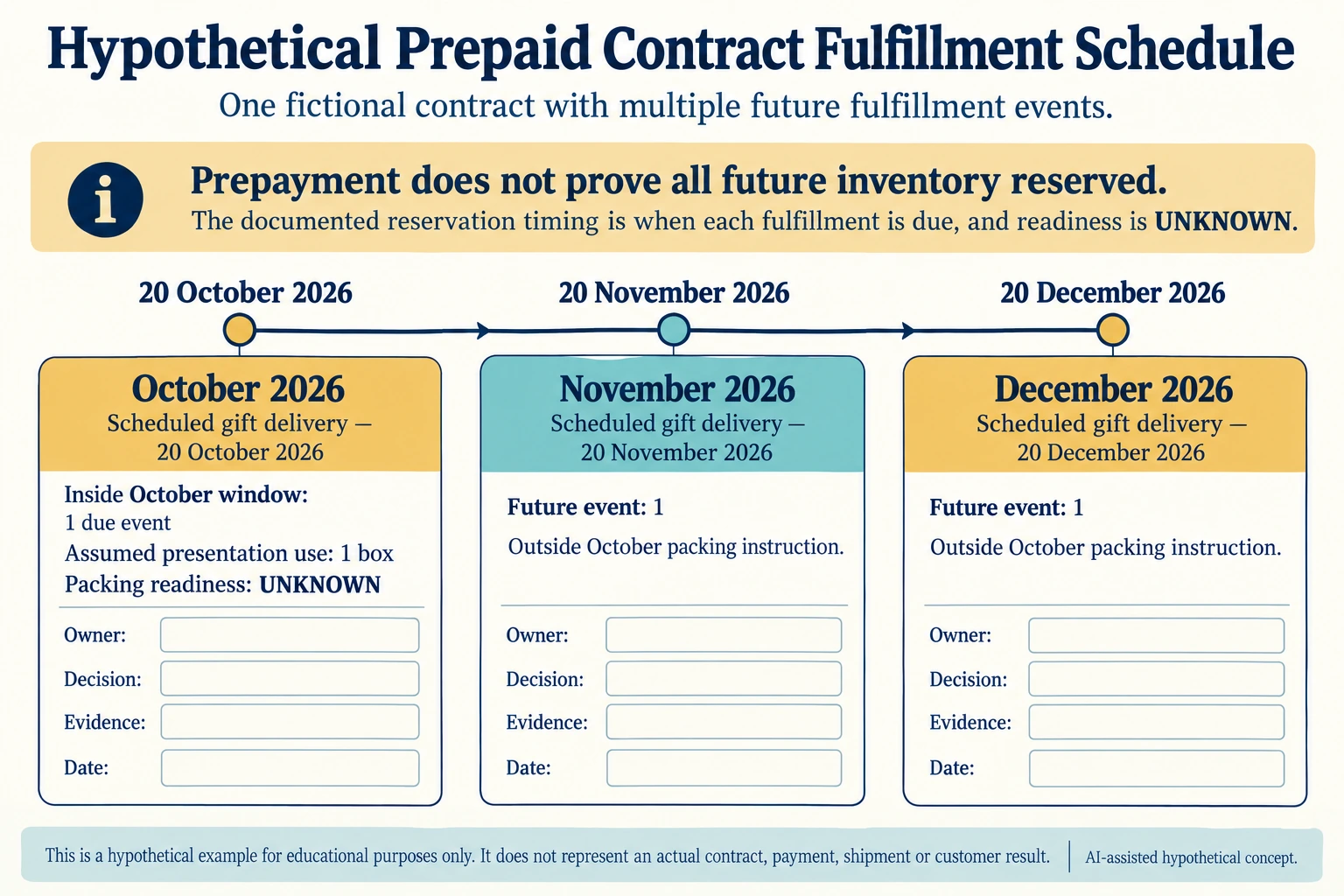
Use one fictional prepaid contract with one scheduled gift delivery on each of 20 October, 20 November and 20 December 2026. Assume one presentation box per event only for this model. The October planning window contains one due event, while the complete three-date schedule contains three. Payment count and current-cycle presentation demand therefore answer different questions.
Scroll horizontally if columns extend beyond the view.
| Hypothetical configuration | Named object | Relationship | Input or next scope |
|---|---|---|---|
| OCT_EVENT | OCT_EVENT | hypothetical due date | 2026-10-20 |
| OCT_EVENT | OCT_EVENT | window scope | INSIDE_OCTOBER_WINDOW |
| OCT_EVENT | MODEL_PRESENTATION_REQUIREMENT | calculated from | OCT_EVENT_COUNT*BOX_PER_EVENT; 1 box |
| NOV_EVENT | NOV_EVENT | hypothetical due date | 2026-11-20 |
| NOV_EVENT | NOV_EVENT | window scope | OUTSIDE_OCTOBER_WINDOW_FUTURE |
| DEC_EVENT | DEC_EVENT | hypothetical due date | 2026-12-20 |
| DEC_EVENT | DEC_EVENT | window scope | OUTSIDE_OCTOBER_WINDOW_FUTURE |
| SCHEDULE | TOTAL_SCHEDULE_EVENTS | calculated from | OCT_EVENT_COUNT+NOV_EVENT_COUNT+DEC_EVENT_COUNT; 3 delivery events |
| SOURCE_SCOPE | SHOPIFY_DOCUMENTED_PREPAID_INVENTORY | reserved when | EACH_SCHEDULED_FULFILLMENT_BECOMES_DUE_NOT_ENTIRE_INITIAL_CONTRACT |
Shopify’s prepaid-fulfillment documentation says inventory is reserved when each scheduled fulfillment becomes due, rather than reserving the entire future contract at initial order creation. Do not read a three-event schedule as evidence that three units are already reserved or that the current event can ship.
The actual due event still needs its fulfillment, inventory location and readiness checks. The other two dates remain future planning obligations, not current packing instructions. This calendar supplies neither a purchasing lead-time decision nor an assumption that later stock will be available.
The timing explanation concerns Shopify’s documented prepaid arrangement, while specific contract and retry functions depend on the chosen app and configuration. An order edit is not automatically a future-contract edit. No actual contract, payment, reservation, order, customer or completed fulfillment is represented by the timeline.
Download the prepaid subscription scheduled fulfillment inventory due date record (.csv). It includes the original table fields and scenarios alongside the added relationships. HYPOTHETICAL rows are editorial examples or required review scopes, not actual records. Actual quantity, configuration, component and file identities, materials, process, specification, copy, method, condition, observation, owner, decision, evidence and dates are blank. ACTUAL_BLANK is a separate empty starting row; enter permitted project evidence before using an actual record. A blank means unknown.
Use the Gift Ready Ecommerce Packaging: Messages and Packout for its separate question. Use the Packaging Reorder Point During Replenishment for its separate question.
Source scope checked 17 October 2026: Shopify subscription-fulfillment, first-party contract and app-settings HTML were actually read; reliable separate publication dates were not shown. Prepaid inventory reservation occurs at due fulfillment, not for the entire initial contract. Due does not guarantee readiness, and first-party functions do not apply to every app. The added configurations and calculations are hypothetical, with actual evidence and decisions pending.
What this changes in a packaging enquiry
Calculate component demand from shipments due in the purchasing window, including the actual packaging version for each subscription cycle. Keep subscriber roster counts separate from due deliveries and planned spare material. The example schedule is not a supplier forecast or a confirmed replenishment time.
Discuss this packaging specification with Packrivo. We coordinate independent suppliers. MOQ: 500 pieces per product/design; illustrative quantities are not production offers. Confirm materials, samples, price and timing for your project.