
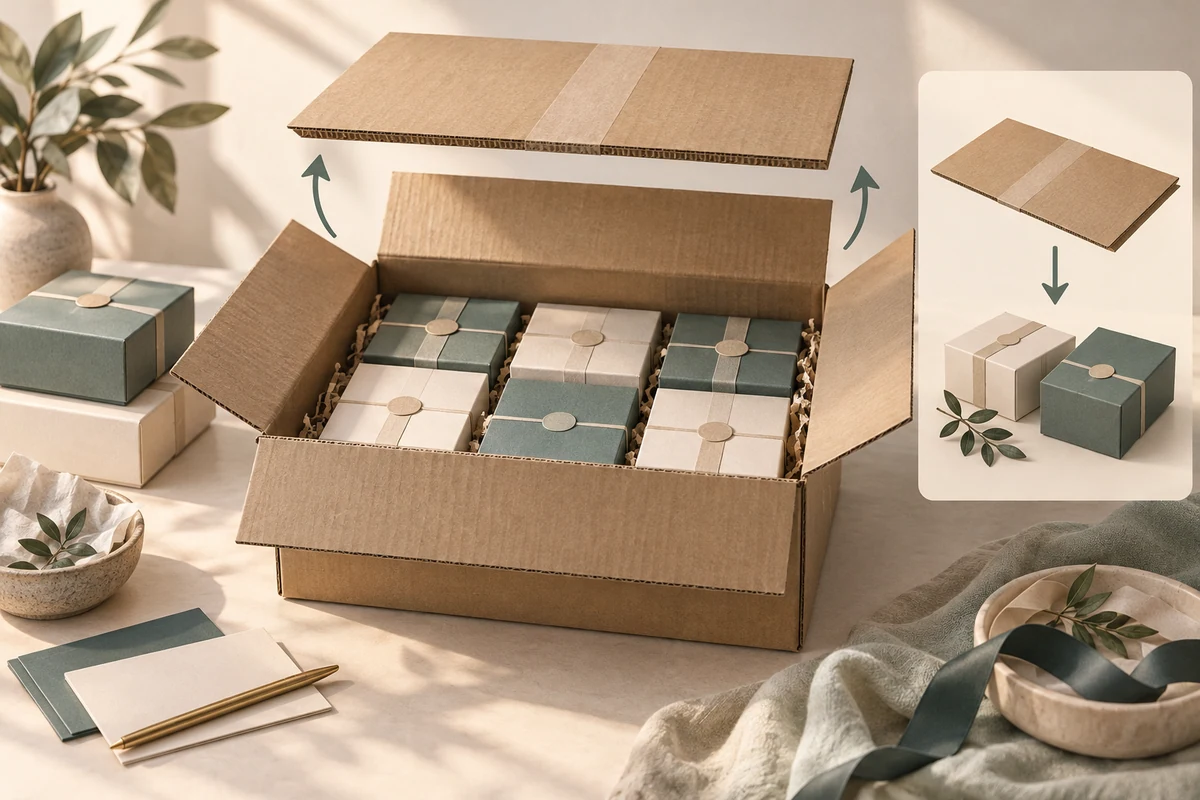
Review a shipping carton’s opening action against the retail packs immediately beneath it. The top seam, inner-unit positions and receiving method share an interface. A complete sealing specification does not establish that opening the carton will leave the presentation surfaces inside undisturbed.
In this guide
Start with the actual loaded state before anyone moves the units. Identify which retail faces sit near the opening area, what separates them from it and what opening method the receiving location permits.

Locate the seam and the exposed surfaces together
Show the top flap arrangement and seam on a section through the loaded carton. Name the retail unit beneath each relevant area, including its lid, sleeve, projecting tag or other vulnerable presentation surface.
The shipping-carton sealing scope records closing method, tape candidate and application responsibility. Its dispatch operation does not supply the receiving opening instruction.
Keep the loaded orientation consistent with the map. If packing staff rotate a gift box or change a top layer, the opening-interface drawing needs that actual state rather than the earlier arrangement.
Compare two hypothetical interface proposals
Assume retail gift lids sit directly beneath the center top seam in a proposed carton. No actual opening action or damage has been observed. The buyer asks the relevant supplier and receiving owners to compare two proposals.
Scroll horizontally if columns extend beyond the view.
| Proposal | Interface to confirm | Evidence still needed |
|---|---|---|
| Identified protective top layer | Its position, attachment and relationship to the retail lids | Review on the actual loaded proposal using the site-approved opening method |
| Defined non-cutting opening construction | How the receiver finds and operates the feature | Actual starting state, complete movement and resulting inner condition |
These options are not available or approved merely because they can be drawn. A top layer can affect packing work and clearance; another opening construction changes the carton. Keep those changes in the proposal and commercial scope.
No universal blade depth, safe gap or cutting sequence follows from this comparison. Actual tools and operating rules belong to the receiving location’s responsible process.
Observe first opening as a distinct task
Record the unopened loaded carton, the instructed action and the retail-pack state immediately afterward. Keep any deviation or additional movement visible. A later tidy arrangement cannot show what happened during the initial action.
The retail-pack orientation record supports the loaded map and receiving order. An opening-zone section adds the specific relationship between that load and the outer seam.
If an observation reveals a mark or contact, describe its location without inventing the cause. The next technical or operational review should assess the actual evidence and determine whether a construction or method change is needed.
Confirm the receiving route with its owners
OSHA’s US warehousing guidance addresses handling, suitable working areas and clear routes. UPS US packing guidance concerns shipment preparation. Neither establishes a site-specific opening procedure or proves that a top layer prevents damage.
Send the loaded section, named opening area, proposed construction and actual receiving-method question together. Ask who supplies the instruction and which evidence supports it for that configuration.
Packrivo can coordinate the carton and supplier questions through a packaging project inquiry. Public sources were checked on 14 October 2026. This hypothetical example supplies no tested protective layer, approved tool instruction or observed damage result.
Keep the first-opened view before rearranging the retail units
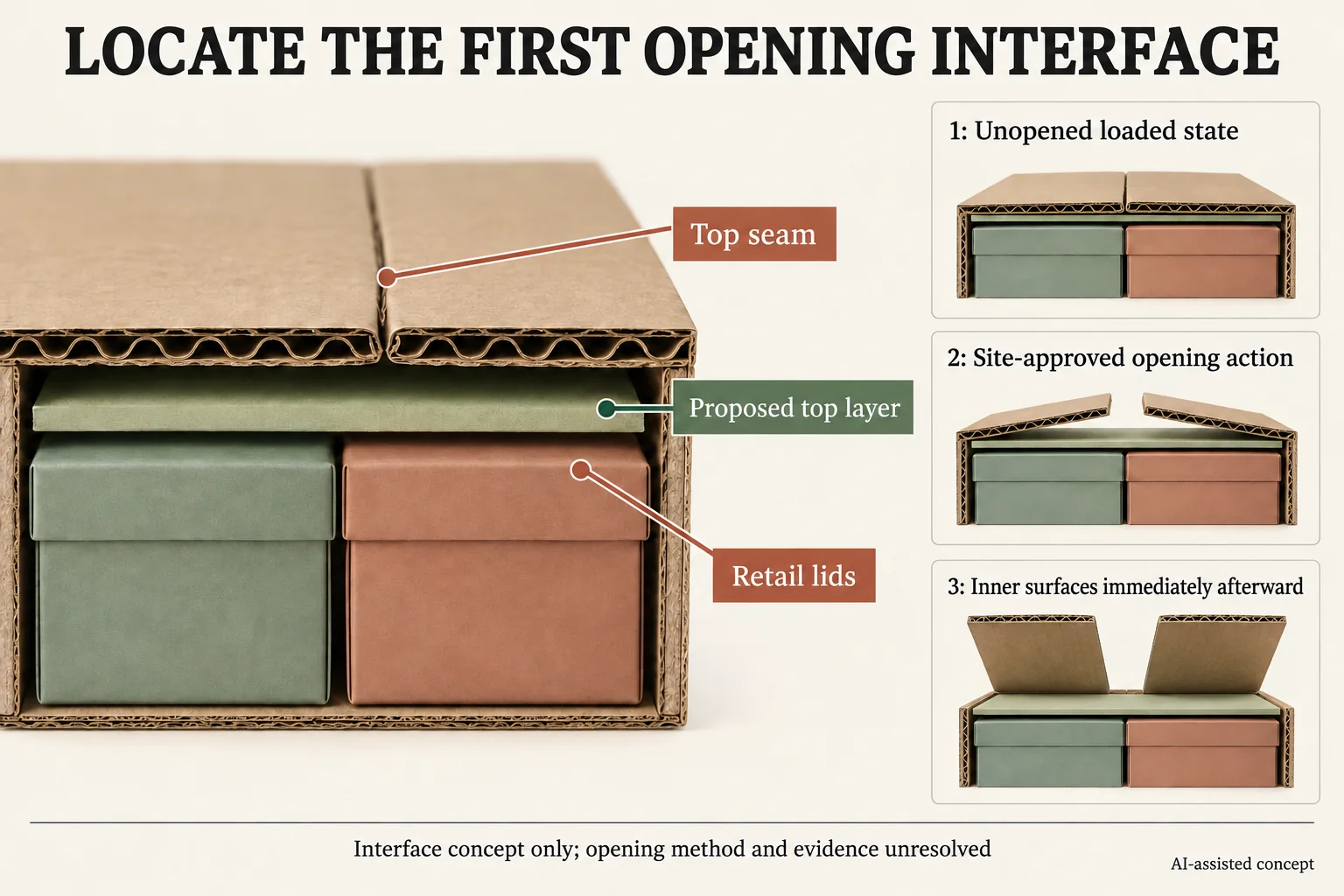
The section should identify the same loaded state the receiver actually encounters. Give the top seam, proposed layer and retail lids separate references. A layer visible in a drawing is a construction proposal, not evidence that it protects the lid or can be opened through a particular action.
Scroll horizontally if columns extend beyond the view.
| Record stage | What to identify | What it does not establish |
|---|---|---|
| Unopened loaded state | Carton version, seam S1, layer L1 and retail units U1/U2 | No opening result yet |
| First opening | Actual site-permitted method and any deviation | No universal tool or cutting-depth instruction |
| Immediately after | Located inner surfaces before the units are moved | No cause or whole-shipment result from one view |
| Revised proposal | Changed layer, carton or instruction with version | Old evidence does not automatically cover the new state |
For a hypothetical view, a mark on U1 near the seam would be recorded at that location. It would not by itself establish that a tool caused it or that every lid is affected. Keep any prior condition view, the actual opening action and the resulting view available for the responsible reviewer.
If the proposal changes the top layer, check its effect on loaded height, packing work and access. If it changes the carton opening feature, identify the actual starting condition and full action. Neither response should be called approved before its relevant evidence exists.
The retail pack orientation map provides the loaded positions. This opening record adds what happens between the closed seam and the first view inside, using the receiving location’s authorised method rather than inventing a tool technique.
Download the shipping carton opening design record (.csv). This file contains field definitions, clearly fictional teaching entries and a blank actual-project row. Keep unknown evidence open rather than copying the example as an approval.
Bring the specific open question to the project brief
For an opening-interface review, provide the loaded carton cross-section, seam and lid positions, proposed top layer, permitted opening-method reference and immediate observations. Send the current configuration, actual records available, quantity by design, destination and the unresolved question through Packrivo’s packaging inquiry. Packrivo coordinates sourcing and project questions with independent suppliers; the responsible parties confirm materials, service, methods and commercial terms.
What this changes in a packaging enquiry
Show the supplier the outer-carton seam, intended opening tool or action and the presentation lids immediately underneath. Compare a defined protective layer or opening arrangement, not only the outer carton size. A closing specification that ignores the opening route can leave the gift surface exposed. A relevant configuration to compare is the Regular Slotted Shipping Cartons: Size Around the Inner Pack; it is a concept reference, not confirmed suitability.