

Reconcile packaging stock movements with a physical count at the same cutoff before fixing the next purchase quantity. Opening stock, receipts, issues and returns create an expected balance. A different count needs an identified explanation or authorized adjustment; it should not automatically become waste, theft or extra purchasing demand.
Keep component version and condition within the counted scope. A physically present obsolete sleeve may belong in the warehouse count while remaining outside the quantity available for current orders.

Define the counted unit and cutoff
State whether the unit is a box, lid, complete set, card or another component. Count actual stock under the responsible method and keep unopened bundles, partial groups and held items distinguishable.
Record the point at which receipts and issues are included. If staff continue moving material during a count, retain those movements so an item is not omitted or counted in two places.
The Australian Government stocktake guidance recommends planning the count and giving staff clear instructions and tools. Its Australian tax discussion is outside this article’s operational use and is not applied to US or UK brands.
Locate a hypothetical fifteen-unit gap
Assume the counted component is one identified gift-box version. The period opens with 400 units, receives 200, issues 350 and takes back ten eligible unused units. All quantities are invented.
Scroll horizontally if columns extend beyond the view.
| Movement or comparison | Units |
|---|---|
| Opening stock | 400 |
| Receipts | +200 |
| Recorded issues | -350 |
| Recorded eligible returns | +10 |
| Expected closing balance | 260 |
| Physical count at the stated cutoff | 245 |
| Unexplained difference | 15 |
Check whether an issue remains unposted, a receipt uses another unit basis or a return was counted in the wrong period. A recount or identity check may also be appropriate under the actual method.
The fifteen-unit difference establishes none of those causes. Preserve it until the responsible owner can resolve the evidence. Purchasing fifteen extra pieces does not correct the underlying record.
Keep physical quantity and usable quantity separate
After reconciling the movement balance, identify held, obsolete or otherwise unavailable stock within the physical quantity. Do not subtract an unavailable group twice, once as a movement and again as a status restriction.
The leftover version and condition register reviews whether remaining components match the current baseline. It answers a use-eligibility question after their identities and quantities are established.
Official inventory-management guidance supports comparing counted stock with records and reviewing the findings. The arithmetic bridge here is an original packaging application, not an accounting policy or stocktake certification.
Make the adjustment and reorder basis traceable
Return the expected balance, counted balance, discrepancy evidence and decision owner. Any authorized record correction should identify its reason and cutoff rather than overwrite the earlier movements without history.
Then use the reconciled, eligible quantity in the actual purchasing plan, alongside current demand and outstanding supplier commitments. Stock physically absent and stock already ordered but not received are separate inputs.
Packrivo can coordinate component and quantity questions through a packaging project inquiry. Sources were checked on 14 October 2026. No real inventory gap, fault, theft or tax conclusion is reported by this example.
Bring the ledger and physical count back to the same cutoff
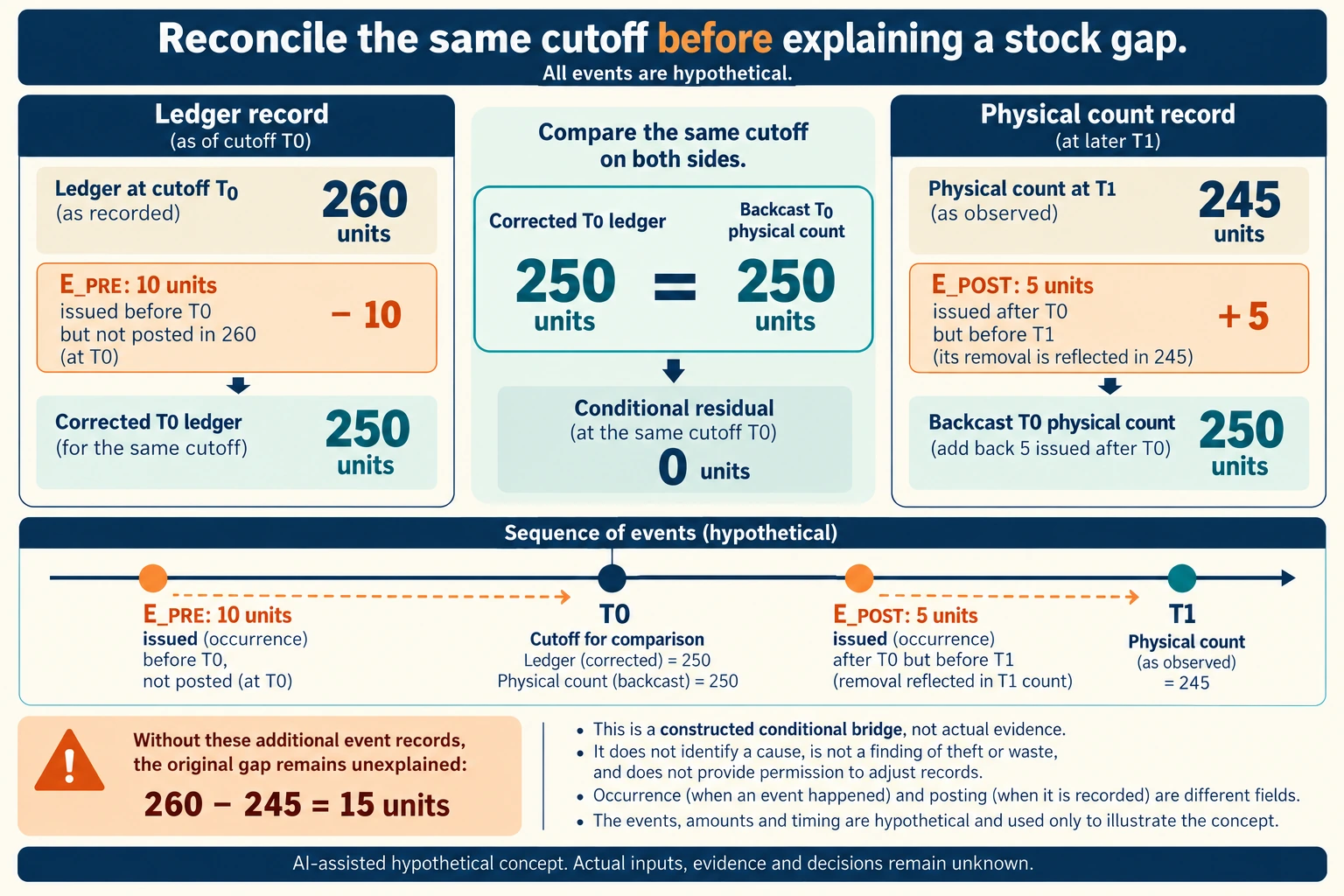
The original 260-versus-245 comparison leaves fifteen units unexplained. Keep that scenario intact. In a separate conditional bridge, assume supporting records identify E_PRE: ten units issued before cutoff T0 but not posted in the 260 ledger, and E_POST: five units issued after T0 but before a later physical count at T1. No actual movement records have been obtained.
Scroll horizontally if columns extend beyond the view.
| Hypothetical scenario | Item or operation | Planning relationship | Assumed input or calculation |
|---|---|---|---|
| CUTOFF35 | CONDITIONAL_CORRECTED_T0_LEDGER | calculated from | O_EXPECTED-PRE_ISSUE; 250 units |
| CUTOFF35 | CONDITIONAL_BACKCAST_T0_PHYSICAL | calculated from | O_COUNT+POST_ISSUE; 250 units |
| CUTOFF35 | SAME_CUTOFF_RESIDUAL | calculated from | LEDGER_T0-COUNT_T0; 0 units |
Apply E_PRE to the cutoff ledger: 260 − 10 = 250. Backcast the later physical count by adding back the post-cutoff issue: 245 + 5 = 250. The two quantities now describe the same T0 boundary, producing a constructed residual of zero. The five issued units are absent from the later stock; their removal is reflected in the 245 count.
Keep occurrence, posting and counting times as separate fields. A late posting does not move an earlier physical event into a later period. The event IDs and inclusion decisions matter as much as the arithmetic when the responsible owner reviews a real reconciliation.
Zero here follows from two additional hypothetical inputs. It is not evidence that the original gap had these causes, that the warehouse is accurate or that an adjustment is authorised. A stock transfer’s physical states and a retailer’s spare-carton consumption answer different questions; this bridge aligns the cutoff used on both sides of a count.
Download the packaging stock cutoff movement reconciliation bridge record (.csv). It includes the original table fields and scenarios alongside the added relationships. HYPOTHETICAL rows are editorial examples or required review scopes, not actual records. Actual quantity, configuration, component and file identities, materials, process, specification, copy, method, condition, observation, owner, decision, evidence and dates are blank. ACTUAL_BLANK is a separate empty starting row; enter permitted project evidence before using an actual record. A blank means unknown.
Use the Leftover Packaging: Check Versions Before Reordering for its separate question. Use the Packaging Transfers Between Locations Need a Single Inventory Ownership Count for its separate question. Use the Consignment Gift Stock Needs Packaging Counts Separate from Sales Settlement for its separate question.
Source scope checked 17 October 2026: Australian public stocktake/inventory guidance supports clear records and review. Its tax simplifications do not apply here as US/UK rules; the cutoff bridge is original conditional arithmetic, not accounting certification or an actual cause. The added configurations and calculations are hypothetical, with actual evidence and decisions pending.
What this changes in a packaging enquiry
Use the counted packaging balance to locate a purchasing gap only after movements and the count cutoff are reconciled. Separate unavailable, committed and unverified units from usable stock. An unexplained variance should not be converted straight into an order or treated as confirmed packing waste.
Discuss this packaging specification with Packrivo. We coordinate independent suppliers. MOQ: 500 pieces per product/design; illustrative quantities are not production offers. Confirm materials, samples, price and timing for your project.