
Compare a new retailer’s actual requirements with the packaging stock already held before treating that stock as channel-ready. Existing boxes may remain physically usable while lacking an approved identifier, receiving arrangement or display feature for the proposed channel. Keep channel eligibility separate from overall physical stock.
In this guide
- Map each requirement to a component or operation
- Count a hypothetical visible-variant requirement
- Assess added components against the current configuration
- Return the use, addition and new-purchase quantities
- Record the retailer-specific count without writing off other stock
- Bring the specific open question to the project brief
Use the retailer’s supplied requirements, not a generic list presented as mandatory for every store. Confirm the actual version, market and operation the requirements concern.
Map each requirement to a component or operation
Identify what the retailer needs at receipt, on display and during replenishment. A requirement may affect a retail-unit label, an outer-case count or a packing operation rather than the main box structure.
The ecommerce and retail layer comparison separates shared customer-facing components from channel-specific tasks. This eligibility map applies those tasks to already held stock and an actual new-channel brief.
Record which requirements are met by existing accepted components, which need an approved added part and which reopen the configuration. A familiar exterior is not evidence the retailer has accepted it.
Count a hypothetical visible-variant requirement
Assume a fictional retailer requires a closed gift unit with a visible approved variant reference and dispatches whole cases of six. The brand holds 150 qualified blank boxes and 100 approved matching variant labels. All requirements, quantities and approvals are invented.
Scroll horizontally if columns extend beyond the view.
| Component or quantity | Available in the example | Channel consequence |
|---|---|---|
| Qualified blank boxes | 150 | Box stock alone does not provide the visible reference |
| Approved matching labels | 100 | At most 100 labeled retail units can be completed |
| Whole-case dispatch count | 6 retail units per case | Sixteen full cases contain 96 labeled units |
| Remaining labeled retail units | 4 | Still individually eligible, but not a full case under this rule |
| Boxes without an available matching label | 50 | Need another approved label supply or defined channel route |
The fifty unlabeled boxes do not automatically become unusable across all channels. Their eligibility for another accepted configuration remains a separate decision.
The four labeled units also show why sale-ready count and dispatchable whole-case quantity differ. A partial-case route cannot be assumed where the retailer requires whole cases.
Assess added components against the current configuration
An extra label needs actual approved source content, placement and application evidence where required. A new inner pack or outer case can change the loaded system. Identify the affected reviews rather than treating additions as purely administrative.
The configuration-change trigger map helps locate interfaces requiring review, although its original example starts from a product change. Retain the retailer requirement that triggered the new question.
Smurfit Westrock’s retail packaging description discusses retail-related structures in its own offerings. It establishes no universal requirement or acceptance of the hypothetical retailer arrangement here.
Return the use, addition and new-purchase quantities
Give the decision owner the actual requirement reference, eligible stock, missing approved components and complete dispatch quantities. Keep open requirements outside the confirmed channel-ready total.
Packrivo can coordinate those component and supplier questions through a packaging project inquiry. Public manufacturer information was checked on 14 October 2026. This example supplies no real retailer rule, accepted stock or mandatory industry standard.
Record the retailer-specific count without writing off other stock
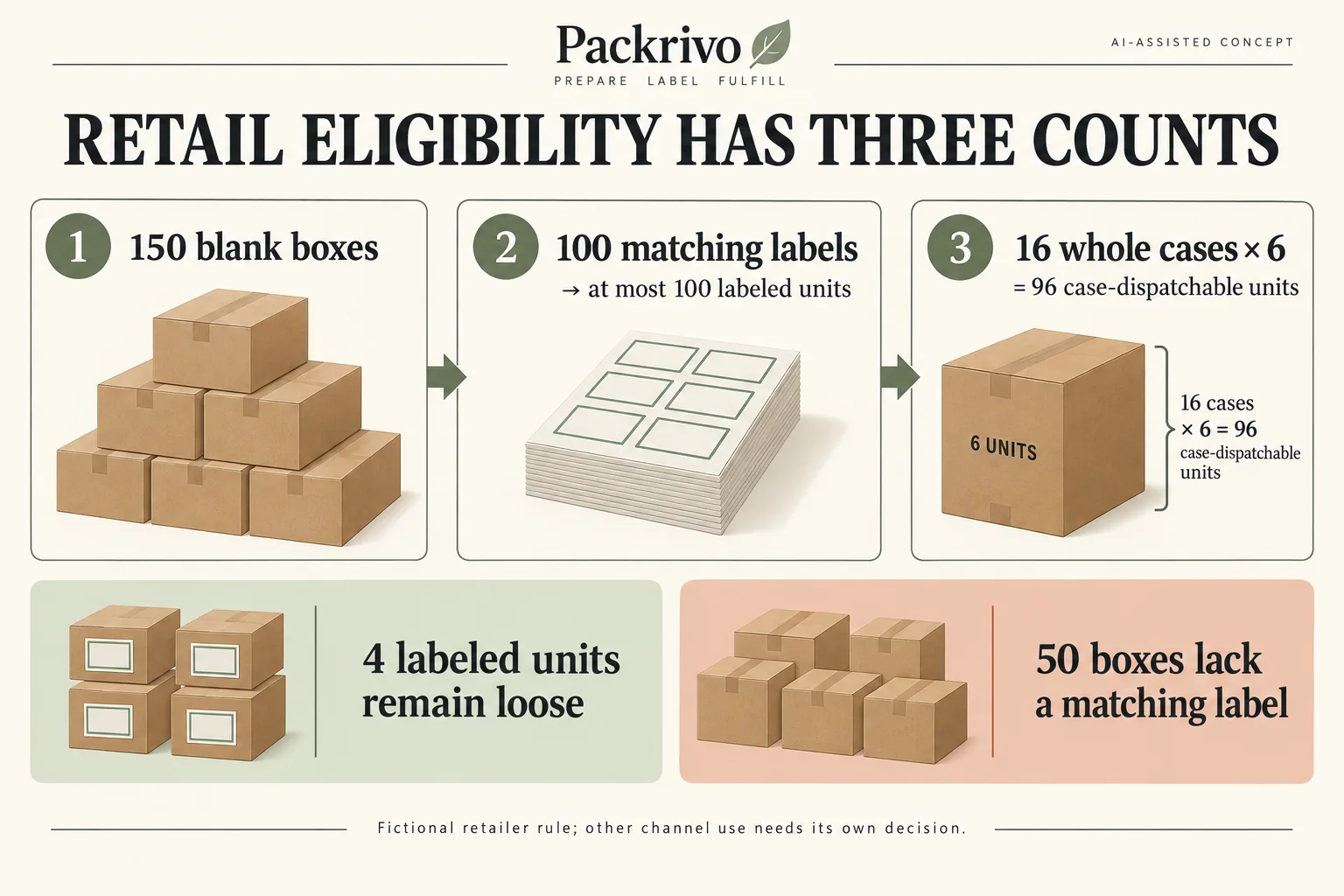
The fictional retailer asks for an approved visible variant reference and whole cases of six. Keep the label and whole-case constraints separate: a unit can meet its individual presentation requirement while not completing another case.
Scroll horizontally if columns extend beyond the view.
| Count boundary | Hypothetical arithmetic | What remains open |
|---|---|---|
| Boxes with matching label supply | Minimum of150 boxes and 100 labels =100 units | Actual label placement and use decisions remain required |
| Whole-case dispatch | Floor of100 divided by6 =16 cases;16×6=96 units | Actual case configuration and retailer acceptance |
| Loose labeled remainder | 100−96=4 units | No partial-case route assumed |
| Boxes without matching label | 150−100=50 boxes | Other channel eligibility or additional approved label supply |
Do not add the four loose labeled units to the fifty unlabeled boxes as one undifferentiated unavailable group. The missing conditions differ. Four need a permitted dispatch quantity; fifty need a matching label or another accepted channel route. A future label receipt also needs the correct design and usable status.
Copy the actual retailer requirement reference into the record before using the calculation. Another retailer may permit partial cases, specify another case multiple or require a different identity method. The example supplies none of those rules for a real account.
The ecommerce and retail component map identifies the channel tasks; the wholesale case-cycle guide compares supply multiples over time. This eligibility record applies an actual requirement to existing stock without treating physical quantity as automatic channel approval.
Download the retail packaging requirements record (.csv). This file contains field definitions, clearly fictional teaching entries and a blank actual-project row. Keep unknown evidence open rather than copying the example as an approval.
Bring the specific open question to the project brief
For channel stock eligibility, send the retailer requirement revision, matching label identity, eligible box count and case multiple; identify whether the question concerns units or whole cases. Send the current configuration, actual records available, quantity by design, destination and the unresolved question through Packrivo’s packaging inquiry. Packrivo coordinates sourcing and project questions with independent suppliers; the responsible parties confirm materials, service, methods and commercial terms.
What this changes in a packaging enquiry
Send the retailer's actual requirements and the identity of existing packaging stock before asking for added labels, sleeves or replacement boxes. Identify which requirement can be met by an approved added operation and which needs a new configuration. Existing stock quantity alone does not establish retailer acceptance. A relevant configuration to compare is the Sheet labels; it is a concept reference, not confirmed suitability.