
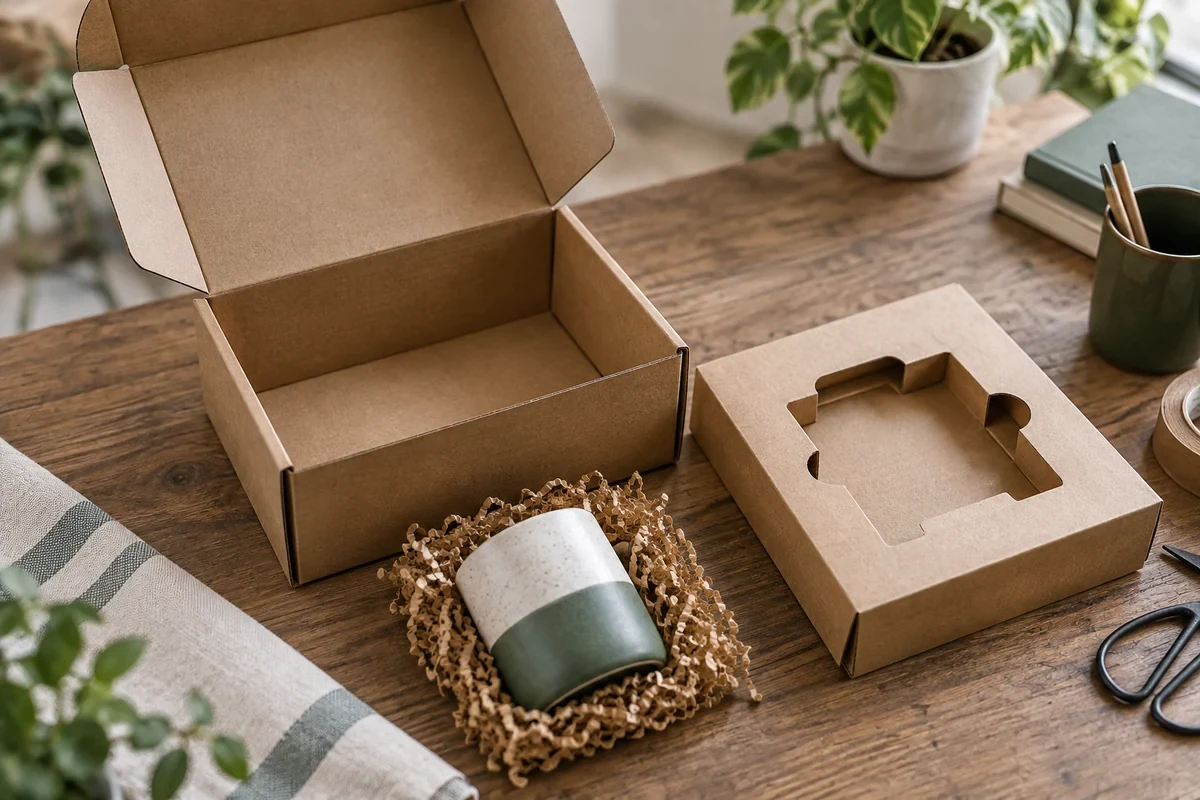
A mailer box with insert needs one brief for the complete packed arrangement. Record the product, accessories, support and card positions before asking for box and insert dimensions. Check the assembled sample for loading, closure and removal, while keeping any transport-protection requirement separate.
A cavity that accepts the product is only one relationship. The insert must also fit the finished mailer, and the complete contents must leave the lid able to close as intended. An empty-box size cannot settle those questions.
List the complete contents before sizing the mailer
Give each included item a reference and version. Measure it in its packed orientation, including lids, wraps, projecting parts and any accessory carton. Record actual measurements separately from estimates or supplier drawing values.
Sketch the arrangement from above and from the side. Identify the order in which the packer adds the parts. A care card placed above a product can change the closing question even when the product and cavity remain unchanged.
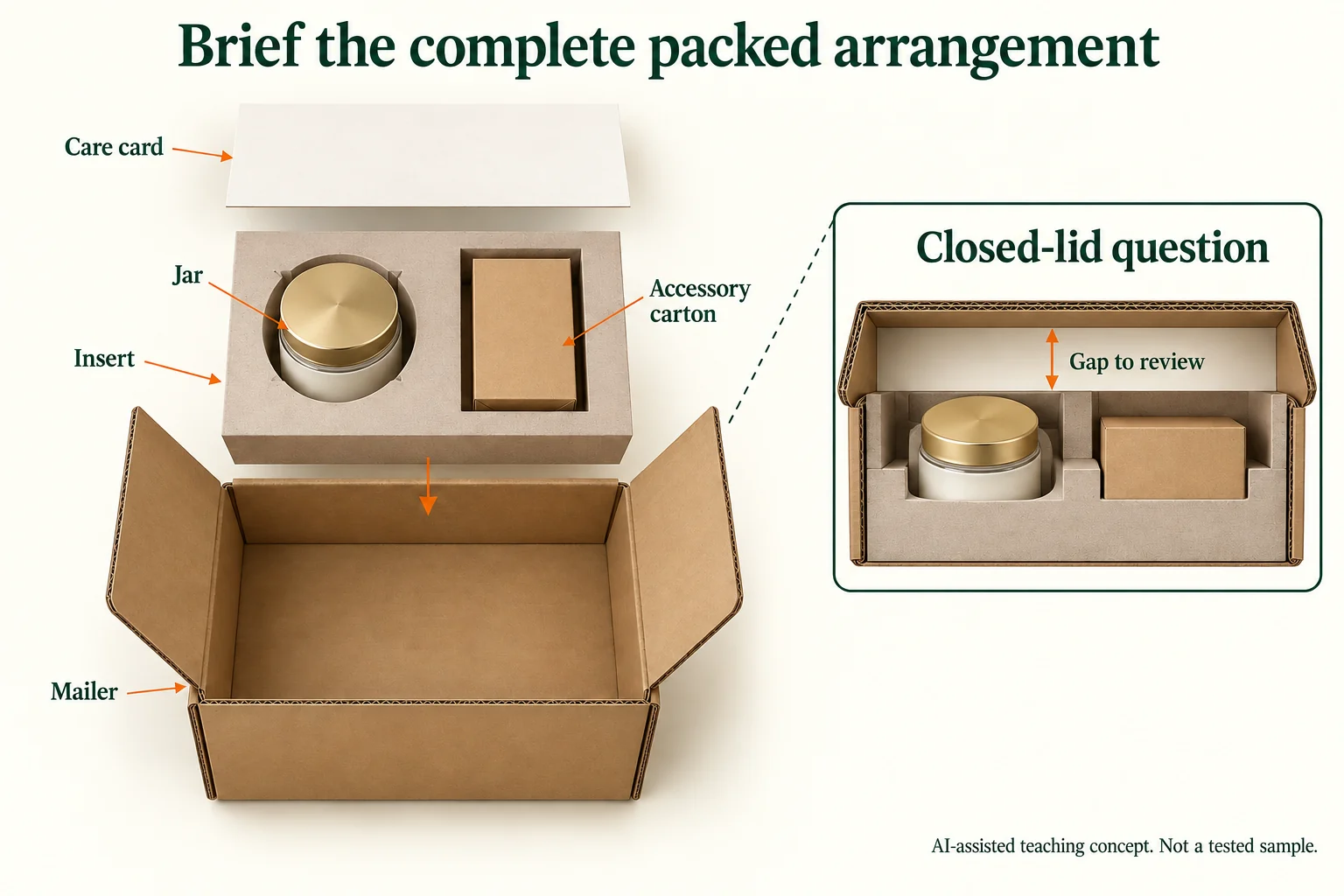
Ask for the mailer’s finished internal dimensions, the insert’s outside dimensions and the relevant cavity geometry. Identify what each number measures. The dimension and acceptance method keeps locations, conditions and measurement basis attached to a value.
Do not add a universal clearance to every product. The selected construction, product sensitivity, loading action and actual sample determine which allowances need technical confirmation.
Review the mailer box with insert as one configuration
Begin with the delivered assembly state. Confirm which forming, fastening and insert-seating steps remain with the packing team. A supplier’s already assembled demonstration does not explain every operation needed at your bench.
Scroll horizontally if columns extend beyond the view.
| Relationship | Action to observe | Record separately |
|---|---|---|
| Product to cavity | Load the actual item in the intended position | Contact, obstruction and force needed |
| Insert to mailer | Seat the specified insert in the finished box | Edges, seating position and movement |
| Complete contents to lid | Close with all cards and accessories present | Contact location and closure behavior |
| Person to product | Open and remove the item by the proposed route | Reach, grip and any snagging |
Keep observations located. “The card edge catches under the lid at the front-right corner” identifies a question for the supplier. “The box feels small” leaves the affected item, action and surface unclear.
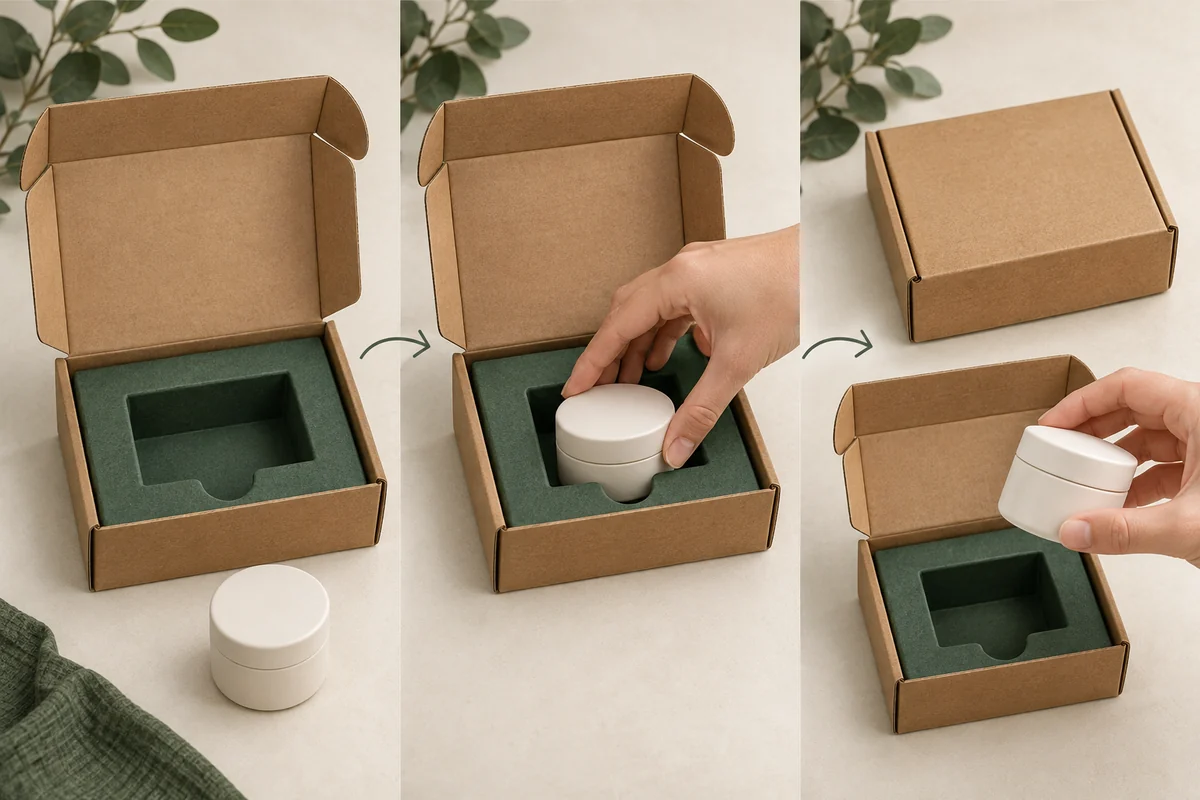
The retained concept shows loading and lifting a jar. It is a visual prompt for examining the actual configuration, not evidence that its fit, materials or shipping behavior have been approved.
Pair box, insert and product revisions
Write the product, mailer and insert references on the same fit record. Keep the card or other layer version there too. An insert revision can change seating depth or how the product is presented; a thicker material does not imply one predictable change without the construction details.
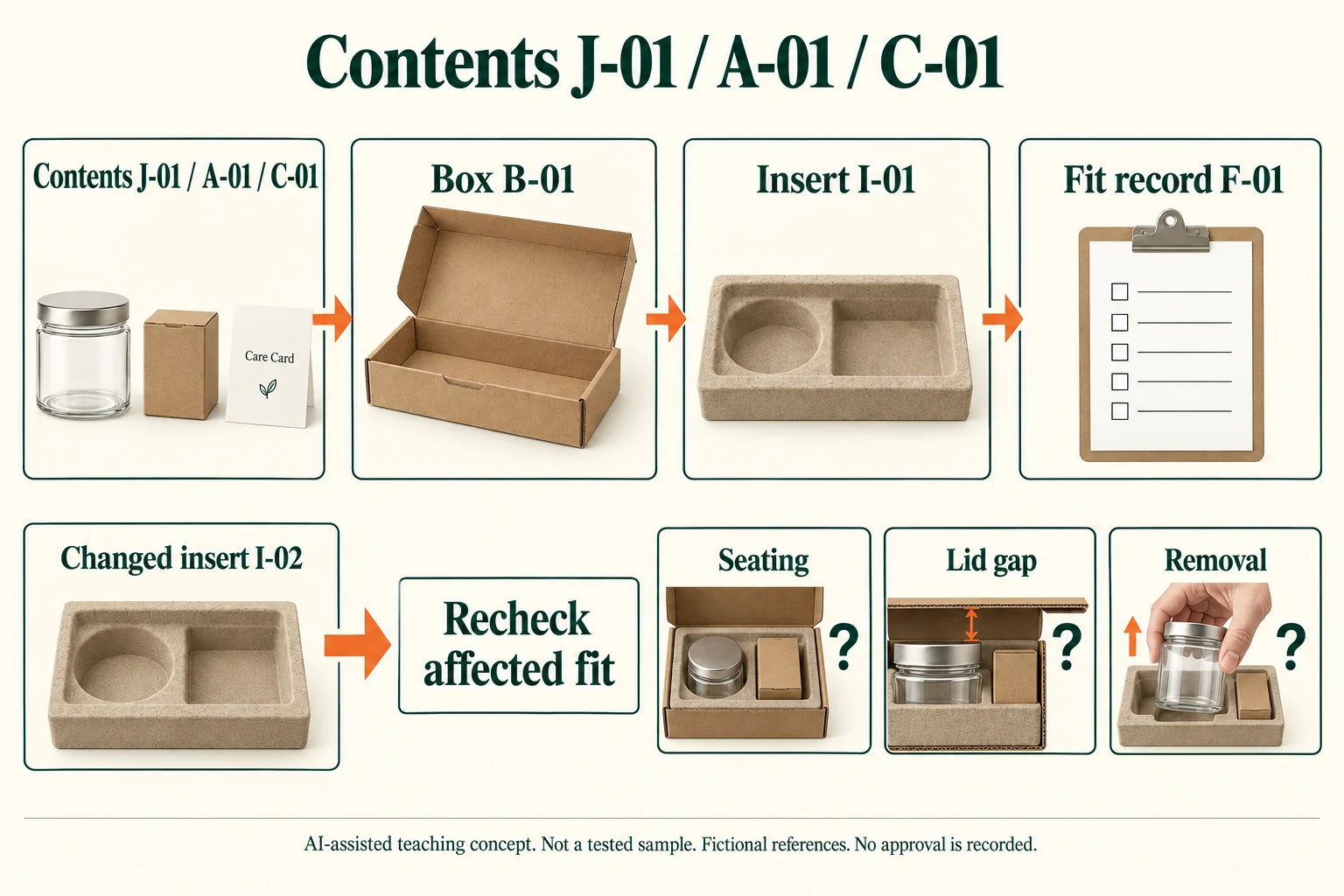
When a change is proposed, retain the previous record and identify which relationship it affects. A revised cavity may require another loading and removal observation. A changed outside insert size may reopen the insert-to-box review even if the product cavity is unchanged.
Fill a hypothetical two-item fit brief
Suppose a fictional gift contains lidded jar J-01, accessory carton A-01 and care card C-01. Mailer B-01 and insert I-01 are candidate components. The illustration and these references are teaching concepts, not a developed or tested package.
The brand proposes one cavity for the jar and another for the accessory carton. It has not established the final card position. Record that as an open arrangement rather than drawing the card through an occupied product or assuming that it adds no height.
If a proposed insert I-02 changes the seat, ask which loaded dimensions and removal path should be reviewed again. Keep B-01 proposed until the supplier confirms whether it still serves the changed interior. A useful output is a list of affected checks, not a blanket “same box, approved” note.
Download the fit configuration CSV. Its fictional rows separate the jar, accessory and unresolved card. The blank project row accepts your measurements and evidence references without default passing values.
Keep shipping evidence outside a fit-only decision
Load, close and remove observations describe what happened during that review. They do not reproduce all distribution conditions. ISTA’s procedure overview distinguishes evaluation purposes and shipment environments; it does not approve the arrangement shown here.
For a protection requirement, define the actual product, complete packaging, route and objective with the responsible technical parties. The complete mailer protection guide explains that wider brief. Keep any report linked to the configuration it evaluated.
Send the contents list, versioned drawings, supplied-state requirements, located fit questions, quantity and destination through a mailer and insert inquiry. Packrivo coordinates the sourcing questions; the supplier confirms its proposal and the agreed reviewer decides the evidence scope.
Questions about mailer and insert fit
Should I choose the empty mailer size first?
Start with the complete packed requirement. The supplier can then develop the finished mailer and insert together instead of forcing the contents into an unrelated empty-box size.
Can one insert hold several products?
List each product and packing arrangement separately. Review each proposed combination rather than extending one sample observation to every variant.
Does a snug cavity prove shipping protection?
Snugness describes one fit condition. Shipping performance needs an appropriately scoped evaluation of the complete packed system.
Must every change restart every review?
Identify the affected interfaces and evidence first. Recheck the changed relationships and any dependent functions; keep valid unchanged evidence attached to its original scope.
Key takeaways
- Include every item and its packed position in the brief.
- Keep product, box, insert and card identities together.
- Separate fit observations from transport-performance evidence.
Source scope: ISTA’s public procedure overview was checked 16 October 2026. No paid procedure, laboratory work or physical sample evaluation was performed. The two-item example and worksheet are original planning aids.