
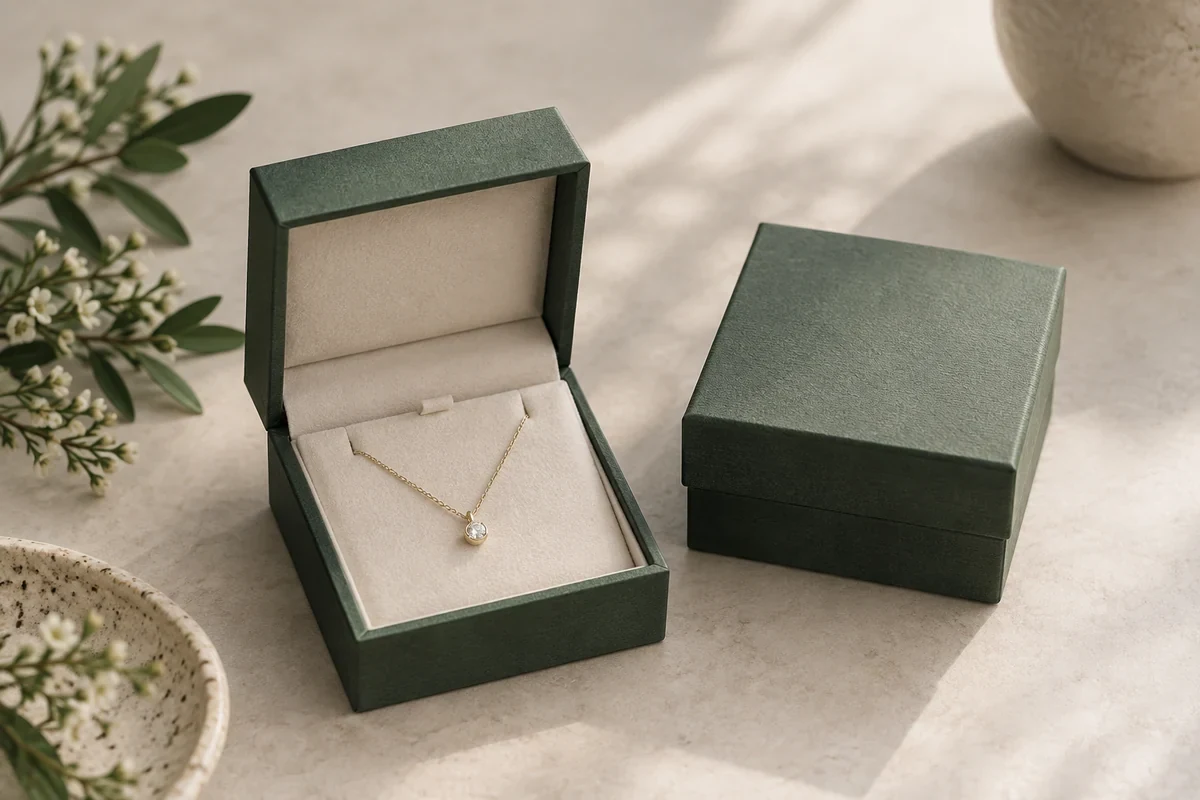
A packaging insert materials comparison should start with the product, finished box interior and job of the holder. Paperboard, corrugated, molded pulp and PET describe possible directions; they do not specify cavity shape, contact surface or protection. Compare proposed forms against the same contents before asking for a material and sample recommendation.
A useful choice leaves you with an identified configuration to review: how it is made, where it touches, how it loads and how the customer removes the item.
Give the insert a defined job
Rank what it must do. The holder may separate products, keep a jar positioned, display jewelry or give the recipient a lifting point. Those requirements can lead to different forms even when the outside box remains unchanged.
Record the product in its packed orientation, including projections and accompanying components. Give the supplier the finished box interior and drawing reference, or mark them unknown. An insert’s outside outline and its usable cavity dimensions are separate fields.
For delicate surfaces, identify the actual contact restriction rather than requesting a broad “premium” material. A material category cannot establish scratch resistance, tarnish behavior or chemical compatibility for your product.
Compare packaging insert materials through their form
Scroll horizontally if columns extend beyond the view.
| Direction | Construction to ask about | What to review |
|---|---|---|
| Folded paperboard | Tabs, folds and the surfaces locating the product | Assembly, seating and removal |
| Corrugated divider | Cells, separators and the complete box arrangement | Required separation and usable cell space |
| Molded pulp | Proposed contours, contact faces and tooling | Loaded support and release path |
| Clear PET tray | Formed depth, flange, edges and visibility | Product contact and complete-box fit |
The table is a question set, not a ranking. Ask for the actual grade, thickness, forming method and delivered assembly. Suppliers must confirm feasibility for the proposed construction; names alone cannot make two offers equivalent.
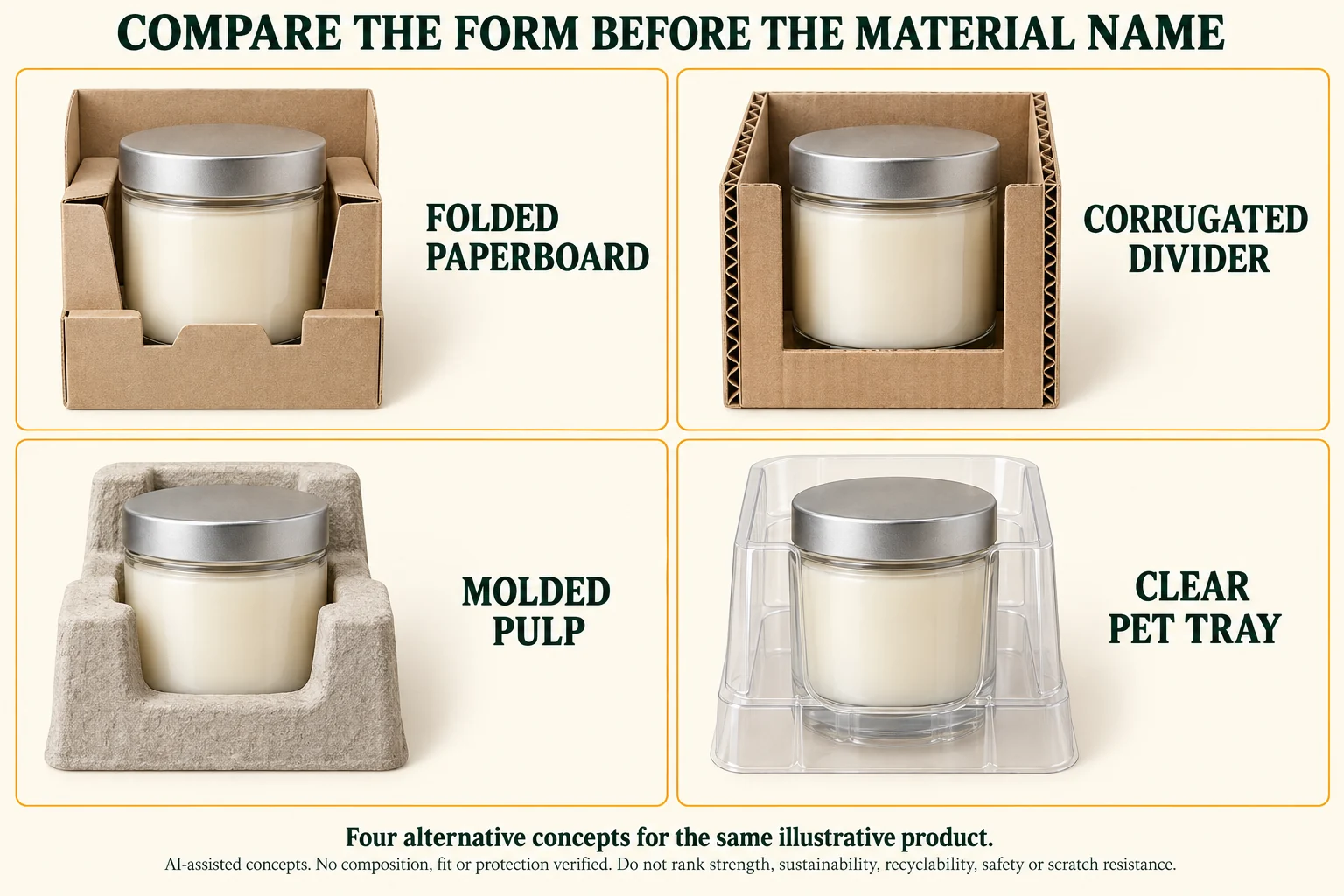
The four illustrations use one generic lidded jar as a comparison subject, with a separate candidate holder in each panel. They are not measured samples or evidence of actual composition. Each proposal still needs its own geometry and contact review.
Map contact and the customer’s exit route
Mark where the holder is intended to touch the product and where contact should be avoided. Include surfaces encountered during loading, not only the final resting position. A label can catch on an edge before the jar reaches the cavity.
Show how the recipient starts removal. Identify the grip, movement and what remains in the box. Finger recesses, a card or a tab are proposals to review; their presence in a drawing does not prove the action is reachable or comfortable.
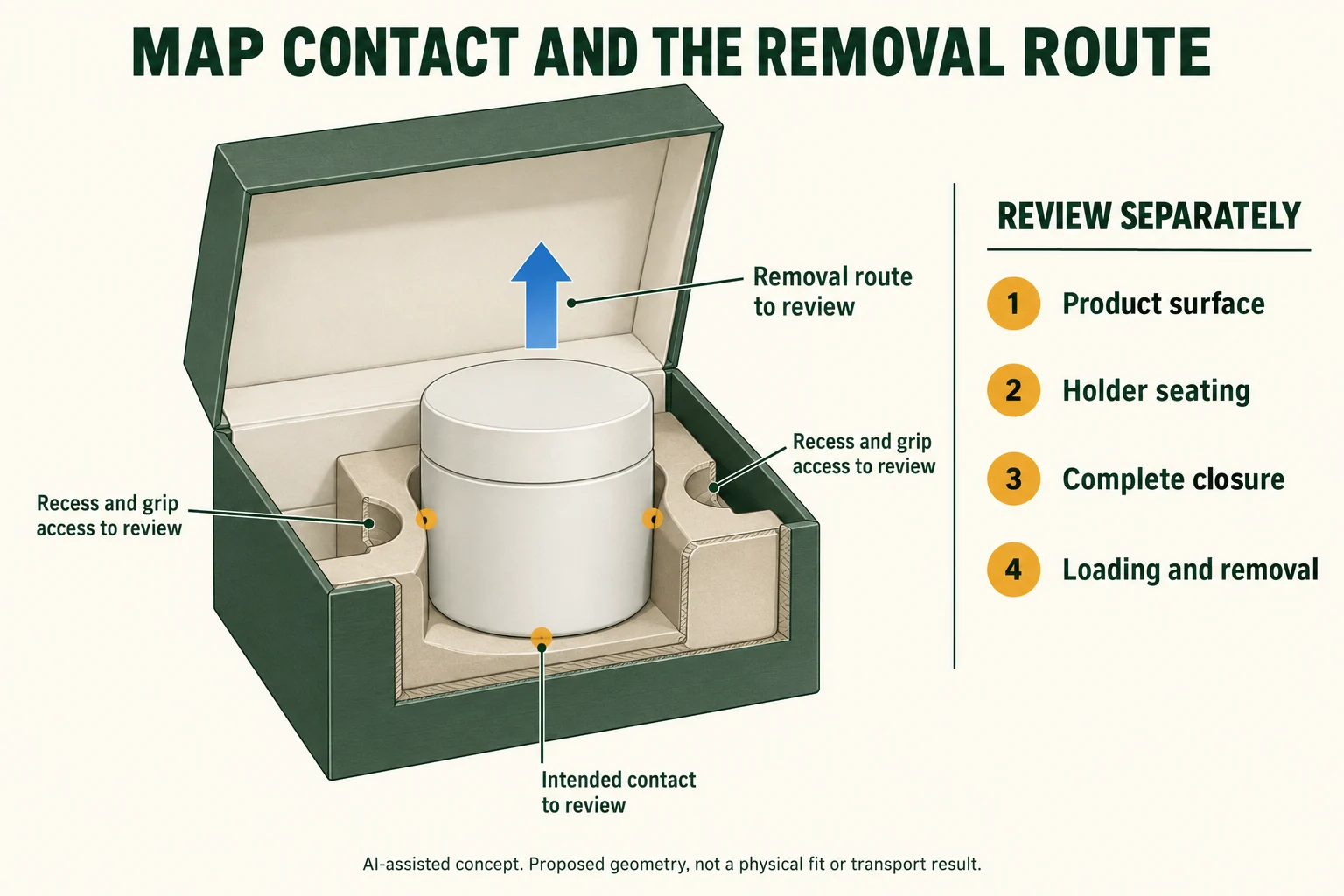
The cutaway exposes proposed side and base contacts for discussion. The blue arrow names an intended direction, while the recesses identify access questions. No contact force, material compatibility or fit result follows from the drawing.
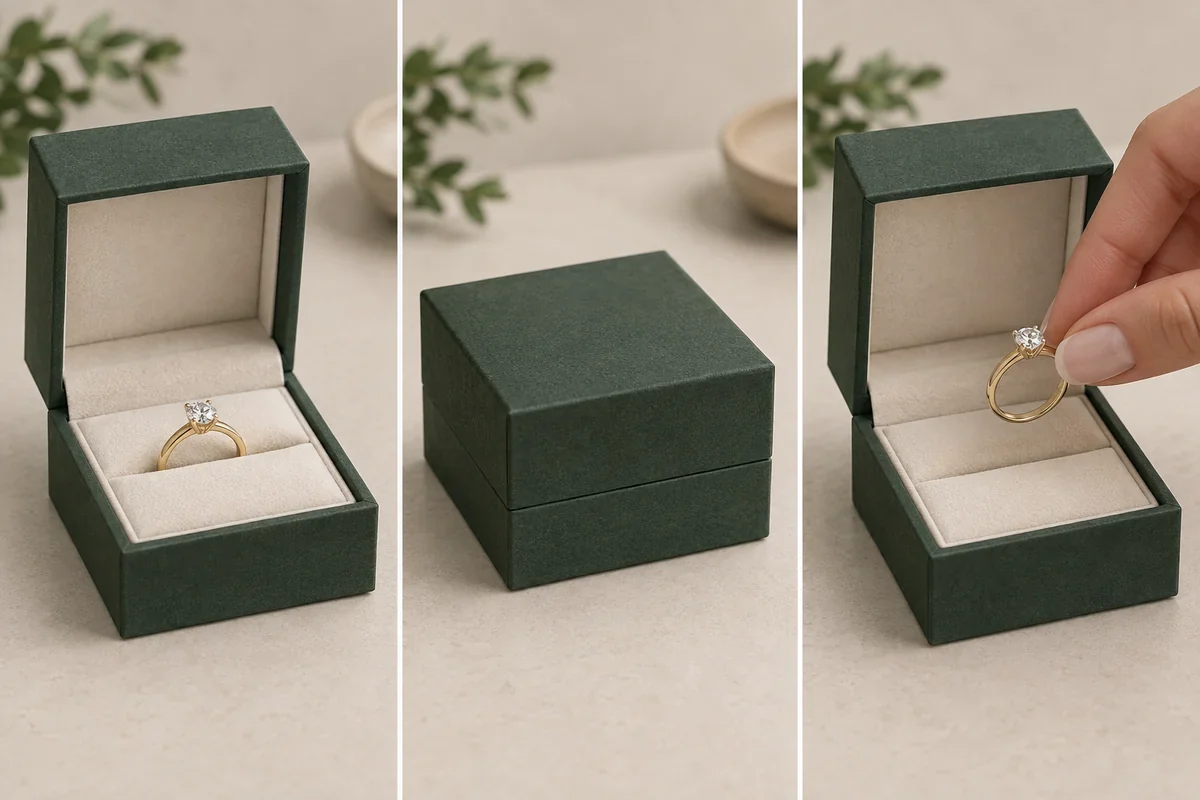
Jewelry has its own projections and removal constraints. The jewelry insert measurement guide covers those inputs. The retained image below is a separate ring-handling concept; it does not compare four insert materials.
A fictional comparison with the unknowns retained
Assume a fictional brand is packing one lidded jar J-01 in a presentation box B-01. The desired holder keeps the jar positioned while leaving a usable removal route. No real dimensions, grade, tolerance or accepted sample is assumed in this example.
Candidate A proposes folded paperboard tabs around the jar. Candidate B proposes a formed pulp cavity. Both descriptions are incomplete: the supplied drawing, intended contact surfaces, box seating and material specification remain to confirm.
The buyer asks each source to show the same jar and B-01 relationship, identify the proposed grade and explain loading and removal. If the pulp proposal needs a different box interior, record that change explicitly rather than comparing only the holder name.
A useful next response includes a dimensioned candidate and a sample scope. It does not need to announce a winner. If one proposal remains unreviewed, keep that status visible while continuing the specific comparison.
Review the complete loading sequence
- Identify the product, holder and box versions together.
- Load all contents in the intended order and locate contact.
- Check the holder’s seating and the complete closure.
- Remove the product through the proposed grip and path.
- Record observations, changes and anything not reviewed.
Keep the same product and box while comparing candidates, unless a changed variable is explicitly part of the proposal. Photograph the located issue with enough context to identify the part. A close-up without the installed orientation can leave the supplier guessing.
A formed cavity also needs an exit relationship. The pulp cavity removal guide develops that question without assuming that insertion proves removal.
Separate fit from transport and material claims
A fit review can describe geometry and handling under the recorded conditions. It cannot grant a shipping-protection rating to a broad material name. Define the complete packed product and route before agreeing any distribution evaluation.
ISTA’s public procedure overview separates screening from distribution simulations. Use the appropriate qualified review for the intended system; the overview does not select a test or certify these concepts.
Environmental and product-contact claims need their own component and destination-market evidence. A paper-like appearance does not prove recycled content, recyclability or compatibility. Keep proposed wording out of customer promises until its scope is supported.
Prepare an answerable insert inquiry
Download the insert comparison worksheet (CSV). Enter the product and box reference, required job, proposed form, contact and access questions, and sample status. The fictional A/B rows illustrate open proposals and contain no passing result.
Use the insert structure directions to name a form, then bring your versioned requirements to a packaging insert inquiry. Ask for the missing drawing, construction or evidence rather than a universal “best material.”
Questions about choosing an insert
Is corrugated always stronger than paperboard?
The names cannot settle that. Compare specific constructions against the same requirement with relevant evidence.
Can one insert fit two boxes?
Compare both finished interiors and locating features. Review each proposed box-and-insert combination separately.
Does a snug fit prove shipping protection?
It describes one geometric relationship. Complete-package performance needs its own evaluation for the actual contents and route.
What if the product surface is delicate?
Identify every intended contact and the proposed surface material. Request representative review instead of assuming a category is scratch safe.
Key takeaways
- Choose the required job and geometry before a material name.
- Review contact, seating, closure and removal together.
- Keep fit, transport and material claims in their own evidence scopes.
Source and scope: ISTA’s public overview was checked 16 October 2026; paid procedures were not read. The comparison method and hypothetical candidates are original planning aids, not measured materials, accepted prototypes or verified performance.