

There is no one certificate that proves every food-contact package is compliant in every market. The evidence depends on where the package will be sold, the food and contact conditions, the complete material stack, and the exact supplier and intended use. First describe those facts; then ask for documents and test evidence that cover the actual packaging configuration.
Key points
- Name the destination country or region before asking which rules apply.
- Describe direct and indirect food contact, food type, time, temperature and use conditions.
- List every layer, coating, ink, adhesive, label and insert in the package.
- FSC, ISO 9001 and customs documents answer different questions from food-contact safety.
- This is a buyer education checklist, not legal advice or a Packrivo food-packaging offer.
Why does “food grade” not settle the question?
“Food grade” by itself does not identify a market, authorized substance, complete package structure or use condition. A paperboard carton can include coatings, inks, adhesives, windows or an inner bag; each layer and its position may matter. A document for one material or supplier should not be assumed to cover a different structure or manufacturer.
Start with a description of the actual use: the food, direct or indirect contact, single or repeated use, temperature, contact time, storage and any heating or processing condition. Then identify the country or region where the packaging will be placed on the market.

AI-assisted concept diagram. It illustrates questions to ask; it does not identify actual ingredients, migration, compliance or supplier evidence.
What is different between the EU and US document paths?
In the EU, food-contact materials placed on the market are covered by the general framework in Regulation (EC) No 1935/2004 and Good Manufacturing Practice rules in Regulation (EC) No 2023/2006. Additional legislation covers certain materials; the EU plastic materials regulation has its own substance, use and documentation conditions, while some other materials may also be subject to national rules. Check the current law for the specific material and market.
In the US, FDA food-contact substances must have a lawful basis for the intended use. FDA describes multiple possible routes, including applicable regulations, effective Food Contact Substance Notifications (FCNs), and other authorizations or exemptions. An FCN is tied to the notifier/manufacturer and conditions in the notification; another supplier cannot assume it covers their product. Use FDA’s food-type and conditions-of-use references with the actual product and process.
Primary sources: European Commission: Food Contact Materials; EU food-contact legislation; FDA: Determining the Regulatory Status of Components; FDA: Food Types and Conditions of Use.
These examples do not cover every country. For other destinations, identify the competent authority and rules that apply to the intended market before settling a document list.
For packaging placed on the EU market, check the PPWR requirements separately. The European Commission says the regulation began applying on a phased basis from 12 August 2026 and flags limits on PFAS in food-contact packaging. This is a distinct regulatory check, not a certificate name or a product-specific compliance decision. See the Commission’s PPWR update, the official PPWR text and our buyer checklist for PPWR packaging preparation.
Which documents answer which buyer question?
Scroll horizontally if columns extend beyond the view.
| Record or certificate | What it may help verify | What it does not establish by itself |
|---|---|---|
| Applicable food-contact declaration or regulatory basis | Whether a defined material/structure is covered under specified conditions | Compliance of another supplier, food type, material revision or use condition |
| Migration or other test report | Results for the tested sample, method and time/temperature conditions | A result for a changed formulation or untested final package |
| FSC Chain of Custody | Traceability claims for qualifying forest-based materials through the chain | Food-contact safety, migration, adhesive or ink compliance |
| ISO 9001 certificate | The holder’s quality-management system within the certificate scope | Approval of a specific food-contact packaging material |
| Commercial/export documents | Trade and customs information for a particular route and transaction | Food-contact safety or market authorization |
The FSC and ISO distinctions above follow their scheme descriptions: FSC Chain of Custody concerns forest-based material chain of custody; ISO 9001 is a quality-management system standard. ISO now lists the 2026 edition as current; check the edition, holder, certificate scope, validity and any transition status with the issuer. A QMS certificate still does not establish compliance of a specific food-contact material. Export paperwork varies by origin, destination, goods and route; see U.S. Department of Commerce export transaction documents and the European Commission Access2Markets tool. Neither set of trade documents substitutes for the relevant packaging-safety evidence.
What should a buyer send before requesting a document check?
- Destination: Name each sales or import market.
- Food: Describe food type, such as dry, acidic, aqueous or fatty, where known.
- Use conditions: State whether the package touches food directly, expected contact time, temperature, single/repeated use, heating and storage.
- Full structure: List paper, board, plastic, barrier layers, coatings, ink, adhesive, label, window, insert and inner bag. Mark the food-facing surface.
- Supplier identity and version: Record the manufacturer/supplier, product name or grade, batch/revision, and who issued the declaration or report.
- Evidence scope: Check whether the document names the same composition, structure, food category and conditions. A matching material family is not enough if the tested package differs.
- Change control: Ask who updates documents after an ink, adhesive, coating, substrate, process or supplier changes.
If a document does not state what sample, formulation, time, temperature or market it covers, ask the issuer before treating it as applicable. A fit sample and a compliance assessment answer different questions. A laboratory report should be read with the method and conditions, not reduced to “passed” in a sales message.
This guide is for buyers doing research. Packrivo’s current service focus remains jewelry, candle and gift packaging; it does not establish that Packrivo can supply or certify food-contact packaging. A request involving food contact should be reviewed by the importer/manufacturer responsible for the market and, where needed, a qualified regulatory specialist.
For ordinary packaging requests, the supplier brief checklist helps record known details and open questions before a conversation.
Questions buyers ask
Is there a universal “food-grade” certificate?
No single document name proves all packaging is lawful for every destination and use. Identify the market, complete structure and contact conditions, then verify the evidence scope for that exact combination.
Does an FDA certificate prove a package is safe?
FDA describes food-contact authorizations and conditions of use; a logo or generic “FDA approved” statement does not identify the substance, manufacturer, package formulation or intended use. Ask for the applicable regulatory basis and supporting evidence.
Does FSC certification prove food-contact compliance?
No. FSC Chain of Custody concerns traceability of forest-based materials and claims. It does not by itself establish chemical migration or food-contact compliance of the full package.
Does ISO 9001 mean the material is approved for food?
No. ISO 9001 concerns a quality-management system within the certificate’s scope. It is not a product-specific food-contact authorization or migration report.
What should I do if my packaging is not in direct contact with food?
Record all layers, how the package is used, and any inner liner or barrier. Then check the applicable market rules and ask whether the supplier’s evidence covers the complete configuration and foreseeable conditions.
Does a customs certificate replace a material declaration?
No. Customs/export documents support a trade route and transaction, while food-contact evidence addresses the material’s use with food. Confirm each requirement with the relevant importer and competent authority.
Route a changed use to a scoped document review
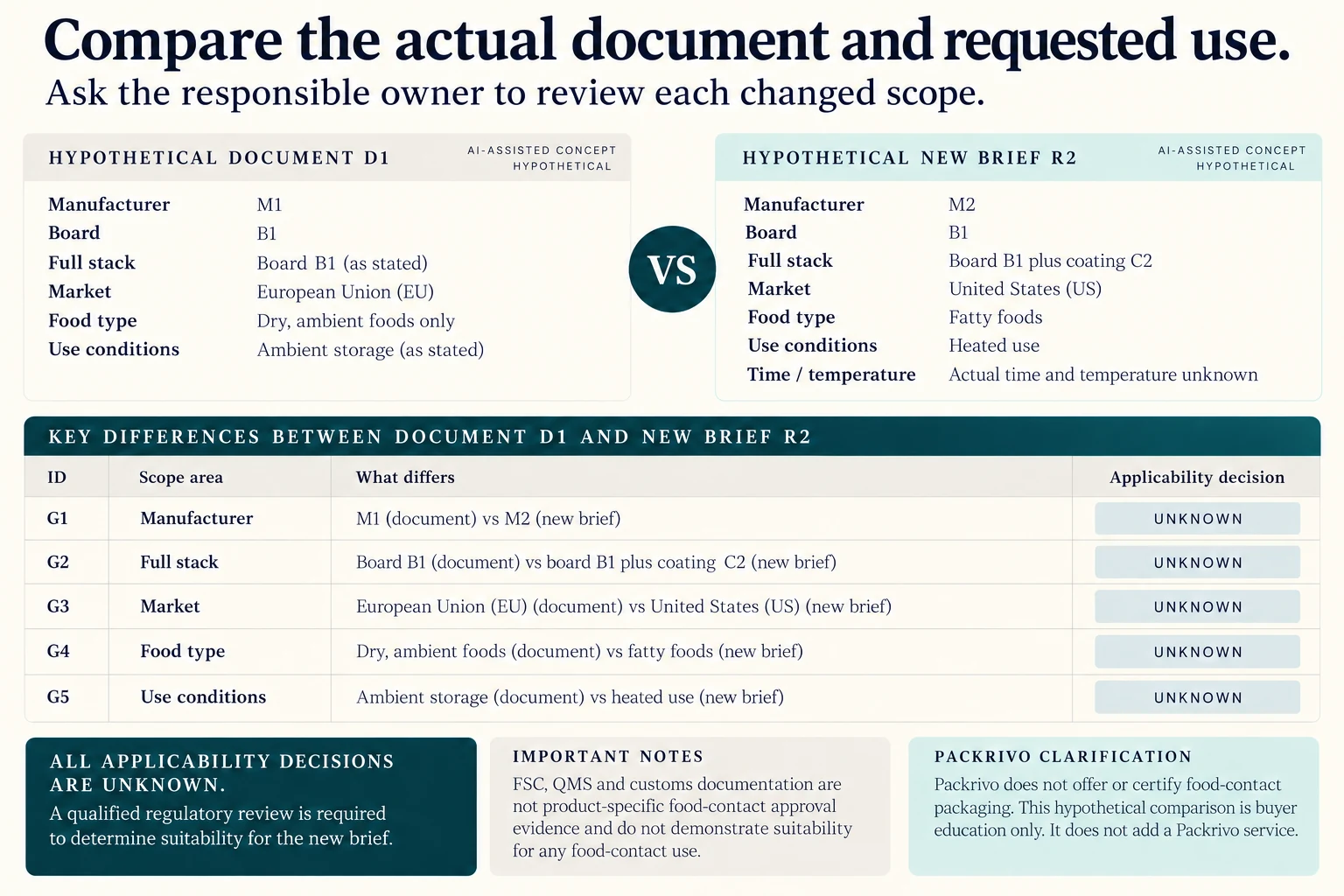
Compare a wholly fictional document D1, naming M1 and board B1 for a stated EU dry/ambient use, with a fictional new brief R2: M2, B1 plus coating C2, a US fatty/heated use, and unknown time and temperature. Neither is an actual declaration, order or compliance determination.
Scroll horizontally if columns extend beyond the view.
| Scenario scope | Exact object or route | Hypothetical input or output | Calculation or record boundary |
|---|---|---|---|
| Hypothetical scope comparison | D1 | Unobserved; actual fields blank | Fictional document only: manufacturer M1, board B1, stated EU dry/ambient scope; no actual valid declaration |
| Hypothetical scope comparison | R2 | Unobserved; actual fields blank | Fictional changed request: manufacturer M2, B1 plus C2 coating, US fatty/heated use; actual time and temperature unknown |
| Hypothetical scope comparison | D1_TO_R2 | Unobserved; actual fields blank | M1 versus M2 is a manufacturer/notifier scope question |
| Hypothetical scope comparison | D1_TO_R2 | Unobserved; actual fields blank | B1 versus B1+C2 is a full-structure scope question |
| Hypothetical scope comparison | D1_TO_R2 | Unobserved; actual fields blank | EU versus US is a market/applicable-route question |
| Hypothetical scope comparison | D1_TO_R2 | Unobserved; actual fields blank | Dry versus fatty is a food-type scope question |
| Hypothetical scope comparison | D1_TO_R2 | Unobserved; actual fields blank | Ambient versus heated with time/temperature unknown is a conditions-of-use scope question |
The five comparison rows isolate manufacturer, complete structure, market, food type and use conditions. Keep each applicability decision unknown while the responsible importer/manufacturer and qualified specialist review the actual evidence. A document title or an unchanged board nickname cannot silently fill those gaps.
Retain regulatory-basis and test-report questions separately from FSC, quality-management and customs records. The original EU and US routes are background for asking the responsible party, not an instruction to select a legal authorization from this table. Packrivo’s ordinary jewelry, candle and gift coordination scope does not become a food-contact packaging offer.
Download the food contact packaging documents record (.csv). It covers the original scenarios and this added comparison. HYPOTHETICAL rows are invented planning examples. Actual quantity, value, configuration, method, owner, observation, condition, decision, evidence and dates are blank because no actual project record has been obtained. Copy a relevant row and replace its type with ACTUAL only when entering permitted project evidence; keep the example and actual record separate. ACTUAL_BLANK is an empty starting row. A blank is unknown, never approval.
The related EU PPWR Packaging Checklist for Small Brands guide concerns a separate requirement. Use this record for the specific comparison above rather than treating that guide as evidence of a completed result.
A physical fit correction remains separate from regulatory review; use the physical sample revision record.
References retain their stated general-guidance or manufacturer-example scope. Worked figures and records are teaching examples, not observed orders, stock, prices or measured performance.
For ordinary jewelry, candle and gift packaging projects, bring the relevant brief to a Packrivo packaging enquiry. Food-contact applicability remains with the responsible importer/manufacturer and qualified specialist; Packrivo does not offer food-contact supply or certification. Packrivo coordinates independent suppliers for its stated ordinary packaging scope. Its published MOQ is 500 pieces per product/design; the small quantities in these planning examples do not establish a smaller custom-production offer. Actual materials, construction, sample scope, price and timing require project confirmation.