
Coordinate a Mailer, Wrap Seal and Care Card in One Packing Brief
Write the packing order for the complete contents, then define the mailer cavity, wrapped bundle, seal position and card placement together. This lets supplier responses describe the same packing task.
Illustrative planning walkthrough. This worked scenario is hypothetical and shows how to prepare a brief.
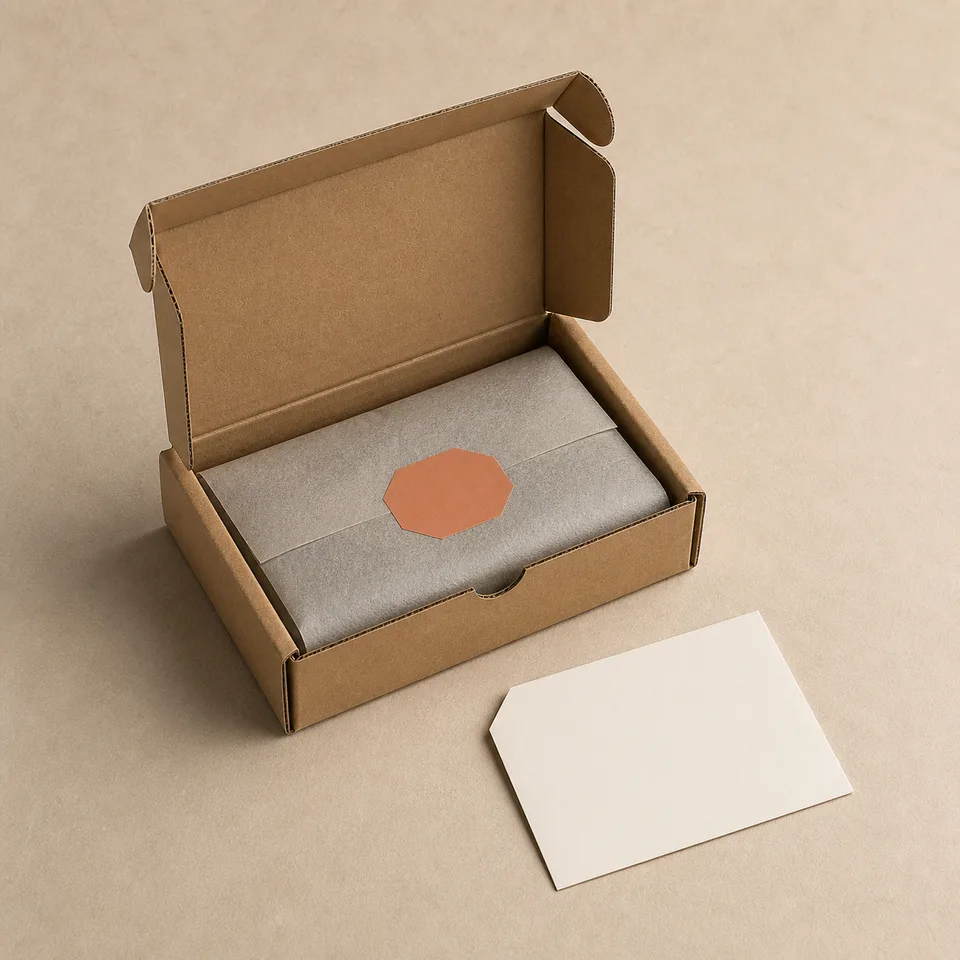
Name what enters the box
Suppose a small gift brand sends a flat gift set wrapped in tissue, with a printed care card. The wrapping seal closes the tissue bundle; it has a different task from any seal used on the outer mailer. The buyer writes both roles separately to avoid comparing two quotes that contain different components.
Measure the bundle after wrapping, including folds and any projecting item. Give the card its own finished size and intended location. A photograph of loose contents does not define the envelope that enters the box.
Write the actual packing sequence
| Step | Input to record | Interface to clarify | Visible completion check |
|---|---|---|---|
| Prepare bundle | Complete gift set and intended orientation | Items remain arranged during wrapping | All intended contents included |
| Fold the wrap | Material, fold order and wrapped envelope | Folded layers fit the proposed cavity | Bundle envelope recorded after wrapping |
| Place wrap seal | Seal artwork and intended contact surface | Adhesive proposed for the actual wrap | Seal position identified in the packing photo |
| Place care card | Finished card size and location | Card avoids a fold or lid contact that changes placement | Card is included and accessible |
| Close the mailer | Loaded bundle and card arrangement | Closing flaps and any outer seal are a separate operation | Complete pack shown before closure |
On a small screen, scroll the table sideways to read every field.
Compare responses by component and operation
One response may include a printed mailer but leave wrapping and assembly to the buyer. Another may describe a mailer with an insert but exclude the care card. Record these differences before comparing totals. A familiar box name is not enough to show that the same scope is being quoted.
The wrapping seal needs its own proposed material, adhesive and surface information. Ask the converter what observation or evidence is appropriate for that interface rather than adopting a universal adhesion claim. The mailer and finished parcel have a separate handling and transport review.
Keep the unresolved question in its place
| Illustrative open item | Evidence required | Owner and next action |
|---|---|---|
| Bundle envelope | Photograph and measurements after wrapping | Buyer prepares a complete packed reference |
| Wrap-seal contact | Proposed seal material and actual wrapping surface | Converter proposes the contact review |
| Card placement | Complete loaded arrangement and finished card size | Buyer identifies intended reading/removal position |
| Mailer closure | Current drawing and loaded pack review | Supplier clarifies closing and sealing operations |
| Destination handling | Route and complete outward-parcel scope | Agree the applicable review before drawing conclusions |
On a small screen, scroll the table sideways to read every field.
These are example questions, not completed checks. Record the actual source, version and decision when a response arrives. If a card or wrap changes thickness, reopen the affected cavity and closure review instead of treating the old sample as unchanged.
Prepare a brief suppliers can answer on the same basis
Start with 250 pieces per design and list the quantities for the box, wrapping seal and card separately. Name which components and operations should be included. Attach the packing sequence, complete bundle reference, destination and open questions.
The mailer RFQ checklist helps organize the request. Compare a mailer with an insert if a holder is needed, and use the delivery scope worksheet to identify who performs each remaining operation.