
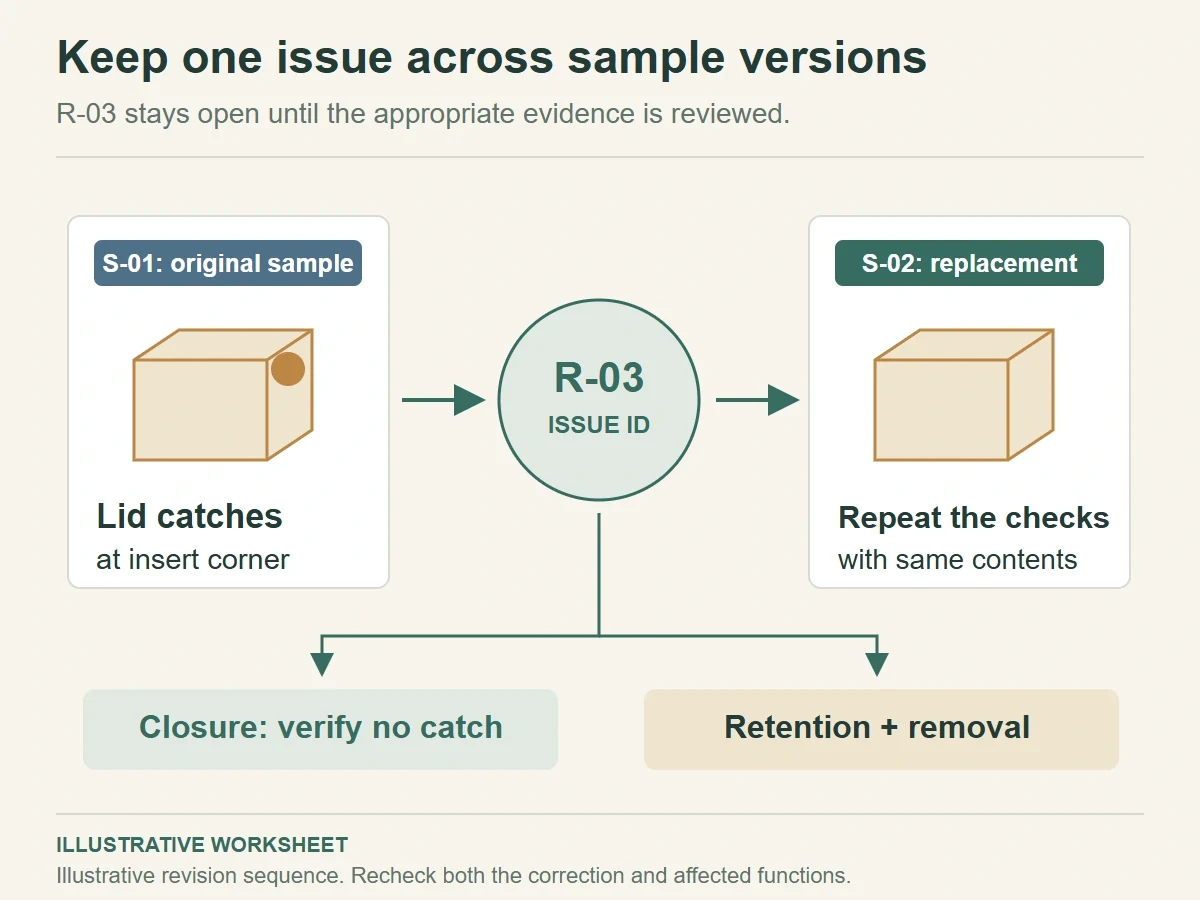
A packaging sample revision comparison should show what changed between two physical sample versions and what still needs checking. Keep the earlier sample, the supplier’s proposed correction and the replacement evidence together. Close a finding only after reviewing the new version with the same product arrangement and checking any nearby function the correction could affect.
Use this record after the first packaging sample inspection identifies something to change. It produces a revised sample decision. A delivery already received for packing needs a separate batch acceptance record.
Capture the problem before requesting a change
Give the finding an issue ID. Record the sample, drawing and artwork versions, the contents used and the action that exposed the problem. Keep a photograph that lets someone locate the same contact point.
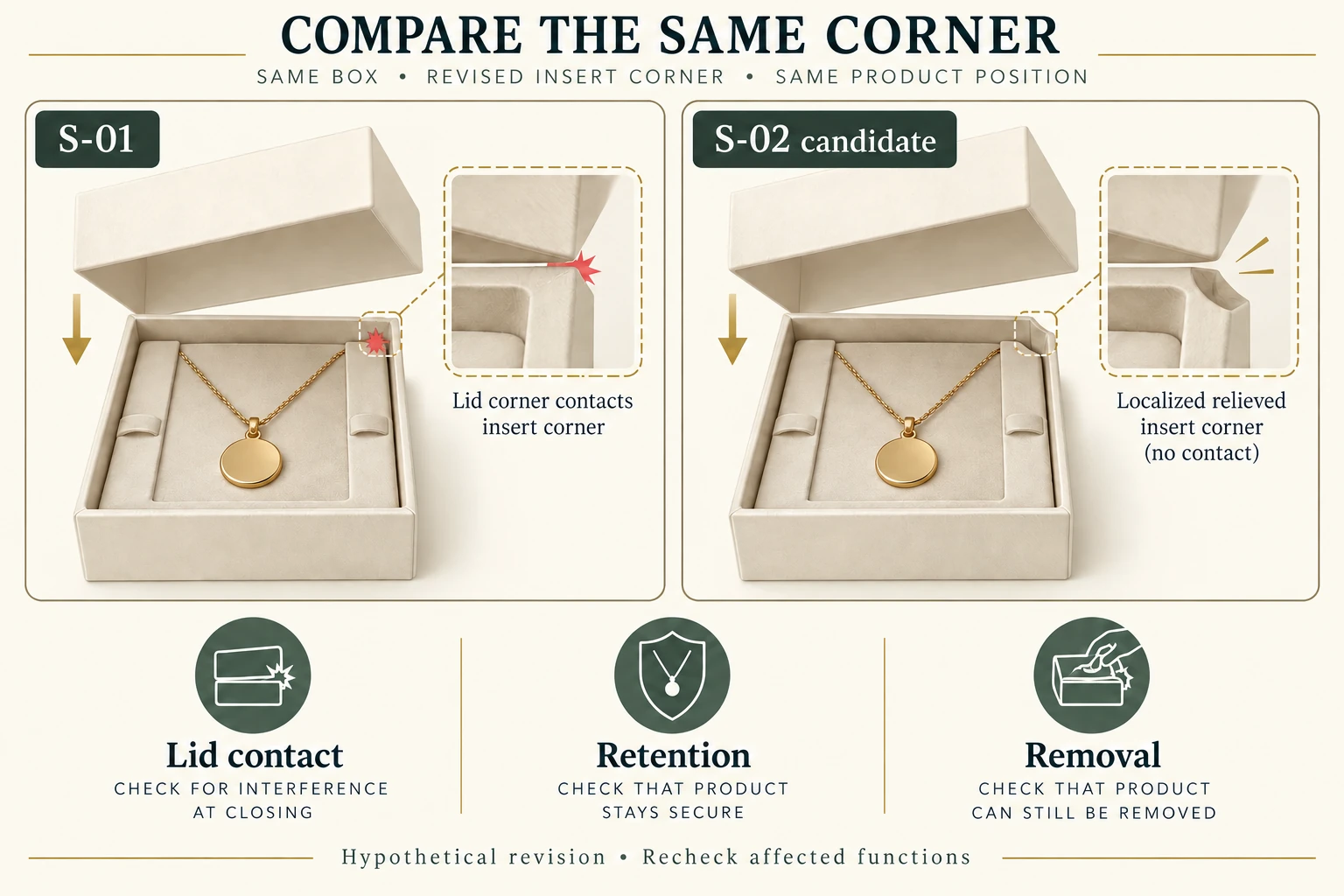
For a hypothetical pendant gift box, issue R-03 could read: “The lid catches the upper-right insert corner on sample S-01 when closing with product set P-01 installed.” That is a testable observation. “Poor fit” leaves the supplier to guess what to change.
Describe the result you need before prescribing a dimension. Asking for the lid to close without catching preserves the functional requirement. Asking for a shorter insert can also change retention, display height or removal. The supplier’s proposed correction should identify those consequences.
Retain S-01, where practical. If it must be returned, keep dated views and measurements that will support the later comparison. Record any change to the product or packing arrangement so it cannot silently alter the review.
Ask for a located proposal, then compare the replacement
Keep the supplier’s proposal separate from the result observed on the replacement. “Corner relief proposed on drawing D-02” is a proposal; it does not close R-03.
When S-02 arrives, identify its drawing, material and artwork references before testing the correction. Compare the marked corner with S-01, using the same P-01 arrangement. Then check the functions the proposed correction could reasonably affect.
| Comparison point | S-01 baseline | S-02 entry to complete | Evidence or open decision |
|---|---|---|---|
| Located change | Upper-right insert corner marked for R-03 | Describe the change actually found on the replacement | Link D-02 proposal and the S-02 contact view; leave open until checked |
| Loaded closing | Lid catches with P-01 installed in the hypothetical S-01 case | Record whether the same action catches on S-02 | Keep separately named S-01 and S-02 closing views |
| Product retention | Retain the baseline support/contact view | Record support after the located change | Record the retention result or mark it not reviewed |
| Customer removal | Retain the baseline grip and exit route | Record removal with the same contents | Link the removal views and any new interference |
| Version identity | Original drawing and sample IDs | Confirm replacement drawing, material and sample IDs | State which configuration the observations cover |
These entries describe a hypothetical comparison, not a completed Packrivo test. Use your actual component names and observations. A correction can resolve the original finding while leaving another check open.
Keep the same issue ID across function rows
The worksheet follows the same issue from the old sample to the new one. Keep its issue ID across versions and use a separate linked row for each affected function, such as loaded closing, retention or removal. Reuse the issue ID if the problem returns, and retain dated observations so a new function row does not hide the earlier history.
| Field | What belongs in the revision row |
|---|---|
| Issue and original sample | Issue ID, S-01 identity, drawing/artwork references |
| Observed problem | Located contact or behaviour, contents and evidence |
| Requested result | What the next sample must demonstrate |
| Supplier proposal | Proposed change and affected functions |
| Replacement identity | S-02 and its confirmed configuration |
| Changed feature | What actually differs between the original and replacement |
| Before/after evidence | Separate references for the S-01 and S-02 observations |
| Function results | Loaded closing, retention and removal, each checked or explicitly open |
| Decision | Open, correction accepted or further revision, with reviewer/date |
Download the accompanying sample-version comparison worksheet. Keep the supplier’s actual reply and supporting files beside it rather than replacing them with a summary.
Separate a corrected contact from an unfinished fit decision
The following filled record is fictional. Assume the reviewer’s S-02 closing view E-02 shows the marked corner no longer catching, but removal has not yet been repeated. That supports one recorded observation, not acceptance of the whole correction.
Scroll horizontally if columns extend beyond the view.
| Issue | S-01 observation | S-02 illustrative record | Decision boundary |
|---|---|---|---|
| R-03 corner | Lid catches at upper-right insert corner with P-01 | E-02: no catch observed in the stated closing action | Contact observation recorded for S-02 only |
| R-03 retention dependency | Baseline support view E-01 retained | No S-02 retention evidence supplied | Open; do not close the full fit change |
| R-03 removal dependency | Baseline removal route identified | Removal not repeated | Open; repeat with P-01 and record evidence |
Ask for the missing retention and removal checks against S-02, D-02 and P-01. Keep the original problem and its dependencies under R-03 so the reader can see why the complete change remains open. If a new material is introduced during the correction, add that identity before deciding which old evidence can still apply. UPS packing guidance addresses shipping-package preparation; neither the corner correction nor this worksheet establishes transport performance.
Approve the correction with its remaining limits
An entry could say: “R-03 correction accepted on S-02 with P-01 after the recorded loaded-closing, retention and removal checks.” Use that wording only if all three were reviewed. If retention remains unreviewed, state that the lid-contact correction was checked and keep retention open instead of accepting the complete fit change. Name any other work still open, such as colour or a separate transport review.
Carry the selected sample and drawing references into the next sample request or release discussion. The responsible owner should decide which work may proceed. If another revision changes the insert, reopen the affected comparison instead of carrying forward the earlier result automatically.
Once a delivered batch arrives, use the incoming packaging acceptance guide to compare received goods with the selected baseline and decide their disposition. That later record covers received units, not another design iteration.
Bring the current issue, both sample references and the unresolved comparison to a packaging inquiry. The next useful response should identify the proposed change and the evidence needed to review it.
Blank template. Enter actual project records; no sample size or acceptance limit is prescribed.
Keep the current record with the project brief
Download the sample revision decision CSV. It contains field definitions, clearly hypothetical examples and a blank actual-project row. Replace invented values with your own supported records; keep unknown fields open.
Packrivo coordinates packaging sourcing and project questions with independent suppliers. The worksheet is a discussion aid, not a confirmed quotation, manufacturing promise or sample approval. The published starting MOQ is 500 pieces per product/design; actual component, design and commercial scope require confirmation.
Source scope: Original sample-comparison method; carrier source only distinguishes shipment preparation from a scoped fit correction. Public references checked 16 October 2026. All new illustrations are AI-assisted concepts. No real customer, test, shipment, stock, savings or production outcome is represented.