
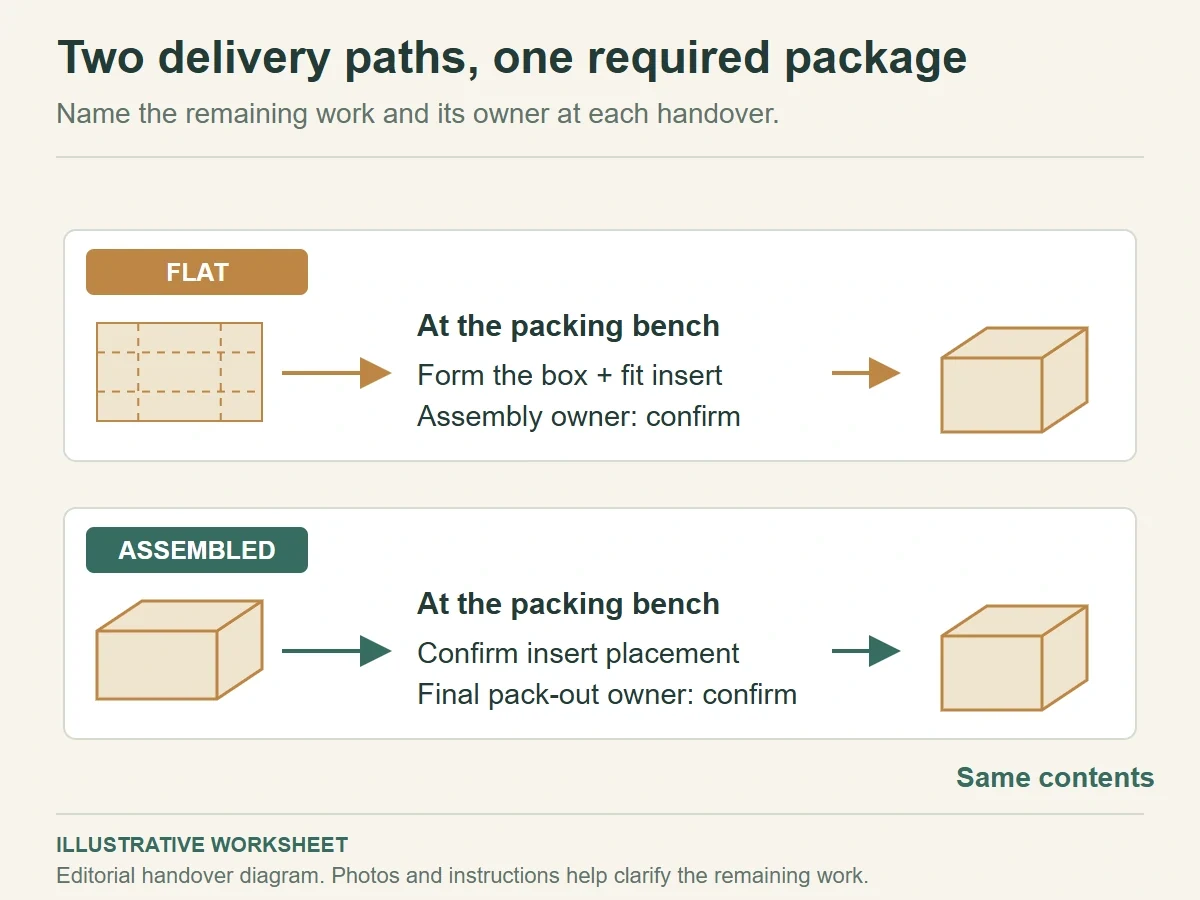
Choose flat pack or assembled packaging by assigning the work, storage and delivery responsibilities in each proposal. Ask what arrives, who assembles it, where it is stored, and which packing and freight activities the quote includes. Compare the same completed packaging requirement across both options, using the actual carton information and your own handling capacity.
A flat box can look attractive on a planning sheet while leaving assembly work unresolved. An assembled box can be ready for use while taking more room than the receiving area allows. The useful decision is the delivery arrangement your operation can handle, with its included work written down.
Describe the state that reaches your packing bench
Ask for the delivered state using a photograph, diagram or representative sample. Flat, partly formed and fully assembled are useful labels only when the proposal explains them. A box may arrive folded but need corners secured, an insert fitted or a separate sleeve added.
Write the receiving unit as well. You may receive loose box blanks, bundles of collapsed boxes, assembled boxes nested together, or complete sets in protective outer cartons. State whether inserts, tissue, seals and cards arrive inside each box or in separate packs.
Identify every operation between arrival and a usable finished package. Include unfolding, fastening, fitting the insert, checking the closure and placing the product. List any tape, glue, tools or separate components that the assembler needs. Request instructions for the proposed construction.
The folding gift box specifications help establish the structure being supplied. This delivery review takes that structure into your operation: it identifies who performs the remaining work and where that work fits.
Name the assembly owner. It might be your team, a fulfilment provider or the supplier before dispatch. If another business handles packing, confirm that it accepts the proposed delivered state and components. A neat supplier diagram doesn’t establish your fulfilment provider’s available service.
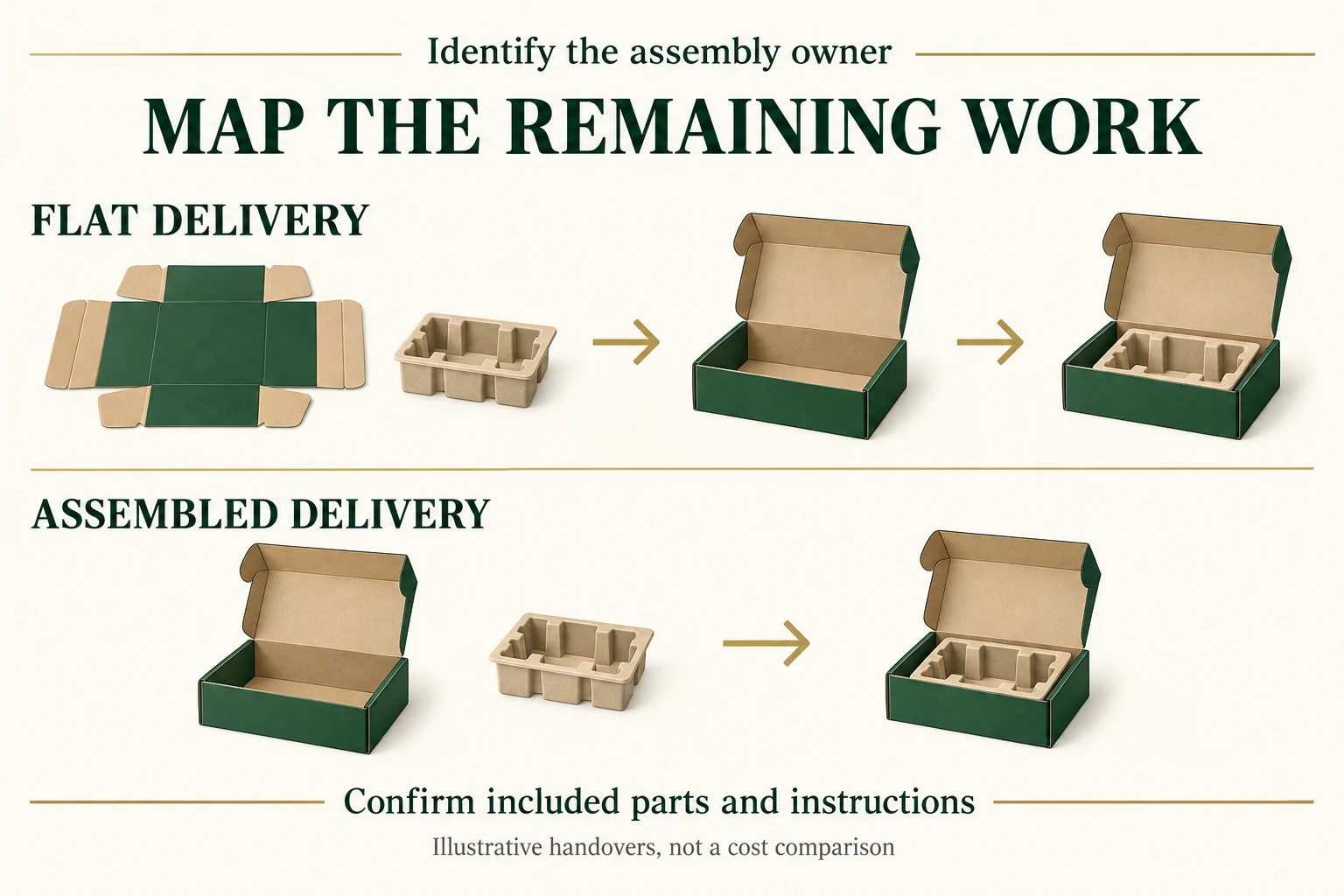
Compare responsibility rather than the box label
Create two columns for the same product and packaging specification. Hold the box design, included pieces and required finished quantity steady. Then show how each delivery option changes the handover and work.
This worksheet uses an illustrative gift set. Fill it with actual replies and observations before choosing an option.
Swipe the table to view all fields.
| Responsibility | Flat delivery proposal | Assembled delivery proposal |
|---|---|---|
| State at receipt | Collapsed box, insert separate | Box formed, insert placement to confirm |
| Assembly owner | Buyer or fulfilment provider to confirm | Supplier scope to confirm |
| Additional supplies | Adhesive or fastening parts to identify | Any final packing supplies to identify |
| Storage information | Bundle and carton dimensions requested | Carton dimensions and nesting method requested |
| Assembly evidence | Instructions and trial required | Sample of received state required |
| Freight scope | Carton count, packed dimensions and terms requested | Same fields requested |
The table prevents an assembled offer from silently including work that the flat offer leaves to you. It also prevents you from assuming that either proposal includes the complete product pack-out.
A supplier may quote box assembly while leaving insert fitting to the buyer. Record those as separate operations. The point where responsibility changes should be clear enough that someone receiving the shipment knows what remains to be done.
Test the local work and space assumptions
Try assembly on a representative sample with the person who would actually perform the task. Record the steps, handling difficulties and supplies used. If you time the trial, state the number of boxes, operator and conditions so a short demonstration doesn’t become a promised packing rate.
Look for tasks that affect other work. Adhesive curing may require a staging area; separate inserts may need sorting; repeated handling may require a clean surface to protect the finish. Ask the supplier to clarify any construction-specific requirements and check them during the trial.
Storage has two stages: packaging as received and packaging ready for packing. A flat delivery arrangement can still require a working stock of assembled boxes near the bench. Record both spaces and how often the team would replenish that stock.
Check the receiving limits with your warehouse or fulfilment provider. Useful facts include the available shelf or floor area, maximum manageable carton size, delivery access and rules for loose components. Use the quoted carton information to evaluate those limits.
For freight, request carton count, packed dimensions, gross weight, destination and the named delivery scope for each option. Let the relevant provider calculate charges on the actual shipment. The comparison then has a documented basis rather than an assumed saving from the word “flat.”
UPS packing guidance supplies US carrier context for shipment preparation. The carrier shipping pack is separate from whether the supplier delivers your gift boxes flat or formed.
Make a scoped assembly-time comparison
A small timing model helps expose transferred work without promising a packing rate. Suppose an invented flat-delivery trial takes 12 minutes to form 10 boxes and fit their inserts. A separate invented assembled-delivery trial takes four minutes to fit 10 inserts; box forming was included before receipt. Both stop at the same empty box-and-insert state.
Scroll horizontally if columns extend beyond the view.
| Hypothetical task boundary | Flat proposal | Assembled proposal |
|---|---|---|
| Local elapsed time for 10 named samples | 12 minutes | 4 minutes |
| Arithmetic mean for this trial | 1.2 minutes per box-and-insert unit | 0.4 minutes per box-and-insert unit |
| Straight-line 500-unit scenario | 600 minutes, or 10 hours | 200 minutes, or 3 hours 20 minutes |
| Outside this timing model | Setup, breaks, replenishment, adhesive waits and product packing | Same excluded tasks; actual scope must be checked |
The straight-line difference is 400 minutes, or 6 hours 40 minutes. It is an arithmetic scenario from invented inputs, not validated staffing capacity or a saving. Freight, storage, consumables and quoted assembly charges are still separate. If a trial includes a task that the other omits, align the stopping state before using the numbers. A package delivered as assembled can still leave product loading and final pack-out to your team.
Bring all included work into the quotation
A useful quotation identifies the finished packaging unit and the services included around it. Ask whether carton packing, protective materials, assembly and component sorting are priced within the offer. List delivery activities and exclusions separately so you can see who arranges each stage.
Use the quote comparison checklist to keep the unit and commercial scope aligned. If one proposal changes the structure or included components, mark that difference before comparing its total with the other.
Make the decision in your own terms. A team with limited packing labour may prefer more work completed before receipt. A business with limited storage may consider a different delivery state after checking its assembly trial. Either choice needs the project-specific price and handling evidence.
Record the selected delivery state in the order specification, sample approval and receiving instructions. If it changes later, review the assembly owner, cartons and quote together. Those fields describe the same arrangement and should stay consistent.
Bring your completed responsibility table to Packrivo’s packaging inquiry. The next discussion can then focus on a defined handover: the state arriving at your door, the work remaining at your bench and the scope that still needs a quotation.
Keep the current record with the project brief
Download the delivery state work record CSV. It contains field definitions, clearly hypothetical examples and a blank actual-project row. Replace invented values with your own supported records; keep unknown fields open.
Packrivo coordinates packaging sourcing and project questions with independent suppliers. The worksheet is a discussion aid, not a confirmed quotation, manufacturing promise or sample approval. The published starting MOQ is 500 pieces per product/design; actual component, design and commercial scope require confirmation.
Source scope: Original responsibility and invented timing model; carrier context is not evidence of quoted assembly work or freight savings. Public references checked 16 October 2026. All new illustrations are AI-assisted concepts. No real customer, test, shipment, stock, savings or production outcome is represented.