
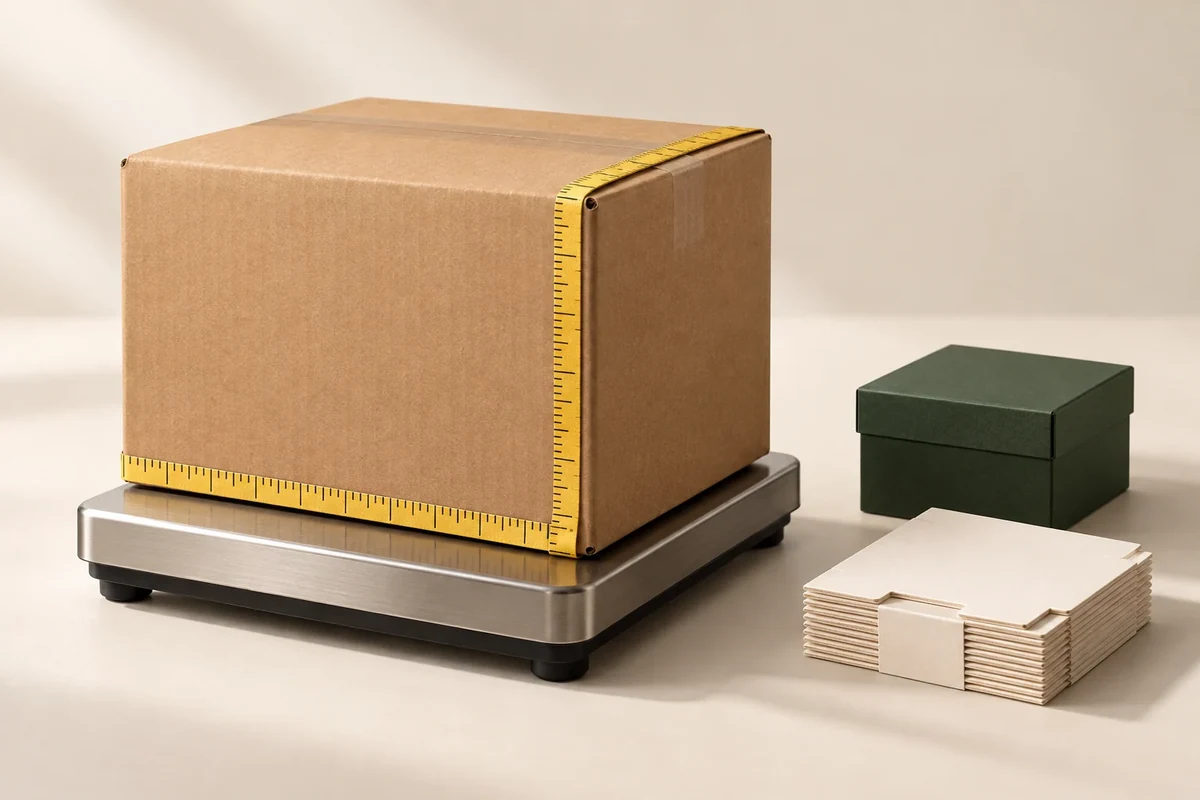
Prepare a packaging freight inquiry with the shipping carton count, outer dimensions, gross and net weights, units per carton and delivery format. Label every unit and say whether each value is measured or estimated. Add the pickup and destination details, then ask the freight provider to confirm the service and charging basis for that shipment.
The finished size of a gift box isn’t the shipping size of an order. Flat boxes, assembled boxes, separate inserts and bundled accessories can create different carton arrangements. A useful freight record describes the goods in the form they will actually travel.
Identify every shipping unit before totaling the order
Assign an ID to each carton type. Identical cartons can share a row with a count; a partly filled carton needs its own row if its contents, weight or dimensions differ. Include separately packed tissue, labels or inserts instead of assuming they travel inside the boxes.
Record units per carton and define the unit. “100 units” could mean 100 flat boxes, 100 assembled boxes or 100 complete sets with accessories. State the contents in the same row. Then reconcile the carton totals against the requested quantity for each component.
Packrivo’s starting order requirement is 500 pieces per design. That order quantity is separate from the carton count and the number of complete sets. A request for 500 boxes and 500 inserts needs a packing description that shows how both components travel.
State whether goods are loose cartons, palletized or in another proposed shipping arrangement. If palletization is planned, ask for the final pallet dimensions, weights and carton arrangement as a separate shipping record. The freight contact needs to know which outer unit they’re evaluating.
The folding gift box specifications explain why delivery state belongs in a packaging brief. Carry the agreed state into the freight record, and ask the packing contact to confirm the actual arrangement before comparing services.
Keep dimensions, weights and measurement status together
Measure the outer dimensions of the closed shipping carton in the intended packed state. Label length, width and height, and use one stated unit throughout the table. Record whether tape, bulging sides or another packing feature affects the final outer measurement.
State what net weight includes in your record. Ask the packing contact to identify the goods included and what they exclude as shipping packaging. Gross weight should describe the complete shipping unit as presented, with its carton and packing materials. Keep the definitions with the figures so another party can interpret them.
An estimate is useful for early planning when it’s labeled. Record the basis, such as a proposed carton arrangement, and the person who will replace it with a measured result. A change to assembly state or protective packing should trigger a check of the affected row.
FedEx’s US dimensional-weight explanation distinguishes dimensional weight from actual weight when describing its charging basis. Check the current service-specific rule with the provider. This worksheet deliberately computes geometric volume only, without applying a universal divisor or charge.
If you calculate carton volume, retain the original dimensions and unit. A carton measuring 50 cm by 40 cm by 30 cm has a geometric volume of 0.06 cubic metres. That arithmetic describes space; ask the provider to state how dimensions and weight affect its actual charge for the proposed service.
Copy a freight inquiry data worksheet
Use one row per distinct shipping unit. This original worksheet organizes an inquiry; the packing party and freight provider should confirm the shipment data and service basis.
Swipe the table to view all fields.
| Shipping unit | Count | Contents and units each | Outer L x W x H | Net weight each | Gross weight each | Status and method |
|---|---|---|---|---|---|---|
| Carton type A | Complete | Define pieces or sets | Value and unit | Value, unit and scope | Value and unit | Measured or estimate, date, owner |
| Carton type B | Complete if different | Identify separate component | Value and unit | Value, unit and scope | Value and unit | Measurement or estimate basis |
| Other shipping unit | Describe | State carton arrangement | Final outer dimensions | Define included goods | Complete unit weight | Confirmation owner |
Reconcile an illustrative flat box shipment
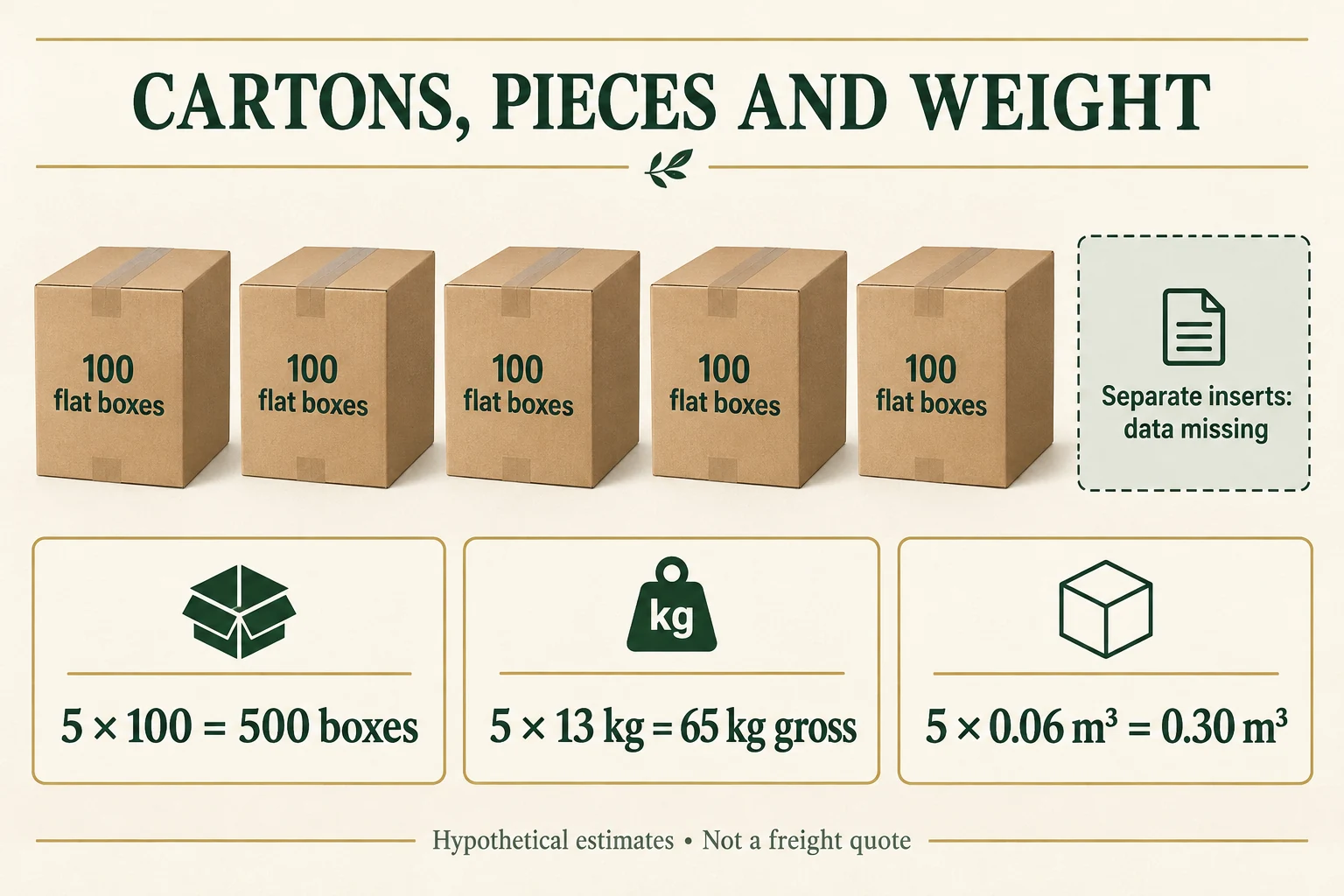
In this hypothetical example, a brand requests 500 flat gift boxes for one design. The proposed packing arrangement has five identical cartons, each holding 100 boxes. Each carton is estimated at 50 x 40 x 30 cm, with 12 kg net weight for the boxes and 13 kg gross weight including the shipping pack.
The buyer records 500 boxes, 60 kg total net weight and 65 kg total gross weight. The five cartons occupy 0.30 cubic metres based on the stated outer dimensions. All figures remain marked as planning estimates until the packing contact measures the final cartons.
The inserts are packed separately, so the buyer adds their row before sending the inquiry. The freight contact can now evaluate the whole shipment rather than only the boxes. If the brand later requests assembled delivery, the packing contact revises the carton arrangement and measurement status.
This example demonstrates reconciliation, not a standard packing density or freight offer. The useful check is that component quantities, carton counts and totals agree before the provider works from them.
Close the missing-component gap before requesting a total
The diagram intentionally stops at the box-only estimate. Continue the same hypothetical exercise by assuming, solely for calculation, that 500 inserts will travel in two further cartons of 250 inserts each. Each invented insert carton measures 40 × 30 × 25 cm and has 7 kg net and 8 kg gross weight. These are not a proposed packing density or measured shipment.
Scroll horizontally if columns extend beyond the view.
| Estimated carton line | Cartons × contents | External size each | Net / gross each | Line totals |
|---|---|---|---|---|
| A: flat boxes | 5 × 100 boxes = 500 boxes | 50 × 40 × 30 cm | 12 / 13 kg | 60 kg net; 65 kg gross; 0.30 m³ |
| B: separate inserts | 2 × 250 inserts = 500 inserts | 40 × 30 × 25 cm | 7 / 8 kg | 14 kg net; 16 kg gross; 0.06 m³ |
| Combined shipment model | 7 cartons; 500 boxes plus 500 inserts | Two carton types, not one averaged size | Defined component scope above | 74 kg net; 81 kg gross; 0.36 m³ |
For line B, 0.40 × 0.30 × 0.25 = 0.03 m³ per carton; two occupy 0.06 m³ geometrically. Sum net and gross weights separately. The combined 1,000 component pieces could support 500 one-box/one-insert sets only if the components actually match; they are not 1,000 complete sets. Keep both carton rows and mark every value estimated until final packed measurements replace them. Ask the provider for charges against that version, service, destination and named delivery scope; 0.36 m³ is not a shipping price or dimensional weight.
Send a versioned shipment description
Keep the carton record with the corresponding packaging configuration and quantity. Replace estimates with confirmed measurements when available, and resend the data when the shipment changes. That gives each freight response an identifiable basis.
Bring the packaging quantity, delivery state and available carton data into a Packrivo delivery brief. Clear units and open questions help the human review identify what the packing and freight contacts need next.
Keep the current record with the project brief
Download the carton freight reconciliation CSV. It contains field definitions, clearly hypothetical examples and a blank actual-project row. Replace invented values with your own supported records; keep unknown fields open.
Packrivo coordinates packaging sourcing and project questions with independent suppliers. The worksheet is a discussion aid, not a confirmed quotation, manufacturing promise or sample approval. The published starting MOQ is 500 pieces per product/design; actual component, design and commercial scope require confirmation.
Source scope: FedEx explains US dimensional-versus-actual-weight charging context; numeric carton model is invented geometric arithmetic, not a carrier tariff or a freight quote. Public references checked 16 October 2026. All new illustrations are AI-assisted concepts. No real customer, test, shipment, stock, savings or production outcome is represented.