

AI-assisted concept cover. Open the cover at full size.

Define a candle label's placement using the actual container, a named alignment reference and the finished label outline. Keep the intended printed area separate from seams, changing curvature and other features that need review. Trial the position on representative containers before approving the layout, while keeping adhesive compatibility as its own supplier-confirmed decision.
A label can have the right artwork yet look uneven when applied to a tapered or irregular vessel. The placement brief should explain where the visible face begins and how the operator finds it. That task is different from choosing an adhesive construction for the receiving surface.
Mark the container features that control placement
Photograph the actual vessel from the front and side. Identify its seam, shoulder, base transition, decoration and any existing mark that can help establish orientation. Record the container version so a new mold or finish does not silently replace the reference.
Define the customer-facing direction. A cylindrical jar may offer several possible fronts, while a shaped vessel may have an intended display face. Ask the product owner to choose that direction before the designer aligns the logo within the label.
Mark a proposed application area on a physical sample or clear photograph. Show its edges relative to the container features, with measurements and units where available. Keep those marks as a proposal until the label supplier and packer review the actual position.
Avery's hand-application guidance uses physical references such as a seam or straight edge for alignment. A seam can help locate a position without requiring the label to bridge it. Your brief should distinguish the reference used from the surface actually covered.
Leave curved transitions visible in the map. Ask whether the proposed label outline crosses a changing surface and what candidate is needed to evaluate that position. Avoid importing a fixed edge allowance from another container or manufacturer's example.
Give the operator one clear positioning method
State which edge or centre point of the label aligns with the chosen reference. Include the finished label orientation and which side faces upward. A diagram that only shows a centred logo leaves the physical starting point unresolved.
Ask the intended operator how they will locate that reference during application. They may use the container feature, a proposed guide or another agreed method. Record the method with the candidate rather than assuming that a hand-applied and equipment-applied label use the same positioning approach.
Use the roll and sheet application guide when the delivery format affects that work. Keep orientation in the supplied roll or sheet identifiable if the packer needs to receive the label in a particular direction.
Trial the position with the actual label outline and representative container. A paper outline can help discuss coverage, but final application review needs the proposed construction on the intended finished surface. Record which stage each candidate represents.
This original map record separates the location from the application and adhesion questions. Fill it with the actual container and candidate references.
| Placement field | What to identify | What to observe |
|---|---|---|
| Front reference | Named vessel direction or feature | Whether the operator can locate it |
| Label outline | Finished size and orientation | Coverage of the intended visible area |
| Seam relationship | Reference only, nearby or proposed crossing | Alignment and local surface interaction |
| Curved transition | Shoulder or base area in the candidate | Wrinkling, lifting or position distortion |
| Application method | Operator, guide and sequence | Repeatability of the chosen position |
| Review evidence | Candidate and vessel versions | Photograph and decision for that arrangement |
Review appearance without losing the applied geometry
Look at the applied label in the intended display orientation. Note whether text, graphics and margins appear as planned on the curved container. Keep those visual observations tied to the physical position, rather than changing artwork to compensate for an undefined application reference.
Inspect the label's edges and the relationship to nearby features. Record a crease or lifted edge with its location and the condition observed. The supplier should investigate whether outline, placement, construction or application contributed; a placement photograph alone does not identify the cause.
Keep surface compatibility and later exposure in a separate record. The label adhesion planning guide covers receiving surfaces, construction and use conditions. This placement map supplies the geometry that record needs, without repeating its adhesive selection process.
For a hypothetical candle jar, candidate A might align the label centre with the chosen display face while leaving a visible seam to one side. Candidate B might use a different outline around a curved transition. Compare those as defined proposals and record observations rather than declaring either position universally better.
If the label includes a barcode, reserve its area and review it using the appropriate symbol requirements. A visually balanced composition does not establish barcode readability. Keep the finished proof and applied-container review connected to the relevant barcode decision.
Approve a position that can be found again
Retain one marked container view and one photograph of the applied candidate. Name the front reference, label outline, application method and accepted placement scope. A new operator should be able to identify the intended position without relying on a memory of the first trial.
When the vessel shape, finish or label outline changes, review the affected placement fields. A small artwork adjustment can remain within the same physical outline, while a changed container may require another application candidate. Write that distinction into the revision request.
For a roll-supplied candidate, the custom roll label direction helps describe format and orientation. Confirm that supply description alongside the actual vessel position.
Bring the location map and actual vessel details to Packrivo's packaging inquiry. A focused brief tells the supplier where the label belongs, how it will be aligned and which physical interaction still needs evidence before the position is accepted.
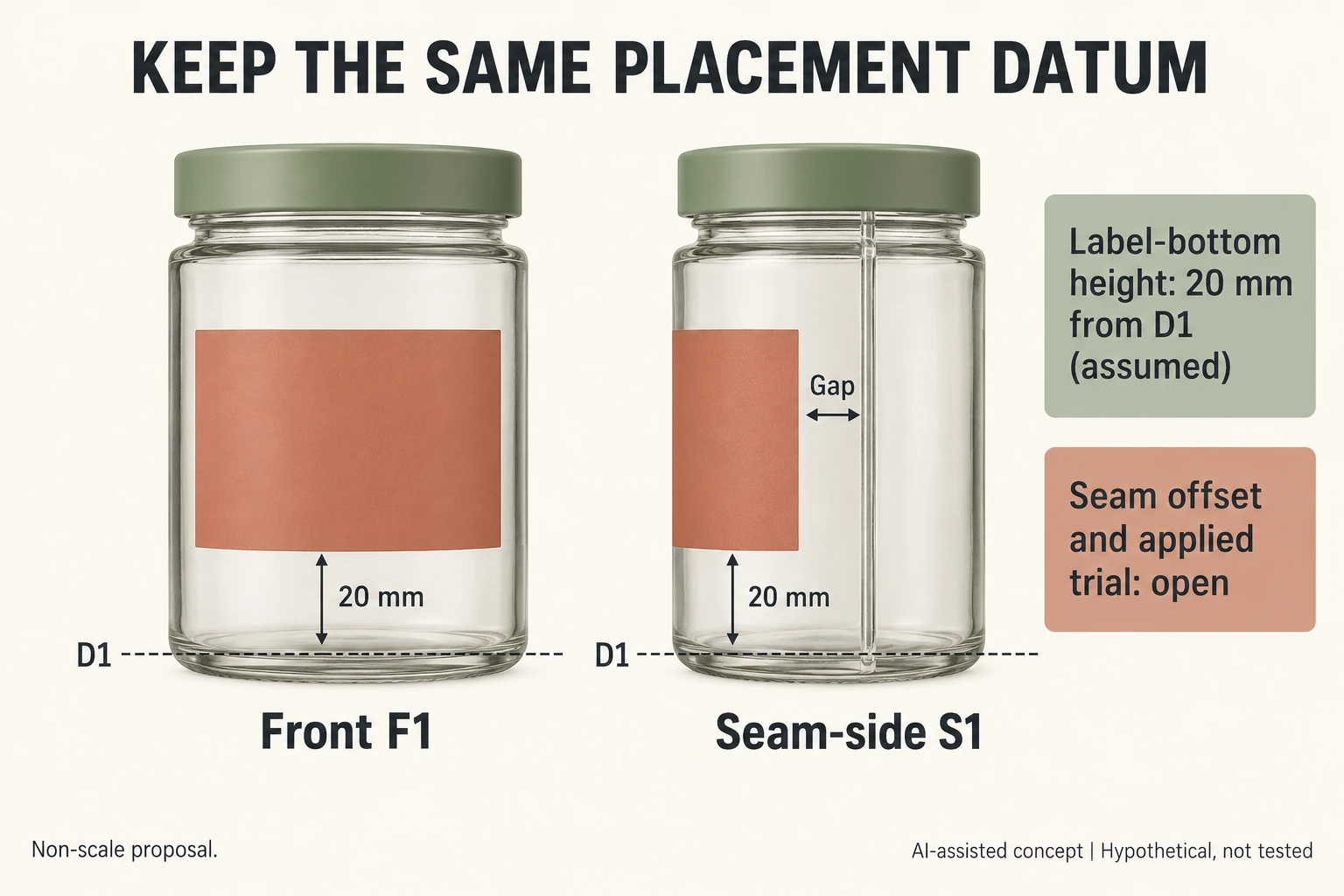
Use the same datum in front and seam-side views
Invented vessel V1 uses base datum D1 and a proposed label-bottom height of 20 mm above D1 in both front F1 and seam-side S1 views. This is an assumed positioning brief, not a recommended clearance or a measured jar. The seam offset remains unknown.
Scroll horizontally if columns extend beyond the view.
| View or reference | Proposed entry | Open question |
|---|---|---|
| D1 | Same base reference | Actual repeatable datum |
| Front F1 | Label bottom 20 mm fromD1 | Selected display face |
| Seam-side S1 | Same 20 mm height | Actual seam-to-label offset |
| Application | Method unselected | Position repeatability |
| Applied label | No trial yet | Geometry and adhesion separately |
Keep orientation and height in the same candidate record. A front image and a seam-side image from different vessel revisions cannot establish one placement. The diagram shows a gap near the seam but gives it no numerical value; it is not permission to cross or bridge that feature.
During an actual trial, record how the operator finds D1 and F1 before application, then retain the applied view and any deviation. Changing the outline or vessel can reopen geometry even if the 20 mm proposed height stays unchanged. Avery's alignment guidance is contextual; neither it nor this worksheet establishes an adhesive choice, a universal offset or barcode performance.
Download the candle label placement record (.csv). HYPOTHETICAL rows are invented examples. Use ACTUAL_BLANK for permitted project inputs; replace that row label only when recording actual facts. Empty evidence, observation and date fields mean unknown or not performed, never acceptance. Keep checkpoints and revisions separate.
Send same-vessel front/seam views, the actual datum and intended application method with unknown offsets left open. Packrivo coordinates independent suppliers. These records establish no supplier offer, service availability or MOQ exception; its published baseline is 500 pieces per product/design.