
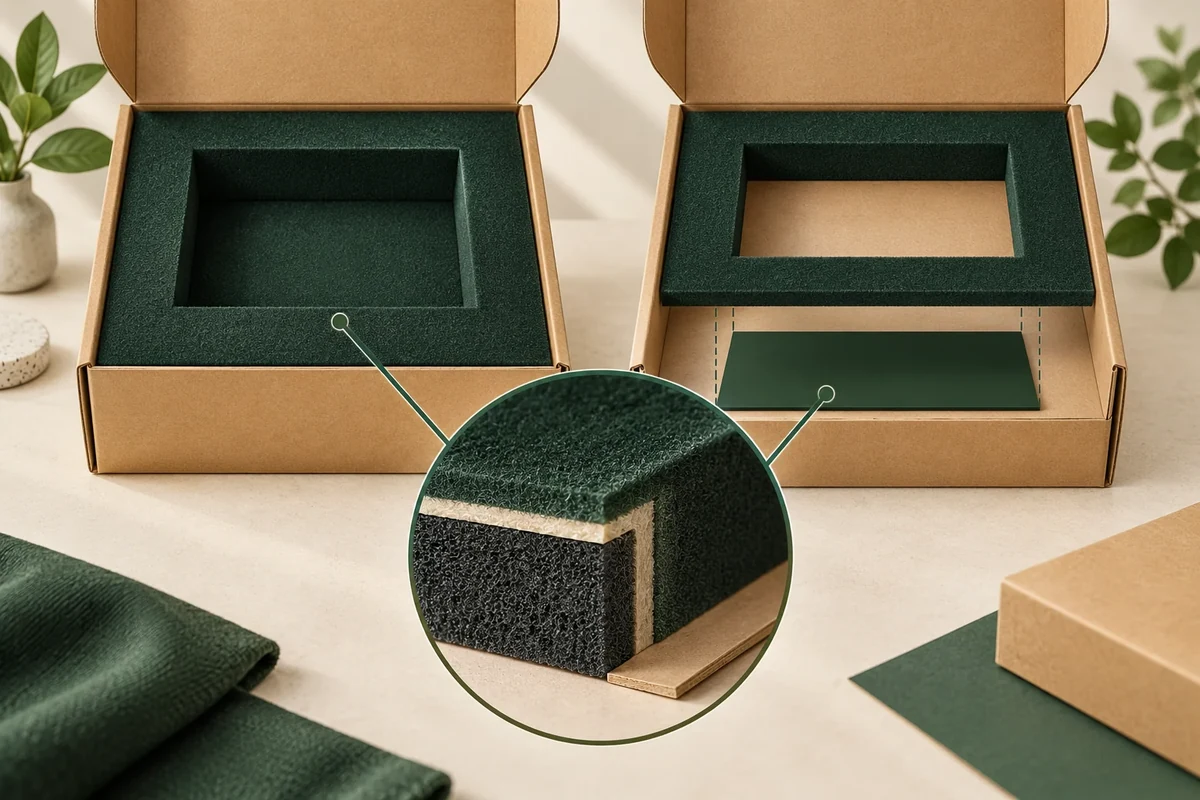
AI-assisted concept cover. Open the cover at full size.
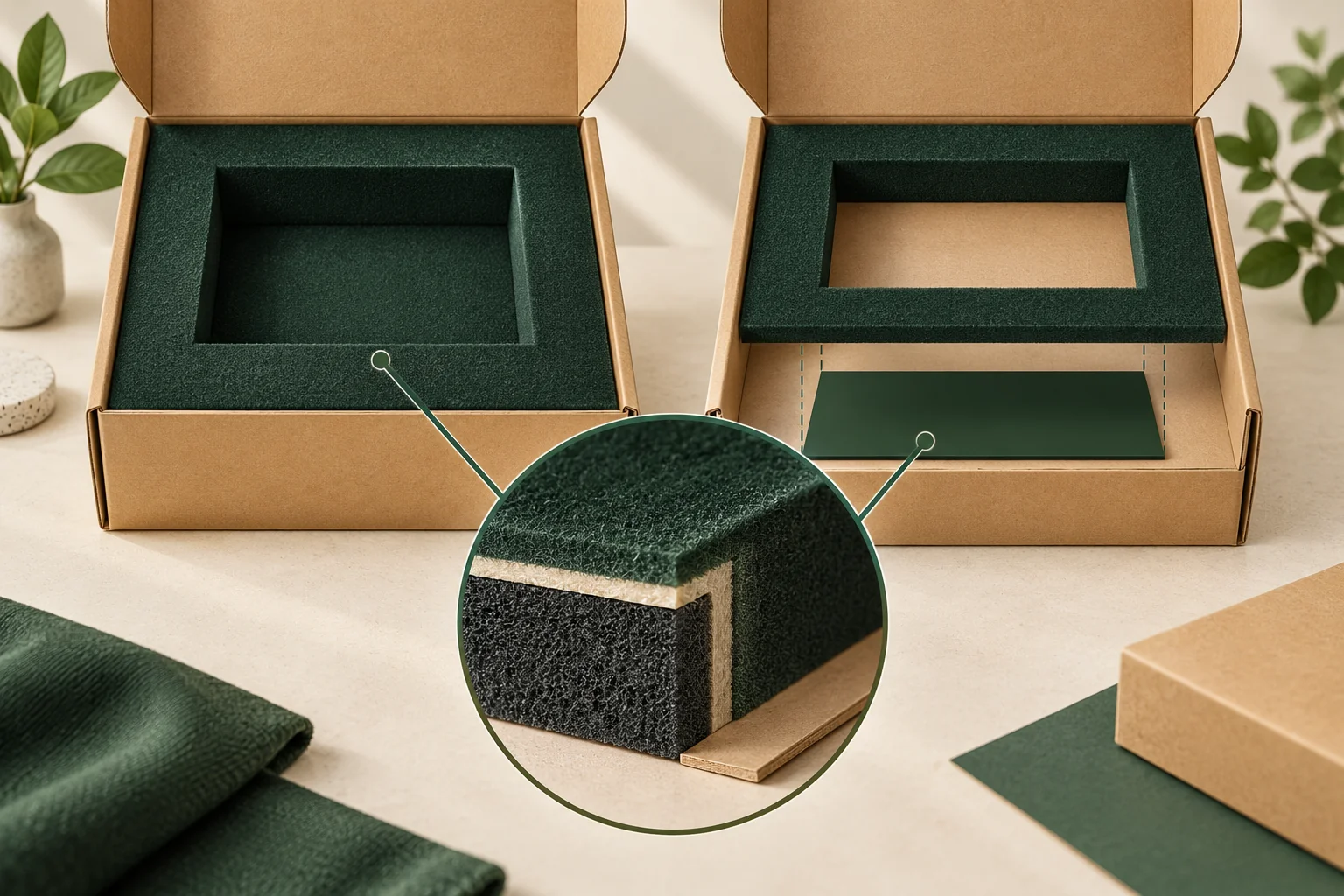
Turn a foam-holder idea into a candidate component drawing and layer recipe before sampling. Identify depth-cut versus through-cut geometry, backing, adhesive, flocked faces and exposed cut faces, then record how the component arrives. This proposal record prepares fabrication questions; product-surface contact observations belong to a separate review.
Draw the component section before choosing the recipe
Ask the supplier which cutting, bonding or surface-coating operations they propose for each component in the offered section. Use that fabrication description to request the actual layer recipe. A proposed process category does not establish that a supplier can make every geometry in a chosen grade.
Label the foam component, cavity outline and section plane. For a depth-cut pocket, request the proposed cavity depth and remaining bottom layer. For a through-cut top piece, identify the separate backing or other offered support beneath the opening.
The flexible PU grade reference identifies material grades and technical fields. Attach the actual offered grade to the component drawing rather than using a generic foam name as its fabrication specification.
Assign a layer and face identity
Give the base foam, backing and any bonding layer separate BOM rows. Identify proposed thicknesses and attachment method as supplier fields, with unknowns left open. A total finished thickness does not explain which pieces or interfaces create it.
If flock is proposed, label the covered face F1 and the exposed cut face C1 separately. Mark where the surface layer stops relative to the cut. Ask whether fabrication occurs before or after another offered layer operation when that affects the actual component proposal.
Record the supplied state: one prepared component, a loose top/backing kit or another offered arrangement. State who completes any local bonding or fitting operation. The output should explain the component construction and remaining preparation before a sample instruction is issued.
Use a component-drawing and layer-recipe table
The hypothetical alternatives below are original planning examples, not measured samples or universally compatible processes.
| Proposal field | Depth-cut candidate A | Through-cut/layered candidate B |
|---|---|---|
| Component/section | I1, pocket section AA | I2, top-piece section BB |
| Cut geometry | Pocket with remaining bottom to be proposed | Opening passes through top layer T1 |
| Backing | Integral remaining bed in offered section | Separate backing B1 identified |
| Bonding | Only if another layer is offered | Adhesive/attachment row AD1 to confirm |
| Faces | Base face and cut wall IDs | Optional flock face F1 and exposed cut face C1 |
| Supplied state | Prepared pocket component or stated kit | Attached assembly versus loose T1/B1 kit |
| Required output | Candidate drawing, grade and fabrication response | Candidate section, layer BOM and preparation owner |
Compare an illustrative component recipe
Imagine the buyer requests one holder outline but receives a pocketed block proposal and a cut-through top/backing proposal. Request the two sections and layer recipes first. They can be different physical components even when their plan view is similar.
The converter should identify which grade, cutting method and layer order are being offered for each candidate. Keep an unsupported method or missing adhesive row open. The buyer can select which construction to sample once the component drawing and supplied state are defined.
Handoff fabrication scope before the contact review
Compare the depth-cut PU bed, through-cut EVA holder and flocked foam holder through their component sections. Use the insert-material method to retain offered grade identity.
The separate finish-contact observation method concerns the product touching packaging during handling; this record outputs a fabrication/layer proposal. The converter supplies drawing and recipe facts, the packing owner confirms local preparation and the buyer selects the candidate sample scope. Send the component sections and remaining recipe questions through your packaging brief. MOQ is 500 pieces per design; material, sample and commercial details are confirmed for the project.
Keep the integral bed separate from a bonded backing
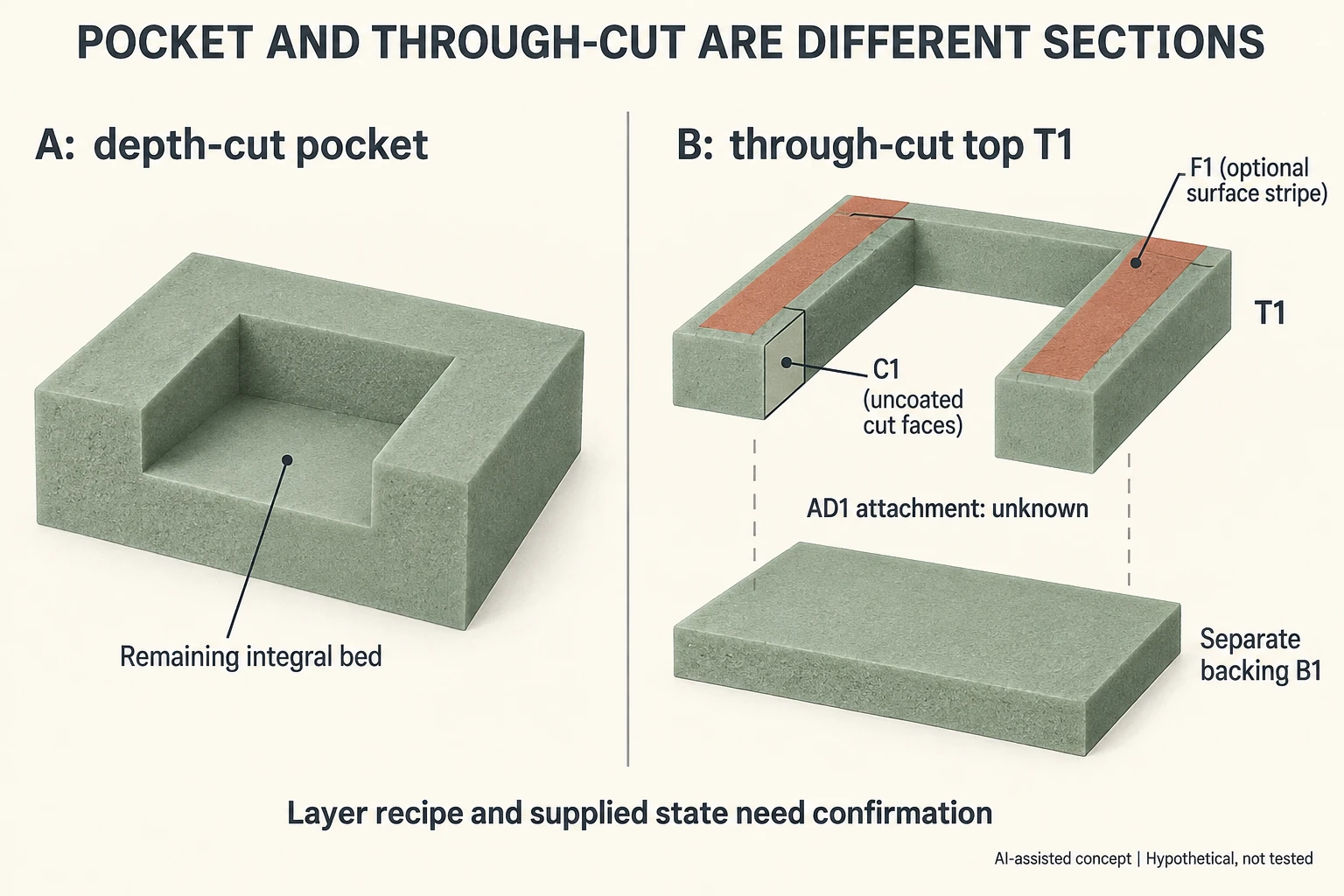
For an invented bare-foam pocket A, assume a 20 mm block and 14 mm cut depth, leaving 6 mm integral bed. Alternative B uses 14 mm through-cut top T1 and 6 mm backing B1. Their known layer subtotal is 20 mm before the unknown AD1 attachment and optional F1 surface layer. B's finished thickness remains unconfirmed.
Scroll horizontally if columns extend beyond the view.
| Candidate | Assumed geometry | Known arithmetic | Still missing |
|---|---|---|---|
| A: bare pocket | 20 mm block;14 mm depth | 20-14=6 mm integral bed | Actual grade, section and fabrication |
| B: layered | T1 14 mm;B1 6 mm | 14+6=20 mm before other layers | AD1, F1 and finished thickness |
| Faces | F1 optional surface;C1 exposed cut face | No contact-pressure calculation | Covered face limits and product compatibility |
An equal subtotal does not make the constructions interchangeable. A's bottom is part of one block; B introduces a separate backing and attachment interface. Do not enter 20 mm as B's finished value while those additional layers are unknown.
The cutaway and exploded sections identify construction questions, not production templates. Colored F1 indicates a possible surface treatment only; it does not establish flock chemistry or coverage on C1. Obtain the offered grade, actual layer recipe and supplied state. Keep the person who completes local bonding or fitting identifiable. Product-contact compatibility and any foam response under compression need their separate evidence.
Download the foam packaging insert fabrication record (.csv). HYPOTHETICAL rows are invented examples. Use ACTUAL_BLANK for permitted project inputs; replace that row label only when recording actual facts. Empty evidence, observation and date fields mean unknown or not performed, never acceptance. Keep checkpoints and revisions separate.
Send both sections, actual grade and layer identities, then ask for the supplied state and owner of any remaining preparation. Packrivo coordinates independent suppliers. These records establish no supplier offer, service availability or MOQ exception; its published baseline is 500 pieces per product/design.