
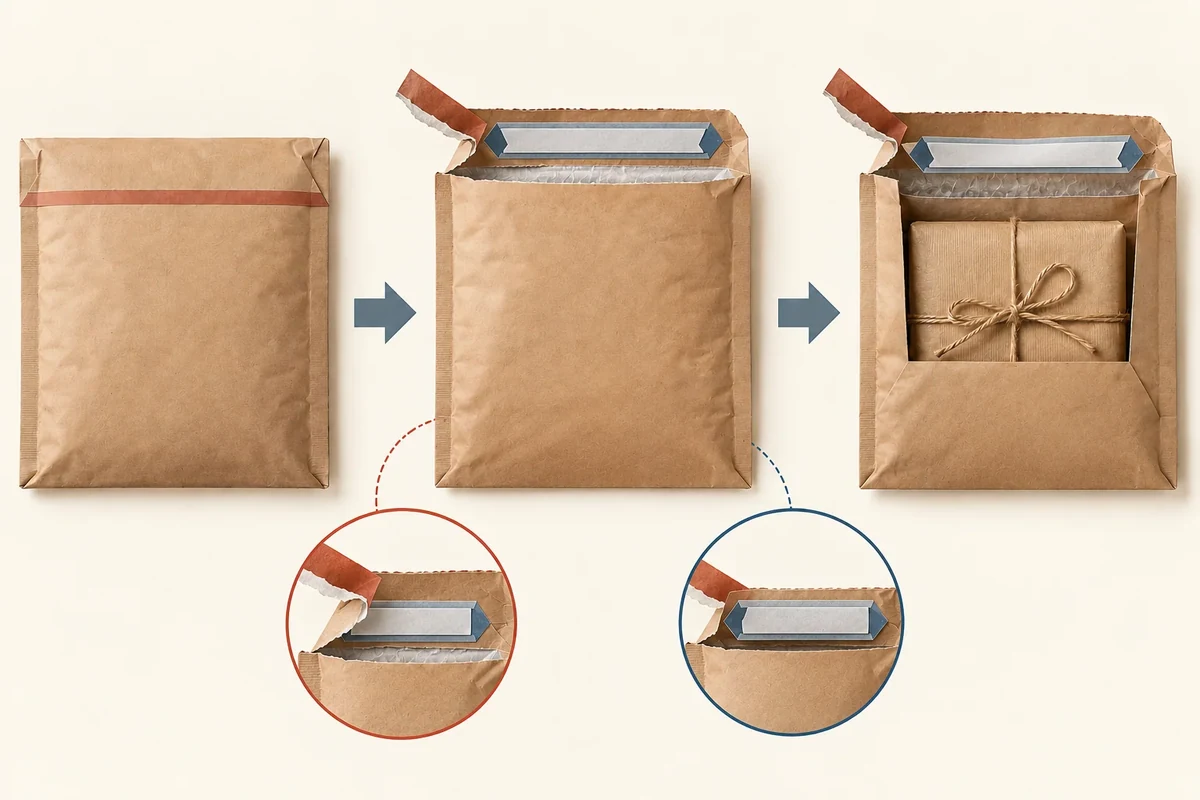
AI-assisted concept cover. Open the cover at full size.
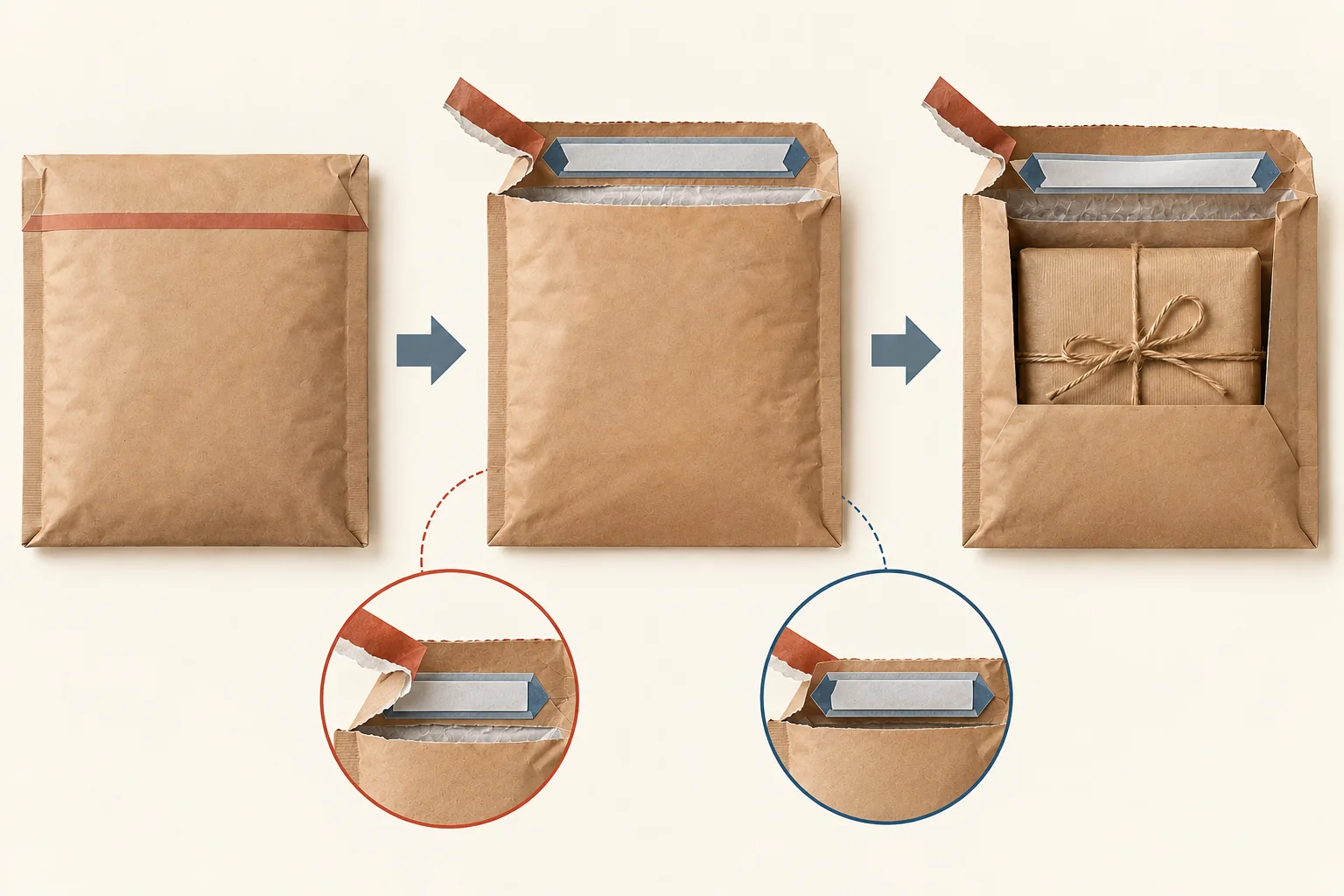
Plan the second closing action before choosing a return mailer proposal. Record first closure, customer opening and the remaining surface intended for return closure on the same bag. A returnable label or two-strip concept does not establish the actual mechanism the customer can use after opening.
The sequence should describe the expected returned contents as well as the outward pack. Those envelopes can differ, and the second closing question needs the real return configuration.
Ask for both closing proposals
The returnable kraft reference identifies the use direction. Request drawings of the first closure, opening feature and proposed second closure. Keep an unconfirmed mechanism marked as open rather than inferring it from the style name.
Name the outward and return contents. Include inner wrapping or components the customer is expected to replace. State who performs the second closing and what instruction will be available.
The paper return-bag direction carries the broader component brief. This record focuses on the sequence and what the first action must preserve.
Review the same used mailer
Close the sample by the proposed first method, then follow the intended opening action. Photograph the resulting bag before repairing, trimming or rearranging it. Identify the remaining joining surface for the return stage.
Load the proposed returned configuration and review the second action. A fresh second bag may help explain a mechanism, but it does not represent the used state being reviewed.
| Sequence field | Input | Evidence/status |
|---|---|---|
| Outward close | First method and filled state | Initial closed sample |
| Customer open | Feature and written action | Same bag after opening |
| Preserved surface | Part intended for second close | Located used-state view |
| Return fill | Complete returned contents | Used bag loaded again |
| Second close | Confirmed method and user instruction | Action and final relationship |
| Labels | Outward/return information areas | Readable return state |
Use the supply-state method to identify which closure parts arrive prepared. Keep customer work distinct from the packing team’s original actions.
Follow a hypothetical accessory return
Suppose a gift accessory travels outward in an inner wrap. The brand expects the customer to replace it in that wrap and use a second closing area. The source has named a returnable mailer but has not yet shown the exact opening and second-closing mechanism.
The buyer keeps those fields open and asks for the proposal. On the sample, first opening O1 is recorded before second closure S2 is reviewed. If O1 changes or damages S2’s receiving surface, the sequence needs another source response.
The label plan is also reviewed in the used state. An old outward label and a new return label can have a separate visibility question from the closure itself.
Write the sequence-dependent question
Ask: ‘Please confirm what O1 must preserve for S2 with return contents RC1.’ It names the link between the two stages. A drawing showing S2 on a fresh bag leaves O1’s outcome unanswered.
If the source revises the opening feature, update the customer instruction and repeat the used-state review. An unchanged outside artwork file does not establish an unchanged return sequence.
This tool documents one proposed use cycle. Any sealing, reuse or distribution requirement needs separate agreed evidence; no general reusable performance follows from a local sequence demonstration.
Send the preserved-surface record
Bring the first-open photos, return contents and second-close questions through the packaging enquiry. The next response should identify the actual mechanism and the same used state it needs to be reviewed on.
Give each used-state checkpoint the same mailer identity
Use invented mailer MB1 for outward configuration OC1 and proposed return configuration RC1. Keep MB1 at checkpoints C0 before opening, C1 after O1 and C2 at the S2 return-close review. These are planned states, not a real use cycle or evidence that a second seal works.
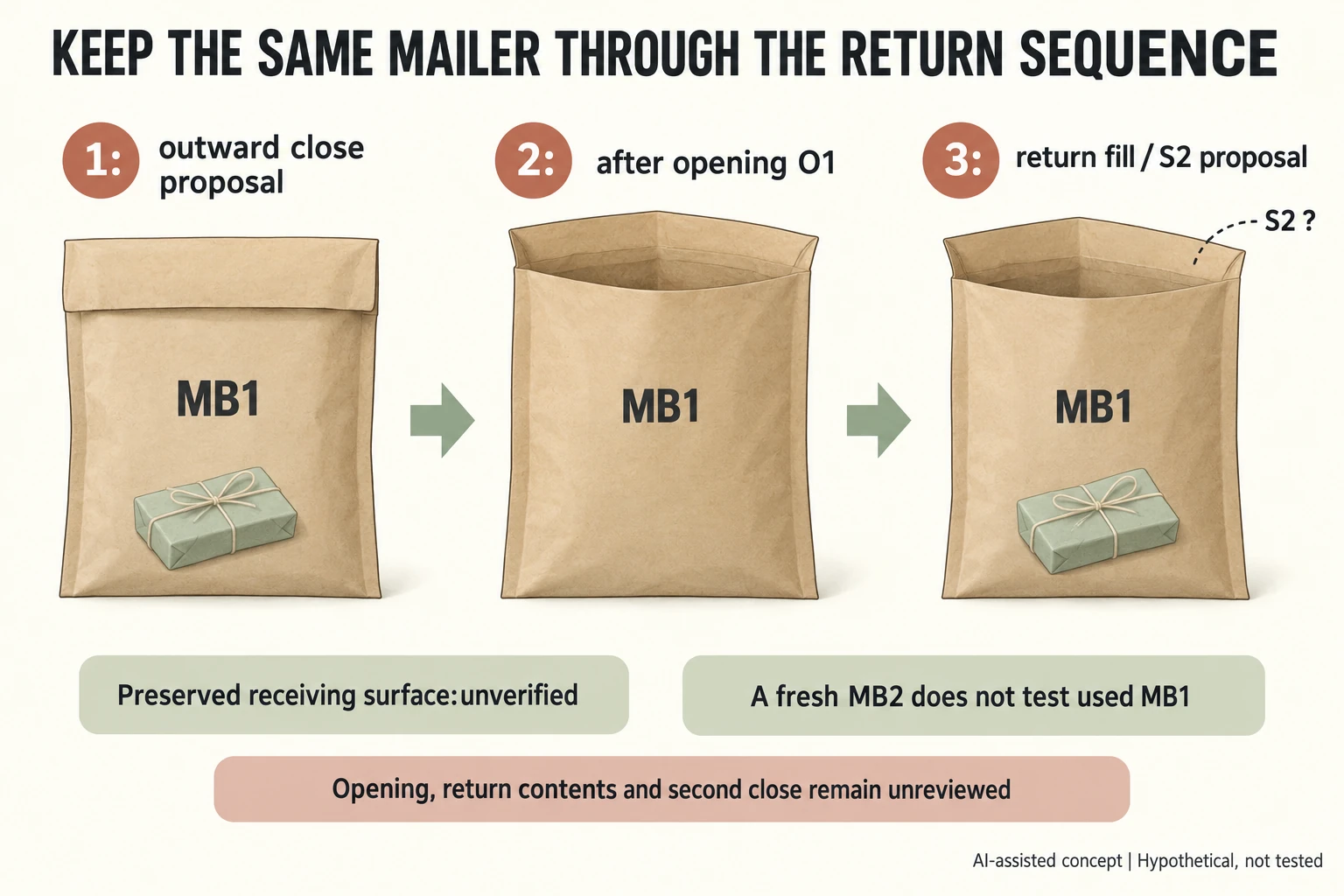
Scroll horizontally if columns extend beyond the view.
| Checkpoint | Same physical identity | Question | Conditional next step |
|---|---|---|---|
| C0 outward | MB1 / OC1 | Which first closure and opening? | Get actual construction |
| C1 after O1 | MB1 unchanged identity | Was S2 receiving surface preserved? | Retain used state before repair |
| C2 return | MB1 / RC1 | Can proposed S2 close this used bag? | Review actual returned contents |
| Fresh comparison | MB2 | Different bag | Do not substitute for MB1 evidence |
If opening changes the receiving surface, keep that condition visible and ask for another construction response. Silently trimming or repairing MB1 would create a different checkpoint. A fresh MB2 might explain a proposal but cannot answer what happened to MB1.
The wrapped-packet icons denote intended contents, not printing on the bag or goods transported uncovered. They establish no exact closure mechanism. Date, actual condition and evidence fields remain blank. Confirm RC1, the customer instruction and relevant shipping arrangement before deciding what a limited demonstration would support. A second-close sequence alone proves neither repeated reuse nor return-journey protection.
Download the return mailer second seal record (.csv). HYPOTHETICAL rows are invented examples. Use ACTUAL_BLANK for permitted project inputs; replace that row label only when recording actual facts. Empty evidence, observation and date fields mean unknown or not performed, never acceptance. Keep checkpoints and revisions separate.
Send the same used-mailer identity, first-open condition, returned contents and unresolved second-close surface question. Packrivo coordinates independent suppliers. These records establish no supplier offer, service availability or MOQ exception; its published baseline is 500 pieces per product/design.