
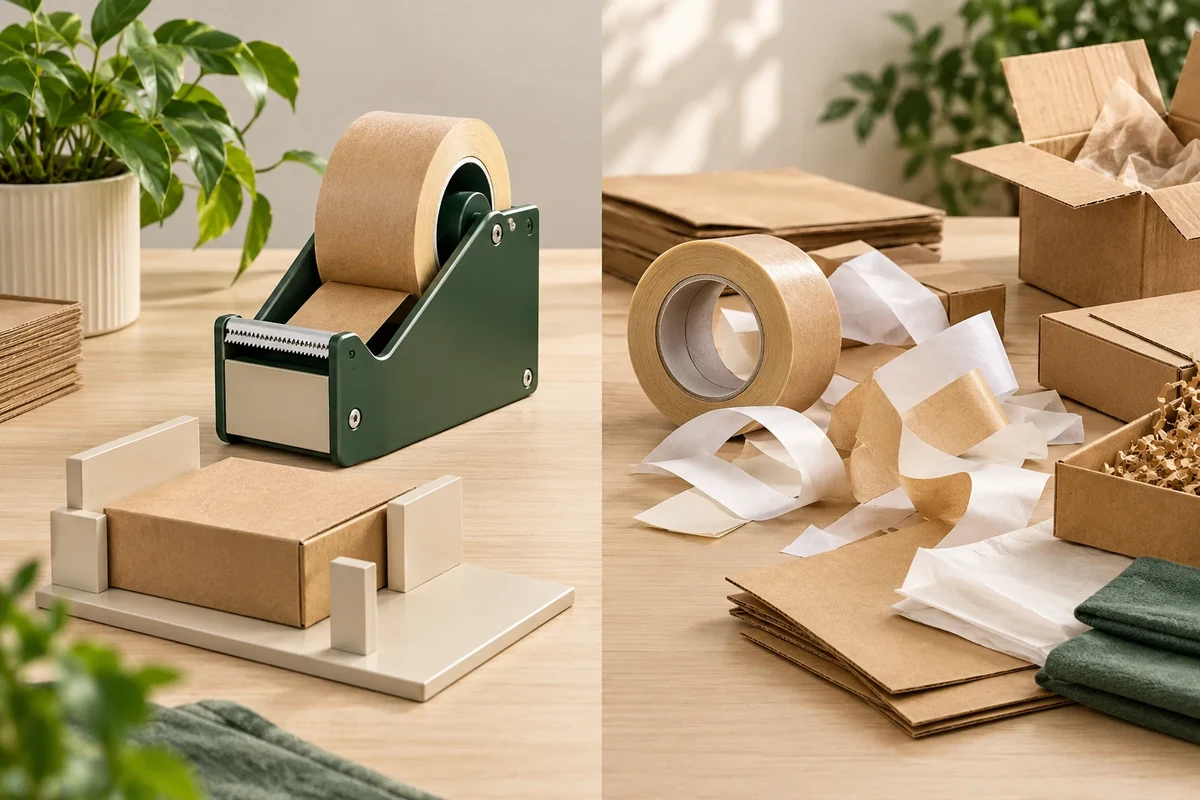
Separate reusable assembly tools, recurring consumables and supplied packaging components before comparing the packout scope. Record each resource’s unit, owner and replenishment question. A dispenser, a length of tape and a formed box should not be counted as though they are the same kind of per-pack item.
Give every resource a counting basis
The original paper-tape application reference identifies manual or machine dispensing for a named tape. The water-activated tape sheet identifies a different layer and application construction. These show why the packing tool and consumable operation need their own identities; they do not define your consumption rate or tool life.
List what reaches the packing bench: the box and insert, tapes or adhesives, release liners, a jig, a dispenser and other actual resources. Identify whether each item is a supplied packaging component, a reusable setup tool or a consumable used through a stated packing operation.
Give the unit explicitly. A component may be counted per set, a consumable by the supplier’s offered unit and a reusable tool by the equipment instance. Keep the per-pack basis as a question requiring actual observation when it has not been established.
Separate delivery responsibility from replenishment
The existing flat and assembled delivery-scope method identifies the remaining packing work and owner. This resource table adds the counting and replenishment basis for that work. It should remain attached to the actual supplied state.
Ask who supplies the tool, who supplies the consumable and who completes the operation. If the packing owner already has a tool, confirm that it is suitable for the offered component instead of silently including a replacement in the packaging quantity.
Record the observation or maker instructions needed to confirm a consumable’s use. Do not invent labor time, waste percentages or cost savings. The next comparison should show which unit and responsibility remain unresolved before a price line is treated as complete.
Use an assembly-resource unit map
This original Packrivo worksheet uses hypothetical carton-sealing resources without assumed usage values.
| Resource | Counting class | Illustrative unit/owner question |
|---|---|---|
| Carton BX1 | Supplied packaging component | Count cartons by design and delivered state |
| Insert I1 | Supplied component in a pack set | Confirm count per complete set |
| Dispenser D1 | Reusable setup tool | Packing owner confirms existing or supplied equipment |
| Tape T1 | Recurring consumable | Record offered unit and actual per-carton use basis |
| Release liners | By-product of the agreed operation | Packing owner identifies handling responsibility |
| Replenishment | Separate resource decision | Name trigger, supplier and unresolved order unit |
Compare an illustrative tool and tape response
Imagine one proposal includes a tape consumable line while another also offers a dispenser. Keep the dispenser separate from the tape quantity before comparing the packaging unit price. Ask whether it is a one-time supplied resource, existing equipment or another stated arrangement.
If tape use per carton is still unknown, record the next packout observation and its owner. A buyer can compare the scope while leaving that consumption field open. The useful output is a resource plan with confirmed units, not an invented total derived from an unobserved operation.
Handoff the remaining resource decisions
Compare pressure-sensitive paper tape and reinforced water-activated tape through their actual preparation and dispensing questions. Use the quote comparison method to keep component units and resource scope visible across supplier responses.
The converter names delivered components and preparation. The consumable supplier identifies the offered unit and application instructions. The packing owner confirms equipment and observed use, while the buyer resolves the remaining scope before approving a complete comparison.
Bring the resource-unit map and unresolved ownership/replenishment questions to your packaging brief. MOQ is 500 pieces per design; supplied resources, actual consumable quantities, samples and commercial terms are confirmed for the project.
Unknown tape use blocks a roll total, not the whole resource map
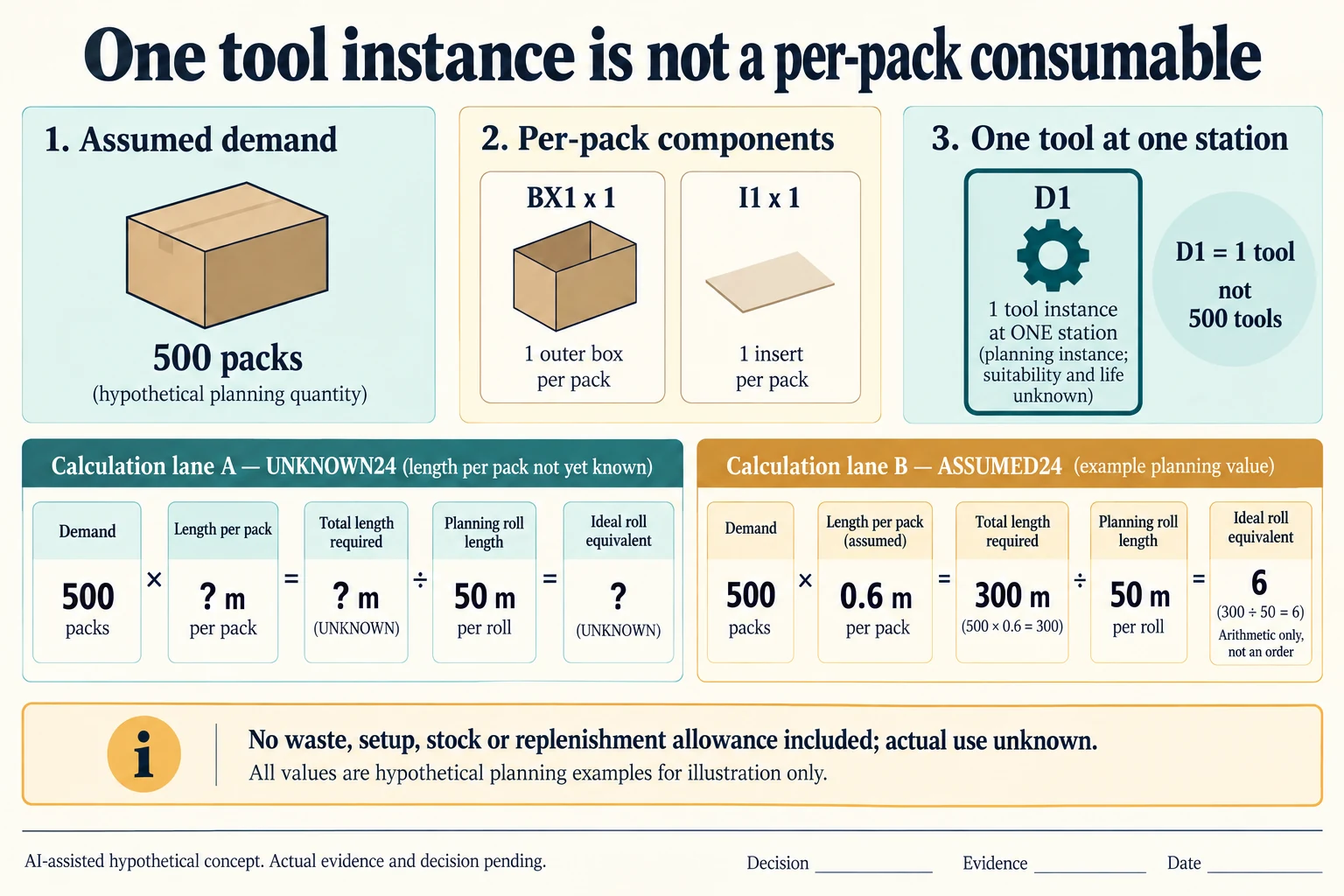
Use an invented demand of 500 complete packs, each requiring one BX1 carton and one I1 insert. Give one packing station a hypothetical D1 tool instance. The 500-pack demand does not turn D1 into 500 dispensers or establish its service life. Tool suitability and whether it is existing equipment or a separately supplied resource remain questions for the packing owner and the offered construction.
Scroll horizontally if columns extend beyond the view.
| Hypothetical configuration | Named object | Relationship | Input or next scope |
|---|---|---|---|
| UNKNOWN24 | DEMAND | assumed quantity | COMPLETE_PACKS; 500 packs |
| UNKNOWN24 | D1 | assumed tool instances | ONE_STATION; 1 tools |
| UNKNOWN24 | T1 | assumed consumption rate | PACK |
| UNKNOWN24 | T1 | assumed offered unit | ROLL; 50 m/roll |
| UNKNOWN24 | T1 | calculated from | PACKS*USE |
| UNKNOWN24 | T1 | calculated from | LENGTH/ROLL |
| ASSUMED24 | DEMAND | assumed quantity | COMPLETE_PACKS; 500 packs |
| ASSUMED24 | D1 | assumed tool instances | ONE_STATION; 1 tools |
| ASSUMED24 | T1 | assumed consumption rate | PACK; 0.6 m/pack |
| ASSUMED24 | T1 | assumed offered unit | ROLL; 50 m/roll |
| ASSUMED24 | T1 | calculated from | PACKS*USE; 300 m |
| ASSUMED24 | T1 | calculated from | LENGTH/ROLL; 6 rolls |
UNKNOWN24 leaves T1 use per pack blank. Even if a planning roll unit is assumed to be 50 m, total tape length and roll count remain undefined because the use basis is missing. Their numeric cells stay empty with UNKNOWN_NO_USE_BASIS status, rather than zero, undefined text or an invented order. The original article’s unknown-use scenario is therefore retained as a usable branch.
A separate ASSUMED24 branch invents 0.6 m per pack solely to explain units. Then 500 × 0.6 = 300 m and 300 ÷ 50 = 6 rolls in an exact ideal division. The CSV links both calculations to their assumed input rows. These are not observed use, a quoted roll size or a purchase recommendation; the calculation contains no waste, setup, unusable roll remainder, existing stock or replenishment allowance. Keep those missing scope questions open before deciding an actual order.
The linked tesa URL currently titles its specific product PV10 and describes manual or machine application. IPG’s 240 sheet is marked EFFECTIVE 08/24 and describes a different water-activated construction. Neither supplies this project’s consumption or compatibility. Confirm the exact tape, application instructions, equipment and owner; identify any operation by-products without assuming all tape has a release liner or a verified collection route.
Download the packing tools consumables unit planning record (.csv). It includes the original table fields and scenarios alongside the added relationships. HYPOTHETICAL rows are editorial examples or required review scopes, not actual records. Actual quantity, configuration, component and file identities, materials, process, specification, copy, method, condition, observation, owner, decision, evidence and dates are blank. ACTUAL_BLANK is a separate empty starting row; enter permitted project evidence before using an actual record. A blank means unknown.
Use the Define Flat and Assembled Packaging Delivery Scope for its separate question. Use the Name the Sealing Method in the Shipping-Carton Scope for its separate question. Use the Separate Label Liner Waste Before Choosing a Collector for its separate question.
Source scope checked 16 October 2026. References cover only the named materials, processes or guidance. Added configurations and geometry are hypothetical, not supplier specifications, tests or production approval; they set no universal tolerances or machine limits. Confirm the actual material, process, drawing and formed sample for the project.
Discuss this packaging specification with Packrivo. We coordinate independent suppliers. MOQ: 500 pieces per product/design; illustrative quantities are not production offers. Confirm materials, samples, price and timing for your project.