
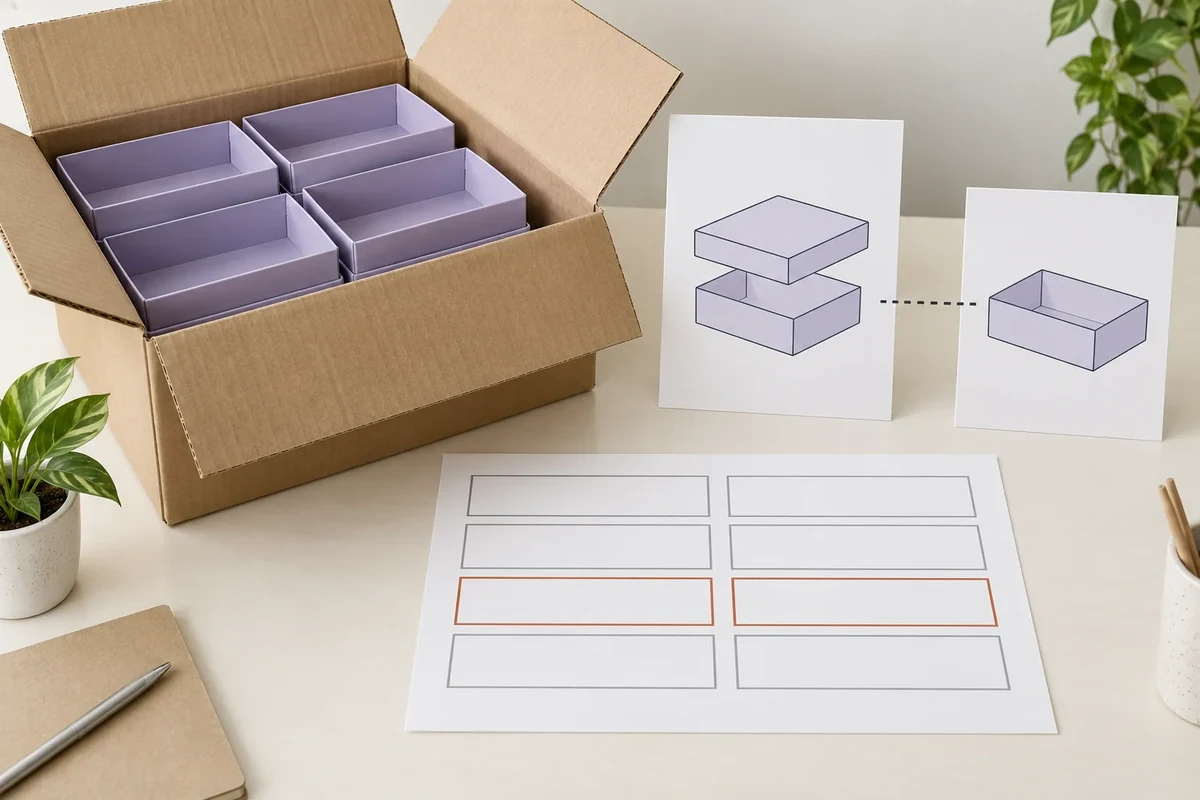
Reconcile a master-carton label with the actual components, versions and units packed inside that carton. Retain the label identity, counting basis and mismatch evidence before correcting or releasing it. A printed total can only be reviewed after the unit it describes is clear.
Identify what the printed label is counting
The official GS1 logistic-label guideline distinguishes logistic-unit identity and applicable contents/count fields. Use that context only where the actual identifiers apply. This original reconciliation record does not create a GS1 code or imply a retailer-compliance result.
Name the master carton and exact label version. Record whether the printed unit means complete gift sets, assembled boxes, separate lids, inserts or another supplied item. Keep the actual packing record with that definition rather than treating every piece as a complete set.
Identify the component and configuration versions expected inside. A quantity may match while the contents reference does not. Retain those two checks separately so a correct total does not hide a changed holder or card.
Check the label against the actual packed record
Ask the packing owner to confirm the actual carton contents and count basis under the project’s agreed method. Attach the count or packing evidence to the same carton reference. Record what was verified and what remains uncertain.
Compare the printed fields with those actual entries. Locate a wrong quantity, unit, component description or version by its label field. Keep the earlier label and observation if a correction is required, then identify the replacement label and who authorizes its use.
This task concerns contents reconciliation. Carrier-label placement is a separate operation that uses its own service instructions. Do not assume that a well-positioned barcode proves the carton label accurately describes its packed units.
Use a master-carton label reconciliation table
The following hypothetical carton record uses internal project references, not invented GS1 identifiers.
| Check field | Illustrative record | Decision evidence |
|---|---|---|
| Carton/label | Carton CT1, label LB1_r01 | Retain exact printed label reference |
| Unit basis | Separate bases, rather than complete gift sets | Expected order/packing-unit definition |
| Actual packed contents | Base BX1_r02 in CT1 | Packing owner confirms actual component/version |
| Count | Printed count versus verified packed record | Actual count evidence and uncertainty |
| Mismatch | LB1 description says sets while contents are bases | Located field and proposed correction |
| Disposition | Correct/review/hold/release named field | Authorized owner, replacement label and date |
Resolve an illustrative unit-label mismatch
Imagine a shipping carton contains gift-box bases, while the label describes complete box sets. The immediate issue is the unit description, even before comparing the numbers. Keep the actual contents and the printed field visible in the record.
The packing owner can confirm the bases and their actual quantity; the supplier can return a corrected label proposal. The buyer or named release owner then accepts the corrected reference with its evidence. Keep LB1 retained as the observed earlier label rather than silently replacing the history.
Connect reconciliation to the right upstream record
The carton freight-data method records shipment measurements and unit definitions. Use the acceptance record to keep requirement, observed mismatch, action and final disposition together.
A carton-to-component-version manifest identifies which revisions are inside; this table verifies what the printed label states about them. The supplier provides the proposed label, the packing owner provides actual contents/count evidence, and the named decision owner resolves the discrepancy.
Bring the carton/label references and unresolved packed-unit fields to your packaging brief. MOQ is 500 pieces per design; actual component grouping, samples and commercial conditions are confirmed for the project.
Check quantity, unit and version as three separate fields
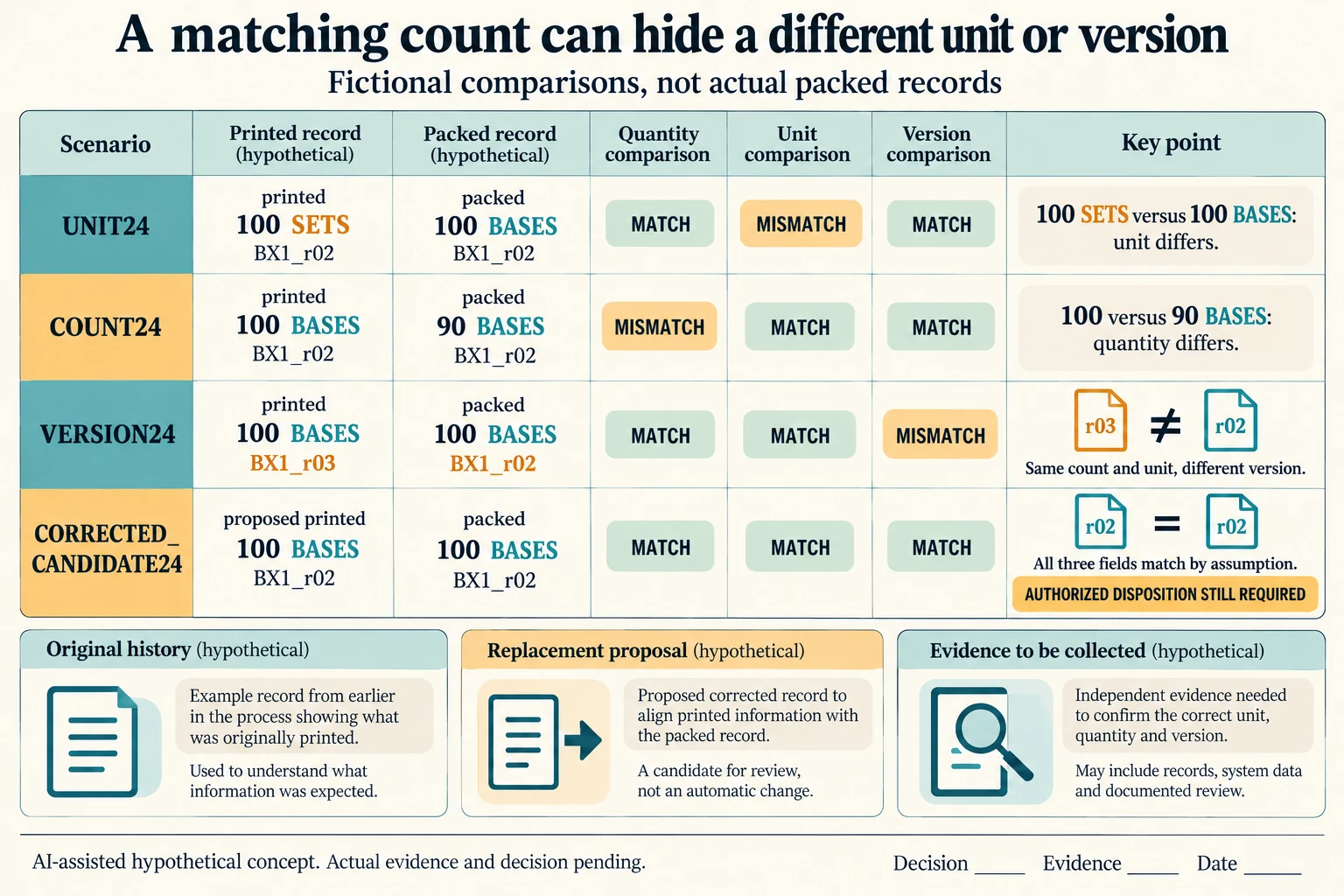
Use three distinct fictional comparison cases instead of one combined verdict. UNIT24 prints 100 sets while the assumed packed record contains 100 bases of BX1_r02. The number matches, but the unit does not. COUNT24 prints 100 bases of BX1_r02 while the assumed packed record contains 90 of that same component. VERSION24 prints 100 bases of BX1_r03 while its assumed packed record contains 100 BX1_r02 bases. A quantity agreement answers only one of these three fields.
Scroll horizontally if columns extend beyond the view.
| Hypothetical configuration | Named object | Relationship | Input or next scope |
|---|---|---|---|
| UNIT24 | QUANTITY | assumed comparison | MATCH |
| UNIT24 | UNIT | assumed comparison | MISMATCH |
| UNIT24 | VERSION | assumed comparison | MATCH |
| UNIT24 | UNIT24 | requires | AUTHORIZED_DISPOSITION_AND_REPLACEMENT_EVIDENCE |
| COUNT24 | QUANTITY | assumed comparison | MISMATCH |
| COUNT24 | UNIT | assumed comparison | MATCH |
| COUNT24 | VERSION | assumed comparison | MATCH |
| COUNT24 | COUNT24 | requires | AUTHORIZED_DISPOSITION_AND_REPLACEMENT_EVIDENCE |
| VERSION24 | QUANTITY | assumed comparison | MATCH |
| VERSION24 | UNIT | assumed comparison | MATCH |
| VERSION24 | VERSION | assumed comparison | MISMATCH |
| VERSION24 | VERSION24 | requires | AUTHORIZED_DISPOSITION_AND_REPLACEMENT_EVIDENCE |
| CORRECTED_CANDIDATE24 | QUANTITY | assumed comparison | MATCH |
| CORRECTED_CANDIDATE24 | UNIT | assumed comparison | MATCH |
| CORRECTED_CANDIDATE24 | VERSION | assumed comparison | MATCH |
| CORRECTED_CANDIDATE24 | CORRECTED_CANDIDATE24 | requires | AUTHORIZED_DISPOSITION_AND_REPLACEMENT_EVIDENCE |
For every case, the CSV stores printed quantity and unit, printed version, packed quantity and unit, and packed version separately. Comparison rows mark the illustrative match or mismatch by field, never an actual count result. The original CT1/LB1_r01 example still has no assumed actual quantity; these added numbers belong to newly named teaching cases, not retroactively measured contents.
CORRECTED_CANDIDATE24 aligns the assumed 100 bases/BX1_r02 on both sides. Even three matching fields do not authorize a replacement label or release the carton. Retain the earlier exact label, located discrepancy, count/packing evidence, proposed replacement and named owner’s disposition. Actual order, lot, label identity, uncertainty, authorizer and decision date remain blank until supported records exist.
This comparison does not generate logistics identifiers or assess a barcode. The linked GS1 material provides limited identity/contents context, while carrier placement follows its own applicable instruction. A carton-version manifest locates packed revisions; this record asks whether the printed statements agree with them. Keep those jobs connected without treating a readable barcode or a neatly placed label as reconciliation evidence.
Download the master carton label mismatch comparison record (.csv). It includes the original table fields and scenarios alongside the added relationships. HYPOTHETICAL rows are editorial examples or required review scopes, not actual records. Actual quantity, configuration, component and file identities, materials, process, specification, copy, method, condition, observation, owner, decision, evidence and dates are blank. ACTUAL_BLANK is a separate empty starting row; enter permitted project evidence before using an actual record. A blank means unknown.
Use the Packaging Carton Data Makes Freight Inquiries Easier to Compare for its separate question. Use the Agree Packaging Dimensions and Acceptance Methods for its separate question. Use the Packaging Sample Revisions: Compare Versions Before Approval for its separate question.
Source scope checked 16 October 2026. References cover only the named materials, processes or guidance. Added configurations and geometry are hypothetical, not supplier specifications, tests or production approval; they set no universal tolerances or machine limits. Confirm the actual material, process, drawing and formed sample for the project.
Discuss this packaging specification with Packrivo. We coordinate independent suppliers. MOQ: 500 pieces per product/design; illustrative quantities are not production offers. Confirm materials, samples, price and timing for your project.