

Check parcel classification using the current carrier, service, country and effective-date rule that applies to the actual packed parcel. Retain measured dimensions and mass with that reference. A threshold from another country or service should remain a separate example, not a universal packaging limit.
Identify the applicable service before reading a threshold
The official FedEx Canada rate-changes page includes dated dimension/oversize criteria and applicable Express services. It is a useful example of why carrier rules need a country, service and effective date. Its criteria are not a US, UK or worldwide default.
Record the shipment origin, destination and selected service, then locate the actual carrier reference for that route. Keep its URL, version or effective date and the date checked in the record. If service selection is still open, record each candidate separately instead of combining their rules.
Identify the classification being checked, such as a named dimension, volume or handling category in the applicable reference. Retain the carrier’s actual measurement and rounding instructions where supplied. Ask the carrier or responsible shipping owner to confirm an unclear field.
Measure the completed parcel configuration
Use the actual proposed pack with the product, insert, closure and any outer wrap in place. Record the measuring method, units and parcel state. Keep a bulging edge or changed closure envelope visible rather than substituting the empty box dimensions.
Attach the actual mass record and configuration identity. A changed insert or outer component may need a new parcel measurement even when the product remains the same. Record who measured it and which sample or packed proposal the result refers to.
Compare the measured input to the applicable carrier field without claiming a shipping fee or classification from an incomplete reference. A buyer can identify a question needing confirmation while the service, rule or actual packed measurement remains open.
Use a dated carrier-rule applicability record
This original Packrivo tool uses hypothetical parcel references and does not freeze a price or threshold.
| Applicability field | Illustrative entry | Evidence or owner |
|---|---|---|
| Route/service | Origin O1 to destination D1, selected service S1 | Shipping owner confirms actual service |
| Rule reference | Current official URL and effective date | Retain country/service applicability |
| Parcel state | Complete packed configuration PK1 | Product/insert/closure identities |
| Measurements | Recorded dimensions/mass and units | Actual method, observer and sample |
| Criterion | Exact applicable carrier field | Use supplied rounding/measurement rule |
| Uncertainty | Unclear classification or revised envelope | Carrier/shipping owner confirmation and date |
Resolve an illustrative cross-service comparison
Imagine two carrier options for the same gift parcel. One official page refers to a particular Express service in Canada, while the proposed shipment uses another service or country. Keep the first page as an example and request the actual applicable reference before assigning the parcel category.
If a packed corner or wrap changes the measured envelope, retain the revised configuration and recheck the relevant field. The next decision should reference the actual measurements and current service rule. Avoid turning a packaging suggestion into a promise that a surcharge can always be avoided.
Handoff measured data with the rule question
Use the carton-data method for shipment measurement fields and the dimensions/review-method guide to define the feature or parcel state being measured. Those records support a clear carrier inquiry without supplying a universal tariff.
The packing owner identifies the complete state and measurements. The shipping owner chooses the service and official reference. The carrier confirms unresolved classification, while the buyer decides the next packaging or route comparison using that evidence.
Bring the packed parcel data, rule reference and remaining classification question through your packaging brief. MOQ is 500 pieces per design; package design, sample scope and commercial terms are confirmed for the project. Carrier rules should be checked again when the actual shipment is arranged.
A rule reference and a pack measurement close different gaps
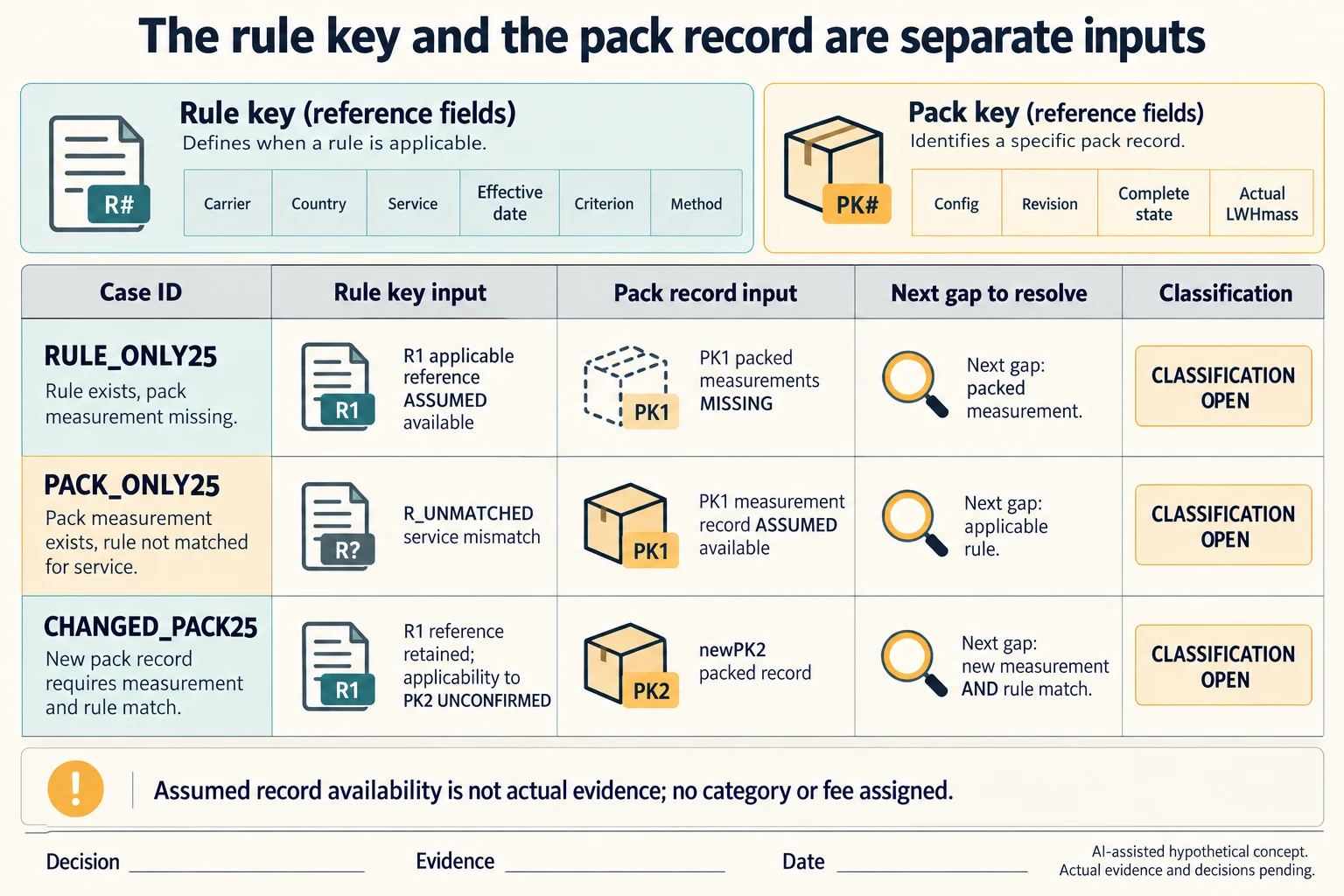
Keep a rule-reference record and a packed-configuration record as two different inputs. RULE_ONLY25 assumes that an applicable reference R1 is available for the teaching example, but PK1 still lacks its packed measurements. PACK_ONLY25 assumes a PK1 measurement record exists while the rule reference R_UNMATCHED does not match the chosen service. Neither case supplies a basis for assigning an actual parcel category.
Scroll horizontally if columns extend beyond the view.
| Hypothetical configuration | Named object | Relationship | Input or next scope |
|---|---|---|---|
| RULE_ONLY25 | RULE_ONLY25 | uses rule reference | R1 |
| RULE_ONLY25 | RULE_ONLY25 | uses pack reference | PK1 |
| RULE_ONLY25 | RULE_ONLY25 | requires | PACKED_MEASUREMENT |
| PACK_ONLY25 | PACK_ONLY25 | uses rule reference | R_UNMATCHED |
| PACK_ONLY25 | PACK_ONLY25 | uses pack reference | PK1 |
| PACK_ONLY25 | PACK_ONLY25 | requires | APPLICABLE_RULE |
| CHANGED_PACK25 | CHANGED_PACK25 | uses rule reference | R1 |
| CHANGED_PACK25 | CHANGED_PACK25 | uses pack reference | PK2 |
| CHANGED_PACK25 | CHANGED_PACK25 | requires | NEW_PACK_MEASUREMENT_AND_RULE_MATCH |
CHANGED_PACK25 links R1 to proposed PK2 after an outer component changes. It requires the new packed measurements and confirmation that the rule still matches the shipment. An old PK1 measurement does not become PK2’s reading, and an unchanged carrier brand does not confirm the same country, service, effective date or criterion. The CSV leaves length, width, height and mass values empty in every case; a hypothetical statement that a record exists is not an actual measurement.
The FedEx Canada page reviewed for this article is explicitly a Canadian 2026 rate-change reference, with service-specific criteria and effective dates. It illustrates applicability rather than supplying a worldwide limit. This worksheet imports no threshold, surcharge, rounding rule or classification result from that page. The actual responsible shipping owner must identify the complete current reference for the intended route and shipment date.
Ask which input is missing before requesting a packaging change. Missing measurements call for the complete packed state and method; an unmatched reference calls for the correct service rule. A changed wrap can reopen the envelope without proving any fee can be avoided. Retain the actual units, method, sample revision and uncertainty beside the rule question, then obtain the responsible classification response.
Download the carrier classification evidence pairing record (.csv). It includes the original table fields and scenarios alongside the added relationships. HYPOTHETICAL rows are editorial examples or required review scopes, not actual records. Actual quantity, configuration, component and file identities, materials, process, specification, copy, method, condition, observation, owner, decision, evidence and dates are blank. ACTUAL_BLANK is a separate empty starting row; enter permitted project evidence before using an actual record. A blank means unknown.
Use the Packaging Carton Data Makes Freight Inquiries Easier to Compare for its separate question. Use the Agree Packaging Dimensions and Acceptance Methods for its separate question.
Source scope checked 16 October 2026. References cover only the named materials, processes or guidance. Added configurations and geometry are hypothetical, not supplier specifications, tests or production approval; they set no universal tolerances or machine limits. Confirm the actual material, process, drawing and formed sample for the project.
Discuss this packaging specification with Packrivo. We coordinate independent suppliers. MOQ: 500 pieces per product/design; illustrative quantities are not production offers. Confirm materials, samples, price and timing for your project.