
AI-assisted concept cover. Open the cover at full size.
Map a flat, readable barcode area for the shipping label on the actual packed parcel, clear of the opening seam and relevant edges. Review the label with tape, folds and tear strips in their final state. Keep the carrier’s specific placement guidance with the selected service rather than assuming a blank box face remains available after packing.
Name the actual parcel face and opening route
The official FedEx label-placement guidance advises using the largest surface, avoiding a middle seam or edge and keeping the barcode flat. It also cautions against tape over the barcode. These are carrier-specific placement instructions, not a guarantee that every labeled parcel will scan.
Identify the label template or required dimensions supplied for the actual shipment. Mark the parcel face, closing seam, edges and customer opening feature on a working map. Include the final outer wrap or mailer lip rather than reviewing only the empty enclosure.
Keep the address and barcode fields in their intended orientation. Where the package geometry makes placement difficult, the responsible shipping owner should use the actual carrier instructions and confirm the offered arrangement. Do not alter a real carrier barcode to make a diagram look tidy.
Review tape and label contact on the completed pack
Apply the required sample label or a clearly marked planning outline to the complete proposed parcel. Inspect the face after the final seal is formed. Locate any seam, fold, tape or tear-strip conflict with the readable area.
Record the actual state shown in the photograph. A flat outline on an unfolded mailer may occupy a different surface after the filled lip is sealed. Likewise, a label close to a box edge may need its orientation or face choice reviewed under the applicable carrier instructions.
The shipping label and removable retail information have different roles. Keep product branding or another decorative sticker clear of the required carrier-label decision, and retain the responsible shipping owner’s confirmation before finalizing the packout instructions.
Use a label and opening-zone map
This original Packrivo worksheet uses a planning label outline without a fabricated tracking barcode.
| Placement field | Hypothetical record | Next check |
|---|---|---|
| Parcel face F1 | Largest suitable face of complete pack PK1 | Shipping owner confirms carrier arrangement |
| Label template | Actual carrier/service reference | Retain its required layout and size |
| Barcode area | Flat readable zone on F1 | Locate seam/edge/tape conflicts |
| Opening zone O1 | Tear strip or customer opening route | Review filled and finally sealed state |
| Photograph | Actual packed label arrangement or marked planning outline | Identify the evidence type |
| Decision | Keep face, rotate or request another arrangement | Carrier/packing owner confirmation |
Resolve an illustrative mailer-label conflict
Imagine a filled parcel bag whose outbound seal folds over the intended label area. The next action is to review the actual filled and sealed geometry, then ask the shipping owner for a suitable face or orientation under the carrier requirements.
For the returnable poly mailer direction, also retain the future return strip and label arrangement. The original outbound label placement should not hide the separate opening/return action. Review both planning states without claiming that one diagram proves repeated journey performance.
Handoff the final face and opening map
The carton-data guide keeps the actual packed envelope identified. Use the supplied/assembled scope record to name who applies the final label and seal.
The shipping owner supplies the applicable carrier template and instructions. The packing owner returns the final sealed state. The buyer keeps the chosen arrangement and any unresolved opening conflict attached to the packaging configuration. A visible barcode on a screen remains a different evidence type from an actual parcel review.
Bring the parcel face map and remaining label/seam question to your packaging brief. MOQ is 500 pieces per design; package materials, samples and commercial conditions are confirmed for the project.
Retain the conflict and the alternative as separate proposals
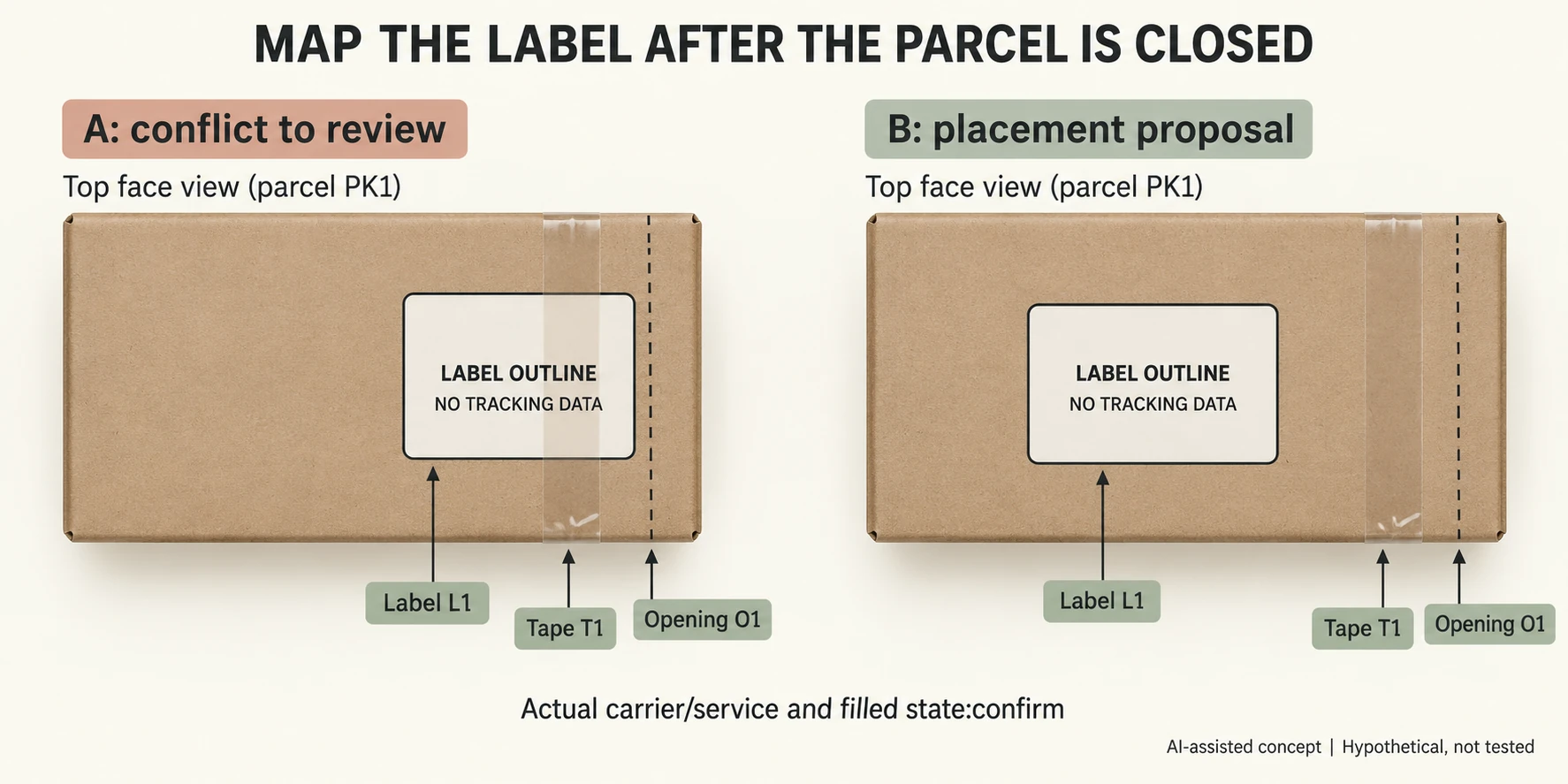
For invented parcel PK1, candidate A places label reservation L1 across tape band T1; opening zone O1 is nearby. Candidate B moves L1 into another proposed area while keeping T1/O1 identified. Neither diagram is a real carrier label, tracking record or accepted parcel.
Scroll horizontally if columns extend beyond the view.
| Candidate | Illustrated relationship | Open confirmation |
|---|---|---|
| A | T1 intersects L1 reservation | Locate actual readable area conflict |
| B | L1 separated from T1/O1 in plan | Review filled/sealed state and carrier rules |
| Both | No real label data or dimensions | Actual template, route and service |
| Opening | O1 retained separately | No conflict hidden after final sealing |
Keep A as the located problem rather than replacing it without a change note. Record which face or orientation B proposes and ask the shipping owner to assess it against the actual country/service guidance. A clear-looking reservation is not scan evidence.
FedEx's linked instructions are US carrier context, not a worldwide layout rule. Review the completed filled and sealed parcel, since tape, folds and the final lip can alter available space. The CSV leaves the real carrier/service/template and actual observations blank. Do not invent tracking data or edit a real barcode to fit the concept. A return label or second-closing arrangement still needs its own used-state review.
Download the shipping label placement on boxes record (.csv). HYPOTHETICAL rows are invented examples. Use ACTUAL_BLANK for permitted project inputs; replace that row label only when recording actual facts. Empty evidence, observation and date fields mean unknown or not performed, never acceptance. Keep checkpoints and revisions separate.
Send the filled sealed face map, actual carrier template and the exact seam, tape or opening conflict that needs a decision. Packrivo coordinates independent suppliers. These records establish no supplier offer, service availability or MOQ exception; its published baseline is 500 pieces per product/design.